Nils-Krister Persson (2024). Haptic (tactual), portable, hands-free communication for body compliant interfaces. In: Human Interaction and Emerging Technologies (IHIET 2024). AHFE Open Access, vol. 157, pp. 385–394. https://doi.org/10.54941/ahfe1005498
Swedish School of Textiles, Polymeric E-textiles, University of Borås, Sweden SE-501 90 Borås, Sweden; Smart Textiles, Smart Textiles Technology Lab, University of Borås, Sweden SE-501 90 Borås, Sweden ↗
There is a growing number of technical communication devices, not least wearables, which take use of the haptic sense(s). Then tactors (vibrotactile elements, heating elements, cooling elements, pressure generators, active indentators, electro-stimulating electrodes etc.), are employed. Haptic technologies are often limited to binary, point-wise actuation (one vibrator). However, as we discuss, in a semiotic sense, this can only generate a representamen that is symbolic, thus only also concerning symbolic communication. For a richer communication coming closer to what exists for visual and audial displays also haptic communication that is semiologically iconical and indexical are of interest. We here present a classification of tactile displays. For this, we make a distinction between the stimulus (the tactor characteristics and relationship to human reception) and the spatial arrangement i.e. the geometrical placement of tactors. For wearables, in the latter case, the human body shape and anatomy is taken into concern.From this, we build two (partially ordered) hierarchies, the stimulus richness hierarchy and the spatial ordering hierarchy, respectively.Combining these hierarchies gives a (partially ordered) hierarchy of tactile displays for the human body. We show that the informatical richness is fast growing with placement complexity. However, such displays need space. Hands and fingers are sensitive for haptic stimuli but are better reserved for active touch. Instead, other body parts might be used. For this, textiles are employed. We demonstrate a chairable i.e. a portable textile based haptic display for communication to (deafblind) humans, arena spectators etc., that can be applied to furniture, thus enriching the Umwelt of the users.
Haptics offer a number of interesting possibilities for communication; an extra channel when the other senses are occupied and saturated; the potential of a hidden communication channel from the outside; opening up for affective communication, bridging somato-mental treatment and
communication etc. It is also the case that there are individuals that need to completely rely on haptic communication for their interaction with others. These are persons having deafblindness.
A haptic display is any device that is able to artificially generate stimulus perceived as haptual (touch, heat etc.) Haptic displays (HD) could be designed along different strategies and have a variety of features. Here we discuss ways of ordering such displays. For many applications of wearables, it is favorable with hands-off solutions, as hands should be reserved for other purposes such as carrying a bag or maneuvering a cane. Active touch is related to finger and hand movements and might better be reserved for that rather than becoming involved in and disturbed by haptic displays. Instead merely 2 m2 of body skin is at disposal for communication. We start by making a distinction between the stimulus and its characterisations, quality, quantities and modes on one hand side and is number and spatial arrangement with geometric considerations on the other. We then have a model where the central distinction is about a stimulus domain and a spatial domain. The latter is a purely geometrical description of how a display could be arranged. From this, we build two (partially ordered) hierarchies, the stimulus richness hierarchy of the stimulus domain and the spatial ordering hierarchy of the spatial domain, respectively.
Combining these hierarchies gives a (partially ordered) hierarchy of haptic displays for the human body.
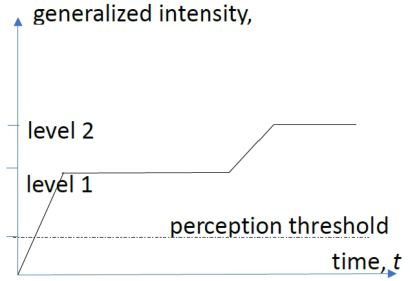
STIMULUS DOMAIN The stimulus is in a haptic and tactile display generated by a tactor. A tactor (from Latin tactile feeling) is any physical device that by some (or several) mechanical-electrical (occasionally biochemical) mechanisms affect any human receptor so that human perception is possible. A tactor is giving some physical quantity, force, pressure, vibration frequency, voltage, electrical current etc. We generalize this to an intensity, Q, see Figure 1. The quantity must be such that it stimulates human receptors in the skin. They are of many different types, here not further discussed; Connect with the next phrase “Pacinian ...”
Figure 1: Stimulus requirement for perception.
Haptic (Tactual), Portable, Hands-Free Communication for Body Compliant Interfaces 387
Pacinian corpuscles, Meissner corpuscles, Skip the phrase, Merkel complexes, Ruffini corpuscles, C-fiber LTM (low threshold mechanoreceptors), etc.
For creating the most simple of signals one need to have contrast, see Figure 1. Level 1 is meant to create a sensed signal. It then needs to be above any perception threshold. For creating nil can either use “non presence” of signal i.e. something below the perception threshold for this quantity or having two levels, level 1 and level 2 both above the perception threshold for this quantity. The latter case is typically more difficult to discriminate and perceive.
A tactor is defined in general manner (“is possible”) but of course, only tactors that generates stimulus that is sensed by human receptors and perceived by the Central Nervous System are of practical interest. Several categories of tactors have been developed; foremost of these are vibrotactile elements (Table 1). The tactor is such that it gives many types of stimuli (pressure, vibration, skewing etc.) at each point.
Table 1. Overview of tactors suitable for integration into wearables and smart textiles.
Table available in the original PDF paper.
Type Mechanism Vibrotactile elements Coin vibrators Nonconcentric Cylindrical vibrators Nonconcentric Pressure and skewing Pneumatic compressors Pumping out to under-pressure McKibben adstringent McKibben effect: pressure is causing a locked, tubular bladder expand radially and therefore contract axially Adstringent band Electrical DC motor Pointwise pressure
Electromagnetic break Actuators A wealth of mechanisms incl. electroactive polymers Electrostimulation Stimulating electrodes Polarisation of the skin
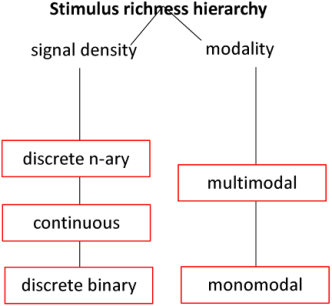
We could divide tactors also based on their output. Modality is here regarded as a type of communication channel differentiable from other channels so that it has the potential of being sensed and being based on a certain physical quantity.
There could be just one output, then Q is monomodal. For example, vibration with one single frequency, pressed with a constant pressure to the skin och one single position. But it could also be that there are several types of output, Q being a vector (Q1, Q2, …,Qn) in which the case it multimodal. Thus, there could be alternating current (AC) with current intensity, I, frequency, f etc. Q could also be discrete i.e. step wise or continuous. In the former, the case binary case (0 and 1) is the most simple. Then one could
generalize this to three intensities and further on to n-ary signals. It is not self-evident but it might be that many tactors are not perfect and that in fact it is signals with intensities in a band rather than at discrete levels that are sent in. In devices presented it is also the case that it is common to employ only one type of discrete signal, not several types.
Figure 2: Stimulus richness hierarchy.
Thus we place discrete n-ary above continuous in terms of complexity. We then get the stimulus richness hierarchy of the stimulus domain. It consist of two legs, see Figure 2 signal density i.e. if it is discrete or continuous and modality if there are many types of Q:s. The relationship between the signal density and modality legs is not specified here. To the stimulus domain, we could also count how the stimulus could be conceived. Used for communication haptics are conveying signs. A sign is whatever entity bearing meaning and that is representing anything else than itself. With Peirce there are three classes of signs namely symbols, icons, and indices. A symbol is something to which there is a social-societal-cultural agreement, a convention. Examples include a letter of an alphabet symbolizing a certain linguistic sound. An icon expresses similarity to another entity. Examples include a photo that resembles the person in question. An index is something that is indicating that w is around, w, being some ontological entity; event, thing etc. An index is something that is there due to causality or otherwise bear some information on something else. Examples include touch indicating presence of another person.
SPATIAL DOMAIN The placement i.e. spatial arrangement of tactors in and on the device is here of concern. They should be related to the geometrical position on the body. This we denote location thus being an anatomical measure. The spatial domain consist of geometrical aspects only, no perceptual. Still of course, how tactors are arranged will be important when one adds human spatial resolution capabilities and the uneven distribution over the body of this.
Haptic (Tactual), Portable, Hands-Free Communication for Body Compliant Interfaces 389
The placement with a set of tactors could be regarded as ordered or not. In the former case – we denote that a heap - they are potentially able to convey more information as the number of combinations is growing fast. In the latter case individual tactors are not meaningful and the tactors are effectively regarded as one.
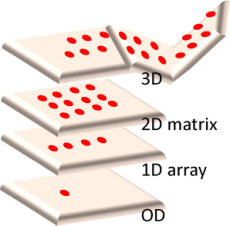
We denote one single tactor as zero dimensional, 0D and we notice that this is a much-used situation in wearables or cell phones.
Arranging actuators in a linear order, one dimensional, 1D, opens up for temporal sequencing of the actuators. We differentiate between array consisting of n distinct elements and matrix. Two-dimensional actuation, 2D, is the arrangement of actuators on a limited part of the body so that the set of actuators still could be said to be in a plane or having maximum one single curvature. Actuators in a 2D arrangement could be in any non-array formation but a matrix arrangement is perhaps first at hand, by this forming columns and rows.
Figure 3: Spatial ordering hierarchy.
If the arrangement is having a more tactors complicated geometry, switching between concave and convex shape, (pseudo) three dimensional, 3D, could be the term used. This also includes the case when covering different body parts. A switch between convexity and concavity might provide a surface where it is difficult to maintain mechanical contact with the skin for wearables.
It can be noted that full-fledged three-dimensional actuator arrangements are probably of less interest, as humans cannot, by the tactile sense, detect things outside of each other and actuators risk to cover each other. Still, for future research it is interesting to open up for this.
Awaiting introducing human capability aspects from a purely geometrical point of view the potential for communication is enormous. Assuming a m × n matrix system with freedom for the distances in row direction, all being d1 and distances in the vertical direction, d2. The m × n matrix has every tactor (commonly vibro-tactile elements) in either of say two states; active (‘high voltage sent’) and non-active (‘low voltage applied or nothing sent’). Each tactor could be active for an individually controllable period. There are m·n tactors. There are 2 times 2 times 2 times… = for m, n = 10, say (which could be feasible on the back of a person), this is a very high
number of combinations, i.e. signs, possible to generate, around 1.26 ·1030. This is of course far outside of any human discrimination capability.
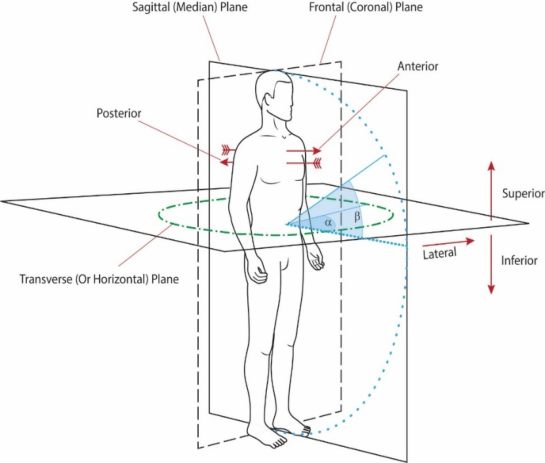
Figure 4: Human and planes, sections and directions used within medicine. Tactors could be place in many ways. Arranging them in the lateral, sagittal and coronal plane enables some directionality. It could be advantageous to avoid hands (red).
Many senses are directional. Vision gives information of where the dorsal object is, i.e. information on from which direction the flow of photons is coming from. Thanks to doubled ears audial stimulus in general show the same characteristic. For haptics, this is even more pronounced. Due to the fact that even in passive mode we know not only that someone touched us but also where on the body haptic stimulus occurred, the haptic sense is directional. Directional faithfulness is the characteristic of a sense that a proximal stimulus convey information about the direction (i.e. some angle and some distance) of the distal stimulus. In fact, the human body could sense haptic stimulus from beneath to the foot, normal to the legs and torso and from above on the head or shoulders or stretched-out arms. This is 180 degree in a vertical plane and 360 degree in a horizontal plane, see Fig 4. This could be called 580 degree sensing. Thus, body worn haptic displays should beneficiary have the input capability of directional faithfulness. By 2D arrangement, directional information is possible. By activating some of the actuators in a sequence this could mimic from where a certain phenomenon is coming (left-right, up-down).
Haptic (Tactual), Portable, Hands-Free Communication for Body Compliant Interfaces 391
HAPTIC DISPLAY HIERARCHY Of course merging two partial ordered structure is not possible to perform unambiguous. Here we suggest a hierarchy primary based on spatial dimensionality, and secondary on stimulation modality.
The simplest haptic display is one where there is a tactor at one single anatomical position that is able to one and only one stimulating quantity, Q. This is what is found in an alarm clock that besides giving sound – not interesting in our context - is shaking or vibrating. It could also be the vibrating function such as in a smart watch or vibrator found in cell phones.
This stimulus has two levels. “low” or “passive” or “zero” or “0”, silent” on one hand side and “alarming”, “active”, “on”, “1” on the other. Thus, it is binary 0-1. No other modulation is possible in this case. In order to be interesting from an informatical point of view the low level must be beyond any receptor detection level or be regarded as nothing more than a noise level. The Active level must be above any human threshold limit. The semantic content in itself-is very limited, just “on” typically used as an “alarm”. There need to be a convention introduced to contextualize what it is to be meant when the tactor is active, if it is to be a fire alarm, burglary alarm, iron overheating alarm or hindrance detection signaling for people having deafblindness. Or is it a notification for an incoming mail in a smart watch? Thus, conventionalizing, this type of haptic display is a symbol. However, it could be argued that there is also an indexical component in it. If there is an alarm clock on the bedside table shaking to such an extent it is causing the person in the bed to be impacted and awakening it is an index for wakening up.
The tactor could then be exchanged to give not a binary signal but a continuous one. We then define this as the next level in the hierarchy for haptic display, Table 2. Of course, another alternative could have been chosen for the next step such as having two binary tactors. However, we keep to the strategy of working through a spatial dimensionality before going to the next level.
Next level is to let the tactor be such that many modalities are generated. This is typically technical complicated and seldom used. Instead, several tactors with different modalities are used in array or matrix form. We then introduce an array of tactors i.e. having what we denote a one-dimensional arrangement (class IV). The most simple of such is to have a binary stimulus 0-1. One could argue that one could also have an unstructured heap of a number of tactors is the most immature version of the 1D case. However, as discussed in the chapter earlier this is of less interest. So keeping the 1D spatial arrangement but switching the tactor to a continuous stimulus (class V) and then to a multimodal stimulus (class VI) comes next. In the last case, the stimulus could be either binary or continuous.
We now place the tactors spatially in a matrix, the 2D situation. We follow the same strategy as in 1D case. First, we create a class with binary tactors (class VII) then with continuous tactors (class VIII) and then allowing for multimodal stimulus (class IX).
If we now place the tactors (1D or 2D, but unified and for generality denoted 2D in Table 2.) curvilinear and distributed for individual perception it is possible to obtain directionality. This can be done in three planes as in Fig. 4. For navigation, tactile navigation belts have been developed. They are a system with tactors worn around the waist or on the shoulders, sometimes on the arms and hands. For geographical guiding a left-right indication is the most interesting the variant of “Partly directional haptic display” with tactors in the - transverse plane (fig 4) being the most relevant. The two other potential variants with tactors in the sagittal and coronal plane, respectively are included for completeness but are probably of less use and are placed below the transverse. All is denoted class X.
Generalizing this is gives a full body haptic device (class XI). Such is covering in a reasonable part of directions of the human body. An imaginable grid is wrapped around the body and at some crossings point a tactor is placed. We could differentiate between simple tactors each one being binary (class XI), which is technically more simple to make say by vibrators; or multimodal and continuous (class XII). We then open up for full body haptic displays (class XIII) where the aim is to mimic skin both so that the stimulus is resembling natural environment such as wind and cooling and by having a similar spatial resolution of the stimulus given. This call will probably be interesting to aim for from a scientific perspective whereas class XII is more realistic from a technical and product point of view.
Finally we denote ‘hyperskin’ (class XIV)as potentially a good term for a Haptic Display that goes beyond a multimodal full body skinlike HD. Here new modalities are added that gives new sensations using sensor switching. In addition, stereoscopic stimulus could be applied. We do not discuss hyperskin HD further in this text, but probably this will be employed for scientific interest in the future. It is also possible to expand here with new classes.
Table 2. Overview of tactors suitable for integration into wearables and smart textiles.
Table available in the original PDF paper.
haptic display hierarchy ordered in a tentative complexity from the lowest (less informatical content) to higher (more informatical content). HD = haptic display.
Directional?
Suggested name of the display type
Spatial extension
Stimulus Stimulus richness
iconic
XIV Hyperskin 3D, full body
continuous Multimodal and adding new senses
Yes. Detects up-down, back-front and left-right iconic
XIII Skinlike haptic display 3D, full body
Yes. Detects up-down, back-front and left-right
Multimodal mimicking humans cutaneous senses multimodal yes XII Full-body haptic display 3D Continuous or binary
XI Full-body haptic display 3D binary monomodal yes Continued
Haptic (Tactual), Portable, Hands-Free Communication for Body Compliant Interfaces 393
Table 3. Continued
Table available in the original PDF paper.
Directional?
Suggested name of the display type
Spatial extension
Stimulus Stimulus richness
Xa Partly directional - transverse
multimodal no
2D Binary or continuous array
bent 2D Partly. Detects left-right Xb Partly directional -sagital bent 2D Partly. Detects back-front Xc Partly directional - coronal bent 2D Partly. Detects up-down IX Haptic matrix with several tactors with different modalities, continuous or binary monomodal no
2D Continuous matrix
VIII Haptic matrix or Continuous matrix haptic display
2D Binary matrix monomodal no
VII Haptic matrix or Binary matrix haptic display
multimodal no
1 D Binary or continuous array
VI Haptic array with several tactors with different modalities, continuous or binary
monomodal no
1D Continuous array
V Haptic array or Continuous array haptic display
1D Binary array monomodal no
IV Haptic array or Binary array haptic display
0 D continuous multimodal no
III Point wise multimodal haptic display or zero dimensional multimodal HD
0 D continuous monomodal no
II Point wise haptic display or zero dimensional HD
0 D binary monomodal no symbolic
I Point wise haptic display or zero dimensional HD or binary single point type
As mentioned, 0D, can only convey some information that is synonymous with “Something is happening” but nothing more (like what is happening, if several things are happening, from where somethings is happening etc.). 0D is necessary indexical and symbolic in a semiotic parlour, whereas 2D could potentially also mimic reality in some very simple meaning and being iconic.
APPLICATION Textiles with its characteristics of being able to cover surfaces and volumes such as the human body is mostly used for garments. The enrichment of textiles with sensors and actuators, including haptic devices, is referred to as smart textiles. A novel type, a chairable, has been constructed which is a communication device covering furniture but aimed for humans, such as people having deafblindness or spectators at a sports event. It is a device that is close to the body without being a traditional worn wearable. Thanks to being textiles it fits on a broad variety of chairs, sofas, arm chairs etc. It has a 2D arrangement of tactors (vibrators) and is a binary matrix haptic display (class VII) in our HD hierarchy. In a pocket powering and electronics is gathered, not further described here. The chairable is wireless receiving signals. Incoming signals are translated to stimulus applied from the back
to the sitting user. Thus the chairable is allowing for having the hands and fingers free. It is a fully portable device that can even be folded. It can be mass- produced for arena or domestic use besides its main application as assistive device for persons having deafblindness.
ACKNOWLEDGMENT
This work has been partially funded by the European Union’s Horizon 2020 research and innovation programme under grant agreement No. 780814 SUITCEYES and Familjen Kamprad stiftelse under LISA agreement.
LISTED IN THE AHFE DIGITAL BOOKSTORE CATALOGUE
Explore the complete digital volume
Human Interaction and Emerging Technologies (IHIET 2024)
Read this individual research paper free through the original publisher, or explore the full digital proceedings book.
ISBN 978-1-964867-33-5
Explore this ISBN in the AHFE Bookstore ↗Listed in the July 2026 bookstore catalogue; search by ISBN to confirm current availability · Digital book purchase optional