Ahmed Farooq, Roope Raisamo (2025). Harnessing Magnetorheological Fluids in Implantable Actuators: A Novel Approach to Precision Haptic Feedback in Biological Tissues. In: Intelligent Human Systems Integration (IHSI 2025): Integrating People and Intelligent Systems. AHFE Open Access, vol. 160, pp. 537–549. https://doi.org/10.54941/ahfe1005859
This research introduces rheACT, an innovative implantable actuator that utilizes magnetorheological (MR) fluids encased in hydrogel to deliver precision haptic feedback. The system leverages the tunable properties of MR fluids, which alter their viscosity in response to external magnetic fields, allowing for real-time, localized tactile feedback when controlled via electromagnetic coils. Designed to be injected sub-dermally, rheACT addresses challenges of biocompatibility and long-term stability through hydrogel encapsulation, which prevents fluid diffusion and can minimize immune responses. Laboratory experiments conducted on animal tissue demonstrated significant mechanical displacement (up to 1.3mm) at lower actuation frequencies (80–100 Hz), indicating the system’s ability to provide distinct and perceivable feedback. A user study further validated the system, showing consistent tactile sensations across varying frequencies and confirming rheACT's potential for precise haptic interaction. Although these findings are within animal tissue testing, results suggest that rheACT could be a reliable, externally controlled solution for applications in human-computer interaction (HCI), prosthetics, and assistive devices, where nuanced and adaptable feedback is crucial. The research highlights the integration of MR fluid technology and smart materials injected into the skin as smart tattoos, paving the way for future clinical and wearable applications that demand responsive, long-term haptic feedback.
Over the past decade, techniques for delivering vibrotactile actuation have greatly improved with significant advancements in material science, microelectronics, and biomedical engineering. Early vibrotactile systems relied on relatively large and inefficient actuators, often constrained by power consumption and size limitations. However, the introduction of magnetorheological fluids (MRFs) and piezoelectric materials has marked a paradigm shift toward miniaturization and efficiency. MRF- based actuators allow for tuneable haptic feedback, as they change their
rheological properties in response to an external magnetic field, offering a more controlled and efficient way to deliver vibrotactile sensations (Carlson & Jolly, 2000; Oh & Choi, 2022). Furthermore, with the development of hydrogel-encapsulated fluids, it is possible to greatly enhance biocompatibility and safety, of novel actuation liquids, thereby enabling the integration of these materials in wide range of actuation systems. Additionally, developing direct skin and inter-dermal stimulation by encapsulate mechanical components using biological agents can also reduce the adverse immune responses and limit fluid diffusion into surrounding tissues (Sun et al., 2021; Jiang et al., 2022).
In parallel, advances in microelectromechanical systems (MEMS) and miniaturization techniques have further accelerated the progression of vibrotactile actuators. The shift towards energy-efficient actuators has been supported using piezoelectric materials, which convert mechanical stress into electrical signals and vice versa, allowing for highly responsive and low- power actuators. This has led to the development of compact, wearable, and implantable devices capable of delivering precise haptic feedback, even in power-constrained environments (Li et al., 2020; Yan, 2022). Moreover, recent innovations in smart materials and soft robotics have also enhanced the adaptability and responsiveness of these systems, ensuring that they can provide real-time, personalized feedback in prosthetics, medical devices, and human-computer interaction applications (Park et al., 2019; Payne et al., 2017). Such advancements not only improve the user experience but also extend the longevity and functionality of vibrotactile systems in clinical and everyday use. These developments have led to the creation of actuators that are not only highly efficient but also miniaturized and cost-effective, making them suitable for a wide range of applications.
With ongoing progress in electronics, materials and battery technologies, it has become feasible to design and deploy miniature actuation components that are specifically customized to deliver targeted feedback. This research capitalizes on such technological advancements by introducing an innovative long-term implantable actuation system called rheACT, which mimics a skin tattoo and can be externally actuated using electromagnetic stimulation. We test various volumes of the fluid injected into animal tissue and measure its efficiency in creating vibrotactile feedback.
IMPLANTABLE ACTUATORS FOR PRECISION HAPTIC FEEDBACK Mechanoreceptors in the skin, such as Pacinian corpuscles and Meissner’s corpuscles, are critical for detecting vibrations and light touch, making them ideal targets for haptic systems (Delhaye et al., 2018). Conventional techniques of simulating tactile feedback, target these receptors externally by creating vibration or pressure waves on top of the skin. This is done through actuation sources embedded in common interaction devices (i.e. mobile phones, smart watches, rings or glasses). However, as the actuation source is not collocated with the skin or the specific receptors, the signal needs to travel through various propagation mediums, which increases the probability of signal attenuation or integration. Although this
Harnessing Magnetorheological Fluids in Implantable Actuators 539
approach can be cost effective and robust, it can often be unreliable for applications that require precise actuation. The development of implantable actuators capable of delivering precision haptic feedback can be a promising innovation in fields such as human-computer interaction (HCI), medical prosthetics, and rehabilitative technologies. Such systems have the possibility to enhance sensory feedback, providing a more intuitive and naturalistic experience through vibrotactile signals delivered directly within biological tissues targeting specific mechanoreceptors.
Research shows (Johnson & Hsiao, 1993; Corniani & Saal, 2020) that the skin is a highly sensitive organ, equipped with specialized mechanoreceptors that can detect a wide range of tactile and mechanical stimuli. Pacinian corpuscles, located deep within the dermis and subcutaneous layers, are particularly sensitive to high-frequency vibrations, typically ranging between 30 to 800 Hz, and are responsible for detecting fine texture and vibration (Johnson, 2001; Delhaye et al., 2018). In contrast, Meissner’s corpuscles respond to light touch and low-frequency vibrations between 10 to 50 Hz, making them crucial for detecting subtle changes in surface texture and grip (Johnson & Hsiao, 1993; Corniani & Saal, 2020). Other receptors, such as Merkel cells, detect sustained pressure and texture, while Ruffini endings are involved in sensing skin stretch, both contributing to the sense of touch (Delhaye et al., 2018). Furthermore, these mechanoreceptors are known to play a critical role in proprioception and fine motor control, making them ideal targets for haptic feedback systems that seek to simulate natural tactile sensations.
However, current techniques of stimulating these receptors do so by propagating vibrotactile signals through actuation systems that are either embedded in handheld or wearable devices or are partially in contact with the user’s skin. Depending on the properties of the device in question and actuation setup, these signals are attenuated and distorted by the time they reach the skin contact, therefore their perceptual output is reduced considerably. But by activating these receptors through implantable actuators, it is possible to provide vibrotactile feedback that feels lifelike to the user, enhancing the efficacy of a wide range of application areas such as HCI (Farooq et al., 2022a; Farooq et al., 2023), remote or virtual communication (Farooq et al., 2022a) and neuro-prosthetic devices (Kaczmarek et al., 2012; Abraham et al., 2019).
Similarly, implantable actuators can be designed to engage specific mechanoreceptors with precise vibrotactile cues. For instance, an actuator targeting Pacinian corpuscles (PC) can be capable of producing high- frequency vibrations (up to 800 Hz) to create tactile sensations that mimic fine textures or pressure changes. Using low intensity high frequency calibrated signals, directed at PCs from within the dermis, can provide localize feedback for precise actuation. In contrast, devices aiming to activate Meissner’s corpuscles could benefit from lower-frequency high intensity actuation, such as simulating the sensation of a pulsating vein or light sub- dermal contact, which could be useful in prosthetic hand applications for grip force feedback (Johnson & Hsiao, 1993; Dietz et al., 2021).
540 Farooq and Raisamo
In this research our goal is to develop a setup that can recreate naturalistic sensations through the precise activation of these mechanoreceptors. An implantable haptic actuator opens the door to improving user experience in not only common human-computer interaction but also creates an opportunity to optimize medical, assistive, and therapeutic applications. Traditionally, implantable systems, as demonstrated by Park et al. (2019) may not be easily calibrated or fine-tuned for specific application areas. In most cases such optimizations may not even be possible at all. On the other hand, using magnetorheological fluids (MRFs) and piezoelectric materials can enhance the ability to provide adaptive feedback in implantable systems, as argued by Farooq et al., 2022a (DTIP) and Yan et al., 2022 (in Micromachines). Additionally, Li et al. (2020) discusses the potential of degradable piezoelectric biomaterials in bioelectronics, focusing on wearable and implantable devices. Therefore, there is precedence for creating partial or entire systems which can reside within the user’s skin and provide stable long- term feedback while being control externally through magnetic or electrical signals.
ROLE OF MAGNETORHEOLOGICAL FLUIDS IN HAPTIC FEEDBACK Magnetorheological fluids (MRFs) consist of micron-sized magnetic particles (typically carbonyl iron) suspended in a carrier fluid such as hydrocarbon or silicone oil. When exposed to a magnetic field, the particles align into chain- like structures, dramatically increasing the fluid’s viscosity and allowing it to function as a controllable actuator (Carlson & Jolly, 2000; Kciuk & Turczyn, 2015) in the presence of a magnetic field. In the absence of a magnetic field, the fluid behaves like a low-viscosity liquid, making MRFs highly versatile for applications requiring variable mechanical properties. Research has shown that MRFs are particularly effective in applications where controlled displacement and force generation are necessary, such as in prosthetics or haptic feedback systems (Wang & Meng, 2016; Farooq et al., 2022a). For instance, the ability of MRFs to produce large variations in mechanical stiffness when subjected to different magnetic field strengths allows for precise tuning of the actuator’s response, which is critical for delivering accurate haptic feedback (Farooq et al., 2023; Nguyen et al., 2019). The key advantage of MR-fluids lies in their tunability, which is achieved by varying the magnetic field strength applied to the fluid. In an implantable actuator, this would allow the system to provide dynamic feedback that can be modulated in real time. For example, a magnetorheological actuator would be able to produce soft, subtle vibrations or strong, sharp pulses depending on the strength of the magnetic field, which makes it ideal for applications such as rehabilitative devices or prosthetics (Park et al., 2019; Li et al., 2020). Additionally, encapsulating MRFs within hydrogels is a recent advancement that can address challenges related to biocompatibility and tissue integration as well as possible diffusion over time of the fluid through various cells in the skin. Hydrogels are water-based polymers that mimic the mechanical properties of biological tissues (Sun et al., 2021), and
Harnessing Magnetorheological Fluids in Implantable Actuators 541
can provide a biocompatible interface between the MRF and the surrounding tissue. This encapsulation would not only prevent the fluid from diffusing into the surrounding tissue but also ensure that the actuator can operate safely over long periods without causing irritation, inflammation, or immune rejection similar to other application areas (Jiang et al., 2022).
Our previous work explored the use of MRFs encased in various materials for creating various types of haptic feedback systems (Farooq et al., 2023). Some of these systems can be directly attached to the skin and later excited by external electromagnetic coils, generating localized tactile feedback without requiring complex ridged wearable devices (Farooq et al., 2022a; Zamanian et al., 2023). This novel approach may be able to produce significant mechanical displacement of the skin contact, with actuation displacements of up to 1.3mm being recorded in controlled experiments (Farooq et al., 2022b; Zamanian et al., 2023). Previous adaptations of using MR-Fluids in soft deformable haptic systems, shows this technology can offer a highly controllable and safe solution for delivering vibrotactile feedback externally to the skin. For that reason, we hypothesize that by encapsulating MRFs in hydrogels, we can create a versatile actuation system which can be implanted sub-dermally and controlled externally, producing precise and perceivable tactile feedback stimulating the target receptor field. To test this hypothesis, we developed rheACT actuation system using non-hazardous custom developed MR fluid encased with hydrogel and injected it, within animal tissue.
rheACT: AN IMPLANTABLE MRF BASED HAPTIC ACTUATOR Building on existing research in magnetorheological fluids and novel haptic actuation systems (Farooq et al., 2022a; Farooq et al., 2023) we developed a non-hazardous optimized solution for an implantable actuation setup. For the purpose of this research, we created a custom MRF solution using caster oil, palm oil, and silicon oil and carbonyl iron fillings suspended into a homogenous colloid. We then tested the MRF solution for its viscosity in the presence and absence of a strong magnetic field (see Table 1).
Table 1. Specifications of the custom MRF fluid.
Table available in the original PDF paper.
Custom MRF Fluid Properties Value Carrier liquids caster, silicon, palm oils Metal composites carbonyl iron filling Particle volume / size 32% / (30–40 µm range) Appearance Dark Gray Liquid Density (g/cmÂ3) 2.55 Viscosity (Pa.s) 40Â
C (800 1/s) 0.04 Response Time < Milliseconds Flash Point (Â
C) >220 Operating Temperature Range (Â
C) −40 to +150 Viscosity Index 118 Solid Content by Weight % 74 Max Yield Stress (kPa), at 200 kA/m 44
542 Farooq and Raisamo
After establishing that the resulting MRF fluid was viable for usage, we encased it using a custom hydrogel solution. The custom hydrogel materials was synthesized through free-radically-initiated polymerization of acrylic monomers. The resins were prepared in a hydrocarbon medium where the monomers were well-dispersed using 40g of water-soluble carbohydrates along with 25g of water, mixing the solution constantly. Once the colloid was clear, we then added 1.2g of sodium alginate to stabilize the solution. We then injected the hydrogel into animal skin samples in such a way that it encased the custom MRF fluid and ensured minimum leakage into nearby tissue.
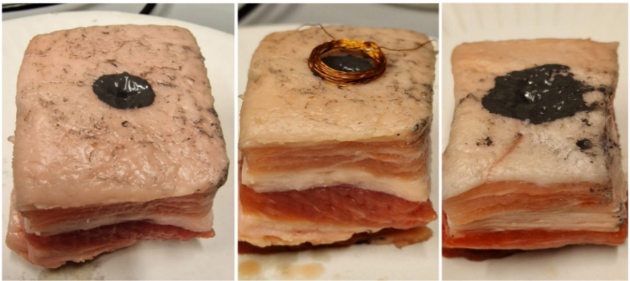
Injecting rheACT into Animal Tissue Magnetorheological fluids can be very efficient in translating magnetic fluctuations into mechanical energy. For that reason, they can be an ideal component for a wireless actuation setup (Farooq et al., 2022b). Using an MRF fluid within an electromagnetic housing can yield dynamic multi- resonant actuators for direct skin feedback. However, most MRF fluids may contain hazardous material or skin irritants which hinder their use for direct skin contact or injectable actuation setups. To resolve this issue, we fabricated our custom MRF fluid to ensure its composition remain free of hazardous material. Additionally, we tested various hydrogel linings to encapsulate the MRF keeping the solution intact for sub-dermal deposition. To test our setup, we utilized 65 grams of slabs of animal meat (pig belly) containing sub-dermal fat deposits and injected the hydrogel solution in between the top layers. Once the hydrogel was stabilized, we carefully deposited 5ml, 10ml, and 15ml of MRF fluid into the fat layers, ensuring that the fluid was encased by the hydrogel from three sides, as seem in Fig. 1. Only the puncture point on top of the animal tissue remained exposed, whereas the rest of the fluid was covered by the hydrogel compound.
Figure 1: Hydrogel encased MRF fluid stabilized within slabs of animal meat (pork belly). (Frome left to right) The illustration shows the deposition of 5ml, 10ml, and 15ml of MRF fluid into the fat layers of the animal tissue. The center image also shows the electromagnetic coil used to actuate the MRF fluid ingested into the animal tissue.
Harnessing Magnetorheological Fluids in Implantable Actuators 543
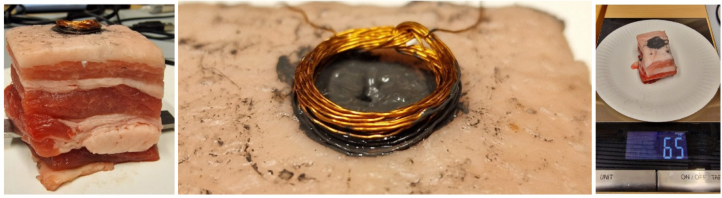
The animal tissue was then left in the fridge over night to test a) if it remained viable for actuation and b) if the hydrogel successfully stopped the MRF fluid from diffusing to the surrounding tissue and layers of fat. Once the setup was stable, we attached an electromagnetic coil onto the surface of the slab of meat, above the injected MRF fluid. The coil contained approximately 150 turns and a current of 3 amps was applied to it, resulting in a 450 Gause magnetic field on top of the MRF fluid. Using a piezoelectric displacement sensor, we measured the actuation and displacement in the tissue while applying 6 different frequencies of actuation (80, 100, 120, 140, 160 and 180Hz) and recorded any variances (Fig. 2). Additionally, we also ran a user perception study, to evaluate the overall feedback intensity and sensibility across the 6 applied frequencies. Twelve participants lightly gripped each slab of meat from the edges and evaluated if the various frequencies applied through the coil and MRF fluid could be felt through contact.
Figure 2: (Left) The various layers of fat and tissue in the slab of meat, (center) the attachment of EM coil and application of electromagnetic flux and (right) the weight and shape of the slab of meat which participants gripped to feel the tactile feedback.
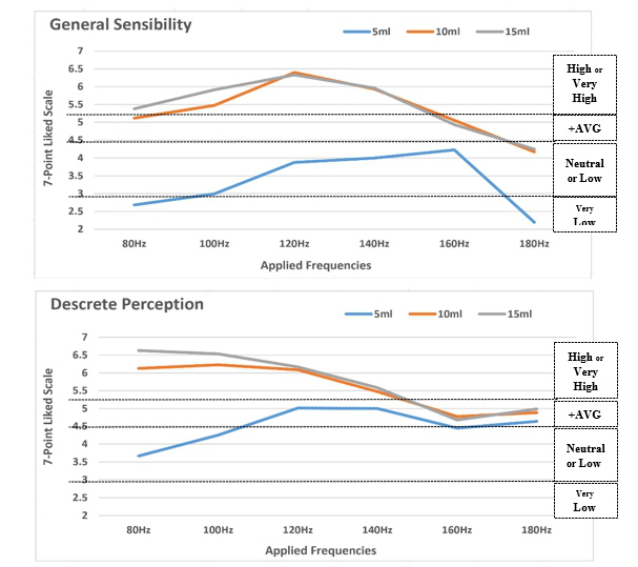
STUDY RESULTS We tested the setup by injecting various volumes of the MR fluid to gauge the ideal actuation feedback and force envelop created between the custom MRF encapsulated by the hydrogel structure and external coils. In our study we measured a maximum displacement of 1.3mm of the sample pigskin using 15ml of MR fluid and minimum displacement of 0.7mm using 5ml of MR fluid at 80Hz. We also created actuation signals using 100Hz, 120Hz, 140Hz, 160Hz and 180Hz, and measured the perceptual feedback of animal tissue deformation to external human contact. Users were asked to hold the tissue sample from the corners of the slab and provide information regarding general sensibility as well as distinct perception of each actuated frequency (see Fig. 3).
Twelve participants rated their feedback on a 7-point Likert scale for each of the measured frequencies. If participants were able to distinctly identify the actuation signal from the previous signal, they rated the feedback higher and if the feedback was not perceived distinctly from the previous stimulation, they rated the output lower. Results of the user perception study illustrated that actuation for all signals and MR-fluid volumes were perceivable via
544 Farooq and Raisamo
external contact near the area of stimulation. However, participants rated the distinct perception of lower frequencies i.e., 80-100Hz positively, while perception of frequencies ranging from 120-180Hz was rated neutral or negative. Overall volume of 15ml yielded on average higher sensibility and distinct perception of applied frequencies, but the difference between 10ml and 15ml was not statistically significant beyond 100Hz. To investigate further, we measured the skin displacement caused in the animal tissue by using a piezoelectric sensor mounted to the surface of the slab (Fig. 4).
Figure 3: (Above) User rated sensibility of applied actuation and (below) perception of unique signal across the measured frequencies.
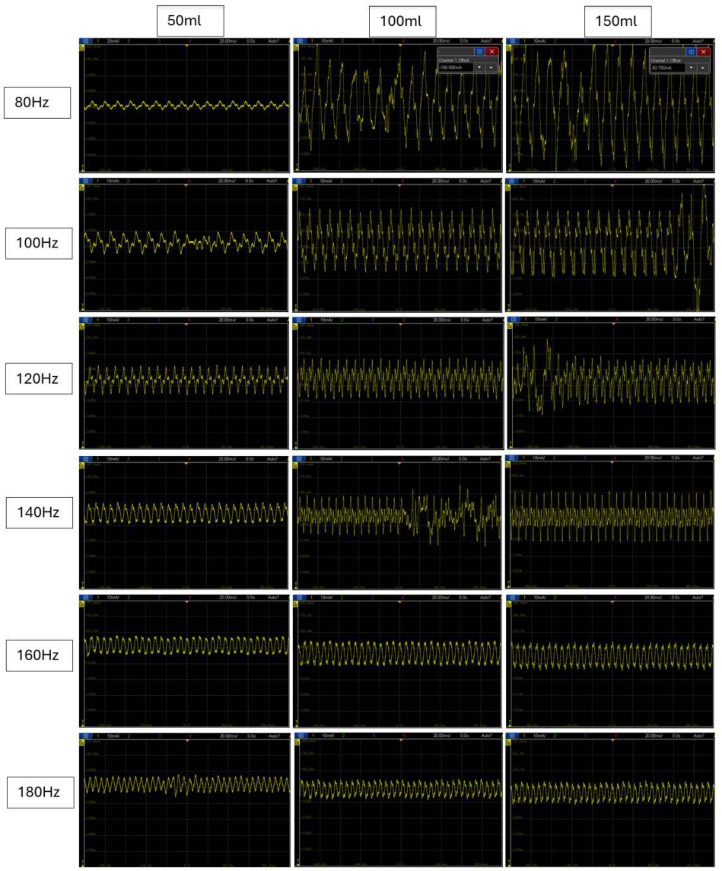
A miniature piezoelectric sensor (FT13.8H-4.9DI) was placed on the surface of the tissue sample near the EM coil to measure the vertical component of vibration signals generated throughout the frequency spectrum. The piezoelectric sensor was calibrated using MicroSense displacement sensor (5810) and 5622-LR, 20 kHz probe. The calibration was such that variations of 300mV on the piezo sensor registered a displacement of 25um with an error threshold of +/– 0.85um. The sensor was connected to a GDS2104-A (GW Instek) four channel digital oscilloscope to record all the signals as seen in Fig.4. Analysing the results it was evident that lower frequencies resulted in greater displacement and more effective propagation of the actuation signal throughout the animal tissue. This was clearly visible in 80-120Hz frequency bandwidth.
Harnessing Magnetorheological Fluids in Implantable Actuators 545
Figure 4: Vibration propagation from the animal tissue measured across the 6 applied frequencies (80, 100, 120, 140, 160, & 180Hz) and the three MRF volumes (5, 10, & 15ml).
Additionally, as the slab contained muscle, fat and connected tissue, propagation of vibration feedback (signal attenuation) was affected with the change of frequency. Similarly, the volume of MR fluid also contributed to the magnitude of the signal, as hypothesized. There was a statistically significant difference between 5ml and 15ml, however, no statistically significant difference was recorded between 10ml and 15ml beyond 100Hz. On the other hand, signal integration was recorded at lower frequencies but was not a major issue beyond 120Hz for any of the 3 MF fluid volumes. This showed that at higher frequencies signal propagated through the slab with
546 Farooq and Raisamo
little distortion through the connected tissue, but its amplitude was reduced in the slab with 5ml MR fluid.
The results illustrate that once the MR fluid delivery and hydrogel casing is optimized and safe for live animal subject delivery, it would be possible to create an implantable actuation structure which is controlled externally using electromagnetic coils as a wearable device interface. Human perception of the actuation signals within the sampled pigskin show that the feedback is felt as a palpitation or distension of the skin similar to a pulsating vein on the skin, especially at lower actuation frequencies (80Hz or below).
DISCUSSION: IMPLANTABLE HAPTIC SYSTEMS CHALLENGES AND OPPORTUNITIES Implantable haptic systems present numerous challenges, particularly in achieving biocompatibility, preventing immune rejection, and ensuring long- term reliability in dynamic biological environments. Overcoming these obstacles is essential for the successful deployment of such systems in clinical and prosthetic applications. This research focuses on creating rheACT, an actuation system which uses a hydrogel encapsulated MR fluid mechanism, injected into animal tissue and evaluates its efficiency as a simi-injectable tactile feedback system. Evaluating the propagation of tactile signals through the skin, fat and connected tissue, authors test how the applied signal attenuates and integrates at different frequencies. Results show that the custom developed system is efficient at propagating signal amplitude at lower frequencies and can function with as little as 5ml of MR fluid injected into the dermis of animal tissues. Although there are still some challenges in streamlining the minimum MR fluid needed to create sufficient displacement within the tissue, the current research provides the first step towards an implantable two-part setup for tactile feedback and signal delivery.
Another challenge in developing implantable haptic systems is ensuring that they are biocompatible and do not trigger adverse immune responses. Although this is a key consideration for human interaction, for the scope of this research authors did not investigate the viability of the current version of rheACT as an injectable actuator for human skin. Nevertheless, authors developed a novel approach to encapsulate the implantable MR fluid with a hydrogel structure limiting the contact of biohazardous material within the animal tissue. The results of this study illustrate that this approach can be a suitable candidate for encapsulating implantable actuators moving forward.
Similarly, the encapsulation approach has the potential to address the challenges of fluid diffusion between the implanted device and surrounding tissues. If fluids such as MRFs leak from their encapsulation, they can cause tissue damage or lead to mechanical degradation of the actuator as shown by Sun et al. (2021). In this research the structure of rheACT shows hydrogel encapsulation can offer a promising solution. Authors postulate that this is because hydrogels can mimic the viscoelastic properties of biological tissues, providing both mechanical stability and a barrier to fluid diffusion. Additionally, as discussed in the results section, authors did not see any visible degradation of the rheACT actuator in the sample of skin tissues 24 to 168
Harnessing Magnetorheological Fluids in Implantable Actuators 547
hours after injecting the MR-Fluid. Further testing is needed to validate these results especially as the skin sample utilized for this test was refrigerated for most of this time.
In any case, the use of hydrogels in implantable systems provides dual benefits: they enhance biocompatibility by reducing the risk of immune responses and maintain the mechanical integrity of the system by preventing leakage of active materials. For example, hydrogel-encapsulated MRFs may retain their mechanical properties when subjected to cyclic mechanical loads, which is crucial for long-term operation in dynamic environments such as the skin (Jiang et al., 2022). However, ensuring the long-term reliability of these systems remains a challenge and further research is needed to validate the proposed setup. Additionally, implantable devices may be subjected to mechanical stress, temperature fluctuations, and biological degradation over time, which can lead to device failure. The current setup was tested in a lab setting and did not explore possible external stress. Future research can be focused on developing and utilizing smart materials that can be adapted to changes in the biological environment. Materials, such as shape-memory polymers that can recover their shape at body temperature after deformation or self-healing materials that can repair minor damage without external intervention (Wang et al., 2019), should also be tested.
CONCLUSION
In this research authors introduce a novel approach towards creating a semi- injectable actuation setup. Using hydrogel encapsulated MR-fluid, injected into animal tissues, authors developed an electromagnetic actuation setup which can directly excite individual receptors within the skin and muscle. Targeting a specific frequency bandwidth, authors test the efficiency of the actuation setup in propagating tactile signals through the connected tissue across 6 different frequencies and 3 different actuation volumes within the animal skin. The result illustrates that using the minimum volume of 5ml injected within the slab of pig meat, it is possible to externally excite the fluid using a surface mounted electromagnetic coil, thereby validating the hypothesis of creating a semi-implantable actuator. Results show that for an efficient setup, at least 10ml of MR fluid needs to be injected within the skin. The study also shows that signal propagation remains stable at higher frequencies, but it can be difficult to distinctly perceive differences between frequencies higher than 140Hz.
Despite these challenges, the current research shows that implantable haptic systems can be both biocompatible and reliable using existing technologies. By using materials such as hydrogels and biodegradable polymers, it is possible to create devices that can operate safely and effectively within biological tissues for extended periods. The incorporation of magnetorheological fluids developed during this research can be optimized further to remain viscus at a wide range of temperatures, allowing for precise control over vibrotactile feedback while maintaining the biocompatibility necessary for long-term implantation.
548 Farooq and Raisamo
ACKNOWLEDGMENT
This research is part of the Intelligent Haptic Mediation (IHM) project. The project develops methods for creating reliable actuation techniques for various application scenarios. These techniques include Constructive Wave Interference (CWI), Liquid and Solid Mediation, and Embedded Haptic Waveguides (EHWs) for mobile and hand-held devices. The project is partially funded by Google Inc. and is conducted primarily at Tampere University, Finland.
REFERENCES
Abraham, O., Hariri, H. H., Francis, M., Rahman, T., & Mosher, Z. (2019). Haptic feedback in prosthetics: A review of challenges and opportunities. Frontiers in Robotics and AI, 6(55), 1–14. doi: 10.3389/frobt.2019.00055. Carlson, J. D., & Jolly, M. R. (2000). MR fluid, foam, and elastomer devices.
Mechatronics, 10(4-5), 555–569. doi: 10.1016/S0957-4158(99)00064-1. Corniani, G., & Saal, H. P. (2020). Tactile innervation densities across the whole body. Journal of Neurophysiology, 124(1), 122–131. doi: 10.1152/jn.00174.2020. Delhaye, B., Long, K. H., & O’Connor, D. H. (2018). Tactile feedback and the dynamics of human touch. Journal of Neurophysiology, 119(4), 1175–1188. doi: 10.1152/jn.00794.2017. Dietz, D., Bubic, A., & Peer, A. (2021). Embodied artificial tactile perception for neuroprosthetics. Frontiers in Neuroscience, 15, 713965. doi: 10.3389/fnins.2021.713965. Farooq, A., Rantala, J., Raisamo, R., Hippula, A. (2022a). Haptic Mediation through
Artificial Intelligence: Magnetorheological Fluid as Vibrotactile Signal Mediator. Proceedings of 2022 Symposium on Design, Test, Integration and Packaging of MEMS/MOEMS (DTIP), pp. 1–4. Farooq, A., Rantala, J., Raisamo, R., Hippula, A. (2022b). Creating Dynamic Vibrotactile Output using Magnetorheological Fluid as Signal Mediator. Proceedings of 8th International Conference on Sensors Engineering and Electronics Instrumentation Advances (SEIA’ 2022). Farooq, A., Rantala, J., Sand, A., Nayak, M., Quintero, N., Lappi, J., Sözer, N., Raisamo, R. (2023). Developing Multimodal Food Augmentation Techniques to Enhance Satiety. In: Tareq Ahram and Waldemar Karwowski (eds) Augmented, Virtual and Mixed Reality Simulation. AHFE (2023) International Conference. AHFE Open Access, vol. 118. AHFE International, USA. Hsiao, S. S., Johnson, K. O., & Twombly, I. A. (1993). Roughness coding in the
somatosensory system. Acta psychologica, 84(1), 53–67. Jiang, J., Sun, W., Li, S., & Wang, X. (2022). A novel injectable magnetorheological fluid system for localized haptic feedback. IEEE Sensors Journal, 22(2), 901–911. doi: 10.1109/JSEN.2021.3115476. Johnson, K. O. (2001). The roles and functions of cutaneous mechanoreceptors.
Current Opinion in Neurobiology, 11(4), 455–461. doi: 10.1016/S0959- 4388(00)00234-8. Kaczmarek, K. A., Webster, J. G., Bach-y-Rita, P., & Tompkins, W. J. (2012).
Electrotactile and vibrotactile displays for sensory substitution systems. IEEE Transactions on Biomedical Engineering, 38(1), 1–16. doi: 10.1109/10.121642.
Harnessing Magnetorheological Fluids in Implantable Actuators 549
Kciuk, M., & Turczyn, R. (2015). Properties and applications of magnetorheological fluids: A review. Smart Materials and Structures, 24(4), 043001. doi: 10.1088/0964-1726/24/4/043001. Li, J., Zhang, Q., & Yang, X. (2020). Magnetorheological haptic feedback systems
for sub-dermal actuation: A novel design and evaluation. IEEE Transactions on Haptics, 13(3), 453–460. doi: 10.1109/TOH.2020.2963127. Nguyen, Q., Jo, Y., & Park, J. (2019). Development of magnetorheological fluidbased haptic interfaces for medical applications. IEEE Transactions on Medical Robotics and Bionics, 1(2), 92–100. doi: 10.1109/TMRB.2019.2932428. Park, J., Seo, H., & Kim, Y. (2019). A study on magnetorheological fluid-based
haptic feedback for prosthetic hand devices. IEEE Transactions on Haptics, 12(3), 455–466. doi: 10.1109/TOH.2019.2918529. Richer, E., Thayer, N., & Cao, J. (2021). Injectable magnetorheological haptic actuators for sub-dermal applications. Proceedings of the 2021 IEEE International Conference on Human-Computer Interaction, 303–311. doi: 10.1109/CHI2021.9392085. Sun, W., Jiang, J., Li, S., & Wang, X. (2021). Hydrogel-based magnetorheological actuators for biomedical tactile feedback. IEEE Sensors Journal, 21(12), 13367– 13376. doi: 10.1109/JSEN.2021.3054511. Wang, Y., & Meng, G. (2016). Magnetorheological fluid devices: Principles, characteristics and applications in mechanical engineering. Advances in Mechanical Engineering, 8(1), 168781401662841. doi: 10.1177/1687814016628417. Yan, B. (2022). Actuators for Implantable Devices: A Broad View. Micromachines. Zamanian, A. H., Krueger, P. S., & Richer, E. (2023). Dynamic Lumped Parameter
Modeling and Stability Analysis of Planar Hydraulically Amplified Dielectric Elastomer Actuators. Journal of Dynamic Systems, Measurement, and Control, 145(9).
LISTED IN THE AHFE DIGITAL BOOKSTORE CATALOGUE
Explore the complete digital volume
Intelligent Human Systems Integration (IHSI 2025): Integrating People and Intelligent Systems
Read this individual research paper free through the original publisher, or explore the full digital proceedings book.
ISBN 978-1-964867-36-6
Explore this ISBN in the AHFE Bookstore ↗Listed in the July 2026 bookstore catalogue; search by ISBN to confirm current availability · Digital book purchase optional