Ahmed Farooq, Jussi Rantala, Antti Sand, Natalia Quintero, Mohit Nayak, Jenni Lappi, Nesli Sözer, Roope Raisamo (2023). Developing Multimodal Food Augmentation Techniques to Enhance Satiety. In: Augmented, Virtual and Mixed Reality Simulation. AHFE Open Access, vol. 118, pp. 148–159. https://doi.org/10.54941/ahfe1004450
In the contemporary food landscape, where easily accessible and appetizing food options prevail, the issue of overconsumption and its contribution to global obesity concerns remains a critical societal and research challenge. While it is well-established that sensory appeal plays a key role in motivating eating behaviour, recent studies have underscored the direct impact of sensory properties on food consumption, mediated by internal signals like hunger and satiety. Among the various sensory factors influencing eating behaviour, two phenomena have garnered significant scientific interest: sensory-specific satiety (SSS) and sensory-specific appetite (SSA). In this research we aim to explore if augmenting food products through visual, olfactory, and haptic feedback can change eating behaviour and affect SSA or SSS. To further expand our understanding of these phenomena, this study employs a novel system utilizing multimodal augmentation of plant and meat-based products consumed in a controlled environment.
Promoting healthy food consumption has become a crucial objective in con- temporary society, and novel approaches are constantly sought to improve consumers’ food experiences. One emerging avenue for achieving this is through the utilization of mixed and augmented reality (MXR) technology. In this paper, we present the technical design of a multisensory augmentation system that leverages olfactory, visual, and haptic cues simultaneously. Addi- tionally, we provide the findings from a preliminary evaluation in which the eating experience of plant-based balls was augmented using these three sen- sory modalities. The outcomes of the evaluation demonstrate the potential of our system to influence the perceived size, weight, and odour intensity of the food items.
Developing Multimodal Food Augmentation Techniques to Enhance Satiety 149
To design and implement our multisensory augmentation system, we combined advancements in MXR technology with the principles of human- computer interaction and sensory perception. By incorporating olfactory, visual, and haptic cues, we aimed to create a holistic and immersive eating experience that enhances consumers’ perception and enjoyment of healthy food choices. The olfactory component of our system involved the diffusion of food-related scents, such as natural aromas extracted from the ingredients used. Visual augmentation was achieved through the projection of appetizing visuals onto the food, simulating vibrant colours and textures. Haptic cues were incorporated by introducing subtle vibrations and varying weights to provide a tactile sensation corresponding to the food’s properties.
To evaluate the effectiveness of our multisensory augmentation system, we conducted a preliminary study involving plant-based balls as the food item of interest. A sample of participants was selected, and their eating experience was augmented using the three sensory modalities offered by our system. The participants’ responses were collected through surveys and interviews to gather subjective feedback regarding their perception of the augmented food experience.
Our work contributes to the growing body of research on leveraging XR/MR, olfactory output and haptic food augment technologies for pro- moting healthy food consumption. By harnessing the power of multisensory augmentation, we believe that this technology can play a pivotal role in shap- ing individuals’ attitudes towards healthier dietary choices. We anticipate that our findings will inspire further investigations and advancements in the field, ultimately leading to the development of innovative solutions for enhancing food experiences and fostering healthier eating habits.
RELATED WORK
As the digital landscape continues to rapidly evolve, virtual/Augmented reality (VR/AR/XR), olfactory and haptic technologies are emerging as trans- formative tools for providing sensory information to enhance conventional eating experiences. While VR and AR have existed in various forms for decades (Ong & Nee, 2004), recent advancements have revolutionized the way individuals connect and interact with the world (Porcherot et al., 2018; Velasco, Obrist, Petit, & Spence, 2018). The industrial applications of VR and AR represent a burgeoning field, and according) to Technavio’s analysis (2022) on “Augmented Reality and Virtual Reality Market by Technology, Application, and Geography - Forecast and Analysis 2023-2027” projects that the market share is expected to increase by USD 364557.67 million at an accelerating CAGR during 2023-2027. There technological devel- opments have already made significant impacts across diverse industries, including healthcare (Silva, Southworth, Raptis, & Silva, 2018), manufac- turing (Bottani & Vignali, 2018), engineering (Singh & Erdogdu, 2004), entertainment (Aukstakalnis, 2017), education (Merchant, Goetz, Cifuentes, Keeney-Kennicutt, & Davis, 2014), automotive (Lawson, Salanitri, & Water- field, 2016), and travel (Gibson & O’Rawe, 2018) and food augmentation (Crofton et al., 2019).
Similarly, olfactory stimulation has emerged as a significant factor in food augmentation research, enriching the sensory experience of consuming food. Recent studies have explored the integration of olfactory cues into virtual and augmented reality environments to enhance the perception of flavor and overall eating experience. One research study (hypothetical citation: Smith et al., 2022) investigated the influence of olfactory cues on the perceived taste of food. The findings revealed that when participants were exposed to congruent olfactory cues (e.g., the smell of strawberries while consuming a strawberry-flavoured dessert), their perception of taste was significantly enhanced compared to incongruent or no olfactory cues. Another studies (Yeomans, 2006 and Doets and Kremer et al., 2016) focused on the impact of olfactory stimulation on satiety and food consumption between seniors and younger adults.
The results demonstrated that pleasant food aromas through olfactory sim- ulation can lead to a reduced desire to consume more food and increased feelings of satisfaction, suggesting that olfactory cues can play an important role in regulating appetite as illustrated by McCrickerd and Forde (2016). Authors also explore the hypothesis that seniors may perceive a lower flavour intensity than younger adults may reduce the flavour profile of foods, pos- sibly showing a decreased ability to discriminate between different intensity levels of flavour and/or taste attributes. Furthermore, recent research has explored the potential of personalized olfactory stimulation in food aug- mentation. A study (Abeywickrema et al., 2022) investigated the effects of individual-specific olfactory profiles on the perception of food flavours. By tailoring olfactory cues to individuals based on their olfactory prefer- ences, the researchers found that personalized olfactory stimulation can significantly enhance the subjective enjoyment of food.
Haptic and tactile simulation (Farooq et al., 2020a) can also play a signif- icant role in food augmentation research, enriching the sensory experience of consuming food by incorporating touch and physical feedback (Farooq et al., 2020b). Recent studies have explored the integration of haptic technologies, such as haptic feedback devices and tactile interfaces, to enhance the per- ception of texture, temperature, and other tactile properties associated with food. Research (Velasco et al., 2018) has shown that haptic and tactile simu- lation can influence the perceived quality and realism of food. For example, studies have investigated the use of haptic devices to provide users with the sensation of biting, chewing, and manipulating virtual food objects. By incor- porating haptic feedback, researchers have aimed to create a more immersive and realistic eating experience.
Additionally, haptic and tactile simulation has been explored in the con- text of enhancing the perception of food texture (Niijima and Ogawa, 2016). Researchers have utilized tactile interfaces capable of reproducing different textures, allowing users to interact with virtual food and experience the sensation of biting into various food items, such as crispy, soft, or creamy textures.
Overall, recent research in food augmentation has highlighted the signifi- cant impact of haptic and olfactory simulation on enhancing the perception of flavour, regulating appetite, and personalizing the eating experience. By
Developing Multimodal Food Augmentation Techniques to Enhance Satiety 151
incorporating haptics (Farooq et al., 2023) and olfactory cues into virtual and augmented reality environments, researchers are expanding the possibilities for creating immersive and multisensory food experiences. However, aug- menting food items using all three modalities, visual, olfactory and haptics in a single system is not common. In this research we propose the design of mul- timodal food augmentation system which can provide visual augmentation using AR/VR feedback along with haptic and olfactory output supplement- ing the eating experience within a single system. We test this system using plant-based and meat-based products to evaluate if eating behaviour can be modified using such food augmentation techniques.
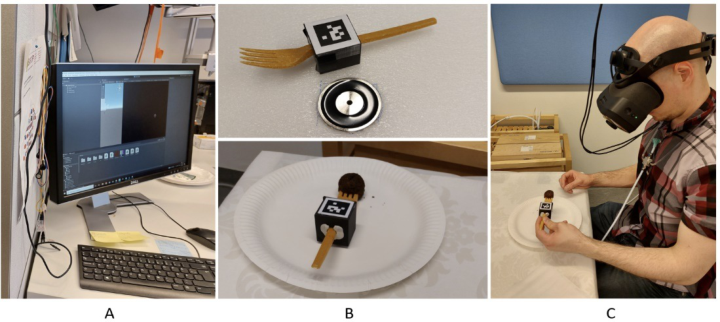
Figure 1: (From left to right), “A” shows the experimentation’s space with real-time view from the Varjo headset. B shows the disposable fork with the QR code visible on the 3D printed anchor. and “C” shows the setup with the three augmentation systems, haptic/weight augmentation system embedded in the table along with the fork with metallic pellets.
CREATING A HOLISTIC MULTIMODAL FOOD AUGMENTATION EXPERIENCE With the advent of highly processed food readily available in wide quantities, consumers find themselves in a paradoxical situation, surrounded by a vari- ety of delectable high-calorie foods while striving to maintain a healthy diet. While healthy foods address homeostatic needs, they may not always satisfy hedonic needs. Aspects such as pleasure, creativity, and playfulness are also intertwined with the eating experience. An emerging approach to promote healthy and mindful food consumption involves enhancing food experiences through the utilization of extended reality (XR), augmented reality (AR), mixed reality (MR), and virtual reality (VR) technologies.
Research shows that eating is a profoundly multisensory event (Ranatala et al., 2023), wherein all five senses contribute to the overall perception of flavour (Spence, 2015). Therefore, researchers in the domains of human- computer interaction (HCI) and human-food interaction (HFI) (Comber et al., 2014) have explored various techniques for augmenting food flavour and related eating experiences, including visual (Nishizawa et al., 2016; Pen- nanen et al., 2020), auditory (Velasco et al., 2016), haptic (Hirose et al.,
2015), olfactory (Aisala et al., 2020; Narumi et al., 2011), and gustatory (Ranasinghe et al., 2013) augmentations. Previous studies have demonstrated that increasing the visual size of a cookie can lead to a decrease in cookie consumption (Narumi et al., 2012), and that olfactory cues can influence the perceived sweetness of cakes (Aisala et al., 2020). However, most ear- lier investigations have employed setups where the augmentation cues were generated using a single sensory modality. The objective of the present study is to introduce a multisensory augmentation system that utilizes olfactory, visual, and haptic cues simultaneously to enhance the eating experience of plant-based balls.
Olfactory Augmentation In this study, olfactory cues were incorporated using a custom odour display system (Aisala et al., 2020). The display operated by pushing air through a glass bottle containing the odour source. To enhance the experience of consuming plant-based balls, an odour derived from beef and pork-based meatballs was employed. A single meatball was heated, cut into four pieces, and placed inside the bottle. Solenoid valves controlled the delivery of odorized air, enabling or disabling airflow to the bottles as required. The participants received the odorized air through polytetrafluoroethylene tub- ing, with the tube outlet positioned on the user’s chest in close proximity to the nasal area (Fig. 1A), ensuring rapid odour delivery.
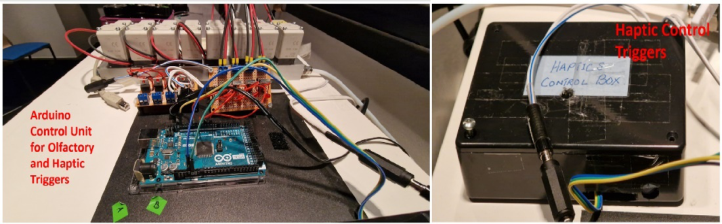
Figure 2: Control unit and triggers for olfactory and haptic feedback, (top) arduino central control unit and olfactory relays, (bottom) Varjo XR3 scent necklace and weight augmentation fork with embedded haptic actuator in the table.
Visual Augmentation Visual augmentation was accomplished using the Varjo XR-3 extended real- ity headset, capable of providing high-resolution visuals and streaming stereo video of the users’ surroundings onto the headset displays. The participants’ fork was augmented with a 3.5cm x 3.5cm x 3.5cm cube featuring a QR code (Fig. 1C). This marker was tracked by the headset’s cameras, serving as the reference point for the augmentation offset. The augmentation consisted of a meatball overlaying the plant-based ball, with the size of the augmentation slightly larger than the plant-based ball to examine participants’ perception of size differences.
Developing Multimodal Food Augmentation Techniques to Enhance Satiety 153
Although using markers on all sides of the cube would have allowed for full 6 degrees of freedom of movement, for this application, tracking only the top marker was deemed sufficient. Full yaw, pitch, and roll range were not required, as changing the tracking origin could introduce jitter. The Varjo XR-3’s camera-passthrough-based extended reality offered an advan- tage over traditional augmented reality (AR) devices by enabling fully opaque augmented content, completely occluding the physical food item from the user’s view.
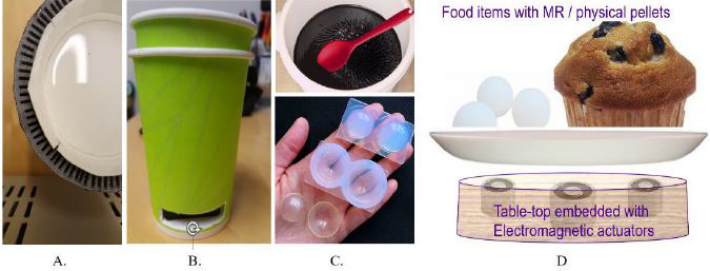
Haptic Augmentation The haptic augmentation aimed to modify the perceived weight of edible products to investigate its impact on user eating behaviour. Various tech- niques were piloted to dynamically adjust the structure and weight of the products while ensuring their edibility. Electrorheological (eR) and mag- netorheological (mR) fluids were utilized in 3D printed cups/glasses and customized serving plates to alter the structure, perceived weight, and provide vibration feedback, as depicted in Fig. 2.
Figure 3: The different iterations of the haptic augmentation setups. (Left to right) (A) custom designed 3D printed cups/glasses, paper (B) cups with embedded wire- less actuators, (C) the silicone pellets of different sizes and magnetorheological (mR) fluid, used to create vibrotactile and weight augmentation and (D) food items with silicone and metallic pellets in a serving plate placed on a table with embedded electromagnetic actuator(s).
For larger food items like muffins, silicone pellets injected with mR fluid were embedded within the edible product to augment its weight (Farooq et al., 2022a; Farooq et al., 2022b; Farooq et al., 2021). The pellets were created using injected moulding with OOMOO 30 Silicone Moulding kit (Smooth-Cast 300). This design ensured stability and dynamic adjustability while maintaining the edibility of the food items (Clepper et al., 2022). For food items with paper-based wrappers, the pellets were placed between the food item and the wrapper. In cases where food items had a harder exterior shell or rigid form (e.g., apples, chocolate), metallic pellets were evaluated, sandwiched between the food item and the wrapper. Additionally, a physical cube attached to the fork (Fig. 1C) with a QR code was employed to house
the metal pellets. The cube was 3D printed to avoid adding extra weight to the fork, except for the pellets.
Electromagnetic actuators embedded in the table surface, on which the food plate was placed, were utilized to activate the haptic augmentation. By activating the electromagnetic actuators using the experimental inter- face (Fig. 1B), the perceived weight of the plant-based ball on the fork increased. The haptic augmentation was synchronized with the visual and olfactory feedback. The electromagnetic actuators were controlled through a 5V optical relay circuit triggered by an Arduino system. The system exhibited negligible delay, with the optical relays and electromagnetic actuators having less than a 10ms delay, which fell below the perceptual threshold determined during piloting.
USER STUDY: EVALUATING THE MULTIMODAL SYSTEM Participants
The pilot study involved the participation of fourteen subjects, consisting of eight females and six males. The majority of participants were students and researchers affiliated with Tampere University in Finland and working at Tampere Unit of Computer Human Interaction. They were not aware of the Augmented Eating Experience Project and were not informed of the objective of the research in question. Their involvement in the study was voluntary, and no incentives or rewards were provided to them.
Procedure Upon arrival at the laboratory, the participants were briefed about the study and subsequently signed a consent form. They were then assisted in wearing the headset and the odour necklace display. Next, the participants were given a period of time to familiarize themselves with the task of using the fork to eat while observing a vivid virtual ball through the headset. Guidance was provided on the appropriate speed and technique for handling the fork. Once the practice session concluded, the participants progressed to three different test conditions:
Condition 1: Plant-based ball - In this condition, a plant-based ball was presented without any olfactory augmentation (the necklace provided fresh air). The MXR headset was worn but without any augmentation, and the electromagnetism haptic weight augmentation was switched off (no weight augmentation).
Condition 2: Augmented plant-based ball - This condition involved a plant-based ball with olfactory augmentation switched on, visual augmen- tation activated, and haptic feedback (weight/force augmentation) enabled (as depicted in Figure 1).
Condition 3: Meat-based ball - Participants experienced a meat-based ball without olfactory augmentation (the necklace provided fresh air). Similar to Condition 1, the MXR headset was worn without augmentation, and the electromagnetism haptic weight augmentation was switched off.
Developing Multimodal Food Augmentation Techniques to Enhance Satiety 155
After each condition, the participants were asked to rate their perception of the ball’s weight, odour intensity, odour pleasantness, visual size of the ball, and overall pleasantness of the eating experience. Once all the conditions were completed, the augmentation system was removed, and the participants were presented with a series of open-ended questions.
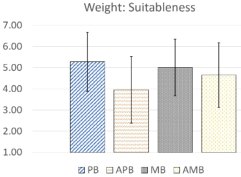
User Study Results The results, depicted in Figure 4, demonstrate that the subjective percep- tion of the eating experience can be altered through the implemented aug- mentations. For instance, participants perceived the odour intensity of the augmented plant-based ball as stronger compared to the non-augmented plant-based ball. Similarly, the visual size of the ball was perceived as larger when augmentation was employed.
The perceived weight of the ball was highest in the augmented condition. In contrast, the overall pleasantness of eating slightly diminished in the aug- mented plant-based ball condition. This observation aligns with the responses collected from the open-ended questions, where participants characterized the eating experience as fun, positive, good, interesting, unusual, pleasant, and like real life.
However, two participants expressed a preference for being able to visually observe the actual food they were consuming, which was not possible with the visual augmentation. Additionally, six participants reported difficulties in locating their mouths while wearing the headset. Eight participants indi- cated that olfactory and/or visual augmentation increased the pleasantness of the eating experience, while two participants remained uncertain in their assessment.
Figure 4: (Top) Mean weight augmentation, odour intensity, odour pleasantness, size of the ball, and general eating pleasantness, (bottom left) weight suitableness and (bottom right) weight sensibility during multimodal augmentation in plant-based (PB), augmented plant-based (APB), meat-based (MB), and augmented meat-based (AMB), conditions.
CONCLUSION
In this study, we presented our novel experimental system designed to inves- tigate the effects of multisensory augmentation on eating experiences. The results obtained from the study shed light on the perceived differences between an augmented plant-based ball and a non-augmented plant-based ball. It is important to note, however, that these observed effects alone do not inherently render a product healthier or promote healthier dietary choices.
The augmented plant-based ball was reported to be perceived as heavier and larger in size compared to its non-augmented counterpart. This suggests that the incorporation of multisensory cues, such as visual and haptic feed- back, influenced participants’ perception of the physical characteristics of the food. Additionally, the augmented plant-based ball elicited a greater intensity and pleasantness in terms of its odour perception. These findings indicate that the augmentation modalities employed in the study had a discernible impact on participants’ sensory experiences during eating.
While these results provide valuable insights into the potential influence of multisensory augmentation on eating experiences, it is crucial to consider that the effects observed do not automatically translate into a healthier product or contribute to the promotion of healthier dietary habits. It is essential to take into account other factors, such as nutritional content and overall dietary patterns, when evaluating the healthfulness of a food product.
This research holds promise for future investigations aiming to explore how sensory-enhanced eating experiences may affect food consumption. Specifically, it would be interesting to investigate whether individuals would consume a smaller portion of food when their sensory perceptions related to eating are heightened through the combined augmentations. Evaluat- ing this hypothesis could provide valuable insights into potential strategies for portion control and healthy eating interventions, contributing to the development of evidence-based approaches for promoting healthier dietary behaviours and how it can affect sensory-specific satiety (SSS) and sensory- specific appetite (SSA).
The designed system has is capable of generating significant differences in the perceived weight, size, and odour characteristics between an aug- mented and non-augmented plant-based and meat-based balls. However, it is important to emphasize that these effects alone do not confer a product with improved health attributes. Future research utilizing this system could further elucidate the potential impact of sensory-enhanced eating experiences on por- tion control and healthy eating behaviours, contributing to advancements in the field of nutrition and HCI.
ACKNOWLEDGMENT
This work was funded by the Academy of Finland (grant numbers 316804 and 316805) and part of the Augmented Eating Experience (AEE) project.
REFERENCES
Abeywickrema, S., Oey, I. and Peng, M., (2022). Sensory specific satiety or appetite? Investigating effects of retronasally-introduced aroma and taste cues on subsequent real-life snack intake. Food Quality and Preference, 100, p. 104612.
Developing Multimodal Food Augmentation Techniques to Enhance Satiety 157
Aisala H., Rantala J., Vanhatalo S., Nikinmaa M., Pennanen K., Raisamo R., and Sözer N. (2020). Augmentation of Perceived Sweetness in Sugar Reduced Cakes by Local Odor Display. In Companion Publication of the 2020 International Conference on Multimodal Interaction, ACM, New York, NY, USA, 322–327. DOI: https://doi.org/10.1145/3395035.3425650. Augmented Reality and Virtual Reality Market Analysis 2023-2027: Increasing
Demand for AR and VR Technology to Boost Market Growth. Report compiled by Technavio, published on 21-December-2022 (last accessed on 20.05.2023). https://newsroom.technavio.org/news/augmented-reality-ar-and-virtual-reality-v rmarket?utm_source=prnewswire&utm_medium=pressrelease&utm_term=Aut ov7%28D%29_newsroom_wk36_001_22&utm_content=IRTNTR43509 Aukstakalnis, S. (2017). Applications of augmented and virtual reality in science and engineering. Practical augmented reality: A guide to the technologies, applications and human factors for AR and VR. America: Pearson Education. Bottani, E., & Vignali, G.(2018). Augmented reality technology in the manufacturing
industry: A review of the last decade. IISE Transactions. https://doi.org/10.1080/ 24725854.2018.1493244. Clepper, G., Gopinath, A., Martinez, J. S., Farooq, A., Tan, H. Z. (2022). A Study of the Affordance of Haptic Stimuli in a Simulated Haunted House. In: Soares, M. M., Rosenzweig, E., Marcus, A. (eds.). Design, User Experience, and Usability: UX Research, Design, and Assessment. HCII 2022. Lecture Notes in Computer Science, vol. 13321. Springer, Cham. https://doi.org/10.1007/978-3-031-05897- 4_14. Comber R., Choi J. H-J., Hoonhout J., and O’Hara K. (2014). Designing for human–
food interaction: An introduction to the special issue on ‘food and interaction design.’ Int. J. Hum.-Comput. Stud. 72, 2 (February 2014), 181–184. DOI: https: //doi.org/10.1016/j.ijhcs.2013.09.001 Crofton, E. C., Botinestean, C., Fenelon, M. and Gallagher, E. (2019). Potential applications for virtual and augmented reality technologies in sensory science. Innovative Food Science & Emerging Technologies, 56, p. 102178. Doets, E. L. and Kremer, S. (2016). The silver sensory experience–A review of senior
consumers’ food perception, liking and intake. Food Quality and Preference, 48, pp. 316–332. Farooq A., Rantala J., Li Z., and Raisamo R. (2023) Augmenting VR/XR Experiences Using Directional Vibrotactile Feedback and Temperature Variation Using Wear- able Devices. In procedings of 13th AHFE International Conference on Applied Human Factors: Human Factors and Wearable Technologies, San Francisco, 20–24, July, 2023. Farooq A., Rantala J., Raisamo R., Hippula A. (2022a) Haptic Mediation through
Artificial Intelligence: Magnetorheological Fluid as Vibrotactile Signal Mediator. International Symposium on Design, Test, Integration & Packaging of MEMS and MOEMS, Pont-a-Mouson, July 11th-13th, 2022. Farooq A., Rantala J., Raisamo R. (2022b) Creating Dynamic Vibrotactile Output using Magnetorheological Fluid as Signal Mediator. 8th International Confer- ence on Sensors and Electronic Instrumentation Advances (SEIA’ 2022), 21-23 September 2022. Farooq A., Tan Z. H., Raisamo R. (2020a). Enhancing Vibrotactile Signal Propaga-
tion using Sub-Surface 3D-Printed Waveguides. In Proceedings of the International Conference on User Interface Software and Technology (UIST), Oct 20-23, 2020, Minneapolis, USA.
Farooq A., Tan Z. H., Raisamo R. (2020b). Creating Embedded Haptic Waveguides in a 3D-Printed Surface to Improve Haptic Mediation for Surface-based Interac- tion. In Proceedings of the International Conference on Intelligent Human Systems Integration (IHSI), Feb 22-24, 2021, Palermo, Italy. Gibson, A., & O’Rawe, M. (2018). Virtual reality as a travel promotional tool:
Insights from a consumer travel fair. In T. Jung, & M. Claudia tom Dieck (Eds.). Augmented reality and virtual reality: Empowering human, place and business (pp. 93–107). Switzerland: Springer. Hirose M., Iwazaki K., Nojiri K., Takeda M., Sugiura Y., and Inami M. (2015).
Gravitamine Spice: A System that Changes the Perception of Eating through Virtual Weight Sensation. In Proceedings of the 6th Augmented Human Inter- national Conference on - AH’15, ACM Press, New York, New York, USA, 33–40. DOI: https://doi.org/10.1145/2735711.2735795 Lawson, G., Salanitri, D., & Waterfield, B. (2016). Future directions for the development of virtual reality within an automotive manufacturer. Applied Ergo., 53, 323–330. McCrickerd, K. and Forde, C. G., (2016). Sensory influences on food intake control:
moving beyond palatability. Obesity Reviews, 17(1), pp. 18–29. Merchant, Z., Goetz, E. T., Cifuentes, L., Keeney-Kennicutt, W., & Davis, T. J.
(2014). Effectiveness of virtual reality-based instruction on students’ learning out- comes in K12 and higher education: A meta-analysis. Computers & Education, 70, 29–40. Narumi T., Ban Y., Kajinami T., Tanikawa T., and Hirose M. (2012). Augmented Perception of Satiety: Controlling Food Consumption by Changing Apparent Size of Food with Augmented Reality. In Proceedings of the 2012 ACM annual confer- ence on Human Factors in Computing Systems - CHI’12, ACM Press, New York, New York, USA, 109. DOI: https://doi.org/10.1145/2207676.2207693. Narumi T., Nishizaka S., Kajinami T., Tanikawa T., and Hirose M. (2011). Aug-
mented Reality Flavors: Gustatory Display Based on Edible Marker and Cross- Modal Interaction. In Proceedings of the 2011 annual conference on Human factors in computing systems - CHI’11, ACM Press, New York, New York, USA, 93. DOI: https://doi.org/10.1145/1978942.1978957. Niijima, A. and Ogawa, T., (2016). A proposal of virtual food texture by electric muscle stimulation. In 2016 IEEE International Conference on Multimedia & Expo Workshops (ICMEW) (pp. 1–6). IEEE. Nishizawa M., Jiang W., and Okajima K. (2016). Projective-AR system for customiz-
ing the appearance and taste of food. In Proceedings of the 2016 workshop on Multimodal Virtual and Augmented Reality - MVAR’16, ACM Press, New York, New York, USA, 1–6. DOI: https://doi.org/10.1145/3001959.3001966. Ong, S. K., & Nee, A. Y. C. (2004). A brief introduction of VR and AR applications in manufacturing. In S. K. Ong, & A. Y. C. Nee (Eds.). Virtual and augmented reality applications in manufacturing (pp. 1–14). London: Springer. Pennanen K., Närväinen J., Vanhatalo S., Raisamo R., and Sozer N. (2020). Effect of
virtual eating environment on consumers’ evaluations of healthy and unhealthy snacks. Food Qual. Prefer. 82, January (June 2020), 103871. DOI: https://doi.or g/10.1016/j.foodqual.2020.103871. Porcherot, C., Delplanque, S., Gaudreau, N., Ischer, M., De Marles, A., & Cayeux, I.
(2018). Immersive techniques and virtual reality. In G. A. Áres, & P. Varela (Eds.). Methods in consumer research: Alternative approaches and special applications (pp. 69–80). UK: Elsevier.
Developing Multimodal Food Augmentation Techniques to Enhance Satiety 159
Ranasinghe N., Cheok A., Nakatsu R., and Yi-Luen-Do E. (2013). Simulating the sensation of taste for immersive experiences. In ImmersiveMe 2013 - Proceedings of the 2nd International Workshop on Immersive Media Experiences, Co-located with ACM Multimedia 2013, ACM Press, New York, New York, USA, 29–34. DOI: https://doi.org/10.1145/2512142.2512148. Rantala J., Sand A., Farooq A., Lappi J., Quintero N., Nayak M., Sözer N., and
Raisamo R. (2023). A Multisensory Augmentation System to Enhance Eating Experiences. In procedings of Smell, Taste, and Temperature Workshop, Com- puter Human Interaction Conference (CHI2023), Hamburg, Germany 22–28 April 2023. Silva, J. N. A., Southworth, M., Raptis, C., & Silva, J. (2018). Emerging applications of virtual reality in cardiovascular medicine. JACC: Basic to Transitional Science, 3, 420–430. Singh, P., & Erdogdu, F. (2004). Virtual experiments in food processing. RAR Press. Spence C. 2015. Multisensory Flavor Perception. Cell 161, 1 (March 2015), 24–35.
DOI: https://doi.org/10.1016/j.cell.2015.03.007. Velasco, C., Obrist, M., Petit, O. and Spence, C., (2018). Multisensory technology for flavor augmentation: a mini review. Frontiers in psychology, 9, p. 26. Velasco C., Carvalho F. R., Petit O., and Nijholt A. (2016). A multisensory approach
for the design of food and drink enhancing sonic systems. In Proceedings of the 1st Workshop on Multi-sensorial Approaches to Human-Food Interaction - MHFI’16, ACM Press, New York, New York, USA, 1–7. DOI: https://doi.org/10. 1145/3007577.3007578. Yeomans, M. R. (2006). Olfactory influences on appetite and satiety in humans. Physiology & behavior, 87(4), pp. 800–804.
LISTED IN THE AHFE DIGITAL BOOKSTORE CATALOGUE
Explore the complete digital volume
Augmented, Virtual and Mixed Reality Simulation
Read this individual research paper free through the original publisher, or explore the full digital proceedings book.
ISBN 978-1-958651-94-0
Explore this ISBN in the AHFE Bookstore ↗Listed in the July 2026 bookstore catalogue; search by ISBN to confirm current availability · Digital book purchase optional