Haptic communication offers many interesting opportunities such as an unparalleled feel of presence, opening up to emotions and assuring oneself in reality - except for adding to perception of sizes, distances, weight, hardness, softness, warmth, and coldness – all fundamental aspects of the world. Haptic senses (cutaneous, kinaesthesis etc.) are found all over the body which also means that any technological means, such as wearables have/should have the same potential of full body coverage. For haptics, proximal stimulus could be located at two (or more) spatial separated anatomical locations simultaneously. As any proximal stimulus is an event and events have a duration i.e. existing in temporal space, it is of interest to see how events relate to each other. We do this first for two events, where we get an exact number, and then try to generalize this to three and more events. We observe that natural languages typically lack the fine distinctions in their vocabulary, relaying on vague (as we show) expressions like “before” and “after”.
Haptic communication, as any human communication, involves a sender, receiver, message and channel (Shannon and Weaver, 1949). Ontologically, haptic communication is an event (rather than a thing, for example). Fur- thermore, it is an action. An action being an event initiated and caused by a cognitive, intentional agent, IA (for example a human being). Commu- nication is initiated by a sender acting in the world and employing certain resources (including any communication channel) in order to bring a cer- tain message forward to a receiver. Communication also involves the act of listening (reading, feeling, etc.) to the message, which is equally an action. Events, and therefore also, actions, are fractal ontological entities, meaning that meronymically an event can consist of many subevents (fingerspelling with a person involves taking a person’s hand (an event), lifting it up (an event), flattening out the palm (an event). Subevents in turn, consist of sub- subevents (activating my own hand and arm and move them forward towards the receiver (events)) and so on. (Not all categories are fractal, a relation for example does not necessarily consist of another relation, a part of an artefact is not necessarily an artefact itself, just a lump of material.).
Contributing to Chronemics - Multievents for Haptic Communication 349
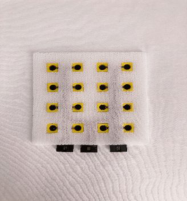
Figure 1: Left: Vibro-tactile coin devices in a matrix with yellow cases. Right: A full body garment for haptics consisting of 10 panels distributed over the body.
Haptics, the technology used to obtain haptic communication, take use of a wide spectrum of effectors for generating tactile sensations with the receiver. Foremost of these is the vibro-tactile coin or cylindrical vibrators, fig. 1.
As the diameter of these devices is small and human resolution is limited they can be regarded as pointwise stimulus. For such, common parameters are i) Duration (typically in ms with a life expectancy of 100 000 or more cycles); ii) Frequency (where for example 10~55Hz is a common interval); iii) Amplitude (stroke length, voltage, ampere etc.); and iv) Location spatially, i.e. the anatomical position. A certain set-up [duration, frequency, amplitude, location] renders a haptic stimulus event. If one introduces several vibrators it is possible to create more complicated stimulus patterns with some vibrators on, some others start vibrating when others are on and so forth. We add a new factor v). Temporal positioning. This is as important as the other four. It is for example known that with vibrators in a row, sequential start of this and a certain temporal overlap creates a sensation of a continuous stroke. Further on, by placing effectors anatomical far from each other (arm and leg, say) the property of natural touch sensation, namely built-in directionality (haptic sensation is taking place somewhere on the body) can be achieved also by artificial haptics. In any case, each stimulus sensation is an event. Temporal patterns of such events can have a communicative contribution by themselves. Thus, it becomes interesting to study in what ways events can relate to each other.
FRAMEWORK Assume linear time and the existence of simultaneity. This is intuitively and following every-day pragmatics. But it could be noted that is does not follow Einsteinian relativistic theory with Lorentz transformation.
We postulate the existence of the ontological category of event. Events are characterized by existing in time, having an extension U, with start, t’0 and end, t’s with t’0 < t’s . We allow both start and end being somewhat unde- termined with t’0 ∈1t around t’0 and t’s ∈1t around t’s , where the time interval 1t << U. This can be illustrated on a time line as in fig. 2.
Now introduce another event, <τ’0 , T, τ’s> . The question is now, in what ways can these two events (actions) relate to each other, such as being “before”, being “after/later than” and so on. It could be guessed that all
350 Persson
Figure 2: An event taking place in time.
Figure available in the original PDF paper.
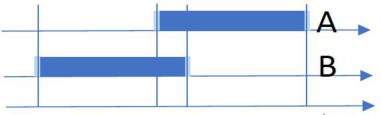
Figure 3: An example of how two events can be related to each other. Event B is occurring before event A but also partly overlapping in time.
natural languages offers some temporal and/or tense distinction as a univer- sal (von Fintel and Matthewson, 2008). Due to simultaneity it is meaningful to place them in relative (temporal) positions to each other, for example as in fig. 3.
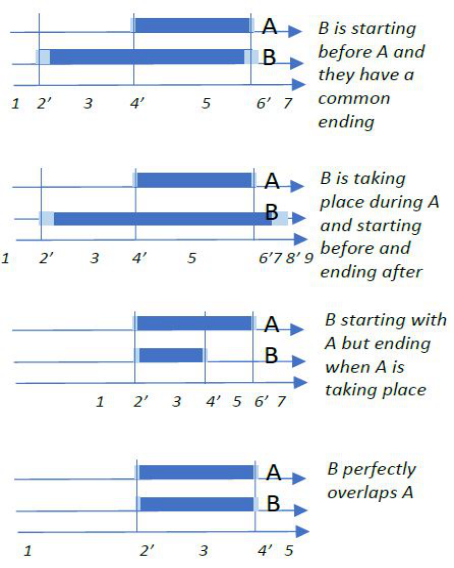
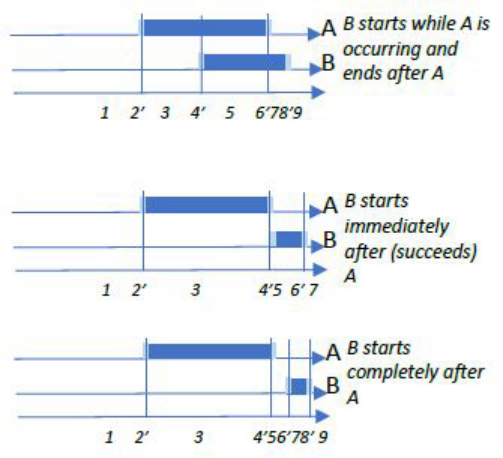
In figure 4 we collect all possibilities for two events (N = 2) where an event is allowed (only) to I. start and/or end both before, during and after another event, II. start and/or end exactly (within limits of 1t) when another event starts and/or stops
I and II are the generative criteria. Due to simultaneity the two timelines of the two events can be projected onto one giving a sequence of starts and ends of different events as well as intervals with none, one or both of the actions taking place.
After two events are placed out there is a sequence of intervals and start- end points when all these have been projected down at the time scale. These can each be denoted as a slot. Slots can be counted using integers. Among the slots, intervals are denoted unprimed, start and endpoints with primed numbers. Thus we have something like {1 2’ 3 4’ 5 6’ 7} which is a sequence.
To be noted is that it might be tempting in fig. 3 ninth case, to write someth- ing like B ∈A. But this is not necessarily correct. A can happen in Greenland, whereas B can take place in Madagascar. They are simultaneous but does not need to be meronymic parts of one another. So for N = 2 there are 13 different possibilities. We see that there are six (6) seven slot sequences, six (6) nine slot sequences and one five slot sequence.
Chronemics Chronemics is the (study and description of) impact of time perception in communication, originally emerging from study of non-verbal communica- tion (Burgoon 2011). There it complements other dimensions such as facial expressions, eye movement, dressing, posture and spatial distance between sender and receiver (proxemics). Our discussion of patterns of communi- cative events relates to chronemics. In fig. 1 right, a full body garment for
Contributing to Chronemics - Multievents for Haptic Communication 351
Figure 4: All possible (temporal) positioning between two (N=2) events together with potential terms or phrases describing them.
haptics is seen. Each panel is having an effector. It is easily understood that a very rich set of temporal patterns can be generated activating some at certain points in time and having others non active etc i.e. employing multievents for comunication. It is interesting to generalize this case.
352 Persson
Figure 4: Continued.
Generalizing to N > 2 When two events have been generated there are a number (13) of sequences of slots. The graphical representation can be replaced by such sequences.
When we are to place a new, third, event, we place the start point in any of the members of the sequence according to the rules I and II. Then looking at the right we place the endpoint in any of the remaining slots, automatically giving the extension for each of the possibilities.
We make two observations. Any sequence starts with an interval (i.e. being unprimed) and ends with an interval (i.e. being unprimed). So first; between
Contributing to Chronemics - Multievents for Haptic Communication 353
any interval (unprimed) there must be a primed (i.e. an interval) slot. Then secondly, it also follows that any sequence consists of an odd number of slots. Thus all sequences are alternating between unprimed and primed.
Assume a general sequence of slots of length n; (as mentioned, n is odd), {1 2’ 3 4’ 5 6’ 7 …n.
- The number of odd numbers/unprimed/intervals in a sequence is n−1
2 + 1. - The number of even numbers/primed/end or start points in a sequence is n + 1 2 −1. (as seen these two expressions add to n when added, as they should). Internal intervals are the intervals except the semiinfinite ones at the ends. - The number of internal intervals in a sequence is two less than all intervals n−1
2 −1. Lemma. Starting from a sequence {1 2’ 3 4’ 5 6’ 7 …n} and adding another event according to I and II, this can only generate sequences of three types of lengths; n, n+2 and n+ 4.
Proof: We start noting that the shortest segment resulting from adding a new event is again n. It cannot according to I and II be shorter than n. And n can be obtained, namely by having the new event exactly (within 1t) overlapping with an existing interval. i.e. spanning between any start and end point.
The maximum length of the new generated sequence is achieved whenever a new event is placed within an existing one (internal or semiinfinte). Every time this is happening the budget is that one unprimed slot is replaced by an unprimed-before-interval of the new event; a new start point, an new internal (unprimed) interval; an new end point; and a new unprimed after-interval i.e. 1→5, that is 4 new slots. The longest segment resulting from adding a new event is thus n + 4.
Knowing the max and the min length of new segments and remember that n is always an odd number the possible new sequences when adding a new event to a n slot sequence is n, n + 2, … n + 4 = n, n + 2, n + 4. Thus, just three alternatives. □ Then the question arises: what are the number of combinations for each of these three sequences.
Theorem. Starting from a sequence {1 2’ 3 4’ 5 6’ 7 …n} and adding another event according to I and II, this generate 1
n2 + 1
2
sequences, distributed on lengths n, n+2 and n+4.
Proof: We start observing that according to I and II there are exactly four possibilities when constructing a new event and its start and end points, namely a) prim to prim, such an event does not create a new sequence and gives length n b) unprimed/interval to unprimed/interval which creates many new slots and is of length n + 4 c) unprimed/interval to primed slot, which creates a new sequence of medium length n+ 2 d) primed slot to unprimed/interval, which creates a new sequence of medium length n+ 2
354 Persson
For a) it is a question of finding the number of possibilities primed to primed.
Equations and mathematical formulas are available in the original paper PDF.
2 −1 n−3
n−3
n−1 n + 1
n −1
2 −1 X
2 X
2 X j
j−1
2 n −1
2 n −3
2 n −1
2 n −1
2 For b) these cases are coming from interval to the same interval as well as from an interval to another interval. The former are equal the number of intervals = n−1
Equations and mathematical formulas are available in the original paper PDF.
2 + 1 −j
2 −j
n −1
Equations and mathematical formulas are available in the original paper PDF.
n −1
Equations and mathematical formulas are available in the original paper PDF.
n−1 n + 1 + n + 1 and in total for b): 1
2
Equations and mathematical formulas are available in the original paper PDF.
2
Contributing to Chronemics - Multievents for Haptic Communication 355
For c) there are the possibilities
2 . In total;
n−1
n + 1
n −1
Equations and mathematical formulas are available in the original paper PDF.
n −1
Equations and mathematical formulas are available in the original paper PDF.
2 X
2 −j
2
Equations and mathematical formulas are available in the original paper PDF.
2 For d), prim to intervals, there are the possibilities
And in the vertical direction there are as many as the number of even slots, which is n + 1
2 . In total;
n−1
Equations and mathematical formulas are available in the original paper PDF.
n −1
n + 1
n −1
Equations and mathematical formulas are available in the original paper PDF.
2 X
n −1
Equations and mathematical formulas are available in the original paper PDF.
n −1
Equations and mathematical formulas are available in the original paper PDF.
n−1 n + 1
Summarizing c) and d), the number of sequences of length n + 2 is then
Equations and mathematical formulas are available in the original paper PDF.
2
356 Persson
So taking all the cases in fig. 4 and the accompanying sequences one got n−1
n + 1
n−1 n + 1
1 2 n−3
2 n−1
2 + 1 2
Equations and mathematical formulas are available in the original paper PDF.
2
Equations and mathematical formulas are available in the original paper PDF.
n−1 n + 1 + n + 1 1 2 n−3 2 n−1
2 + 3 2
Equations and mathematical formulas are available in the original paper PDF.
2
2 □ We are then ready for Theorem. The number of ways N , N ≥2 events can be tempo- rally positioned relative to each other according to the rules I and II is
3N 27
2 34 32N + 4 33N + 25
Proof: Every sequence gives three types of sequences of length n, n+2 and n+4 according to the lemma, n ≥5. Let σ be the number of combinations of each. For each addition of another event there is thus a splaying into three. For two events, three types, for three events, 3 times 3 and so on, which gives P1, 3, 9,..
but the parenthesis is according to the
previous theorem 1
j2 + 1
2
2 gives
1
3N−2 X
3N−2 X
(2k2 + 6k + 5)
2k + 3 2 + 1
3N−2 + 1
+ 53N−2
23N−2 + 1
Equations and mathematical formulas are available in the original paper PDF.
+ 33N−2 . □
2 34 32N + 4 33N + 25
CONCLUSION
Thus, the number of combinations grows extremely quickly, which on one hand side could give a very rich communication system, but on the other hand side also quickly become beyond human discrepancy capacity. Psychophysi- cal studies should guide device construction. Further, we observe that natural languages typically lack the fine distinctions in their vocabulary already for for N = 2 (not to say for higher N:s).
REFERENCES
Burgoon, J. K., Guerrero, L. K., & Manusov, V. (2011). Nonverbal signals. Handbook of interpersonal communication, 239–280. Shannon C.E., Weaver W. (1949) “The Mathematical Theory of Communication”.
University of Illinois Press von Fintel, K., & Matthewson, L. (2008). Universals in semantics. The Linguistic Review Volume 25 Issue 1-2
Read this individual research paper free through the original publisher, or explore the full digital proceedings book.
ISBN 978-1-958651-44-5
Explore this ISBN in the AHFE Bookstore ↗Listed in the July 2026 bookstore catalogue; search by ISBN to confirm current availability · Digital book purchase optional