Kimmo Vanni, Xiaofeng Xiong, Emanuel Gunnarsson (2025). The challenges, limitations, and opportunities of using exosuits and exoskeletons to assess human performance at work. In: Human Factors, Business Management and Society. AHFE Open Access, vol. 176, pp. 72–82. https://doi.org/10.54941/ahfe1006305
The novel solutions offered by exosuits and exoskeleton robots enable their use in supporting human performance across sports, leisure, and work. Some articles report how exosuits and exoskeletons have been applied to enhance human performance in areas such as agriculture, logistics, industrial tasks, and rehabilitation. However, there is a limited number of studies and experiments addressing the use of exosuits and rigid body exoskeletons for assessing human performance, such as muscle power and motion, in real-world environments. Our article explores the challenges, limitations, and opportunities of using exosuits and exoskeletons to assess human performance on-site. This discussion is based on a literature review as well as professionals’ and end users’ interviews during former and ongoing three pilot studies conducted between 2022 - 2025.
Physical work, which includes repetitive movements, lifting heavy loads, hand manipulation, or strenuous body positions, poses potential risks for musculoskeletal disorders (MSDs), is perhaps one of the most common health challenges in European industries, affecting about 60 percent of workers (de Kok et al., 2020).
Wearable robots, such as exoskeletons and functional smart textiles, are promising and innovative solutions for assisting the elderly, people with disabilities, individuals undergoing rehabilitation, athletes, and workers performing strenuous or repetitive tasks (Slade et al., 2022; Berglin, 2013; Sield & Mara, 2021; Vänni & Xiong, 2024). While all exoskeletons are designed to assist humans, users should test different exoskeleton or exosuit types to determine which is most suitable for a specific work task. Exoskeleton manufacturers have conducted numerous experiments and invested considerable time and resources into designing functional and safe
devices (Bornmann et al., 2020), but the final assessment should be made by the end-users.
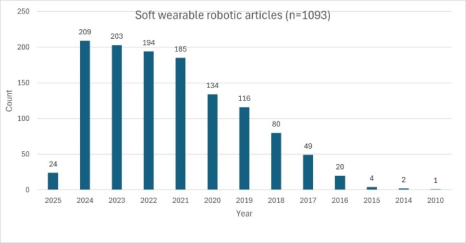
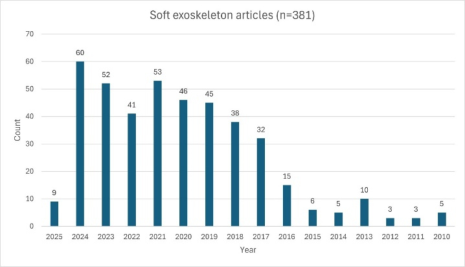
Bardi et al. (2022) conducted a systematic literature review focusing on upper-limb exoskeletons, identifying 105 eligible articles. Of these, more than 80% were intended for assistance, rehabilitation, or both. About one- third of the evaluated exosuits were equipped with sensors or utilized EMG and EEG measurements, indicating that these devices were designed for rehabilitation purposes. Exosuits with embedded sensors are rare in industrial applications, even though sensor data and related control systems could benefit users. It appears that exosuits have great potential for assisting humans in daily activities, though currently only a few exosuits are ready for mass-market adoption (Bardi et al., 2022). We conducted a search for exoskeleton and exosuit articles in the PubMed online database. A search using the keywords ‘soft wearable robotic’ yielded 1,093 results, with 790 articles published between 2021 and 2024 (Figure 1). However, the keywords ‘soft exoskeleton’ yielded 381 articles, with a growing number since 2016 (Figure 2). Surprisingly, the keywords ‘fabric-based soft exoskeleton’ yielded only 8 articles. Overall, researchers’ interest in soft wearable robotics appears to be strong, particularly in recent years.
This article discusses the challenges, limitations, and opportunities of using exosuits and exoskeletons to assess human performance on-site. The article is based on a literature review as well as interviews with professionals and end-users during three pilot studies conducted at HAMK University. These studies involved agriculture, horticulture, forestry, healthcare, and industrial professionals and workers between 2022 and 2025. The aim of the article is to highlight that exoskeletons and exosuits have great potential for improving end-users’ health and productivity. However, there are still challenges and limitations that need to be addressed in order to boost the global exoskeleton and exosuit market.
Figure 1: PubMed search using the keywords ‘soft wearable robotic’ (1093 articles).
The greatest number of available exoskeletons on the market are so-called passive exoskeletons, which do not have an electrical power source and are able to redistribute weight through springs and mechanical structures (McGowan, 2018). Exoskeletons can also be semi-passive or semi-active, where the technical solution is based on both springs, mechanics, and electric motors (Grazi et al., 2020).
Figure 2: PubMed search using the keywords ‘soft exoskeleton’ (381 articles).
Exoskeletons used in industry are typically rigid-body devices made of metal, plastic, or composites. Based on our pilot studies (Vänni & Xiong, 2024) and interviews, including those with healthcare professionals carried out in our multiple projects during 2022–2024, users are increasingly looking forward to exoskeletons made of textiles (Asbeck et al., 2014). Fabric-based soft exoskeletons are ideal for solutions where complex movements of the body or fingers are needed, such as an exoskeleton glove for hand grasping (Bardi et al., 2022; Ismail et al., 2024). Another example is the Mollii exosuit, a device designed to relieve spasticity, featuring electrical stimulation electrodes integrated into a textile structure (Pennati et al., 2021).
EXOSKELETONS WITH SENSORS Opportunities
Powered exoskeletons are equipped with sensors and control software, which make it possible to assess the exoskeletons’ functionality and users’ performance. Powered exoskeletons are prominent in rehabilitation, while unpowered passive exoskeletons, which rely on springs and mechanics, are common in daily tasks for the ordinary workers.
In the case of powered active exoskeletons, Inertial Measurement Units (IMUs) are commonly used to track a user’s movements by assessing the acceleration and angular velocity of different body parts (Neˇtuková et al., 2022). IMU sensors are suitable for measuring human movements in workplaces to adjust the exoskeletons for different end users (Jaramillo et al., 2022). IMUs also offer real-time data, enabling the control of an exoskeleton (Estevez Ruhrberg et al., 2024), especially in rehabilitation (Neˇtuková et al., 2022). IMUs can also be used in soft, fabric-based exosuits to detect angles and acceleration (Little et al., 2019).
Other technical solutions for assessing the impacts of exoskeletons on human performance rely on detecting bio-signals, such as muscular activity (EMG), heart rate, and galvanic skin response (GSR), also known as electrodermal activity (EDA). Electromyography (EMG) signals are widely used to assess muscle activity in sports and occupational settings
The Challenges, Limitations, and Opportunities 75
(Rafique et al., 2024). EMG signals indicate how well muscle cells are activated and how much muscle power a person is using.
Challenges A challenge with EMG measurements is that they can be used to assess the relative performance between two scenarios, for example, muscle strain with and without an exoskeleton. In such cases, a reference signal of a muscle should be available, and if not, it should be detected by performing a maximum voluntary contraction (MVC). However, it has been argued that MVC is often a sub-maximal contraction due to factors such as muscle fatigue and does not represent a true MVC for a human (Alenabi et al., 2018).
Other challenges in using EMG measurements as evidence of the functionality of exoskeletons relate to conducting EMG measurements in real working environments, where standardized and controlled tests are more difficult to carry out compared to laboratory settings. In our exoskeleton studies, we used real-time Fibrux Mpower sensors in forest environments (Borg et al., 2015) and smart clothing by Myontec in factory environments (Bessone & Adamsen, 2023). Both have proven useful for detecting EMG.
Limitations We have also recognized that heart rate variability (HRV) (Kim et al., 2018) and EDA measures (Healey & Picard, 2005) are robust indicators of stress and can be used to detect a user’s performance and physical strain. However, these measures are also used as indicators of a user’s emotions, and therefore, the interpretation of results should be done with caution.
The majority of passive exoskeletons do not offer the ability to assess a user’s performance in real tasks, even though modern work life increasingly demands the monitoring of workers’ workload and well-being. There have been some attempts to use sensor data in exoskeletons to regulate the assistance level according to a user’s performance. One such exoskeleton is the semi-active H-PULSE, which measures shoulder flexion/extension and controls the assistance level (Grazi et al., 2020). However, as far as we know, there are no passive exoskeletons equipped with sensors that are capable of detecting workers’ performance.
Even though objective measures from sensors are considered robust indicators of exoskeleton performance, subjective measures, such as questionnaires, cannot be ignored. Sensor data can be unreliable, and therefore, subjective measures such as the NASA Task Load Index (NASA- TLX) may provide additional insights (Casner & Gore, 2010).
STANDARD HUMAN Challenges
Exoskeletons should align with a user’s body dimensions and work harmoniously to enhance physical performance (Herr, 2009; Little et al., 2019; de la Tejera et al., 2021). However, it is well-documented that human
body dimensions vary significantly due to genetic factors (WorldData, 2024), as well as dietary and lifestyle habits (Moschonis & Trakman, 2023).
For example, according to WorldData (2024), the average height and weight of individuals vary by continent and country. An average man in the Netherlands weighs 87.2 kg and is 1.84 m tall (BMI 25.9), whereas an average man in India weighs 63.4 kg and is 1.66 m tall (BMI 23.1). Surprisingly, data from American Samoa revealed that the average weight is 104.2 kg, with a height of 1.77 m (BMI 33.4). In our exoskeleton pilot studies, the tallest participant weighed approximately 160 kg and was about 2.0 m tall, while the smallest participant weighed around 45 kg and was about 1.50 m tall.
It can also be argued that BMI is not always a relevant measure because body composition differs among individuals. While this is partly true, on an international scale, individuals with very muscular physiques are in the minority.
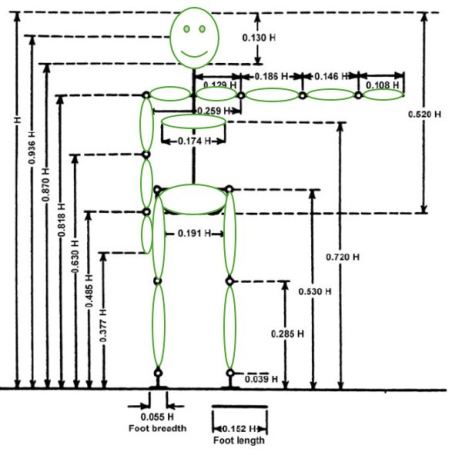
In conclusion, the body dimensions of individuals vary based on gender, genetic heritage, and dietary and lifestyle habits. This variability poses a challenge for exoskeleton manufacturers in designing devices that fit all individuals, as the “standard human” differs across continents and countries. The challenge of varying weight and height affects all body dimensions of an individual (skeleton scaling), including, for example, the length of the upper and lower limbs, as well as the diameters of the chest and waist (Figure 3). Additionally, there is variation among humans even if some standard measures can be used (Winter, 1990).
Figure 3: Body dimensions proportional to height. Modified from Winter (1990).
The Challenges, Limitations, and Opportunities 77
EXOSKELETONS AND EXOSUITS AT WORK Limitations
Ralfs et al. (2023) have reported that exoskeletons are not yet widely adopted and used in workplaces, even though many different exoskeletons are available. They stated that, according to experts, the evidence of the efficiency of exoskeletons is limited, even though all the exoskeleton manufacturers have conducted qualitative and quantitative evaluations of their exoskeleton products. Bardi et al. (2022) reported that clinical trials are needed to assess the effectiveness of exosuits. We agree with earlier reports that it is difficult to find evidence where the effectiveness of exoskeletons has been tested in real-world environments. Especially, studies that report a worker’s motions, muscular activity, and cardiovascular performance in real environments while using exoskeletons are rare.
According to Gorgey (2018), rigid exoskeletons may provide high torque but are heavy, bulky, expensive, and may limit the natural degrees of freedom in human joints. Even minor misalignments of an exoskeleton can disrupt physiological movements and increase muscle strain in other muscles. Due to the disadvantages of rigid exoskeletons, fabric-based exosuits are proposed as an alternative (Asbeck et al., 2014). Exosuits may offer several advantages, such as ease of wear, comfort, and lower costs compared to rigid exoskeletons (Xiloyannis et al., 2021). Despite these advantages, challenges exist, such as the potential for force transmission from the exosuit to the body to be unreliable if the fabric slides (O’Neill et al., 2017). The actuator of an exosuit should be well-connected to a limb and the body to prevent sliding effects (Park & Park, 2019). Another mode of fabric for generating power to a user may involve the elasticity of materials such as rubber (Raghuraman et al., 2024). One possible, but not yet widely studied, phenomenon for improving human performance may relate to the potential to generate intramuscular pressure through fabrics (Lundin & Styf, 1998).
Opportunities The key issue for objective measures is that employers are looking for clear evidence that rigid-body exoskeletons and exosuits can reduce physical load, improve workers’ health, and increase productivity. Exoskeleton and exosuit trials have shown that they can reduce physical load and lower the risks of musculoskeletal disorders (MSD) (Bogue, 2019). Little et al. (2019) found that a soft powered exosuit was able to reduce biceps brachii activation by 24%. Ralfs et al. (2023) reported that a 20–30% reduction in muscle activity can be achieved. Zhao et al. (2024) evaluated the effectiveness of an exoskeleton in real work environments and reported a muscle activity reduction ranging from 24% (climbing down) to 38% (construction tasks). According to Rafique et al. (2024), commercial passive exoskeletons can reduce a user’s EMG activity by up to 60%. Alemi et al. (2019) investigated the impact of an exoskeleton in different lifting tasks can reduce EMG peak values by 17% to 32%, depending on the measured muscle groups.
Based on our experiments and interviews with workers in the forestry, agriculture, industrial, and health sectors, we have identified two scenarios
where real-time measures in real environments would be necessary when using exoskeletons and exosuits. The first scenario concerns the use of an exoskeleton or an exosuit to detect the functionality of a patient’s limb. According to medical doctors, they can assess the functionality of limbs, muscles, and joints in a laboratory environment and determine how well a person is able to perform before a medical operation. However, when it comes to evaluating how well a person performs in everyday life, medical doctors must rely on the patient’s subjective opinions. Medical doctors do not have any measured data on, for example, muscle activity, limb acceleration, or angular velocity related to the real functionality of a limb in real-world scenarios before a medical operation. Information from real-life cases would be advantageous for planning, for example, orthopedic procedures. From another perspective, objective data from a patient’s physical performance, including muscle activity, velocities, and angles of a limb measured by IMUs, would be useful for screening a patient’s functionality after a medical operation. Currently, medical doctors must rely on the patient’s subjective opinion about the limb’s functionality post-operation without information on stress models or physical loads. Therefore, based on our previous exoskeleton pilot studies, it has been suggested to design a lightweight exoskeleton or an exosuit equipped with IMU and EMG sensors to assess a patient’s pre- and post-operative performance. A challenge is measuring objective muscle power, but so far, we must rely on EMG values.
Another case for the need to design an exoskeleton or exosuit concerns the requirement to assess workers’ workload and physical strain. A wide variety of subjective surveys are available for detecting perceived physical and mental workload (Rubio et al., 2004; Casner & Gore, 2010). However, there is a lack of passive exoskeletons and exosuits equipped with sensors that could provide information about a worker’s performance in different work tasks and workload scenarios. Such information would be valuable both for the worker and for occupational health professionals in designing work tasks that minimize physical strain. To the best of our knowledge, only a few passive exoskeletons or exosuits equipped with IMU or EMG sensors for monitoring worker performance are available (Lind et al., 2020). Therefore, we carried out a thesis project at HAMK University, where we attached an IMU sensor to the EksoEvo exoskeleton to test how well and easily the sensor can be integrated into a commercially available exoskeleton and how well the fusion of the sensor and exoskeleton functions.
Challenges A challenge concerning the use of exoskeletons and exosuits for detecting workers’ performance relates to user privacy and ethics, especially in workplace settings. Workers are protected by legal regulations against data collection practices in Europe (Riso & Litardi, 2024) and the U.S. (Blum, 2022). Using biosignals from exoskeletons and exosuits at work requires user consent and a clear policy on how the biosignals will be used and for which purposes. Workers have the full right to refuse the measurement of biosignals, so it is crucial that measurement results provide added value to workers
The Challenges, Limitations, and Opportunities 79
and contribute to their occupational health and well-being. Regarding the detection of biosignals, even in the case of heart rate measurements for research purposes, permission from an Ethics Committee is required.
Another challenge concerns users’ requirements for developing exosuits that are easy to wear and able to generate power in a similar way to rigid-body exoskeletons. End users have commented that rigid-body exoskeletons may limit work in forestry and agricultural environments and may present risks of getting stuck. Another perceived risk is that exoskeletons are challenging to wear under work clothes, whereas exosuits fit well. The need to wear exoskeletons and exosuits under work clothes is especially relevant in the food processing industry and the health care sector.
CONCLUSION
Exoskeletons and exosuits present significant opportunities for enhancing human performance and reducing physical strain in industries, rehabilitation, and daily activities. These devices can support tasks like lifting, repetitive movements, and hand manipulation, while also reducing the risk of MSD. Powered exoskeletons with integrated sensors like IMUs and EMG provide valuable data on user performance, enabling real-time monitoring and optimization. However, there are still challenges and limitations in implementing these technologies, especially in real-world environments, such as the variability in human body dimensions, which complicates universal design and difficulties in collecting objective performance data in uncontrolled environments. Despite the challenges and limitations, also opportunities exist in designing novel exoskeletons and exosuits which incorporate reliable sensors and explores real-time performance metrics on- site for healthcare and occupational applications. Addressing issues such as user diversity, privacy concerns, and the need for on-site real-time monitoring is crucial to unlocking the full potential of exoskeletons. Collaborative efforts among researchers, manufacturers, and end-users are crucial to overcoming these obstacles and advancing the field of wearable intelligence.
ACKNOWLEDGMENT
This study was partly funded by European Regional Development Fund of Häme Regional Council (A80804) and EIP funding of Häme Centre for Economic Development, Transport and the Environment (278719).
REFERENCES
Alemi, M. M., Geissinger, J., Simon, A., Chang, S., Asbeck, A. T. (2019) A passive exoskeleton reduces peak and mean EMG during symmetric and asymmetric lifting. Journal of Electromyography and Kinesiology, 47, 25–34. Alenabi, T., Whittaker, R., Kim, S. Y., Dickerson, C. R. (2018) Maximal
voluntary isometric contraction tests for normalizing electromyographic data from different regions of supraspinatus and infraspinatus muscles: Identifying reliable combinations. Journal of Electromyography and Kinesiology.
Asbeck, A. T., De Rossi, S. M., Galiana, I., Ding, Y., Walsh, C. J. (2014) Stronger, smarter, softer: Next-generation wearable robots. IEEE Robot. Autom. Mag. 21, 22–33 Bardi, E., Gandolla, M., Braghin, F., Resta, F., Pedrocchi, A. L. G., Ambrosini, E.
(2022) Upper limb soft robotic wearable devices: A systematic review. Journal of NeuroEngineering and Rehabilitation, 19(1), 87. Berglin, L. (2013) Smart Textiles and Wearable Technology: A study of smart textiles in fashion and clothing. Review, The Swedish School of Textiles. Bessone, V., Adamsen, S. (2023) Single-use gastroscope reduces endoscopist muscle
load compared to reusable gastroscope. United European Gastroenterology Journal 11(8). Blum, S. (2022) Biometric monitoring is booming in the workplace, raising ethical and legal questions for HR. HR Brew. https://www.hr-brew.com/stories/2022/03/ 04/biometric-monitoring-is-booming-in-the-workplace-raising-ethical-and-legal- questions-for-hr Bogue, R. (2019) Exoskeletons – a review of industrial applications, Industrial Robot,
45(5): 585–590. Borg, F., Laxåback, G., Sandström, L. (2015) Simultaneous EMG measurements with Mpower (Fibrux) and. Telemyo G2 (Noraxon): Comparing amplitude. Research Note 10.12v2. University of Jyväskylä. http://www.mpower-bestrong.com/fi/img/ science/Chydenius.pdf Bornmann, J., Schirrmeister, B., Parth, T. Gonzalez-Vargas, J. (2020) Comprehensive
development, implementation and evaluation of industrial exoskeletons. Current Directions in Biomedical Engineering, 6(2):1–4. Casner, S. M., Gore, B. F. (2010) Measuring and evaluating workload: A primer.
NASA Tech. Memo. 216395. de Kok, J., Vroonhof, P., Snijders, J., Roullis, G., Clarke, M., Peereboom, K., van Dorst, P., Isusi, I. (2020) Work-related musculoskeletal disorders: Prevalence, costs, and demographics in the EU. European Agency for Safety and Health at Work. de la Tejera, J. A., Bustamante-Bello, R., Ramirez-Mendoza, R.A., Izquierdo-Reyes,J.
(2021) Systematic Review of Exoskeletons towards a General Categorization Model Proposal. Applied Sciences, 11(1):76. Estevez Ruhrberg, S., Mallah, J., Kazieczko, D., Tang, C., & Occhipinti, L. G. (2024) Deep learning for motion classification in ankle exoskeletons using surface EMG and IMU signals. arXiv. https://arxiv.org/abs/2411.16273 Gorgey, AS. (2018) Robotic exoskeletons: The current pros and cons. World J
Orthop. 9(9):112–9. Grazi, L., Trigili, E., Proface, G., Giovacchini, F., Crea, S., Vitiello, N. (2020) Design and experimental evaluation of a semi-passive upper-limb exoskeleton for workers with motorized tuning of assistance. IEEE Transactions on Neural Systems and Rehabilitation Engineering, 28(10):2276–2285. Healey, J. A., Picard, R. W. (2005) Detecting stress during real-world driving tasks
using physiological sensors. IEEE Trans. Intell. Transport. Syst. 6(2): 156–166. Herr, H. (2009). Exoskeletons and orthoses: Classification, design challenges and future directions. J. Neuroeng. Rehabil. 6, 21. Ismail, R., Ariyanto, M., Setiawan, J. D., Hidayat, T., Paryanto, Nuswantara, L. K.
(2024) Design and testing of fabric-based portable soft exoskeleton glove for hand grasping assistance in daily activity. HardwareX, 18, e00537.
The Challenges, Limitations, and Opportunities 81
Jaramillo, I. E., Jeong, J. G., Lopez, P. R., Lee, C.-H., Kang, D.-Y., Ha, T.-J., Oh, J.-H., Jung, H., Lee, J. H., Lee, W. H., & Kim, T.-S. (2022) Real-Time Human Activity Recognition with IMU and Encoder Sensors in Wearable Exoskeleton Robot via Deep Learning Networks. Sensors, 22(24):9690. Jarrassé, N., Proietti, T., Crocher, V., Robertson, O., Sahbani, A., Morel, G.,
et al. (2014) Robotic exoskeletons: A perspective for the rehabilitation of arm coordination in stroke patients. Frontiers in Human Neuroscience, 8, 1–13. Kim, H., Cheon, E., Bai, D., Lee, Y., Koo, B. (2018) Stress and Heart Rate Variability: A Meta-Analysis and Review of the Literature. Psychiatry Investig. 5(3): 235–245. Kim, J. H., Chung, W. (2023) Forestry professionals’ perspectives on exoskeletons
(wearable assistive technology) to improve worker safety and health. International Journal of Forest Engineering, 35(1):11–20. Lind, C. M., Diaz-Olivares, J. A., Lindecrantz, K., Eklund, J. (2020) A Wearable Sensor System for Physical Ergonomics Interventions Using Haptic Feedback. Sensors, 20(21), 6010. Little, K., Antuvan, C. W., Xiloyannis, M., Bernardo, A. P. S. N., Kim, Y. G.,
Masia, L., Accoto, D. (2019) IMU-based assistance modulation in upper limb soft wearable exosuits. IEEE International Conference on Rehabilitation Robotics, 1197–1202. Lundin, O., Styf, JR. (1998) Intramuscular Pressure in the Leg and Thigh Related to Tensile Strap Force During Knee Brace Wear. The American Journal of Sports Medicine, 26(4): 567–570. McGowan, B. (2018) Industrial Exoskeletons: What You’re Not Hearing. Available
online: https://ohsonline.com/articles/2018/10/01/industrial-exoskeletons-what- youre-not-hearing.aspx. Moschonis, G., Trakman, G. L. (2023) Overweight and obesity: The interplay of eating habits and physical activity. Nutrients, 15, 2896. Neˇtuková, S., Bejtic, M., Malá, C., Horáková, L., Kutílek, P., Kauler, J., &
Krupiˇcka, R. (2022) Lower Limb Exoskeleton Sensors: State-of-the-Art. Sensors, 22(23):9091. O’Neill, C. T., Phipps, N. S., Cappello, L., Paganoni, S., Walsh, C. J. A. (2017) Soft wearable robot for the shoulder: Design, characterization, and preliminary testing. IEEE International Conference on Rehabilitation Robotics, 1672–1678. Park, S. J., Park, C. H. (2019) Suit-type wearable robot powered by shape-memory-
alloy-based fabric muscle. Scientific Reports, 9, 1–8. Pennati G. V., Bergling H., Carment L., Borg J., Lindberg P. G., Palmcrantz S. (2021) Effects of 60 min Electrostimulation With the Exopulse Mollii Suit on Objective Signs of Spasticity. Front. Neurol. 12:706610. Rafique, S., Rana, S. M., Bjorsell, N., Isaksson, M. (2024) Evaluating the advantages
of passive exoskeletons and recommendations for design improvements. J Rehabil Assist Technol Eng. 21;11:20556683241239875. Raghuraman, RN., Barbieri, DF., Aviles, J., Srinivasan, D. (2024) Age and gender differences in the perception and use of soft vs. rigid exoskeletons for manual material handling. Ergonomics. 67(11): 1453–1470. Ralfs, L., Hoffmann, N., Glitsch, U., Heinrich, K., Johns, J., Weidner, R. (2023)
Insights into evaluating and using industrial exoskeletons: Summary report, guideline, and lessons learned from the interdisciplinary project “Exo@Work.” International Journal of Industrial Ergonomics, 97, 103494. Riso, S., Litardi, C. (2024). Employment and labour markets. Employee monitoring: A moving target for regulation. Eurofound. https://www.eurofound.europa.eu/en/ resources/article/2024/employee-monitoring-moving-target-regulation
Rubio, S., Díaz, E., Martín, J. and Puente, J. M. (2004) Evaluation of Subjective Mental Workload: A Comparison of SWAT, NASA-TLX, and Workload Profile Methods. Applied Psychology, 53: 61–86. Siedl, S. M., Mara, M. (2021) Exoskeleton acceptance and its relationship to self-
efficacy enhancement, perceived usefulness, and physical relief: A field study among logistics workers. Wearable Technologies. 2, e10. Slade, P., Kochenderfer, M. J., Delp, S. L., Collins, S. H. (2022) Personalizing exoskeleton assistance while walking in the real world. Nature, 610(7931):277–282. Vänni, K., Xiong, X. (2024) An Approach to Developing Assistive Robotics for
Manual Forestry Work. in Springer. ICSR 2024. 16th International Conference on Social Robotics +AI. October 23–26, 2024, Odense, Denmark (In press). Winter, DA. (1990) Biomechanics and motor control of human movement. New York: Wiley-Interscience. WorldData. (2024) Average height and weight by country. Accessed from https:// www.worlddata.info/average-bodyheight.php 26th January 2024. Xiloyannis, M., Alicea, R., Georgarakis, A. M., Haufe, F. L., Wolf, P., Masia, L.,
Riener, R. (2021) Soft robotic exosuits: State of the art, core technologies and open challenges. IEEE Transactions on Robotics. Zhao, D., Wang, S., Sun, S., Zhang, X., Vänni, K. (2024) Experimental evaluation of a passive upper limb exoskeleton for high voltage live-line operations. In Proceedings of the 2024 16th International Conference on Intelligent Human- Machine Systems and Cybernetics (IHMSC) (pp. 183–187). IEEE.
LISTED IN THE AHFE DIGITAL BOOKSTORE CATALOGUE
Explore the complete digital volume
Human Factors, Business Management and Society
Read this individual research paper free through the original publisher, or explore the full digital proceedings book.
ISBN 978-1-964867-52-6
Explore this ISBN in the AHFE Bookstore ↗Listed in the July 2026 bookstore catalogue; search by ISBN to confirm current availability · Digital book purchase optional