Kimmo Vanni, Antti Syvanen, Jarmo Viteli (2024). Relationship between Digital Stress and Innovation Capacity. In: Human Factors, Business Management and Society. AHFE Open Access, vol. 135, pp. 190–197. https://doi.org/10.54941/ahfe1004945
Digital stress poses one of the most significant challenges for organizations because of the emerging digital transformation. Numerous reports have discussed the impact of digital work on employees' perceived physical and mental health. Continuous exposure to digital information flow, multitasking, and constant connectivity may lead to cognitive overload and mental fatigue, affecting attention, memory, concentration, and even one's capacity for innovation. This study aimed to investigate the relationship between perceived digital stress, work engagement, and innovation capacity. A large survey was conducted among companies and public organizations in Finland, with 121 respondents. Data were analyzed using SPSS-28, employing Pearson correlations and descriptive methods. The study revealed an indirect association between digital stress and innovation capacity, with digital load and work engagement acting as mediators. However, a moderate correlation was observed between work engagement and innovation capacity. In summary, it can be suggested that moderate digital workload combined with good digital competence may have a positive association with eustress, work engagement, and innovation capacity.
Digital stress, also known as technostress, is one of the most relevant issues related to digital transformation and the forthcoming super smart society 5.0 (Narvaez Rojas et al., 2021). At the same time, as digital transformation accelerates the platform economy and the use of data to find new data-based business opportunities, it has also encouraged people to work anytime and anywhere, resulting in perceived stress symptoms.
It has been noted that competition between companies is intense, requir- ing them to promote employees to generate novel ideas (Chen et al., 2016) while also managing the related work stress factors (Khedhaouria et al., 2017). Although digital transformation has been reported to improve organi- zations’ productivity, it has also increased ethical challenges and employees’ cognitive load, blurring the relationship between free time and work, thus leading to increased work stress (Stacey et al., 2018) and related negative stress symptoms such as anxiety (Salanova et al., 2013).
While digital overload has been shown to be associated with negative stress (distress), recent studies have indicated that digital work can also
Relationship Between Digital Stress and Innovation Capacity 191
increase so-called positive eustress and improve organizations’ performance (Hargrove et al., 2013; Tarafdar et al., 2019). However, the mechanisms for eustress are diverse and not necessarily related to increased digital workload. Turja et al. (2023) reported that even increased digital workload can make work more satisfactory, whereas decreased workload due to digitalization can result in a bored employee. Hargrove et al. (2013) stated that stress fac- tors are inherently neutral, and stress responses are dependent on individuals’ resources. Therefore, we cannot define what kind of digital stressors and stress symptoms are associated with an employee’s innovation capacity.
We can consider the Yerkes-Dodson stress theory (Cohen, 2011), job demands–resources theory (Gardner and Cummings, 1988), and the model by Turja et al. (2023), which indicates that there is an optimum area and workload when the performance and cognitive load of an individual are high, and they are motivated and able to innovate. However, we should also con- sider that digital overload as well as decreased digital workload associated with distress may activate individuals to create new innovations to achieve better working conditions and health. Montani et al. (2020) reported that moderate workload and employees’ innovative behavior have an association through work engagement. They introduced the inverted U-shaped pattern, which replicates the Yerkes-Dodson stress theory (Cohen, 2011), and we can argue that perceived moderate digital stress is positively associated with good performance and the innovation capacity of an employee.
THEORETICAL BACKGROUND AND RELATD FRAMEWORKS The framework of the study encompasses both theories and concepts of digital transformation and stress. The framework of digital transforma- tion (Kraus et al., 2021) defines how technology impacts the operations of organizations and society as a whole. Within the framework of digital trans- formation are concepts such as the platform economy (Kenney & Zysman, 2016) and organizational digital culture (Leal-Rodríguez et al., 2023), which define how an organization utilizes digital platforms and builds a positive culture conducive to digitalization.
A connecting factor between the frameworks of digital transformation and stress is the research of cognitive ergonomics (Kalakoski et al., 2020). Knowl- edge work utilizing digital platforms and systems is largely cognitive work, which may lead to technostress (La Torre et al., 2018). From the perspective of stress, the theoretical basis of the study is the Yerkes-Dodson stress theory (Cohen, 2011), where low and high levels of stress are believed to reduce an individual’s performance, while moderate stress levels produce optimal performance.
Another theoretical basis is that stressors are neutral (Hargrove et al., 2013) and cannot be predetermined as producers of negative or positive digital stress; rather, the experience of stress effects as positive, neutral, or negative depends on an individual’s cognitive ability to process stressors (Cartwright & Cooper, 1996). LePine et al. (2004), however, mention that stressors are not always neutral; they can either produce distress or eustress.
The terms digital stress and technostress are used interchangeably, and cur- rently, research on technostress is primarily focused on examining stressors
and effects of IT systems. The origins of digital stress lie in stress research (Lazarus & Folkman, 1984) and technostress research (Salanova et al., 2013), where stress is understood as a factor negatively affecting well-being. Recently, there has been exploration into the positive effects of stress and technostress (Tarafdar et al., 2019), and it has been observed that increased digital workload can make work more enjoyable (Turja et al., 2023) and increase work engagement (Mäkiniemi et al., 2019). A key component of digital stress research is the measurement (Salanova et al., 2013) and antic- ipation of stressors and effects. There has been relatively little development of measures in this area (Porcari et al., 2023).
MATERIAL AND METHODS An online survey was conducted among employees who were using technolo- gies at work. The respondents represented Finnish healthcare, education, and business sectors. The data were managed using MS Excel and SPSS-28 sta- tistical packages. Statistical analyses were conducted using correlations and descriptive methods.
The dependent variables in the analyses were the sum variable of the Cohen-4 stress measure (Cohen et al., 1994) and the constructed innovation sum variable, which consisted of three following innovation questions: 1) per- ceived creativeness, 2) perceived ability to test new issues, and 3) perceived willingness to play with new ideas. The independent variables were selected from participants’ background information and their attitudes concerning digital stress, technostressors, and technostress. Items on the creators of tech- nostress were presented on a 5-point Likert scale with options ranging from strongly disagree to strongly agree. The perceived stress level was assessed with the Cohen-4 measure, which consists of four items on a five-point scale from 0 (“never”) to 4 (“very often”). Although Cohen-4 has shown good internal consistency and reliability, it may not be the best option for assessing digital stress (Syvänen et al., 2022).
The number of respondents was 121, with 101 women and 20 men. The mean age of the studied population was 45.3 years (SD 10.2). The mean work experience was 18.0 years (SD 10.6). The mean perceived mental health was 7.7 (SD 1.8), and perceived physical health was 8.1 (SD 1.7) on a validated ten-point scale (Ilmarinen & Tuomi, 2004). The perceived stress level of the respondents was 4.6 (SD 2.8) on a 0 to 16-point scale, indicating a low stress level.
RESULTS
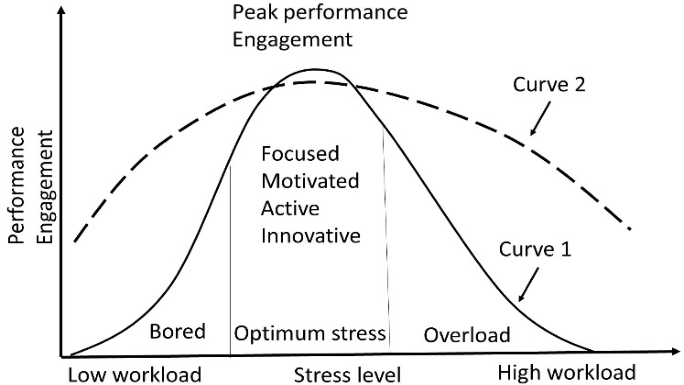
From a theoretical standpoint, the Yerkes-Dodson stress theory (Cohen, 2011) and the inverted U-shaped pattern identified in the research by Montani et al. (2020) suggest that moderate workload may enhance work engagement, innovative behaviour, and work performance. Both models indi- cate that both low and excessively high workloads or stress levels may result in poor performance and innovation. However, there are numerous mediat- ing factors, and the concept of workload should be defined and investigated
Relationship Between Digital Stress and Innovation Capacity 193
more precisely. Both theories assert that an increase in workload is not nec- essarily negative for employees if the workload and associated stress do not exceed the optimal level (see Figure 1).
Figure 1: Combined stress, performance and engagement curves. Modified from Montani et al., 2020 (Curve 2) and Cohen, 2011 (Curve 1).
The impacts of global digital transformation were identified from the par- ticipants’ survey responses. Table 1 presents the attitudes of participants toward the future trend of digitalization concerning their work and orga- nization. The respondents agreed that digitalization will change their work tasks and organizations’ processes in the near future. The majority, approx- imately 65% of the respondents, perceived that digital transformation is positive but may require a good introduction and training regarding the use of new technology. However, about 20% of respondents stated that digital transformation is a negative issue.
Table 1. Mean values of attitudes towards digital transformation on five-point scale.
Table available in the original PDF paper.
Equation reproduced from the original PDF.
Mean SD Impact of digitalization on work tasks is positive 4.02 0.89 Digitalization may change my work tasks in near future 3.88 0.98 Digitalization will be developed in our organization within next 3 years 4.15 0.80 Digitalization is a part of our organization’s future 4.21 0.74
Table 2 presents the Pearson correlations between perceived workload, stress, work engagement, competence, innovation capacity, and other rele- vant factors. There appears to be a negative correlation between perceived stress and the competence to use digital tools, indicating that competence may reduce digital stress. Additionally, work engagement decreases digital
stress, while an attitude that digital technology is strenuous correlates posi- tively with perceived stress. The digital workload resulting from systems or tools, or the number of technical tools did not show a significant correlation with perceived stress. Innovation capacity appears to correlate positively with the possibility to use digital tools and with work engagement.
Table 2. Correlations between workload, stress, work engagement, and other factors (N = 90).
Table available in the original PDF paper.
Innovation Capacity
Perceived Stress
Digital Load
Work Engage- ment
No. of Digital Systems
Competence to Use Digital Tools
Possibility to Use Digital Tools
No. of Techni- cal Tools R 1 0.170 0.262* −0.142 0.260* 0.262* 0.237* 0.118
Innovation capacity R 0.262* 0.597** 1 −0.116 0.144 −0.018 0.031 0.097 Possibility to use digital tools Perceived stress R −0.142 −0.325** −0.116 1 −0.436** −0.030 0.216* 0.279**
R 0.260* 0.284** 0.144 −0.436** 1 0.277** 0.083 −0.069 Work engagement R 0.262* −0.045 −0.018 −0.030 0.277** 1 0.547** 0.446** no. of technical tools
R .237* −0.108 0.031 .216* 0.083 0.547** 1 0.534** no. of digital systems Digital load R .118 −0.110 0.097 0.279** −0.069 0.446** 0.534** 1
Pearson’s correlation.**Correlation is significant, p <0.01, *Correlation is significant, p < 0.05 (2-tailed)
Table 3 presents the correlations between perceived stress, perceived com- petence, attitudes towards digital transformation, creativity, and other factors related to work. The competence to use digital systems correlates negatively with perceived stress, as does a positive attitude towards digital transforma- tion. Additionally, perceived creativity shows a weak but significant negative correlation with perceived stress. All positive attitudes towards digital work appear to decrease perceived stress. Furthermore, we found no significant correlation between perceived stress and age or work experience. However, perceived mental work ability (R = −0.62, p < 0.01), physical work ability (R = −0.39, p < 0.01), and health (R = −0.42, p < 0.01) exhibited significant negative correlations with perceived stress.
Table 3. Correlations between stress, competence and other factors (N = 121).
Table available in the original PDF paper.
We are Creative
I Feel Ener- getic
Work Inspires Me
Competence (Digital Systems)
Digital Systems are Streneous
Digital Transfor- mation is Posivite
R −0.367** −0.381** −0.362** −0.209* 0.358** −0.195* Perceived stress
R 0.072 0.023 −0.095 −0.006 0.132 0.055
Age R 0.203* 0.166 −0.128 0.005 0.209* 0.089 Work experience Pearson’s correlation.**Correlation is significant, p < 0.01, *Correlation is significant, p < 0.05 (2-tailed)
Relationship Between Digital Stress and Innovation Capacity 195
DISCUSSION
The digital transformation is an emerging yet multidimensional topic among companies and public organizations. It is evident that digital transforma- tion impacts all organization’s business processes and employees’ work tasks. The use of digital platforms, APIs, and digital tools is already prevalent, but new technologies such as the effective use of AI will be the next step in digital transformation. It has been well-reported that digital technology improves organizational performance and productivity but may also increase employees’ cognitive load and affect their health (Stacey et al., 2018).
Traditional technostress research has shown that an increased digital load may increase stress and related symptoms such as anxiety (Salanova et al., 2013). However, recent technostress or digital stress research suggests that increased digital load is not always detrimental and can lead to positive outcomes such as better work satisfaction and productivity (Turja et al., 2023). The association between increased digital workload and digital stress is related to an employee’s current digital workload, work tasks, competence, and available technology.
Digital workload as a stressor is inherently neutral (Hargrove et al., 2013), but an employee’s stress response depends on their competence and the orga- nization’s digital culture, strategies, processes, and available digital systems and tools. Too many dysfunctional systems or digital tools may decrease employees’ motivation to utilize digital technology. The digital culture of the organization plays a crucial role in how organizations perceive digital trans- formation and how they make use of novel digital technology. Montani et al. (2020) reported that competition between companies is fierce, and organiza- tions must find ways to promote employee innovation and idea generation while also managing workload to avoid stress.
In this study, we combined the Yerkes-Dodson stress (Cohen, 2011) and workload-work engagement theories (Montani et al., 2020), which sug- gest that moderate workload is positive for performance, work engagement, and innovation capacity. The results showed associations between innova- tion capacity and work engagement. Perceived digital stress was not directly associated with innovation capacity, but perceived stress had a significant association with workload, work engagement, and an employee’s compe- tence. Therefore, we can suggest that moderate digital workload with good digital competence may have a positive association with eustress, work engagement, and innovation capacity.
CONCLUSION
The combination of the Yerkes-Dodson stress theory (Cohen, 2011) and workload-work engagement theories (Montani et al., 2020) provides new insights for designing organizations’ workloads and employees’ tasks. Mod- erate workload may be associated with positive eustress and opportunities for generating novel innovations. It can be concluded that the association between digital stress and innovation capacity is multidimensional and war- rants further research. Digital stress should also be assessed using objective methods (Awada et al., 2023), and perceived workload should be evaluated
more precisely. However, digital transformation impacts all organizations, and positive digital stress, eustress, can enhance organizational performance.
ACKNOWLEDGMENT
Data for the study was obtained from the Digital Culture Project (S 22228) partly funded by the European Social Fund in Finland.
REFERENCES
Awada, M., Becerik-Gerber, B., Lucas, G., Roll, S. C. (2023) Predicting Office Workers’ Productivity: A Machine Learning Approach Integrating Physiological, Behavioral, and Psychological Indicators. Sensors, 23, 8694. Chen, T., Li, F., Leung, K. (2016) When does supervisor support encourage innovative
behavior? Opposite moderating effects of general self-efficacy and internal locus of control. Personnel Psychology 69(1): 123–158. Cartwright, S., & Cooper, C. L. (1996) Coping in occupational settings. In Zeidner, M. & Endler N. S (Eds.) Handbook of coping: Theory, research, applications. John Wiley & sons, Inc. 202–220. Cohen, S., Kamarck, T., Mermelstein, R. (1994) Perceived stress scale. Measuring
stress: A guide for health and social scientists, 10, 1–2. Cohen, R. A. (2011) Yerkes–Dodson Law. In: Kreutzer, J. S., DeLuca, J., Caplan, B.
(eds) Encyclopedia of Clinical Neuropsychology. Springer, New York, NY. https: //doi.org/10.1007/978-0-387-79948-3_1340 Gardner, D., Cummings, L. (1988) Activation theory and job design: Review and reconceptualization. In: Staw BL, Cummings LL (eds) Research in Organizational Behavior. Greenwich, CT: JAI Press: 81–122. Hargrove, M. B., Becker, W. S., Hargrove, D. F. (2015) The HRD eustress model:
Generating positive stress with challenging work. Human resource development review, 14(3), 279–298. Ilmarinen, J., Tuomi K. (2004) Past, present and future of workability. People and Work Research Reports. Finnish Institute of Occupational Health, Helsinki 2004;65:1–25 Kalakoski, V., Selinheimo, S., Valtonen, T. et al. (2020) Effects of a cognitive
ergonomics workplace intervention (CogErg) on cognitive strain and well-being: A cluster-randomized controlled trial. A study protocol. BMC Psychol 8, 1. https://doi.org/10.1186/s40359-019-0349-1 Kenney, M., & Zysman J. (2016) The Rise of the Platform Economy, Issues in Science and Technology, 32(3), 61–69. Khedhaouria, A., Montani, F., Thurik, R. (2017) Time pressure and team member
creativity within R&D projects: The role of learning orientation and knowledge sourcing. International Journal of Project Management 35(6): 942–954. Kraus, S., Jones, P., Kailer, N., Weinmann, A., Chaparro-Banegas, N., Roig-Tierno, N. (2021) Digital Transformation: An Overview of the Current State of the Art of Research. SAGE Open 2021, 2021, 1–15. La Torre, G., Esposito, A., Sciarra, I, Chiappetta M. (2018) Definition, symptoms
and risk of techno-stress: a systematic review. Int Arch Occup Environ Health. 1–23. Lazarus, R. S., Folkman, S. (1984) Stress, appraisal, and coping. New York, NY: Springer.
Relationship Between Digital Stress and Innovation Capacity 197
Leal-Rodríguez, A. L., Sanchís-Pedregosa, C., Moreno-Moreno, A. M., Leal-Millán A. G. (2023) Digitalization beyond technology: Proposing an explanatory and predictive model for digital culture in organizations J. Innov. Knowl., 8 (3). LePine, J. A., LePine, M. A., and Jackson, C. L. (2004) Challenge and hin-
drance stress: relationships with exhaustion, motivation to learn, and learning performance. J. Appl. Psychol. 89, 883–891. doi: 10.1037/0021-9010.89.5.883 Montani, F., Vandenberghe, C., Khedhaouria, A., Courcy, F. (2020) Examining the inverted U-shaped relationship between workload and innovative work behavior: The role of work engagement and mindfulness. Human Relations, 73(1), 59–93. https://doi.org/10.1177/0018726718819055 Mäkiniemi, J.-P., Ahola, S., & Joensuu, J. (2019) A novel construct to measure
employees’ technology-related experiences of well-being: Empirical validation of the TechnoWork Engagement Scale (TechnoWES). Narvaez Rojas, C., Alomia Peñafiel, GA., Loaiza Buitrago, DF., Tavera Romero, CA. (2021) Society 5.0: A Japanese Concept for a Superintelligent Society. Sustainability. 2021; 13(12):6567. https://doi.org/10.3390/su13126567 Porcari, DE., Ricciardi, E., Orfei, MD. (2023) A new scale to assess technostress lev-
els in an Italian banking context: the Work-Related Technostress Questionnaire. Front. Psychol. 14:1253960. doi: 10.3389/fpsyg.2023.1253960. Salanova, M., Llorens, S., Cifre, E.(2013) The dark side of technologies: Technostress among users of information and communication technologies. Int J Psychol. 48(3): 422–36. doi: 10.1080/00207594.2012.680460. Stacey, N., Ellwood, P., Bradbrook, S., Reynolds, J., Williams, H., Lye, D. (2018)
Foresight on new and emerging occupational safety and health risks associated with digitalisation by 2025. European Agency for Safety and Health at Work. Luxemburg. Syvänen, A., Vänni. K., Viteli, J. (2022) Comparison Between Technostress Instruments Among Education and Health Care Sectors. In: Vesa Salminen (eds) Human Factors, Business Management and Society. AHFE (2022) International Confer- ence. AHFE Open Access, vol. 56. AHFE International, USA. http://doi.org/10. 54941/ahfe1002267 Tarafdar, M., Cooper, C. L., Stich, J.-F. (2019) The technostress trifecta - techno
eustress, techno distress and design: Theoretical directions and an agenda for research. Information Systems Journal, 29(1), 6–42. https://doi.org/10.1111/isj. 12169 Turja, T., Hakanen, J., Krutova, O., Koistinen, P. (2023) Traces of Technological Well-being: Digi-uplifters and Digi-downshifters. Nordic Journal of Working Life Studies. https://doi.org/10.18291/njwls.13754
LISTED IN THE AHFE DIGITAL BOOKSTORE CATALOGUE
Explore the complete digital volume
Human Factors, Business Management and Society
Read this individual research paper free through the original publisher, or explore the full digital proceedings book.
ISBN 978-1-964867-11-3
Explore this ISBN in the AHFE Bookstore ↗Listed in the July 2026 bookstore catalogue; search by ISBN to confirm current availability · Digital book purchase optional