Kimmo Vanni, Xuequn Zhang, Yeye Xu, Satu Jumisko Pyykko, Shiqiang Zhu (2022). Design Challenges and Principles of Hustar Footwear Exoskeleton. In: Human Factors, Business Management and Society. AHFE Open Access, vol. 56, pp. 223–229. https://doi.org/10.54941/ahfe1002273
The current information society has been reported to have begun in 1976 and has included five different stages of development, from inception to globalization (Nevalainen 1999). Current society is in a new phase of transition, where applications of digitalization such as artificial intelligence and human-centered robotics are becoming a relevant part of every person’s life in working life, school and leisure. There are already concepts for the future society called 5.0 (Sato & Arimoto 2015) where researchers have considered what issues may change and how changes may happen (Cabinet Office 2019).Wearable intelligence can be defined broadly but it combines textiles and technology and includes sensors (traditional, bacteria-based, etc.), software applications, intelligent textile materials (phase change polymers, textiles), smart design (mass customization, value-based design, etc.) and services (platform economy). The products of wearable intelligence can be wearable sensors, smart textiles and shoes, exoskeleton robots, and fabrics, which are smart and connected to sensor networks and services (AI cloud). Currently, the market expects that researchers would develop efficient, lightweight and reliable exoskeleton robots that make use of high-speed 5G mobile networks and AI. However, the greatest part of the developed exoskeletons is for upper body and they are made from traditional materials and with traditional approaches which emphasize technical issues.The aim of the study was to plan a new approach for designing footwear exoskeleton. The objective was to design a footwear exoskeleton design approach which takes into account smart textile materials, smart sensors, sustainable design, testing data and user expectations. We found that smart footwear exoskeleton design requires professionals from design and user experience, ICT and programming, material and textile technology, mechatronics and energy, and biomechanics domains. As conclusion the ecosystem of smart footwear exoskeleton robotics is still in novice stage and new design approaches are needed, especially now when Society 5.0 may increase demand for assistive technology.
There are number of taxonomies and classifications of robots being based on their functions, outlook, features, and materials (e.g., Onnasch and Roesler, 2021). The three main classes are mentioned as industrial robots, service robots and medical robots. The wearable robots are also the sub-class of wearable technology, which consists of all the devices that people can wear. The wearable robots are the sub-class of service robots and further belongs to assistive robots. The wearable robots can be classified into rigid or soft structure, and further passive or active mode (Xiloyannis et al. 2021). We classify wearable robots (exoskeletons) as upper or lower limb devices and active or passive devices. The aim of the study is to discuss and present the design challenges of an active lower limb exoskeleton robot Hustar by Kuntai Robotics.
Over the past 15 years, smart textiles and soft exoskeletons have been stu- died in a variety of fields, such as medicine, sports, and manufacturing (e.g., Schwarz et al. 2010; Berglin, 2013), but data on soft exoskeletons and smart clothes in rehabilitation purposes are still limited (McLaren et al. 2016; Wang et al. 2017). The development of smart textiles has been technology-driven, and important aspects, such as users’ needs and usability, have received lit- tle attention (Lobo et al. 2019). In general, the combination of textiles and electronics, a lack of standards, and a lack of expertise and training have been identified as barriers to wearable intelligence (Schwarz et al. 2010). Only a few studies have taken into account the adoption of smart textile
and clothing innovations, understanding users’ needs and contexts, or have taken into account “soft” approaches (Schwarz et al. 2010).
Technology assisted work and rehabilitation are actual issues just now. Robot assisted work and human-robot interaction have recently been the interest of many manufacturing companies. Exoskeleton robots are widely used among construction industry (Kim et al. 2019) and in automotive indu- stry (Spada et al. 2017; Sield and Mara, 2021). Also, rehabilitation centers and hospitals have shown interest towards the use of exoskeletons in two ways; for assisting employees and patients. Even if the exoskeletons have been found to be useful for supporting employees, some unintended negative consequences have been reported (Fox et al. 2020). Although the importance of robotics has been addressed and argued to be functional and cost-effective (Lo et al. 2019), there are no universal cost benefit analyses of the use of exo- skeleton robots in workplaces. However, there are some estimates concerning the clinical use of exoskeletons (Lin et al. 2020). From the economic point of view, the exoskeleton design should take into account the possibility to modify an exoskeleton for different work tasks and employees for making possible to use exoskeletons in multiple ways.
The rehabilitation business is currently under a transformation, where need for rehabilitation is going to increase whereas a number of therapists may decrease (Soltani-Zarrin et al. 2017). The need for rehabilitation is incre- asing globally, due to e.g., longer living people, and the likelihood of increased diseases with age (WHO, 2020). The demand and market for service robotics is high, and it is estimated to be about EUR 35 billion by 2022 (Malani and Lanjudkar, 2016). The global market for rehabilitation robotics is estima- ted to be about USD 2.6 billion by 2026 (Fortune Business Insights, 2019) and another report estimate is to be USD 6.4 billion (Research and Markets, 2020). The total value of the rehabilitation equipment market is estimated to be about USD 17.5 billion by 2025 (Grand View Research, 2020). There will be high demand especially in devices that can be used in home environments (Globe Newswire, 2021).
There is a need for wearable lightweight solutions (Szmyt, 2018) that can support a rehabilitee in recovering from ailments. The solutions must be affordable, functional, durable and follow the user -centered design. Exi- sting affordable solutions are based on ‘passive’ technology that measures the user (Lorussi et al. 2016), whereas ‘active’ physical assistance with help of textiles is still in novice stage (Persson et al. 2018; Jager et al. 2020). Exoskeletons offer a new perspective on robot rehabilitation. Light-weight passive and active exoskeletons have been launched to the market recently for supporting people with reduced mobility, and for assisting workers in con- struction and factory work. The great number of passive exoskeletons such as SuitX, Mate XT, EksoEvo and Laevo are developed for supporting upper body. The number of active exoskeletons for supporting lower body and wal- king is well studied concerning clinical rehabilitation, but studies regarding passive devices is limited (Zhou et al. 2020).
It has been estimated that the market for wearable robots will grow. The Covid-19 pandemic will have its own impact on increasing rehabilitation needs in home and work environments (Azhari and Parsa, 2020). The users
Design Challenges and Principles of Hustar Footwear Exoskeleton 225
of exoskeleton robotics are expected to consist of the elderly as well as people with a neurocognitive disorder such as a stroke, a MS, a spinal cord injury, or some other similar disease (Duret et al. 2019). One potential exoskeleton user group is senior workers whose work is physically strenuous, and they need physical support to perform at work. Although the market reports indicate the increased demand for human-centered robotics in rehabilitation such as exoskeletons, the following challenges have been identified. There are only limited number of exoskeletons that can be used outside of clinics, the tech- nology of active exoskeletons is complex and the price of exoskeletons for private use is too high. For example, rehabilitation robots for professional use, such as Lokomat (Nam et al. 2017; Lin et al. 2020) or L-EXOS (Frisoli et al. 2012), cannot be used independently in home or in work environments.
Number of exoskeletons for private use is scarce, and there are no expe- rience or comprehensive reports available on private exoskeleton usage, excluding some experiments (Hyakutake et al. 2019). However, the deve- lopment of exoskeletons and textile technology (Nguyen and Zhang, 2020) and new material innovations in wearable intelligence (Maziz et al. 2017) make it possible that exoskeleton assisted self-rehabilitation could be used at home and in work environment.
IDENTIFIED CHALLENGES OF WEARABLE INTELLIGENCE FROM A REHABILITATION PERSPECTIVE Based on the literature and on-going research work, we have identified three challenges for wearable intelligence and exoskeleton robots. The first chal- lenge is that the integration of sensors, and actuators into soft structures is still under development. Various sensors have been integrated with clothes in the past, but only some attempts have been done for combining actua- tors with soft materials. The design challenge is that actuators may need a supportive structure that is able to offer steady base for transferring power. Materials, such as composites, can be used for designing a lightweight and rigid structure that makes possible to attach actuators to a garment.
Second challenge is that the materials used in wearable robots are passive. Materials used in functional clothing are e.g., elastic materials which are able to store energy. Phase change materials, which are based on physicochemical properties of the material, have also been used to some extent in smart clo- thing and light-weight exoskeletons. However, motion or power provided by phase change materials have been uncontrollable. We state that the displace- ment and power of phase change materials could be controlled, allowing the materials to be used in rehabilitative smart exoskeletons.
Third challenge is that exoskeletons require more human-oriented design. The user experience is a key factor in acceptability of exoskeletons. The design of exoskeletons for rehabilitation tasks should be user-centered, taking into account and understanding the user needs, use cases, and the opera- ting environment. There are only few experiences and reports on the use of exoskeletons in self-rehabilitation in the home and in work environ- ment (Mohamaddan et al. 2015; Soltani-Zarrin et al. 2017). The current exoskeletons designed for home use are comparable with clinical devices
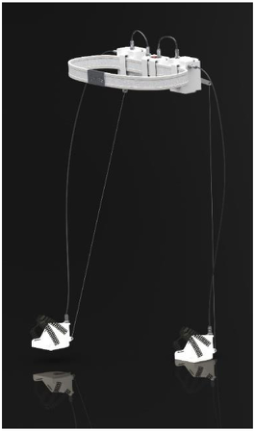
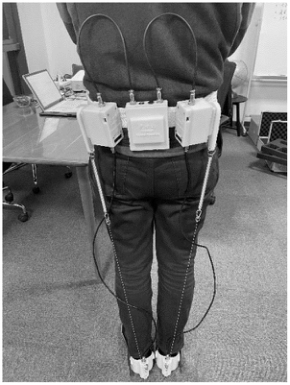
Figure 1: Hustar exoskeleton footwear modeling figure.Figure 2: Photo of wearing a Hustar.
(Díaz et al. 2018) and thus cannot be used for supporting daily activities. Also van Dijsseldonk et al. (2020) have reported that an exoskeleton may be applicable for rehabilitation and socialization at home and in the community, although it did not function as a supportive device in everyday tasks.
Hustar Footwear Exoskeleton Hustar exoskeleton footwear is presented in Figures 1 and 2. Hustar is desi- gned as a light-weight and active exoskeleton robot, integrated with battery, sensors, controller and tendon drivers. This system realizes the synchronous
Design Challenges and Principles of Hustar Footwear Exoskeleton 227
motion of the exoskeleton robot and the human lower extremity and a real- time active control to help wearers to walk easily. The design principle of Hustar has been that it can be used by many users and technology is easy to maintain. In addition, Hustar is meant to daily use anywhere, such as at home, leisure and work. Hustar can also be used in self-rehabilitation. Therefore, Hustar is affordable, easy to use and easy to maintain.
CONCLUSION
There is a need for the affordable exoskeleton footwear that can be used outside of clinics. The rehabilitation markets are growing, and new exoske- leton design approaches and products are needed, especially for private use at home and in work places.
REFERENCES
Azhari, A. Parsa A. (2020) Covid-19 Outbreak Highlights: Importance of Home- Based Rehabilitation in Orthopedic Surgery. The archives of bone and joint surgery. 8:1, 317–318. Berglin, L. (2013) Smart Textiles and Wearable Technology, – A study of smart
textiles in fashion and clothing. Review, The Swedish School of Textiles. Díaz, I. Catalan, J.M. Badesa, F.J. Justo, X. Lledó, L.D. Ugartemendia, A. Gil, J.
Díez, J. García-Aracil, N. (2018) Development of a robotic device for post-stroke home tele-rehabilitation. Advances in Mechanical Engineering. 10. Duret, C. Grosmaire, A-G. and Krebs, H.I. (2019) Robot-Assisted Therapy in Upper Extremity Hemiparesis: Overview of an Evidence-Based Approach. Front. Neurol. 10:412. Frisoli, A. et al. (2012) Rehabilitation Training and Evaluation with the L-EXOS
in Chronic Stroke. In: Donnelly M., Paggetti C., Nugent C., Mokhtari M. (eds) Impact Analysis of Solutions for Chronic Disease Prevention and Management. ICOST 2012. Lecture Notes in Computer Science, vol 7251. Springer, Berlin, Heidelberg. Fox, S. Aranko, O. Heilala, J. Vahala, P. (2020) Exoskeletons: Comprehensive, comparative and critical analyses of their potential to improve manufacturing per- formance. Journal of Manufacturing Technology Management. 31:6, 1261–1280. Fortune Business Insights. (2019) Website https://www.fortunebusinessinsights.com/
//www.grandviewresearch.com/industry-analysis/rehabilitation-products-market Hyakutake, K. Morishita, T. Saita, K. Fukuda, H. Shiota, E. Higaki, Y. Inoue, T.
Uehara, Y. (2019) Effects of Home-Based Robotic Therapy Involving the Single- Joint Hybrid Assistive Limb Robotic Suit in the Chronic Phase of Stroke: A Pilot Study. Biomed Res Int. 18. Jager, E. Martinez, J. Zhong, Y. Persson, N-K. (2020) “Soft actuator materials for textile muscles and wearable bioelectronics” In: Onur Parlak, Alberto Sal- leo, Anthony Turner, Materials Today, Wearable Bioelectronics, Elsevier, (Eds) pp- 201–218.
Kim, S. Moore, A. Srinivasan, D. Akanmu, A. Barr, A. Harris-Adamson, C.
Rempel, D.M. Nussbaum, M.A. (2019) Potential of Exoskeleton Technologies to Enhance Safety, Health, and Performance in Construction: Industry Perspectives and Future Research Directions, IISE Transactions on Occupational Ergonomics and Human Factors. 7:3-4, 185–191. Lin, J. Hu, G. Ran, J. et al. (2020) Effects of bodyweight support and guidance force on muscle activation during Locomat walking in people with stroke: a cross-sectional study. J NeuroEngineering Rehabil 17:5. Lo, K. Stephenson, M. and Lockwood, C. (2019) The economic cost of robotic reha-
bilitation for adult stroke patients: a systematic review. JBI Database System Rev Implement Rep. 17:4, 520–547. Lobo, M.A.,Hall, M.L. Greenspan, B. Rohloff, P. Prosser, L A. Smith, B.A. (2019) Wearables for Pediatric Rehabilitation: How to Optimally Design and Use Products to Meet the Needs of Users. Physical therapy, 99:6, 647–657. Lorussi, F. Carbonaro, N. De Rossi, D. Paradiso, R. Veltink, P. Tognetti, A. (2016)
Wearable Textile Platform for Assessing Stroke Patient Treatment in Daily Life Conditions. Front. Bioeng. Biotechnol. 4:28. Malani, G. Lanjudkar, P. (2016) Service Robotics Market Outlook – 2022. Website https://www.alliedmarketresearch.com/service-robotics-market Maziz, A. Concas, A. Khaldi, A. Stålhand, J. Persson, N-K. Jager, E. (2017) Knitting
and weaving artificial muscles. Science Advances. 3:1, e1600327. McLaren, R. Joseph, F. Baguley, C. et al. (2016) A review of e-textiles in neurological rehabilitation: How close are we?. J NeuroEngineering Rehabil 13, 59. Mohamaddan, S. Jamali, A. Abidin, A.S.Z. Jamaludin, M.S. Majid, N.A. Ashari, M.F.
et al. (2015) Development of Upper Limb Rehabilitation Robot Device for Home Setting, Proceedings of the 2015 IEEE International Symposium on Robotics and Intelligent Sensors, pp. 376–380. Nam, K.Y. Kim, H.J. Kwon, B.S. Park, J.W. Lee, H.J. Yoo, A. (2017) Robot-assisted gait training (Lokomat) improves walking function and activity in people with spinal cord injury: a systematic review. J Neuroeng Rehabil. 14:1:24. Nguyen, P.H. Zhang, W. (2020) Design and Computational Modeling of Fabric Soft
Pneumatic Actuators for Wearable Assistive Devices. Sci Rep 10, 9638. Onnasch, L. Roesler, E. (2021) A Taxonomy to Structure and Analyze Human–Robot Interaction. Int J of Soc Robotics. 13, 833–849. Persson, N. Martinez Gil, J. G. Zhong, Y. Maziz, A. Jager, E. (2018) Actuating Tex-
tiles: Next Generation of Smart Textiles, Advanced Materials Technologies. 3:10, 1700397. Research and Markets. (2020) Website https://www.researchandmarkets.com/repor ts/4745795/rehabilitation-robots-market-shares-strategy Schwarz, A. van Langenhove, L. Guermonprez P. Deguillemont, D. (2010) A roadmap
on smart textiles, Textile Progress, 42:2, 99–180. Siedl, S.M. Mara, M. (2021) Exoskeleton acceptance and its relationship to selfefficacy enhancement, perceived usefulness, and physical relief: A field study among logistics workers. Wearable Technologies. 2, e10. Soltani-Zarrin, R. Zeiaee, A. Langari, R. Tafreshi, R. (2017) Challenges and
Opportunities in Exoskeleton-based Rehabilitation. ArXiv, abs/1711.09523. Spada, S. Ghibaudo, L. Gilotta, S. Gastaldi, L. Cavatorta, M.P. (2017) Investigation into the applicability of a passive upper-limb exoskeleton in auto- motive industry. 27th International Conference on Flexible Automation and Intelligent Manufacturing (FAIM2017), Italy. Procedia Manufacturing 11, pp. 1255–1262. Szmyt. J. (2018) Modern Rehabilitation Systems Based on Textiles. Acta Innovations.
27:5, 5–3.
Design Challenges and Principles of Hustar Footwear Exoskeleton 229
van Dijsseldonk, R.B. van Nes, I.J.W. Geurts, A.C.H. et al. (2020) Exoskeleton home and community use in people with complete spinal cord injury. Sci Rep. 10, 15600. Wang, Q. Markopoulos, P. Yu, B. et al. (2017) Interactive wearable systems for upper
body rehabilitation: a systematic review. J NeuroEngineering Rehabil. 14, 20. WHO. (August 2020) Rehabilitation. Key Facts. Website https://www.who.int/news -room/fact-sheets/detail/rehabilitation Xiloyannis, M. Alicea, R. Georgarakis, A.-M. Haufe, F. L. Wolf, P. Masia, L.
et al. (2021) Soft Robotic Suits: State of the Art, Core Technologies, and Open Challenges. IEEE Trans. Robot. 37, pp. 1–20. Zhou, L. Chen, W. Chen, W. Bai, S. Zhang, J. Wang, J. (2020) Design of a passive lower limb exoskeleton for walking assistance with gravity compensation. Mech- anism and Machine Theory, 150, [103840].
LISTED IN THE AHFE DIGITAL BOOKSTORE CATALOGUE
Explore the complete digital volume
Human Factors, Business Management and Society
Read this individual research paper free through the original publisher, or explore the full digital proceedings book.
ISBN 978-1-958651-32-2
Explore this ISBN in the AHFE Bookstore ↗Listed in the July 2026 bookstore catalogue; search by ISBN to confirm current availability · Digital book purchase optional