Jiaqi Long, Shuai Sun, Zile Xu, Zixuan Wang (2026). Breaking the Silence: Design of a Social-Drama Gamified Toolkit for Sensitive Topics in Children's Sexuality Education. In: Universal Design and Design for Inclusion. AHFE Open Access, vol. 209, pp. 1–10. https://doi.org/10.54941/ahfe1008013
In children's sexuality education, shame and cognitive load often lead children into expressive silence. Particularly within the Chinese cultural context, influenced by traditional concepts, direct discussion of sensitive topics often faces higher psychological barriers and social evaluation pressure, constituting significant implicit educational exclusion. To overcome these expression barriers within a specific cultural context, this study constructs a collaborative toolkit combining social drama and gamification mechanisms from the perspective of Human Factors and Ergonomics. The toolkit establishes a psychological safety distance through role-playing and achieves cognitive offloading using card scaffolding, aiming to lower participation thresholds in high-shame environments. The research team organized in-situ workshops for verification. Results indicate that children are more likely to engage in discussions and situational enactment under autonomous operation and role perspectives, although some core mechanisms still present understanding costs in early usage. This study demonstrates that designing low-friction interaction mechanisms adapted to cultural-psychological characteristics can effectively support inclusive education on sensitive topics.
Research Background: Implicit Exclusion in Sensitive Topics While sexuality education has established a mature framework for knowledge transmission, a significant gap remains in supporting the critical link of Situation– Judgment–Action, often resulting in silence or avoidance regarding sensitive topics like consent (UNESCO, 2018). This gap is particularly pronounced in China, where unidirectional instruction on physiological hygiene dominates. From a Human Factors and Ergonomics perspective, this knowing but not speaking dilemma results from a mismatch between cultural-psychological load and instructional interaction modes:
High Shame Threshold: In a culture valuing implicitness, open discussion of sex-related topics is often viewed as taboo or high-risk behavior (Gao et al., 2001). This environmental pressure consumes children’s psychological resources, forcing them into silence to establish a sense of safety.
Cognitive Overload in Traditional Pedagogy: Adult-led lectures force direct confrontation with sensitive rules, easily triggering social freezing. Furthermore, the Hidden Curriculum in unidirectional teaching often neglects student agency, limiting critical engagement with gender and power issues (Donovan, 2023). This adult-centric structure compresses decision-making space, hindering the transfer from learning to acting in real situations.
Therefore, achieving inclusivity requires designing a low-friction, high- safety interaction interface rather than instilling more knowledge. By distributing psychological and cognitive loads through external mechanisms, we can enable children to enter the discussion space on an equal footing.
Research Objectives, Questions, and Contributions Addressing the aforementioned human factors gaps, this study explores design interventions to overcome expression barriers in sensitive topics by proposing a toolkit that combines social drama narratives with gamification rules. Specifically, the research investigates how the mechanism translation of Role and Situation constructs a psychological safety zone to mitigate shame, how tangible tools function as cognitive scaffolding to lower participation thresholds for children with varying abilities, and evaluates the usability and inclusiveness of these mechanisms in real-world scenarios. The primary contribution lies in verifying the effectiveness of Social Drama & Gamification as an inclusive medium from an HFE perspective. The study demonstrates that rational mechanism design can transform abstract, high-risk topics into actionable, low-threshold collaborative tasks, thereby providing reusable design strategies for future interventions concerning sensitive topics (e.g., bullying, mental health).
RELATED WORK AND THEORETICAL BASIS Social Drama: A Mechanism for Constructing Psychological Safety Distance
Social Drama functions not merely pedagogically but as a psychological safety mechanism for high-risk topics (e.g., bodily experience, consent) where direct expression often triggers defensive silence. Research identifies its core human factors value as the construction of a psychological safety distance (Heathcote and Bolton, 1995). Through the mediating interface of role-playing, de-personalization allows children to act as roles, successfully transforming the risk of personal exposure into a task of role problem- solving (Boal, 2000). Recent empirical studies confirm this mechanism’s value: Zakaria et al. (2024) found that drama-based SEL programs significantly enhance inclusive interaction and friendship quality, rebuilding peer relationships in the post-pandemic era. Crucially for inclusion in high- shame contexts, dramatic frameworks reduce social anxiety and grant safe discursive power to marginalized participants (Mitchell and Stuart, 2012). This allows for consequence-free practice of abstract norms to overcome real-world action paralysis.
Breaking the Silence: Design of a Social-Drama Gamified Toolkit for Sensitive Topics 3 Gamification and Tangible Scaffolds: Cognitive Offloading and Attention Alignment
From an HFE perspective, gamification is introduced primarily to address cognitive overload in complex situations, rather than solely for motivation. Traditional discussions impose heavy demands on rule recall and emotional regulation. Adopting distributed cognition theory, this study uses tangible cards for cognitive offloading, externalizing information (e.g., coping strategies) from working memory into visible physical objects (Gee, 2007). Furthermore, these tools act as shared references that rapidly align group attention, reducing ambiguity and coordination costs (Zagal et al., 2006). Rojas and Idrobo (2025) emphasize that gamification’s Active Learning attributes transform abstract rules into actionable assets, bridging participation gaps across cognitive abilities. However, designers must maintain an ergonomic balance, as overly complex rules can introduce extraneous load that counterproductively hinders learning (Roussou et al., 2018).
METHODOLOGY
Design Research Approach This study adopts a Design Research methodology, following a cyclical path of Contextual Insight—Mechanism Intervention—Situated Reflection. Unlike experimental research that verifies single variables, this study focuses on how design interventions reconstruct real educational contexts.
We view the design process as a means of inquiry: by constructing specific gamified social drama tools and intervening in Chinese children’s sexuality education classrooms, we aim to reveal the mechanisms of expression barriers and potential opportunities for inclusion regarding sensitive topics. The research path aims to answer: How can children’s inhibited willingness to express be released when appropriate scaffolding is provided?
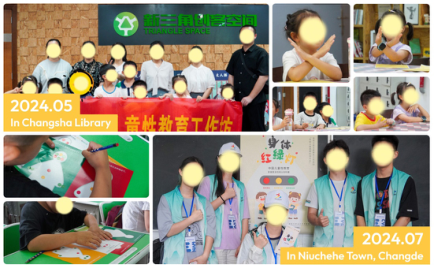
Contextual Observation and Design Requirements Prior to formal design, the team conducted participatory observations in multiple sexuality education activities using basic paper cards (see Figure 1).
Figure 1: Preliminary contextual observation: Identifying interaction bottlenecks using basic paper cards.
Observations revealed that while traditional forms were clear in information presentation, significant human factors bottlenecks existed: Passive Participation and Expression Interruption: Children were mostly in a state of passive listening, lacking active exchange. Once sensitive content was involved, expressive behavior was easily interrupted by shame.
High Cognitive Load: The process required high immediate understanding and rule memorization, leading some children to choose silence or withdrawal due to not keeping up.
Preference for Offline Interaction: Practical feedback indicated that parents generally preferred non-digital, offline multi-person interaction forms, imposing requirements for the physical interaction attributes of the toolkit.
Based on this, the study distilled six key design requirements (see Table 1).
Table 1: Design requirements, evidence sources, and strategies.
Table available in the original PDF paper.
Prototype Construction and Iteration Addressing the above requirements, the research team constructed a tangible gamified toolkit prototype. The choice of tangible rather than digital media aims to reduce reliance on smart devices and reinforce children’s perception of space and roles through embodied operation.
The prototype system consists of three modules: Modular Map System: Provides a freely constructible spatial foundation to support decentralized collaboration.
Role System: Provides a third-person narrative perspective, serving as a psychological buffer for expression.
Multi-type Card System: Serves as the carrier for content and rules, guiding the interaction flow.
This phase verified the synergy of mechanisms through rapid iteration, focusing on ensuring it could support the smooth conduct of multi-person interaction.
Breaking the Silence: Design of a Social-Drama Gamified Toolkit for Sensitive Topics 5 Evaluation Design: Offline Workshop
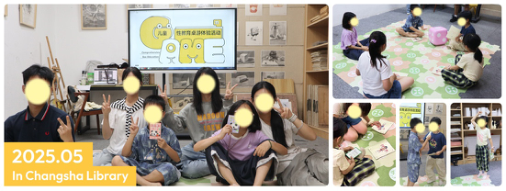
The preliminary evaluation was conducted through an offline workshop with 12 children (aged 9–12), organized into two mixed-age groups to simulate authentic public educational scenarios. Participants were recruited with informed consent and had no prior systematic sexuality education. To enhance ecological validity, the 45-minute sessions took place in a standard public activity space, led by facilitators trained in safety and non-directive principles (see Figure 2). The activity followed a four-stage structure: Rule Explanation, Map Construction, Turn-based Action, and Narrative Integration. Data collection primarily utilized qualitative participatory observation via structured logs—focusing on participation behavior, rule comprehension, and expression modes—supplemented by audio recordings. Subsequently, three researchers independently coded the data to analyze the toolkit’s usability and effectiveness in supporting expression, rather than statistical learning outcomes.
Figure 2: Offline evaluation workshop: Validating the toolkit in a real-world public educational scenario.
Ethics and Safety Approved by the Ethics Committee of the School of Design (see Appendix 1), Hunan University, this study prioritized the psychological safety of minor participants. Written informed consent was obtained from guardians, and children were explicitly informed of their right to withdraw at any time. Data collection remained strictly anonymous for research purposes. Implementation adhered to non-directive principles, preventing the solicitation of real personal experiences. Facilitators focused on maintaining safety boundaries, intervening via scenario switching if discomfort arose. Crucially, these safety protocols were embedded within the activity structure to ensure replicable control independent of individual facilitator experience.
TOOLKIT DESIGN: SYSTEM COMPOSITION AND MECHANISM LOOP Based on prior design research and human factors requirements analysis, this study developed a gamified collaborative toolkit based on social drama. The system aims to build a low-friction, high-safety interaction field, transforming abstract sexuality education goals (Knowledge, Attitude, Skills) into visualized task chains.
The core design logic of the system lies in Mechanism Translation: instead of directly asking children to expose personal experiences, it achieves desensitization and integration of sensitive topics within the game loop through operating tangible components (Map), adopting roles (Role), and utilizing scaffolding (Cards).
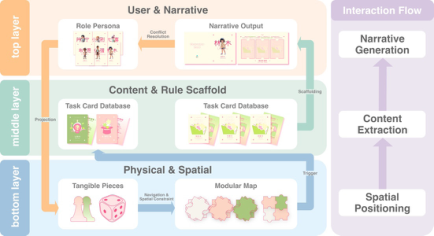
System Composition: Synergy of Action, Role, and Content Scaffolding The toolkit comprises three mutually coordinating systems (The system architecture is illustrated in Figure 3): a Spatial-Motor Trigger Structure for organizing action and rhythm, a Role-Narrative Structure for carrying sensitive topics, and a Content Scaffolding Structure for supporting expression. The three jointly serve a core objective: to urge children to continuously participate and complete expressions without directly requiring self-disclosure.
First, the Action Trigger Mechanism (Spatial Layer). The tool connects operations with task nodes. Children need to enter different stages through movement or operation, thereby triggering discussion or situational enactment tasks. Compared to direct questioning, this Action First, Expression Later structure lowers the psychological threshold for entering discussions and provides a predictable rhythm for interaction, making it easier for children to participate naturally in the process.
Second, the Role Narrative Mechanism (User Layer). The tool introduces fictional characters and their problems to be solved as experiential goals. The presence of roles shifts the subject of discussion from the child themselves to a third-party perspective, providing necessary psychological distance for sensitive topics such as physical boundaries, emotional reactions, or help- seeking. The narrative goals centered on roles provide continuous motivation for the activity process and a structural framework for stage-based review and integrated expression.
Third, Layered Expression Scaffolding (Content Layer). The tool adopts a layered structure, deconstructing learning goals such as factual understanding, attitude judgment, and coping strategies into callable content resources. These resources are embedded in the process as prompting materials to launch discussions or support enactment, thereby reducing children’s cognitive load in immediate language organization, transforming expression from nowhere to start to having clues to follow.
Figure 3: Toolkit system architecture.
Breaking the Silence: Design of a Social-Drama Gamified Toolkit for Sensitive Topics 7 Mechanism Loop: Participation—Resource Integration—Narrative Expression
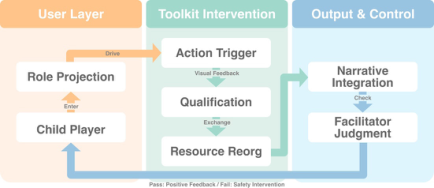
The aforementioned systems collectively form a mechanism closed-loop centered on participation (see Figure 4). Children can only gradually integrate different types of content resources and advance the overall process by actually participating in discussions or enactments. This structure transforms expressive behavior into a necessary condition within the system, preventing participation from remaining at the level of bystanders or passive responders.
In the final stage of the experience, children are required to perform an integrated narration based on the acquired content resources, revolving around the role’s problem to explain how it is understood and resolved. Thus, the learning output is no longer presented as a correct answer to a single question, but as an explainable integrated narrative,emphasizing the connection between understanding, judgment, and action.
Figure 4: Mechanism closed-loop.
RESULTS
Based on the offline workshop conducted at the Changsha Library, the team summarized the usability and human factors performance of the toolkit in real-world usage scenarios through participatory observation and process recording. The analysis focuses on children’s participation status at different stages, rule comprehension, and the actual effects of expression support mechanisms, rather than a quantitative assessment of learning outcomes.
Table 2: Summary of user experience, load estimation, and behavioral patterns across stages.
Table available in the original PDF paper.
Engagement and Involvement: Low-Risk Operations as an Expression Warm-up Observational data indicates that the layered interaction design successfully facilitated a warm-up for sensitive topics. Initially, 100% of children participated in map construction and token movement. These non-verbal motor interactions, with their extremely low threshold, effectively broke social ice in mixed groups. Subsequent discussions during role selection focused on operational tasks (e.g., path planning), establishing a foundational interaction comfort zone. Human factors analysis suggests that these low-risk tasks accumulated necessary social trust and discursive inertia for later high-risk discussions on bodily privacy, enabling even introverted children to establish a team presence through physical operation.
Cognitive Load Analysis: Bottlenecks in Understanding Core Causal Mechanisms While children rapidly mastered surface rules with strong visual cues (e.g., color correspondence, movement paths), significant cognitive bottlenecks emerged regarding the core Participation-Exchange cycle. Data indicates that inquiries about why can I exchange cards were most frequent during the first two rounds (2–3 times/round), identifying this mechanism as a cognitive obstacle. Analysis suggests that the implicit causality of this rule, lacking immediate tangible feedback, led children to misinterpret behavioral feedback as random rewards. This finding underscores that abstract incentive rules require enhanced visual feedback to lower cognitive explanation costs.
Effectiveness and Trade-offs of Expression Scaffolding: From Script Dependency to Autonomous Generation Card scaffolding demonstrated significant cognitive offloading, facilitating smooth initiation where 2–4 children per round utilized prompts to avoid dead air. However, a script dependency emerged during enactments, with ~50% of participants relying on reading scripts. While limiting reflective depth, this behavior functioned as a positive psychological crutch from a human factors perspective. By offering a mode of minimum compliant participation,it ensured that overwhelmed children remained engaged rather than withdrawing, confirming the toolkit’s efficacy in balancing deep expression with psychological safety.
Ecological Validity Verification: Adaptability of Facilitation and Environment Feedback verified the toolkit’s robustness in non-laboratory settings, where structured flows enabled autonomous progress with minimal intervention, demonstrating that the tool bore the primary process control load. However, managing complex emotions still relied on facilitator experience. To ensure standardized scalability, future iterations must translate this implicit experience into explicit system components, such as auxiliary script cards or risk response protocols.
DISCUSSION
This study verifies the effectiveness of social drama and gamification in alleviating expression barriers. We discuss inclusive design implications across three dimensions: psychological safety, cognitive ergonomics, and system boundaries.
Restructuring Expression Load: From Self-Disclosure to Role-Task The study confirms de-personalization as the core mechanism for inclusivity. By introducing roles as a firewall, the toolkit transforms high-risk self- disclosure—a major barrier in high-shame cultures—into safer role-problem solving tasks. Furthermore, the structured turn-based system reframes speaking from a social pressure event into a predictable game rule. This rule- driven expression provides institutional safety, enabling anxious children to participate within a deterministic framework.
Optimizing Cognitive Bottlenecks: Visualization and Layering To address identified bottlenecks, design must visualize implicit logic and refine scaffolding. For abstract causal mechanisms like Participation—Feedback, oral rules proved insufficient; introducing tangible tokens to visualize exchange eligibility is recommended to reduce working memory load. Concurrently, to mitigate script dependency, Progressive Scaffolding should replace static scripts. Distinguishing between Role-entry Cards (lines) and Reflection Cards (structures) guides children from mechanical imitation to autonomous internalization.
Human Factors Boundaries: Translating Experience into Protocols While reducing reliance on facilitators, observations show that emotional safety still depends on individual experience. To enhance scalability, this implicit experience must be translated into explicit system components. By developing standardized Risk Response Protocols and modular script cards, safety control shifts from person to system, ensuring consistent inclusion levels across diverse communities.
Limitations and Future Research This preliminary validation relies primarily on qualitative observations in specific scenarios, limiting long-term inference and generalizability. Future research should conduct multi-round testing across age groups (7–9 vs. 10–12) and regions. Crucially, quantitative metrics (e.g., rule mastery time, silence duration) and control conditions (e.g., non-gamified versions) should be introduced to verify the independent contributions of key mechanisms to learning transfer.
CONCLUSION
Addressing implicit exclusion in sensitive education, this study proposed a social-drama toolkit for children (9–12). By integrating learning goals into an Action-Role-Scaffolding loop, we transformed high-load sexuality education into low-friction collaborative tasks. Evaluation confirmed that map co-creation and role selection offered a low-risk entry path, while role
enactment reduced the psychological burden of expression. Although the structure effectively maintained focus, implementation stability still partially relied on facilitation experience. Consequently, we propose three design implications: (1) Prioritize psychological safety via playable task chains; (2) Minimize cognitive load through visualization and layered design; (3) Systematize facilitation protocols to enhance scalability.
REFERENCES
Boal, A. (2000) Theater of the Oppressed. Pluto Press. Donovan, C. (2023) ‘Understanding gender and sexuality: The hidden curriculum of sexuality education’, Educational Review. Gao, Y., Lu, Z., Shi, R., Sun, X. and Cai, Y. (2001) ‘AIDS and sex education for young
people in China’, Reproduction, Fertility and Development, 13(8), pp. 729–737. Gee, J.P. (2007) What video games have to teach us about learning and literacy. Palgrave Macmillan. Heathcote, D. and Bolton, G. (1995) Drama for learning: Dorothy Heathcote’s
mantle of the expert approach to education. Heinemann. Mitchell, K. and Stuart, J. (2012) ‘The use of drama in sex education’. (Note: Source information appears incomplete regarding journal name). Rojas, X. and Idrobo, E. (2025) ‘Transforming Inclusive Education Through
Gamification and Active Learning Strategies’, Societies, 15(1), p. 29. Roussou, M., Katifori, A. and Pujol-Tost, L. (2018) ‘Interactive storytelling and learning’, Digital Creativity, 29(2–3), pp. 73–89. UNESCO (2018) International technical guidance on sexuality education: An
evidence-informed approach. UNESCO. Zagal, J.P., Rick, J. and Hsi, I. (2006) ‘Collaborative games: Lessons learned from board games’, Simulation & Gaming, 37(1), pp. 24–40. Zakaria, F., Setyowati, N. and Chusniyah, T. (2024) ‘Theatre-based social-
emotional learning program to foster friendship quality in elementary school students’, Research and Development in Education, 4(2), pp. 1304–1325.
APPENDIX
Appendix 1: Ethics review and approval form.
LISTED IN THE AHFE DIGITAL BOOKSTORE CATALOGUE
Explore the complete digital volume
Universal Design and Design for Inclusion
Read this individual research paper free through the original publisher, or explore the full digital proceedings book.
ISBN 978-1-964867-85-4
Explore this ISBN in the AHFE Bookstore ↗Listed in the July 2026 bookstore catalogue; search by ISBN to confirm current availability · Digital book purchase optional