Xiaoling Lin, Shuai Sun, Xuan He (2023). Developing comprehensive sex education smart tools for the young generation with co-design: sex education for parents and children at home. In: Training, Education, and Learning Sciences. AHFE Open Access, vol. 109, pp. 75–85. https://doi.org/10.54941/ahfe1003153
This article introduces the use of design as a communication scenario in collaborative design to provide a holistic, intelligent education tool in the home setting. One out of every ten children has been subjected to sexual harm of varying extents. Implementing children's family sex education can endow children with the required correct knowledge and attitudes regarding sex. Co-design can help the children's family design forms, arrangement of sex, and other sensitive issues relaxed mind. The design prototype to develop a joint design workshop between children and parents was created during the co-design process. The interactive professional books for lessons from discussing body perception and alarms to discussing sex education knowledge comprehensively were expanded. It was concluded that the co-design method is effective in sex education intervention, and smart tools can link sex education institutions with families and empower children for equal dialogue.
In 2015, the World Health Organization reported that 9.5% of Chinese girls and 8% of Chinese boys had suffered some form of sexual assault, mea- ning that one out of ten children were subjected to sexual assault, amounting to 25 million victims (Zhu et al., 2023). The lack of sex education entails a lack of awareness of prevention against sexual assault (Schneider & Hir- sch, 2020), and the lack of comprehensive sexual education prevents children from forming a correct outlook on life and values and sometimes growing into sexual predators due to psychological problems.
The survey shows that 26% of parents have not carried out sex educa- tion, and 77% of parents have stated that there are obstacles in China. The possible obstacles include: the inability to correctly grasp the timing of the development of children’s sex education, incomprehension of the knowledge that should be passed on, and thinking that it is embarrassing to teach chil- dren the knowledge of sex education. The shame of discussing sexual topics in East Asian culture is deeply ingrained, and it is the fuse of difficulties in the
development of family sex education (Lee et al., 2019). Due to social ideology, China lacks exploration of materials and practical forms of sex education. The development of children’s sex education requires appropriate forms of intervention to enrich the materials of sex education practice (Haberland & Rogow, 2015).
Therefore, this article aims to explore the application of collaborative design in the design process of family sex education. Carrying out co-design workshops, using prototypes as a medium of participation, creating oppor- tunities for parents and children to discuss sex education in family, helping designers to define problems, and designing prototypes to devise appropriate solutions. In the collaborative process, the designer completed the iterative process from the “Dida-Interactive Hybrid Toy System” to the “Doll Sit- ter” series of hybrid toy kits with elf dolls as the core, which yielded further iterative ideas.
THEORETICAL BACKGROUND Co-Design With Children
Co-design is a method where designers, users, and people without design backgrounds participate in the entire design process to promote collective creativity (Thabrew et al., 2018). Collective participation in design produ- ces a collective and can be realized between the user and the user through a common design language. These sharable design languages can be design toolkits or prototypes (Druin, 2002). At the beginning of the collaborative design process, through prototyping, determine how to use the preliminary concept in the final design (Sanders & Stappers, 2014).
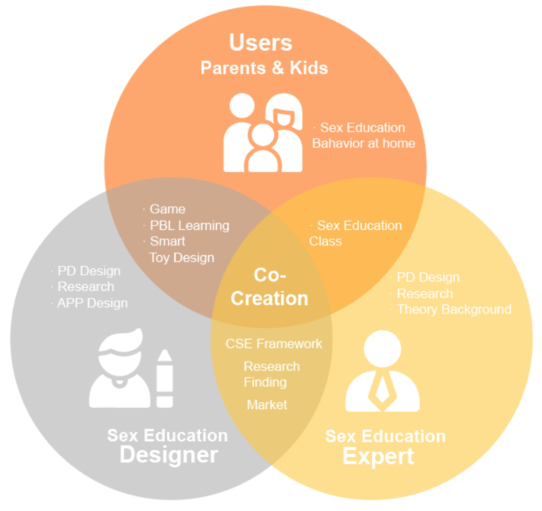
In the process of co-design, children and parents have their own roles in the process of participating in the design. They can act as users, testers, information providers, and design partners. The role of children as users first appeared in the 1960s (Baek & Lee, 2008; Paracha et al., 2019). In the role of users, adults try to understand existing designs by observing and recording children’s use process, and testing children’s preferences and difficulties. The impact on children’s users has thus changed. The role of children as testers appeared in the 1980s (Druin, 2002). Designers had questions or concerns about certain areas of the product. They asked children to perform tests in that specific area and asked them to give suggestions, in order to make a design that is more suitable for children. Successful sex education requi- res cooperation across public services and private providers, and co-design method enables three parties voluntarily engaged in shared decision-making as they work toward a common goal (see Figure 1).
Comprehensive Sexuality Education (CSE) CSE is a curriculum-based teaching and learning process that explores the cognitive, emotional, physical and social dimensions of sexuality (UNFPA; & UNESCO; 2022). Its purpose is to equip children and young people with the knowledge, skills, attitudes and values that will ensure their health, well- being and dignity. CSE fosters respectful social and sexual relationships,
Developing Comprehensive Sex Education Smart Tools for the Young Generation 77
Figure 1: Framework of sex education knowledge organized in the workshop with professionals from sex education charity organizations.
helping children and young people learn to think about how their choices affect their own well-being and that of others, and to know how to advocate for themselves throughout their lives. However, CSE requires appropriate media that enables parents to learn quickly and co-educate with children in their daily lives.
MEDIA Anthropomorphic Dolls
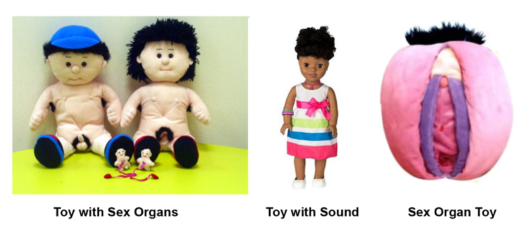
Jean Piaget believes that children have the characteristics of “animism” at some stages of their psychological development (McLeod, 2007; Piaget, 1931). Children have a tendency to recognize inanimate objects as animate and intentional things. The cognitive development of 5 to 8 years old children is in the pre-computing stage, and treat toys as “real” partners, play and talk, and think that things that can be moved are alive. Intelligent anthropomor- phic toys that can speak can strengthen children’s animate cognitive tendency, and it is easier to arouse children’s empathy experience and affect children’s behavior patterns (Sharkey & Sharkey, 2011; van Straten et al., 2020). Chil- dren have empathy for the experience of anthropomorphic dolls. By giving anthropomorphic dolls a storyline, children can use the dolls to have a sense of sovereignty over the body, while avoiding direct harm to children (See Figure 2).
Figure 2: Different anthropomorphic degrees of sex education toys.
Hybrid Toys System Hybrid toys refer to toys that combine tangible physical toys with a computer interface (de Albuquerque Wheler et al., 2021). Children can not only interact with tangible materials but also experience rich digital content(Caruso & Arquilla, 2020). The embodied images in the hybrid toy system exist as a physical part that enhances operability and usability, and at the same time exists as an intelligent play-mate for children. The “intelligent” function of computer software provides new possibilities for carrying content for sex education.
The development of children’s family sex education implies that the tran- smission of sexual knowledge occurs, and visualized content is needed so that parents can directly teach sex education knowledge. Analysis of existing cases shows that three-dimensional books can transform flat expressions into the construction of sex education life-like scenes. Cards, manuals and other forms can break down the subject knowledge and correspond to and consoli- date the knowledge in the form of questions and answers. Therefore, hybrid forms are suitable content bearers and need to be organically integrated with interactive media.
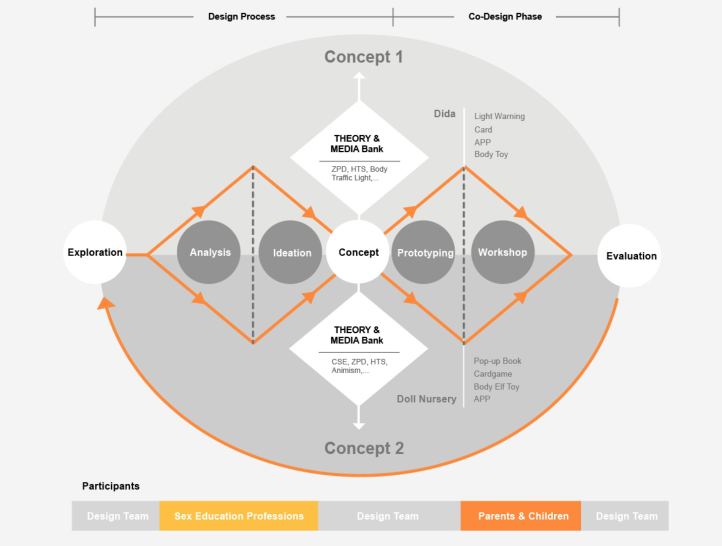
RESEARCH METHODOLOGY We hope to use co-design workshops to explore appropriate content delivery media and intelligent forms of interaction for comprehensive sexuality edu- cation to trigger equal dialogue between children and parents on sensitive topics and to achieve systematic teaching and learning goals. Therefore, we attempted to conduct two co-design workshops to generate a set of intelligent tools (See Figure 3).
We use the double-diamond design process model to carry out the co- design workshop. Through co-exploration and analysis, we summarized the experience of teaching sex education from experts and built a theory and media bank, incorporating design elements such as anthropomorphic dolls, hybrid toys system, etc. as mentioned above. After ideation in the design process with sex education experts, we developed the first prototype design concept: Dida, which was ideated from the theory and media bank. We test
Developing Comprehensive Sex Education Smart Tools for the Young Generation 79
Figure 3: The double-diamond design process model and co-design workshop process.
and evaluate it with the users and iterate on this prototype in the second co- design workshop. After co-design and evaluation with participant families, we developed the second design, Doll-sitter. Finally, we compared the intera- ctive media and game elements used in the two prototypes from the bank to observe the barriers in the behavioural model of parent-child education. In our workshop, we sought ways to design prototype tasks for CSE to change the top-down teaching format and increase children’s participation.
RESEARCH PROCESS Building Empathy: Concept Development in Phase 1 of Co-Design
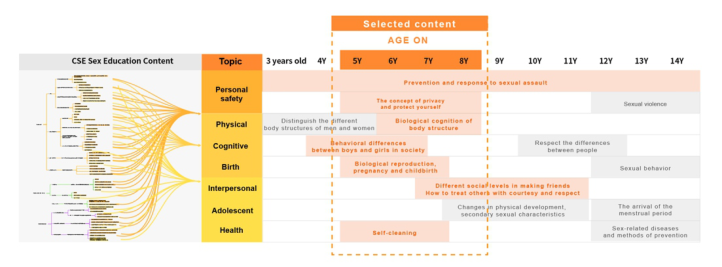
Before starting a family design workshop, it is necessary to build a pre- existing structure of knowledge logic about sex education and explore the problems of existing sex education development. We interviewed experts from Green fruit Classroom, a public service sex education organization in Hunan Province in China, that provides sex education services to schools. Based on UNESCO’s International Sexuality Education Guidelines, children between the ages of 5 to 8 were selected as our target users. Before children develop negative perceptions and shame about sex, the input of appropriate knowledge about sex will help children establish correct values of life. Sub- sequently, we clarified the knowledge that should be conveyed to children aged 5–8 years old by combining the topics in guidelines and constructing a knowledge framework using affinity diagram method with the experts (See Figure 4).
Figure 4: The framework of sex education knowledge organized in the workshop.
In response, we conducted a joint family workshop with the aim of exploring factors that hinder families from implementing sex education and used the organization’s child sex education board game as a medium to recruit families to conduct collaborative workshops and initially record the interaction between children and families.
Using the empathy map method to organize the results of observations, we summarized the problems faced in sex education for children aged 5–8 years: (1) Children, at the level of behavioral perception, reject the top-down model of sex education indoctrination. (2) Parents, at the normative belief level, are highly influenced by traditional social ideology and the views of others, and are shy to talk about sex (3) Parents, at the behavioral perception level, subjectively believe that they lack the level of knowledge to conduct sex education for children in the family. Thus, the design goal is to clarify how to design proper sex education tools.
Co-Design Phase 1- Interactive Hybrid Toy System Dida Since the family sex education scenario involves two key design users, parents and children, and considering the characteristics of the target children’s age group and the dilemmas faced by parents, we believe that the aforementioned hybrid toy system formed by combining a tangible entity and an electronic interface is an appropriate medium. Therefore, we combined the “body traf- fic light”, a basic approach to sex education, to create a smart doll Dida for children. The prototype Dida is an intelligent sound and light toy that focuses on sharing children’s thoughts and feelings about body boundaries through sensing.
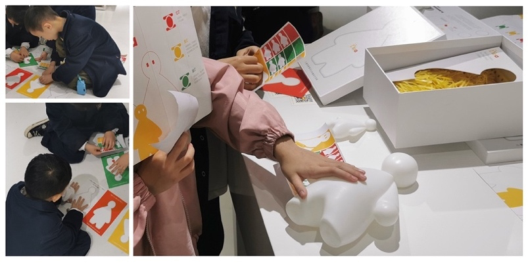
Six groups of families were recruited to participate in the co-design work- shop, each consisting of a parent and a child in the middle of the 5–8 years age range, conducted in about 25 minutes (See Figure 5).
In the first co-design workshop, we found that Dida effectively commu- nicated body boundaries and sparked conversations between parents and children, such as “Mommy thinks other people can touch my shoulders, but I don’t like it”. However, because of its abstract shape, Dida can help children understand the parts of the body that need to be guarded, but parents are often unable to answer the deeper questions about organs that
Developing Comprehensive Sex Education Smart Tools for the Young Generation 81
Figure 5: Children playing with Dida in the first co-design workshop.
children ask. The multitude of sexuality education topics covered in compre- hensive sexuality education requires high-capacity knowledge-bearing media to convey effective sexuality knowledge to children. Besides, children need reward mechanisms to increase motivation and initiative to learn, otherw- ise, they are likely to find it boring after using it for a period of time. Thus, we proceeded to develop a prototype for the second workshop, focusing on adding play elements and using a more tangible organ doll design.
Co-Design Phase 2 - Doll-Sitter In designing the second prototype, we focused on the problem of insuffici- ent knowledge carrying capacity of electronic stories and lack of children’s attention span, and gave new thoughts to the carrying form of comprehen- sive sex education and doll form. We found that the organic integration of three-dimensional books and smart dolls is the suitable medium.
Therefore, we develop the Doll-sitter, a toy set of pop-up books for sex education for children aged 5-8, using doll nurses-nursery teachers in which children play the role of body organs, to know, protect and repair organ spi- rits that encounter difficulties, establish a perceptual connection between the spirits. Through the interaction of dolls and pop-up picture books, children can learn how to take good care of their bodies. Parents use APP and cards for parent-child interaction, complete the task of protecting the doll toge- ther, talk about sensitive topics, and answer children’s doubts about the body through the self (See Figure 6).
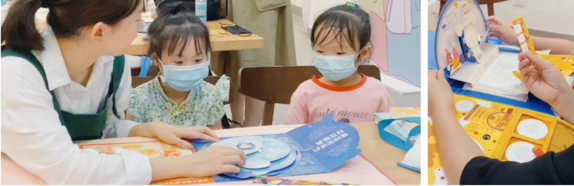
A new round of co-design workshops was held in Changsha Library. We recruited 8 groups of families with children aged 5–8 to participate, Each
Figure 6: Doll-sitter: interactive sex organ elf dolls.Figure 7: Co-design workshop phase 2 with children.
lasted 30 minutes for the workshop. We used the Wizard of Oz experiment in which one of the designers played the role of the organ sprite and narrated the dialogues corresponding to the interactive actions, while the other designers observed the details of the discussion dialogues and interactions in families (See Figure 7).
During the workshop, three parents raised the issue of the more complex game mechanics, the need for extra time to familiarize themselves with the game in advance, and the overly specialized narrative of the parent book. CSE has more educational content, and parents must focus on learning the content itself rather than on the diverse forms of interaction.
Second, too many game elements can lead to children being induced to shift their interest in educational texts to game mechanics. Prolonged play leads to children beginning to lose interest in discussing the sexuality issue itself. The balance between its gameplay and education needs to be further tested and explored.
RESEARCH FINDING In general, both workshops received good feedback. Table 1 compares the design prototypes from the media and game elements used in the workshop. The evaluation found that the use of co-design in sex education would effe- ctively connect traditional sex education institutions with the design industry, help sex educators select and develop nationally appropriate educational con- tent, effectively communicate it to family members, and uphold children’s right to dialogue with their parents about sex education on an equal basis. We gained some insights on how to promote the effectiveness of comprehensive sexuality education for families: 1) curiosity-driven design to establish con- nections between life scenarios and professional knowledge from the child’s
Table 1. Comparison of media and game elements used in two co-design workshops.
Table available in the original PDF paper.
Media and game elements Workshop 1- Dida Work shop 2- Doll-Nursery Pop-up Books √ Phone Application √ √
Smart Doll Toy √ √ Pamplet √ Collective Card √
Developing Comprehensive Sex Education Smart Tools for the Young Generation 83
perspective; 2) intuitive play processes to support education from the parent’s perspective; and 3) the use of empathy to create a more appropriate commu- nication medium to create a relaxed atmosphere for discussion of sensitive topics such as sexuality.
Children’s Perspective: Curiosity and Life Scenario Building Curiosity drives children’s desire to gain new knowledge about sexuality. In the second co-working workshop, after reading the questions about sex education, children will think about content in the context of their daily lives and will want to eagerly verify whether their answers are correct and to get reasons.
Children are more likely to draw knowledge from stories that are relevant to them. We observed that the 5–8 years old age group tends to put them- selves into the storyline and make themselves the protagonists of the story. In the discussion of social boundaries and stranger communication scena- rios in Social Bubbles, children brought up similar memories of the past “I remember my uncle saying that.” This triggered a cautionary tale for parents and led to a deeper conversation about social circles. In both workshops, Dida’s questions about body boundaries and the doll caregiver’s exercises on body cleaning and aggression scenarios, the children would find stories (things they had experienced) from their own lives to refute when the answ- ers did not match their mental expectations, such as the dialogue “But boys wear dresses strangely.” Thus, the substitution of scenarios allows children to relate to real life and discuss the problems and doubts they encounter with their parents.
Parent’s Perspective: Intuitive Media for Accurate Knowledge Parents need visual content media and professional and accurate knowledge in order to provide comprehensive sex education to their children. In the first workshop, parents could see the story and knowledge point corresponding to the results of children’s feedback on the DIDA interaction on the cell phone screen, which effectively conveyed the knowledge of the boundaries of sexual touch, but could not carry the detailed knowledge of body cleanliness and other explanations. In the second workshop, we transferred the electronic educational content, through a number of different sexual themes of a three- dimensional book to carry easy-to-understand educational knowledge, while using the parent manual to assist in corresponding to each part of professi- onal sex education knowledge. This format opens up the educational topics more intuitively, but the narrative in the parent book is too specialized to make it take extra time to learn. A comprehensive sex education content car- rier needs to be developed by child sex educators, designers, and parents and children to complete localized, intuitive, and accurate family sex education.
Equal Participation: Media Create Communication Opportunities China’s avoidance and blushing attitude towards the topic of sexuality is a barrier for parents and children to talk about it. Equal participation and communication between children and parents in the sex education process
require intermediaries to create a natural miracle in order to create an atmo- sphere of free discussion about sensitive topics, and discussion and answers to specific sex-related doubts encountered in life.
Using empathic psychology, children were able to establish a connection between the doll and the body and increase their sense of protection. In the two workshops on the design of the prototype feedback on the different degrees of abstraction of the sexual organs, parents and children gave the appropriate response; Dida’s soft appearance of loved ones was loved by both sides but in the explanation of the specific parts of the structure of the com- munication barriers. Children asked questions such as “why do my boobs tickle”, and parents were unable to explain the exact structure of the sexual organs. The degree of anthropomorphism, its impact on the accuracy of kno- wledge conveyed and the ease with which parents could explain the structure of their sexual organs, but quantitative testing requires further discussion.
CONCLUSION AND FUTURE WORK This paper explores the core difficulties in the development of family sex education through the form of collaborative design, proposes the theoretical basis for the development of family sex education and its application to family sex education, and carries out the design practice of intelligent interactive experience products. In future research, we will focus on quantitative studies placed in natural home scenarios to investigate the educational effectiveness of the two prototypes.
REFERENCES
Baek, J.-S., & Lee, K.-P. (2008). A participatory design approach to information architecture design for children. Co-Design, 4(3), 173–191. Caruso, F., & Arquilla, V. (2020). Yogo: a Hybrid Toy-System for children with DCD.
CEUR WORKSHOP PROCEEDINGS. de Albuquerque Wheler, A. P., Kelner, J., Hung, P. C., de Souza Jeronimo, B., Junior, R. d. S. R., & Araújo, A. F. R. (2021). Toy user interface design—tools for child– computer interaction. International Journal of Child-Computer Interaction, 30, 100307. Druin, A. (2002). The role of children in the design of new technology. Behaviour
and information technology, 21(1), 1–25. Haberland, N., & Rogow, D. (2015). Sexuality education: emerging trends in evidence and practice. Journal of Adolescent Health, 56(1), S15–S21. Lee, J., Cho, H., Chung, J., & Lee, Y. (2019). Enabling people to lower barriers with
a codesign prototyping approach: sex education for upper-elementary students at home. The Design Journal, 22(sup1), 539–551. McLeod, S. (2007). Jean Piaget’s theory of cognitive development. Paracha, S., Hall, L., Clawson, K., Mitsche, N., & Jamil, F. (2019). Co-design with children: using participatory design for design thinking and social and emotional learning. Open Education Studies, 1(1), 267–280. Piaget, J. (1931). Children’s philosophies. Sanders, E. B. N., & Stappers, P. J. (2014). Probes, toolkits and prototypes: three
approaches to making in codesigning. CoDesign, 10(1), 5–14. https://doi.org/10. 1080/15710882.2014.888183
Developing Comprehensive Sex Education Smart Tools for the Young Generation 85
Schneider, M., & Hirsch, J. S. (2020). Comprehensive sexuality education as a primary prevention strategy for sexual violence perpetration. Trauma, Violence, & Abuse, 21(3), 439–455. Sharkey, A., & Sharkey, N. (2011). Children, the elderly, and interactive robots. IEEE
Robotics & Automation Magazine, 18(1), 32–38. Thabrew, H., Fleming, T., Hetrick, S., & Merry, S. (2018). Co-design of eHealth interventions with children and young people. Frontiers in psychiatry, 9, 481. UNFPA;, & UNESCO;. (2022). Comprehensive Sexuality Education Technical
Guideline - - Adaptation of Global Standards for Potential Use in China. https://china.unfpa.org/zh-Hans/publications/22110701 van Straten, C. L., Peter, J., & Kühne, R. (2020). Child–robot relationship formation: A narrative review of empirical research. International Journal of Social Robotics, 12, 325–344. Zhu, Y., Xiao, C., & Zhu, B. (2023). Gender differences in child sexual abuse in
China: Do one-child status and repeated victimization matter? Children and Youth Services Review, 144, 106743.
LISTED IN THE AHFE DIGITAL BOOKSTORE CATALOGUE
Explore the complete digital volume
Training, Education, and Learning Sciences
Read this individual research paper free through the original publisher, or explore the full digital proceedings book.
ISBN 978-1-958651-85-8
Explore this ISBN in the AHFE Bookstore ↗Listed in the July 2026 bookstore catalogue; search by ISBN to confirm current availability · Digital book purchase optional