Markus Holzbach, Valentin Brück, Ziyu Zhou (2023). Informed Materials: Design with Designed Materials as a Method. In: Intelligent Human Systems Integration (IHSI 2023): Integrating People and Intelligent Systems. AHFE Open Access, vol. 69, pp. 505–512. https://doi.org/10.54941/ahfe1002871
Materials link countless design issues we are concerned about the most nowadays: smart technology, digital/analog, user experiences, ecological environment, etc. Thanks to technological evolutions, designers are exploring new hybrid materials, which expands the contemporary design territories. The generation of new materials is due to the transdisciplinary dialogues among design, art, engineering, human-computer interaction, biotechnology, etc., but also thanks to designers' understanding, exploring, and manipulating the properties and attributes of materials in unconventional ways. The new attributes of these material innovations have the potential to subvert the conventional material selection in design, and provide inspiration for new design concepts, functions, and formal potentials. This approach, known as ‘Design with Designed Materials’, emphasises the triggering role of materials, especially for experimental design processes which link with various (artistic) research and creative methods. This paper will describe how the ‘design with designed materials’ approach contributes to new material explorations and innovations, where material can be informed by various aspects: digital, material intrinsic, or a combination of both. By action research, the paper will elaborate on which way ‘design with designed materials’ acts as a methodical approach in design research and design education. This is a transdisciplinary approach that combines the areas of drafting, known from disciplines such as architecture and design, with those of analysis, research and development of materials, which are known from engineering and materials technology. On the basis of an experimental and transdisciplinary approach, new material-based and material-induced design concepts are developed and researched, putting material at the beginning of the design process. This approach was validated in a series of teaching and designing activities, resulting in diverse design works that brought new logic to the use, exploration and transformation of materials, and the generation of design concepts. Four example projects are selected as representatives for describing four characteristics of materials design: properties, structures, interfaces and systems. This paper will share those results, bringing the insight that the new logic of materials is often beyond their original ‘inherent’ properties, which can trigger the new way of concept generations. Materials become carriers of a wide variety of information that enter into a dialogue with their environment, increasingly take on the role of the actual object and become informative and intuitive.
Over the past ten years, the method of ‘design with designed materials’ has been developed in the Institute for Materialdesign IMD, focusing on the material itself with its properties, structures and hybrid systems. Material- oriented design is increasingly turning into ‘design with designed materials’ (Holzbach, 2015a). The aim is to encourage reflection on the role and posi- tion of materiality and design per se and to experiment with a high degree of freedom - and thoroughly unconventional methods - and also to provoke results. Materiality intrinsically influences today’s design concepts. It occurs in an intersection of digital and physical that involves the use of digital design and manufacturing tools. The way these factors are connected also impacts the way the design concept is conceived (Parisi, Holzbach, and Rognoli 2020). Now materials in design have multiple roles: they become carriers of a wide variety of information and intuitive; they trigger infinite possibilities from experimentations. The material in design is not limited to any design sections but a transversal element that links the development phase, manufacturing phase, and user experiences; it elicits issues that are always highly connected with our complex dynamic world, such as the questions on how humans and nonhumans cohabitated, how can we use our resources more efficiently, or what possibilities does digitalization bring to us. New hybrid materials with composite inactive or reactive elements opened new possibilities in design. Sometimes, these new materials can be equipped with complex functions, take over an object’s role, and may arouse new behaviors when encountering our surroundings. Today, design concepts are fundamentally influenced not only by digital design and production tools but also by their materiality in a blending of digital and real (Holzbach, 2021).
One of the recent arguments in the materials design field is, for so many years, that materials have been used as a tool to achieve functions and pro- perties of the design, nowadays some design approaches are putting materials at the beginning of a design process rather than in the end phase (Schäffner, 2016). Instead of selecting materials in design, many designers experiment new approaches: being inspired by materials, exploring their attributes and experiences, and learning from materials (Zhou, 2022). Materials are carriers of a wide variety of information and enter into a dialogue with their environ- ment. By understanding and exploring their properties and attributes, they can be as impulse generators for new forms and functions, which may lead to more unconventional design approaches (Holzbach, 2021).
The current development of digital technology has provided people with more scientific tools and straightforward means to design, and additive manufacturing, such as 3D printing, has brought the democratization of personal fabrication, expanding the threshold of material explorations by designers. For instance, the emerging Interactive Connected Smart (ICS) Materials, as material systems that are able to establish a two-way exch- ange of information by being programmed in not only digital softwares (Parisi et al., 2018; Rognoli and Ferraro, 2022), can transfer information in more sensitive and intuitive ways. With the materials design field involving more types of material innovations, more material functionalities, attributes
Informed Materials: Design with Designed Materials as a Method 507
and experiences are created through designers’ manipulation and bring more design issues not only related to the HCI blending with material technology, but also matter with the design cultures we are creating every day: what is the way we actually design, in the evolving complex world with expanding digital spaces and more environmental concerns. Materials are connecting more issues in their system, and in this way, blending digital and actual cre- ates informed materials with informative and intuitive properties leading to a transformation from the design of materials to design with materials. Its results can trigger more inspiration in different design sections as well. This approach, called ‘design with designed materials’, can engage unique design and learning-by-doing paths and results. In this process, the pre-research, investigation, and experimentation activities can be considered as hybrid design progress, resulting in hybrid materials with various new materials experiences, meanings, and interactive performances.
METHODOLOGY
The methodology that unifies informed materials and the design process is action research, which is generally associated with experimental work and aims to generate knowledge by actively transformatively making changes (Lewin, 1940s; French et al., 2005, p. 106). The researchers applied an action research methodology while constructing the courses, implying collaborative and participative relationships between researchers (course tutors) and con- textual actors (students) (Whyte, 1991) and a continuous reflection on action (Schön, 1983). Itten already established so-called ‘nature and matter studies’ at the Bauhaus. Itten’s pedagogical approach can be described with an oppo- sing pair of terms: ‘intuition and method.’ (Droste, 1998). Moholy-Nagy and Albers explored the concept of composition. The lectures of Moholy-Nagy concentrate on the composition of original and diverse materials. The paral- lel work of Moholy-Nagy and Albers gave students material knowledge from both technological and expressive sensorial dimensions. This was the critical evolution and legacy of what Itten had previously proposed (Ayala-Garcia, 2019, p. 42). In addition to the principle of the minimal, the experimental methods for finding forms and the observation of natural and technical stru- cture, the self-organizing processes, and the finding of forms, the focus is on actively shaping the processes taking place. These seem to contradict each other, as Frei Otto already described in 1972: “The will emphasize design is in contrast to the search for the still unknown form which is subject to the laws of nature” (Otto, 1984; quote translated by the author). The structures and constructive laws of nature often serve as an inspiring source for material design.
Taking material as a privilege aspect in design, the ‘design with desi- gned materials’ approach is implied in a series of design courses in Offen- bach University of Art and Design in the teaching and researching area of Materials Design. These courses’ common intended outcome is to disco- ver opportunities from informative intuitive attributes of the materials and elicit understanding and reinterpretation of materials in specific contexts, which leads the design results open to various scales and matches different
scenarios. Therefore, the courses are never limited to a specific topic but rather emphasize the openness and uniqueness of this particular method. The teaching follows an experimental approach and freedom of creative research as characteristics and places the materials in new contexts today with digital and technological discussions to generate hybrid material combinations and performances.
These courses are distributed into different levels of study curriculum, from basic design activities to advanced projects and PhD research with ‘Design with designed materials’ as a holistic approach that spans different levels and fields of design in the teaching and researching area. Utilizing analog and digi- tal tools, this reciprocal hybrid design process can change materials’ forms, properties, attributes, and experiences. Predominantly focused on the con- tradictory processes and materials’ inherent potentials in creative-scientific and transdisciplinary dialogues. Aspects such as material parameters, attri- butes and processing, and the experimentation activities are embedded in this design and material study process, giving rise to either digital form and function generative strategies or charged materials that lead to adaptive, interactive, or dynamic user-object-environment interactions.
The method brings up critical questions: what impact does materials design have on the design process? How can a material be charged with digital, adaptive, or interactive elements? How can a material be informative and connected? In this way, the material has stayed at the center of the discus- sion since the beginning of the design process, while the creative skills of understanding and exploring materials’ functional and formal potentials are stimulated in the progress of new conceptual and contextual integrations.
RESULTS
The implementation of the method generates variations of materials design projects characterised by different approaches to design with designed mate- rials. Digital analog is highly involved in material development and form generation to achieve various material functions. The material itself takes on an active part in the designed artifact, being adaptive, interactive, informa- tive, and intuitive. The process of ‘designing with designed materials’ was considered a hybrid design process since students are highly encouraged to test, communicate, and develop their concepts and processes through physical material experimentations, models, drawings, and various digital generative design tools, visualization programs, microcontrollers, robotics, AI systems in physical-, chemical- or bio-inspired design processes.
In this way, the materials are digitally informed, changed, and processed. To showcase the characteristics of the teaching outcomes of IMD from the formerly described approach, the following projects are selected as represen- tative examples of four kinds of materials designed for properties, structures, interfaces, and systems.
Materials Design for Properties This approach considers the material as an analog sensor and reacts by itself according to certain external changes and simulations. The representative
Informed Materials: Design with Designed Materials as a Method 509
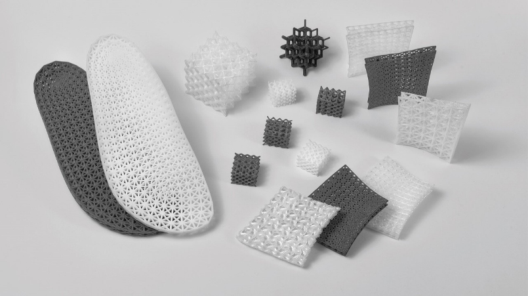
Figure 1: Transformative Paper, Florian Hundt, IMD Institute for Materialdesign.Figure 2: Adaptive grid structures, Andreas Grimm, IMD Institute for Materialdesign.
example is the Transformative paper developed by Florian Hundt (Figure 1). It is a layered paper structure that reacts to environmental conditions like air humidity. The anisotropic material properties of the industrial paper pro- duct are utilized to create both a reactive surface, which opens and closes according to changing humidity levels and a tangible interface. The paper is assembled and cut in a way to emphasize the movement which occurs due to environmental changes.
Materials Design for Structures This approach uses digital tools and additive manufacturing to design digi- tally informed structures. In Andreas Grimm’s projects, he developed a digital tool to generate adaptive grid structures according to the input of a pressure- sensor-matrix (Figure 2) and photogrammetry. By digitally measuring the sole of the feet, deformities can be analyzed and immediately transferred into a digital model of orthopedic shoe inlays support made of the formerly mentioned grid structures.
Figure 3: Interactive Wood, Johannes Wöhrlin, IMD Institute for Materialdesign in cooperation with BMW AG.
The grid structure adapts to the forces added to the sensor by changing its density and thickness. These digitally informed structures are materi- alized afterward by 3D printing, generating individually optimized ortho- pedic arches. Additive manufacturing combined with lightweight structu- res reduces material waste, energy consumption, and manual work. As a mono-material structure, it is easy to recycle.
Materials Design for Interfaces With digital technology, materials can be informed as a functional and aesth- etic interface, charged by interactive technologies. In the project Interactive Wood by Johannes Wöhrlin, the aesthetics and unique structures of wooden surfaces are visible in the dark. Activated by hand touching, the wood grain gives off a faint shimmer that provides light for orientation. It can emit soft light for a while and dim over time (Figure 3).
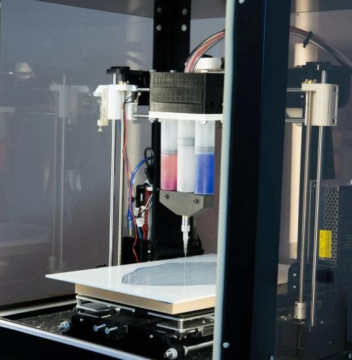
Materials Design for Systems The approach combines the design of material properties and structures, the design of a production process, as well as the digital generation and fabrication to create hybrid dynamic systems. “Maku”, the project of Valentin Brück, is a biologically powered, 3D-printed pneumatic membrane (Figure 4). Similar to the approach of Andreas Grimm, the design of the final model and the process of fabricating it were achieved digitally. The force-optimized shapes were generated in Grasshopper 3D, and printed out in a liquid 3D printing process, where two kinds of microbes in a nouri- shing solution were injected into the membrane and some self-hardening resin to partially stabilize the structure. Both escherichia coli and saccha- romyces cerevisiae coexist in a metabolic cycle that inflates and deflates the silicone membrane according to the environmental temperature. Therefore,
Informed Materials: Design with Designed Materials as a Method 511
Figure 4: Maku, Valentin Brück, IMD Institute for Materialdesign.
the properties of the silicon, the plastics, and the microbes’ lifecycles were carefully curated and utilized to create the speculative project.
CONCLUSION
Materials play a crucial role in the design process, but today, materials are instead developed for their task. The path from static to dynamic, process- oriented properties is thus smoothed. ‘It is precisely the dialogue of the ‘real’ material with the ‘virtual’ and ‘dematerialized’ digital world that leads to new formal and functional impulses and contexts.’ In a complex setting of highly different, often simultaneous, and sometimes even contradictory levels of action, hybrid design processes are initiated, which in their consequence, also lead to hybrid design forms with interactive, connective, smart, or gradually varying properties (Holzbach, 2014).
Hybrid material systems and objects suggest the properties of intrinsic intelligence of the intuitive. Many new design solutions integrate materials and technologies whose complex structure no longer allows conclusions to be drawn about performance or function. Informative and intuitive materi- als enter into a dialogue with their environment - with their new properties as structures, systems, or interfaces. Many new material hybrids focus on the intelligence that is not inscribed into the material itself. The question is how the new material hybrids are constructed, jointed, and used. Designed materials or informed materials are ‘hybrid material solutions’ which contain digital and material-specific technologies or the combination of both.
The new logic of the material often no longer has anything to do with the “inherent” or even “authentic” qualities. The resulting works often move at the intersection between nature and artifact, analog and digital. Mate- rial simultaneously takes on another role – the role of the actual object. (Holzbach, 2021). Formerly existing material properties are overwritten or exchanged. These informed or charged material hybrids link different contexts. There are some ambiguous questions about the informed material.
What is real or fake, natural or artificial? What are the signs of the ‘designed’? What does it represent? Is there a function, and how can it be used? Through this new ‘charging level’, materials and things are given a new and unique nomenclature – in other words, an informed and hybrid material world with hybrid properties and the hybrid nomenclature of the ‘In-Between’.
ACKNOWLEDGMENT
This research is funded by Institute for Materialdesign IMD.
REFERENCES
Ayala-Garcia, C., 2019. The Materials Generation – The emerging experience of DIY Materials. PhD Dissertation, Politecnico di Milano, p. 42 Droste, M.: 1998. Bauhaus 1919–1933. Bauhaus-Archiv, ISBN 3-8228-7601-1,
Verlag Taschen Köln, p. 25 French, W. L., Bell, C. H., & Zawacki, R. A. (Eds.)., 2005. Organization development and transformation (6th ed.). New York: McGraw-Hill. Holzbach, M. (2014 a). MaterialDenken - Materiality and (their) design. In: Leopold,
Cornelie (Ed.) On Form and Structure - Geometry in Design Processes. Springer- Verlag, Wiesbaden, p. 69. Holzbach, M. (2015 a). Materialdesign 2: analog and digital design processes exploring the world between material and structure. Research works and exhibits from the Institute for Materialdesign IMD, – Offenbach am Main: HfG. Holzbach, M., 2014. Material Grove. Hochschule f. Gestaltung. ISBN: 978-
3921997949 Holzbach, M., 2021. Materialdesign: design with designed materials. In Materials Experience 2 (pp. 279–297). Butterworth-Heinemann. Otto, F.: 1972. Das Zeltdach. Subjektive Anmerkungen zum Olympiadach. In B.
Burkhardt (Ed.), Frei Otto. Schriften und Reden 1951–1983. Braunschweig/Wie- sbaden: Vieweg & Sohn. (1984). Parisi, S., Holzbach, M.; Rognoli, V.: The Hybrid Dimension of Material Design: Two Case Studies of a Do-It-Yourself Approach for the Development of Intera- ctive, Connected, and Smart Materials. In: Intelligent Human Systems Integration 2020. Proceedings of the 3rd International Conference on Intelligent Human Systems Integration (IHSI 2020); Integrating People and Intelligent Systems, February 19-21, 2020, Modena, Italy, pp. 916–921. Parisi, S., Spallazzo, D., Ferraro, V., Ferrara, M., Ceconello, M. A., Garcia-Ayala, C.,
& Rognoli, V., 2018, January. Mapping ICS materials: interactive, connected, and smart materials. In International Conference on Intelligent Human Systems. Rognoli, V. and Ferraro, V., 2022. ICS Materials: Interactive, connected, and smart materials (p. 224). FrancoAngeli. Schäffner, W., 2016. Immaterialität der Materialien. In N. Doll, H. Bredekamp &
W. Schäffner (Eds.): + Ultra. Gestaltung schafft Wissen (pp. 27–36), Leipzig E.A. Seemann. Schön, D. A., 1983. The reflective practitioner: How professionals think in action.
New York: Basic Books. Whyte, W. F. (Ed.), 1991. Participatory action research. Sage Publications, Inc. Zhou, Z., 2022. Meaning-driven material education in design. PhD dissertation, Polytecnico die Milano.
LISTED IN THE AHFE DIGITAL BOOKSTORE CATALOGUE
Explore the complete digital volume
Intelligent Human Systems Integration (IHSI 2023): Integrating People and Intelligent Systems
Read this individual research paper free through the original publisher, or explore the full digital proceedings book.
ISBN 978-1-958651-45-2
Explore this ISBN in the AHFE Bookstore ↗Listed in the July 2026 bookstore catalogue; search by ISBN to confirm current availability · Digital book purchase optional