Armand Manukyan, Jérôme Dinet (2024). Analysis of environmental and human factors of attention deficit in special-needs students using eye-tracking technology. In: Human Factors in Aging and Special Needs. AHFE Open Access, vol. 133. https://doi.org/10.54941/ahfe1004907
The visual and auditory attention of students with disabilities is fundamental to their progress at school. However, intellectual disability and neurodevelopmental disorders can lead to deficits in visual and auditory attention, and thus hinder the acquisition of new skills. As a result, the pupils concerned may find it difficult to inhibit certain information, to process others, or to make the link between information received and a response to be given. Assessing students' attention is therefore a key issue for specialist teachers. There are many factors that can affect attention, including motivation, fatigue and executive control deficits, as well as sensory factors arising from the external environment and teacher support. However, it can be complex to observe and assess environmental distractors in a specialized classroom setting. Indeed, traditional observation methods can be subjective and observer-biased. In response, eye-tracking is an infrared measurement of the participant's gaze. This allows us to capture eye trajectories, saccades and visual fixation times. However, the most commonly used eye-tracking techniques tend to assess gaze towards a fixed screen. As a result, they are unable to track gaze in a moving environment. Dynamic eye-tracking, using an on-board eyewear device, can track users' eye trajectories and visual hold. In this way, it can take into account the user's evolution in a given environment, in relation to a group of individuals. Method - The study presented consisted in assessing the ocular patterns (maintains and pursuits) of 17 students with disabilities, using an eye-tracking goggle device. With two 10-minute sessions of learning context, the eye-tracking data collected were viewed and analyzed with the teachers. An evaluation grid was drawn up based on the following criteria: Elements observed, eye-hold time by type of element, number of occurrences of eye contact, number of eye saccades, length of eye saccades, student and teacher behaviors during the session. After using a psychometric tool to assess participants' visual and auditory attention levels (cognitive inhibition, information processing time, working memory), observation and analysis of visual patterns enabled us to assess the factors that can facilitate or disrupt visual attention. Results - First and foremost, the results highlighted the decisive influence of the physical organization of spaces. Indeed, while small spaces grouping individuals together encourage interaction between them, for some students they appear to be detrimental to maintaining attention. On the other hand, they can generate regulatory strategies in other students, through positive peer imitation. Secondly, teachers' attitudes play a decisive role in students' visual attention. Indeed, the teacher's distance from and presence with the pupil is a factor in maintaining attention. Verbal prompts and visual aids also play a decisive role in the teacher's pedagogy. Finally, the support of a digital medium constitutes an attentional attractor that can isolate the student and make him inattentive to his social environment, thus interfering with the processing of information from the teacher. Discussion - The present study fulfils two objectives. Firstly, it enables us to assess the benefits of eye-tracking with on-board goggles in analyzing the behavior and abilities of special-needs pupils. Its use could then be extended to other educational systems. Secondly, the study reveals the influence of the physical layout of the environment and the teacher on the regulation of visual attention in special-needs pupils. It would be useful to use eye-tracking to better evaluate teaching methods, the layout of materials and pedagogical support. It would therefore be necessary to replicate this study on larger samples.
France has approximately 700,000 people with autism spectrum disorders (ASD), including 100,000 children. In addition, intellectual disability is an often-associated disorder, affecting 18 out of every 1,000 births in France (ANESM, 2023). It is characterized by a cognitive deficit, potentially leading to disorders in logical reasoning, executive control, problem-solving, plan- ning and abstract thinking. These difficulties lead to delays that can hinder the inclusion of people with disabilities in school. A real public health issue, these are challenges that need to be met to provide the best possible support for the people concerned, in particular by adapting their environment. The visual and auditory attention of students with disabilities is fundamental to their progress at school. However, intellectual disability and neurodevelop- mental disorders can lead to deficits in visual and auditory attention, and thus hinder progress at school. This is an area where specialist teachers need to provide support. There are many factors that can disrupt attention, including motivation and fatigue, as well as sensory elements from the external envi- ronment. However, it can be complex to observe and assess environmental distractors in a specialized classroom setting, which calls for an analysis of the ergonomics of school spaces. Today, ergonomics has permeated every facet of human activity. One of the most recent areas of application is the ergonomics of the children’s world. Moreover, behaviors, emotions and treatment pro- cessing are impacted by the environment. This point lead to the importance of a well-designed environment in a school context (Faraha et al., 2017). For (Devolvé, 2010), a school situation can define as an ergonomic envi- ronment when: “it has created a real balance, a real compatibility between the pupil, obviously a unique being, and the constraints imposed on him.” Designing effective learning environments for students hinges on a funda- mental principle: when students’ basic needs remain unmet, their engagement in schoolwork suffers. Consequently, respecting children and their funda- mental needs should guide the selection of educational tools and practices. By placing students at the heart of the educational process, ergonomics fos- ters an environment that nurtures the well-being and success of every learner (Devolvé, 2010). Adding ergonomics in school situation would have a pos- itive impact on children’s capacities but also on teachers support. In fact, adapting environment by reduce sensory stimulation, student could improve capacities, such as: attention, autonomy, writing or counting (Hariwidagdo & Roni Sahroni, 2019).
The difficulty of accurately assessing the visual attention of people with autism or multiple disabilities has an impact on educational and pedagogi- cal support, and on inclusion in the mainstream environment. Nevertheless, Human observation lacks precision, as it depends on the observer’s attention and position in space. Moreover, some tools already used like eye-tracking with visual capture bars, requires the person to look at a screen (interaction with the screen only), which severely limits the field assessed. However, eye- tracking technology helps understand visual perception in classrooms. Some authors highlight the benefits of wearable eye tracker glasses. Indeed, this
Analysis of Environmental and Human Factors of Attention Deficit in Special-Needs 189
technology measures where teachers and students look during lessons, reveal- ing critical insights into how they process information (Jarodza et al., 2021). Key findings reveal that a teacher’s gaze changes based on the type of activ- ity and whether the interactions are initiated by the teacher or the child. For instance, during structured activities, teachers often look at teaching materi- als to direct the children’s attention, whereas they focus more on individual children during child-initiated episodes. Overall, the study underscores the importance of teachers’ gaze in supporting young children’s learning, devel- opment, and emotional well-being. It also suggests that eye-tracking technol- ogy can be useful for further understanding and improving teaching practices in early childhood education and implementing the best educational strategies (Zhao et al., 2021; Dargue, 2022). Future research could explore teachers’ reflections on their gaze behavior and incorporate additional methodologies like conversation analysis (Isotalo et al., 2024). Furthermore, Alcañiz et al. (2021) highlight the value of eye tracking in the analysis of visual attention in autistic children, noting a different visual pattern from non-autistic individu- als. Campbell (2014) underscores the potential of eye-tracking technology to measure classroom engagement and recommends considering various factors influencing a child’s attention, suggesting future research directions including interventional studies and self-report measures to complement eye-tracking data. The present study is an exploratory study to assess the eye patterns (holding and following) of disabled pupils using an eye-tracking spectacle device. Indeed, no study in France has shown the benefits of on-board eye- tracking for visual attention in people with disabilities. Wearable eye-tracking glasses could be a solution for analyzing students’ directed attention and the environmental factors at work. Observation and analysis of the patterns will enable us to assess the environmental factors that can facilitate or disrupt visual attention. In collaboration with teachers, proposals for redesigning the environment can be made.
METHOD
The aims of this study are: to define the students’ eye holding points, and their nature; to define the students’ eye trajectories; to assess potential attentional distractors.
The sample consists of 20 participants, aged 6 to 17, of all genders. They have a heterogeneous profile, with attention disorders ranging from mild to severe. First, the participants were identified by their teachers as having visual attention difficulties. In a second phase, the sample was formed on the basis of the following exclusion criteria: severe epileptic disorders were excluded, as were severe attention disorders and participants refusing to wear eye-tracking glasses.
The experiment was carried out over a total of 30 sessions, with 1 or 2 sessions per participant. Each session lasted approximately 8 minutes and was conducted as follows.
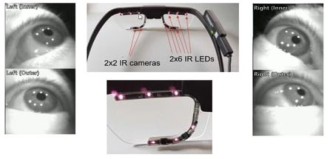
Participants wear eye-tracking goggles (see Figure 1). The experimenter observes the participant’s general or specific behavior (motor agitation) dur- ing the session. The number of trajectories, the number of saccades and the
size of the sweeps (small, medium or large) are recorded. In addition, par- ticipants wear eye-tracking goggles while carrying out different tasks and teaching sequences, in order to assess their attention according to the nature of the activities performed: group work, small-group work and individual work. Finally, the nature of the elements observed will be recorded.
Figure 1: Tobii glass 2.
Figure available in the original PDF paper.
Figure 2: Description of how Tobii glass pro eyewear works (Source: Qualisys.com) sensors placed along the lenses track the wearer’s eye movements.
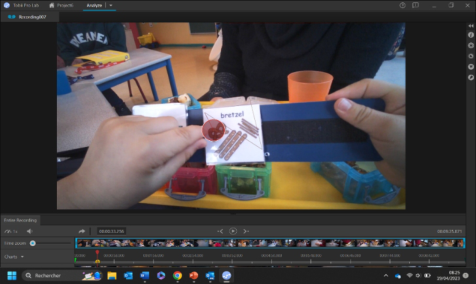
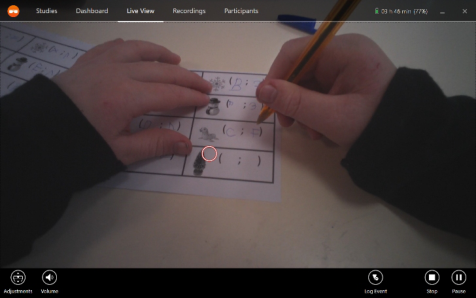
The Tobii eye tracker is an eye tracker that detects where the gaze is directed (see Figure 2). This data is stored in a computer. Thanks to this data, we can analyze where participants focus their attention. The data collected is then analyzed by computerized video processing. The Tobii Pro Lab Analyser software (see Figure 3) is used to track trajectory and eye-tracking (trace and red circle observed on the screen). The software records the trajectories and correlates them with elements in the environment.
Figure 3: Illustration of a video collected and analyzed by the Tobii pro analyzer software.
Analysis of Environmental and Human Factors of Attention Deficit in Special-Needs 191
RESULTS
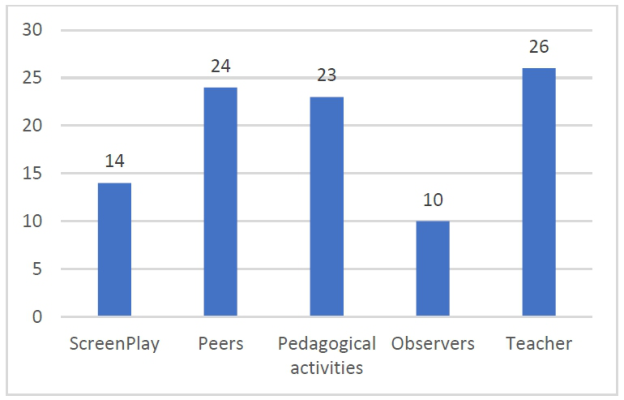
The results show numerous fixations directed towards teachers (26 times on average over the 30 sessions) and peers (24 times on average over the 30 sessions) on the one hand, and towards school materials (23 times on aver- age over the 30 sessions) on the other. The video sessions revealed frequent saccades between attentional maintenance sequences.
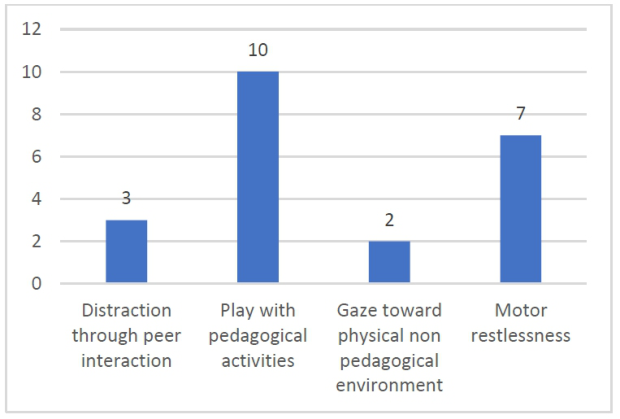
Figure 4: Average number of elements observed per type.Figure 5: Average number of parasitic behaviors observed per nature.
In addition, there are behaviors that can interfere with attention, such as playing with school equipment and motor agitation.
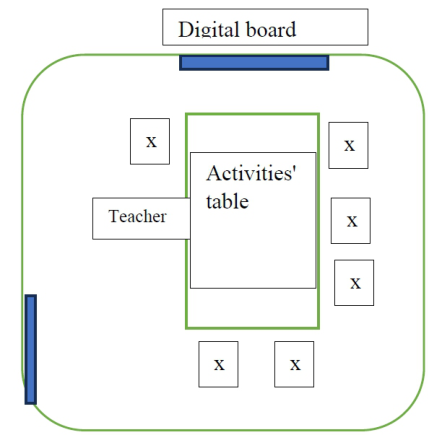
Figure 6: Illustration of the organization of one of the classes hosting participants.
It is interesting to consider the layout of the environment and the ergonomics of the space as a factor in orienting the gaze and maintaining eye contact. In fact, classrooms organized in groups, with tables together, encourage interaction between peers, which is sometimes the effect sought by the teacher. The teacher is in the middle of the group, directing his or her attention to the whole class. He directs the activity and invites students to look at the board. However, this type of organization can also lead to par- asitic behavior on the part of the student wearing the eye-tracking device. Indeed, it is possible to observe that the student looks more at his peers as well as at the teacher. Eye saccades can have the effect of breaking the atten- tional focus on the task. The student may then take longer to return to the task.
Conversely, pedagogical situations in which the tables are set up individu- ally tend to benefit from attentional maintenance directed towards the school material but can lead to a reduction in attention directed towards peers and the teacher. On the other hand, the interactive board can be seen as an atten- tional attractor for certain students, and therefore an interesting pedagogical lever for professionals.
Although the results show that attention is directed towards both the social environment (peers, teachers) and the physical environment (teaching aids), they do not allow us to rule in favor of an attentional deficit. Indeed, the observed eye-holding times tend to suggest that students’ attention may be stable over time. Nevertheless, the results may lead us to consider the impor- tance of the nature of the elements on which students’ attention is focused. For example, if students’ attention is focused on the school material, this does not necessarily indicate activation of the cognitive processes required to complete the task (see Figure 6).
Analysis of Environmental and Human Factors of Attention Deficit in Special-Needs 193
Figure 7: Illustration of a participant observing his school activity, data collected by the Tobii glasses controller software.
In opposition, attention directed towards peers can help students under- stand and retain the instructions and concepts taught by teachers.
This finding highlights the need to consider several dimensions when analyzing the attention of students with intellectual disabilities:
The motivational aspect at play in students’ attentional process: students’ motivation to direct their gaze towards elements deemed more stimulating.
Classroom layout: the organization of tables and classroom spaces can lead to students’ attention being focused on a particular element. This leads us to consider the importance of the ergonomics of spaces within a classroom, depending on the activities carried out by the teacher.
The nature of attention: if attention is directed towards an element, it is necessary to be cautious about the analysis to be made of this atten- tion. Indeed, it seems important to be vigilant about the actual presence of cognitive processes during task performance. As a result, saccades may be more indicative of attention and cognitive monitoring of the task than attentional maintenance.
As a result, measuring the visual attention of intellectually handicapped pupils in a specialized classroom requires multiple observations, combining eye tracking with guided assessment (questions asked to the child).
DISCUSSION
This study will enable us to analyze the factors that explain attention dis- orders in children and adolescents with disabilities. It will also enable us to make recommendations to the professionals who care for them, in this case specialized teachers, educators and psychologists. The aim is to improve support for people with disabilities, determine their ocular trajectories, ana- lyze their visual maintenance and propose correlations with environmental details.
The environment must be adapted to the support objectives set by the professionals. Visual support needs to be re-analyzed to assess the potential benefits of environmental adaptations.
Furthermore, biases need to be taken into account, such as the novelty bias of the device, or the bias of the device itself. Indeed, once the glasses are in place, the child will tend to turn his head to observe his environment through them. They may adopt unusual behavior with their eyes due to their presence. He will also touch them and observe their casing. The other children also behave very differently in front of the device. They will react to the presence of the glasses by calling out to the other child wearing them or trying to touch them.
The device itself has a few drawbacks. It can be a nuisance if the wearer wears glasses, or if it is not adapted to the wearer. As it is wired to a box, it can be a nuisance when the child has to move around (in which case he or she has to wear the box), but also when he or she has a well-defined workspace. The device needs to be calibrated specifically for each child. Measurements can be interrupted when the device is switched off or malfunctions.
This study paves the way for the clinical use of eye tracking to study atten- tion and adapt educational interventions. It needs to be replicated on a larger number of participants and over a larger number of sessions.
AKNOWLEDGMENTS We would like to thank the Association Jean-Baptiste Thiery in Maxéville (France) for its support and the provision of an experimentation area.
REFERENCES
Alcañiz, M., Chicchi-Giglioli, I. A., Carrasco-Ribelles, L. A., Marín-Morales, J., Minissi, M. E., Teruel-García, G., Sirera, M., & Abad, L. (2021). Eye gaze as a biomarker in the recognition of autism spectrum disorder using virtual reality and machine learning: A proof of concept for diagnosis. Autism Research, 15(1), 131–145. https://doi.org/10.1002/aur.2636 Ardhana Hariwidagdo and Taufik Roni Sahroni. “Design improvement of therapy
clinic for autism spectrum disorder using ergonomic aspects”. In: International Journal of Mechanical Engineering and Technology 2 (2019), p. 10. Campbell, E. (2014). Can ‘eye’ tell if you are paying attention? The use of mobile eye-trackers to measure academic engagement in the primary-school classroom (Doctoral dissertation, University of York). Dargue, N., Sweller, N., & Carter, M. (2021). Short report: Learning through iconic
gesture in autism spectrum disorder. Research in Developmental Disabilities, 115, 104000. https://doi.org/10.1016/j.ridd.2021.104000 Isotalo, S., Ukkonen-Mikkola, T., Lämsä, J., & Rutanen, N. (2024). Early childhood education and care teachers’ gaze behavior across pedagogical episodes in toddler groups in Finland. International Journal of Early Childhood. https://doi.org/10. 1007/s13158-023-00387-6 Jarodzka, H., Skuballa, I., & Gruber, H. (2021). Eye-tracking in educational practice:
Investigating visual perception underlying teaching and learning in the classroom. Educational Psychology Review, 33(1), 1–10. https://doi.org/10.1007/s10648- 020-09565-7
Analysis of Environmental and Human Factors of Attention Deficit in Special-Needs 195
L’accompagnement de la personne présentant un trouble du développement intellectuel Volet 1. (2021). has-sante.pf. https://www.has-sante.fr/upload/docs/appli cation/pdf/2023-02/tdi_volet1_argumentaire.pdf McParland, A., Gallagher, S., & Keenan, M. (2021). Investigating gaze behaviour of
children diagnosed with autism spectrum disorders in a classroom setting. Journal of Autism and Developmental Disorders, 51(12), 4663–4678. https://doi.org/10. 1007/s10803-021-04906-z Nicole Delvolvé. Stop school failure: Ergonomics to help students. De Boeck Supérieur, 2010. Parisa Azizabadi Farahani, Hamidreza Mokhtarinia, and Reza Osqueizadeh. “Design of an Ergonomics Assessment Tool for Playroom of Preschool Chil- dren”. In: Physical Treatments-Specific Physical Therapy Journal 6.4 (2017), pp. 217–226. Rebillard, C., Guillery-Girard, B., & Lebreton, K. (2017). Perception and eye-
tracking: A new look at autism spectrum disorders. Revue de neuropsychologie, 9(1), 45. https://doi.org/10.3917/rne.091.0045 Zhao, Z., Xing, J., Zhang, X., Qu, X., Hu, X., & Lu, J. (2021). Random and short-term excessive eye movement in children with autism during face-to-face conversation. Journal of Autism and Developmental Disorders. https://doi.org/ 10.1007/s10803-021-05255-7
LISTED IN THE AHFE DIGITAL BOOKSTORE CATALOGUE
Explore the complete digital volume
Human Factors in Aging and Special Needs
Read this individual research paper free through the original publisher, or explore the full digital proceedings book.
ISBN 978-1-964867-09-0
Explore this ISBN in the AHFE Bookstore ↗Listed in the July 2026 bookstore catalogue; search by ISBN to confirm current availability · Digital book purchase optional