Jérôme Dinet (2022). "Would You be Friends with a Robot?”: The Impact of Perceived Autonomy and Perceived Risk. In: Human Factors in Robots, Drones and Unmanned Systems. AHFE Open Access, vol. 57, pp. 25–30. https://doi.org/10.54941/ahfe1002306
Many authors attempted to model and to predict the users’ attitudes towards technologies by focusing on concepts such as “acceptance”(Venkatesh, David & Morris, 2007; Venkatesh, Morris, Davis & Davis, 2003) or “symbiosis” (Adelé & Brangier, 2013). But we assume that acceptance is not sufficient to explain and to understand human behaviors when these human beings interact with assistive robots (Dinet & Vivian, 2013, 2014; Klamer & Ben Allouch, 2010. As Levy said (2007), nowadays it is important to not only study utilitarian, productivity-oriented factors in the acceptance process of robots by people, but also to include affective factors to get a more complete view of which factors play an important role in the acceptance of and/or atta- chment to robots. Besides utilitarian use of technology, there is also a hedonic, pleasure, and attachment-oriented use of technology (Van der Heijden, 2004) specially when robots offer interaction possibilities to human beings to build long-term relationships, such as friendship and attachment, and even if this relationship is a one-way for the moment. Moreover, sometimes, emotional attachment towards a robot can generate problems (Carpenter, 2013, 2016). But emotional proximity and confidence are necessary if robots are consi- dered as a companion, an assistant or a guide in daily and intimate activity.
It is the reason why more and more studies investigate the empathy between humans and robots (e.g., Tisseron, Tordo & Baddoura, 2014; Scasselti, 2002; Stephan, 2014). If relatedness is a precondition of empathy (Airenti, 2014), empathy needs something more. In the same way, if empathy is sufficient with robots in some cases, it is not sufficient if robots are used as a companion or an assistant or a guide in daily and intimate activity. A companion or a guide in intimate and daily becomes more than an assistant. So, in this paper, we assume that friendship is stronger than empathy.
METHOD
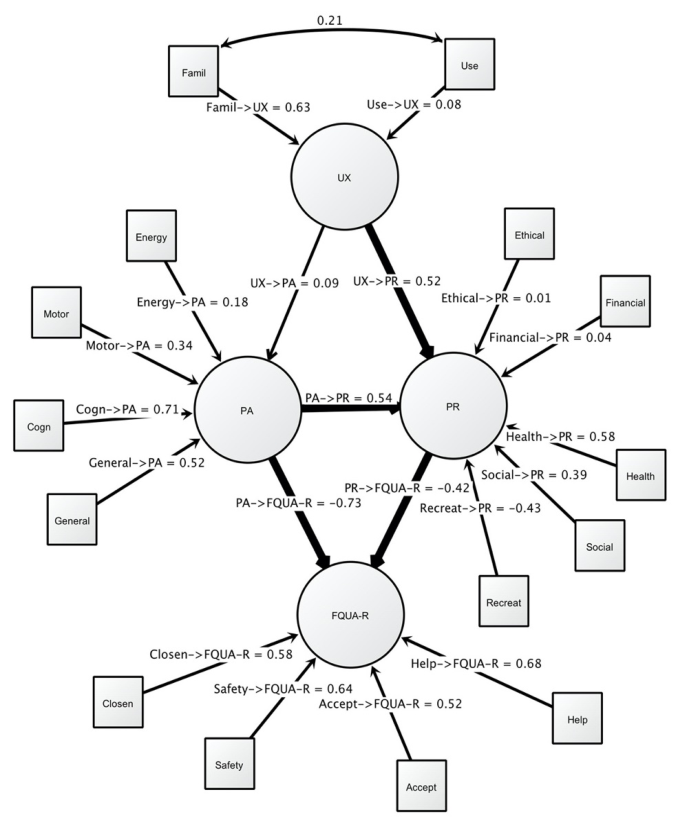
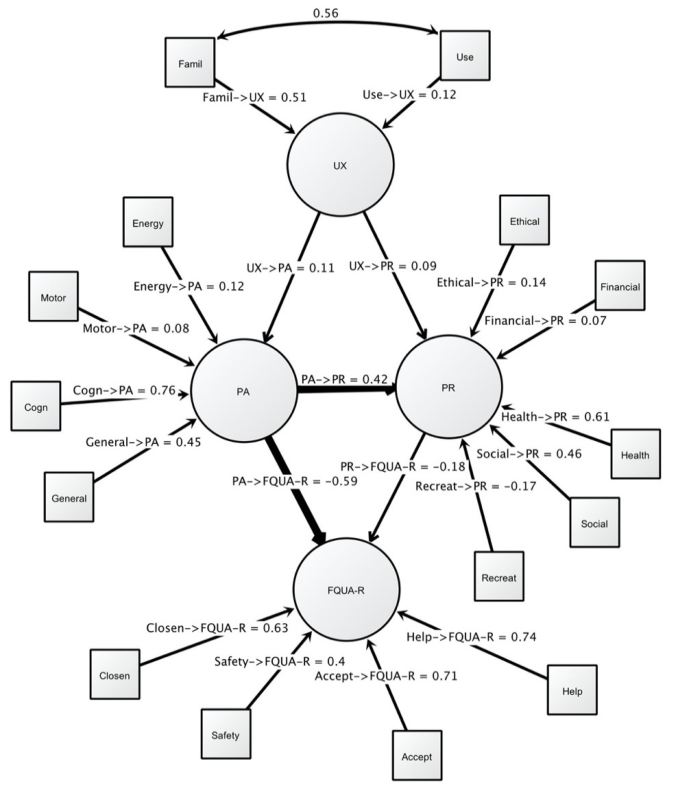
The main goal of the experiment presented here is to investigate the relation- ships between perceived risk, perceived autonomy and friendship by using a large online survey with 2 783 French participants: 936 adolescents (mean- age = 12.2 years); 1077 adults (mean-age = 33.4 years); and 770 seniors (mean-age = 71.3 years). Structural Equation Modeling (SEM) was used.
Latent Variables, Operationalization, and Material User Experience: According to the international standard on ergonomics of human system interaction (ISO 9241-210), user experience (UX) includes the practical, experiential, affective, meaningful and valuable aspects of human– machine interaction. In this study, questioning robot familiarity and robot use assessed UX. Robot familiarity and use questionnaire was assessed by using a 13 item questionnaire that required participants to indicate their level of experience with 13 different kinds of robots on a five- point scale (0 = “not sure what it is”; 1 = “never heard about, seen or used this robot”; 2 = “have only heard about or seen this robot”; 3 = “have used or operated this robot only occasionally”; 4 = “have used or operated this frequently”). The 13 kinds of robots are related to different domains (e.g., autonomous car, domestic/toy) to explore what means “robot” for the participants.
Friendship Quality with Robot (FQUA-R): An adapted version of the FQUA scale (Thien, Razak & Jamil, 2012) has been developed to assess close relationships and potential friendship with a robot. As the original version, the adapted version called FQUA-R is a 6-point Likert scale, ranging from 1 (high strongly disagree), 2 (strongly disagree), 3 (disagree), 4 (agree), 5 (strongly agree) to 6 (high strongly agree). The factor structure of FQUA scale confirmed this scale as a four-dimensional construct that can be explained by a set of positive features of friendship dimensions: (1) Safety, (2) Closeness, and (3) Acceptance, (4) Help and showed its stability (Thien, Razak & Jamil, 2012). Assessment of Perceived Autonomy (PAS): The PAS (for Perception of Autonomy Scale; Lombard & Dinet, submitted) was used to assess attitudes towards autonomy of robots. This Likert-scale is composed by 35 items, and uses a 7-point rating scale ranging from 1 (“Strongly disagree”) to 7 (“Stron- gly agree”). Previous factorial analyses confirmed a four-factors structure of the PAS (Lombard & Dinet, submitted). So four subscales, corresponding to four types of autonomy, compose the PAS: (a) Energy autonomy, composed by with 9 items (e.g., “A robot must be able to recharge itself”, “A robot must
“Would You be Friends with a Robot?” 27
operate without interruption”); (b) Cognitive autonomy, with 11 items and corresponds to the capacities necessary to solve problem, to communicate, to search for information (e.g., “A robot must be able to analyze situations and choose the best solution”, “A robot must be able to make independent initia- tives”); (c) Motor-skill autonomy, with 8 items (e.g., “A robot must be able to run”, “A robot must be able to drive a car or to pilot a vehicle”); (d) General autonomy, with 7 items (e.g., “An independent robot is a risk to humans”, “Human must always maintain control over the robot”. A global score can be computed by adding the four scores obtained with the four subscales.
Assessment of Perceived Risk: The French DOSPERT scale (for Domain- Specific Risk-Taking; Blais & Weber, 2006) was used to assess risk attitude and perception of risks for our participants. This Likert-scale is composed by 30 items, the risk-perception responses evaluating the respondents’ gut level assessment of how risky each activity/behavior is, using a 7-point rating scale ranging from 1 (“Not at all”) to 7 (“Extremely Risky”) for five domains of life: ethical, financial, health/safety, social, and recreational risks. Item ratings are added across all items of a given subscale to obtain subscale scores, with higher scores suggesting perceptions of greater risk in the domain of the subscale.
The two videos provide a lot of information about the two robots from a very positive point of view (i.e., they interact with human beings, they are presented as being useful for elderly people or for people with physical and/or mental disabilities, and they are presented as assistant for daily activities).
Capurro (2020) and Dinet & Vivian (2013, 2014), to see an artificial device as a robot depends on the social and cultural perception in which it is embed- ded). Because relationships between human beings and robots will be go beyond acceptance, the initial question addressed in this paper was: “Would you be friends with a robot?”. But maybe we can go further to ask some que- stions such as “Would you fall in love to a robot?”, “Would you get marry with a robot?”, “Would you adopt a robot?”, “Would you be adopted by a robot?”.
REFERENCES
Airenti, G. (2015). The cognitive bases of anthropomorphism: from relatedness to empathy. International Journal of Social Robotics, 7(1), 117–127. ooher, Harold, ed. (2003). Handbook of human systems integration. New Jersey: Wiley.
30 Dinet
Blais, A. R., & Weber, E. U. (2006). A domain-specific risk-taking (DOSPERT) scale for adult populations. Judgment and Decision making, 1(1). Capurro, R. (2020). The Age of Artificial Intelligences: A Personal Reflection. The
International Review of Information Ethics, 28. Carpenter, J. (2013). Just doesn’t look right: exploring the impact of humanoid robot integration into explosive ordnance disposal teams. In Handbook of research on technoself: Identity in a technological society (pp. 609–636). IGI Global. Carpenter, J. (2016). Culture and human-robot interaction in militarized spaces: A
war story. Routledge. Dinet, J., & Shibata, T. (2013). Des robots et des hommes. M. Carré (Éd.), Innover pour plus d’autonomie, 69–81. Dinet, J., & Vivian, R. (2014). Exploratory investigation of attitudes towards
assistive robots for future users. Le travail humain, 77(2), 105–125. Klamer, T., & Allouch, S. B. (2010). Acceptance and use of a zoomorphic robot in a domestic setting. In Cybernetics and Systems (pp. 553–558). Austrian Society for Cybernetic Studies. Levy, D. (2009). Love and sex with robots: The evolution of human-robot relation-
ships (p. 352). New York. Lombard J, & Dinet, J (submitted). Création d’une échelle de perception d’autonomie des robots et relation avec les attitudes vis-à-vis des robots. Psychologie Française. Scassellati, B. (2002). Theory of mind for a humanoid robot. Autonomous Robots,
12(1), 13–24. Sonia, A., & Eric, B. (2013). Evolutions in the Human Technology Relationship: Rejection, Acceptance, and Technosymbiosis. IADIS International Journal on WWW/Internet, 11(3). Thien, L. M., Razak, N. A., & Jamil, H. (2012). Friendship Quality Scale: Conce-
ptualization, Development and Validation. Australian Association for Research in Education (NJ1). Tisseron, S., Tordo, F., & Baddoura, R. (2015). Testing Empathy with Robots: a model in four dimensions and sixteen ítems. International Journal of Social Robotics, 7(1), 97–102. Van der Heijden, H. (2004). User acceptance of hedonic information systems. MIS
quarterly, 695–704. Venkatesh, V., Davis, F., & Morris, M. G. (2007). Dead or alive? The development, trajectory and future of technology adoption research. Journal of the association for information systems, 8(4), 267–286. Venkatesh, V., Morris, M. G., Davis, G. B., & Davis, F. D. (2003). User acceptance
of information technology: Toward a unified view. MIS quarterly, 425–478.
LISTED IN THE AHFE DIGITAL BOOKSTORE CATALOGUE
Explore the complete digital volume
Human Factors in Robots, Drones and Unmanned Systems
Read this individual research paper free through the original publisher, or explore the full digital proceedings book.
ISBN 978-1-958651-33-9
Explore this ISBN in the AHFE Bookstore ↗Listed in the July 2026 bookstore catalogue; search by ISBN to confirm current availability · Digital book purchase optional