Adriana Seára Tirloni, Diogo Cunha dos Reis, Marcelo Soares, Antônio Renato Pereira Moro (2022). Influence of the school furniture design on the body posture of college students. In: Advances in Ergonomics In Design, Usability & Special Populations: Part II. AHFE Open Access, vol. 19. https://doi.org/10.54941/ahfe1001250
This study examined the perceptions of college students regarding body posture (trunk inclination) adopted while using chair with tablet arm and their preference for two chair models (with and without armrest), and also the associations between these variables and sex, age, course shift and school furniture design. Overall, 420 students aged 22.4 ± 5.0 years of different courses and shifts participated in the study. A questionnaire containing identification data and questions about students' perceptions regarding the trunk position leaned over the tablet arm and their preference for the existence of chair armrest was used. Descriptive statistics and Chi-square test (p < 0.05) were used. It was found that 63.6% of students mentioned staying more than half the time of a class with trunk leaned over the tablet arm and 67.9% would like to have chair armrest at the opposite side of the tablet arm. There was association between body posture and sex (p = 0.003), in which women mentioned leaning more the trunk laterally and/or anteriorly than men and with the current school furniture design (p = 0.003), i.e., chair without armrest, the proportion of students who leaned the trunk over the tablet arm was greater.
Each university course usually has a certain number of credits, varying according to the course progression and the country in which the university is located, which determine the student’s workload (Ruiz-Gallardo et al., 2011). According to Lutes and Davies (2013), the college student’s workload includes hours in classroom, in the laboratory (or other activities in classroom) and activities outside the classroom. As claimed by Savanur et al. (2007), students spend about a quarter of the day (6 hours) in school, and 60% to 80% of that time is spent in classroom. Castellucci et al. (2009) and Reis et al. (2012) claim that this factor added to the possible use of inadequate school furniture lead to the occurrence of postural alterations and problems in the musculoskeletal system, affecting not only the health of students, but also their academic performance.
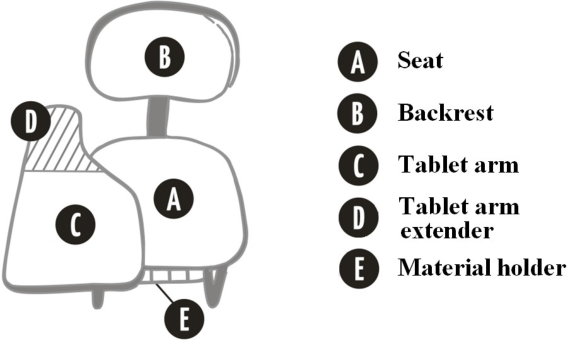
Chair with tablet arm is a school furniture intended for use of adolescents and adults, whose purpose is to meet the educational tasks of reading, writing, discussion and observation expository activities, whose main feature is to group in a single structure the following subsystems: seat, backrest, tablet arm and material holder (Soares, 1998). Other point of view states that this furniture design is intended to read and write, attending only conference or group discussion activities (Brasil, 1982). The same source also points out that this furniture is the result of the coupling of tablet arm and material holder to desks of the own production line of furniture companies.
Studies using chair with tablet arm have found discrepancy between anthropometric measures of students and the dimensions of the furniture used (Castilho et al., 2012; Chung and Wong, 2007; Dianat et al., 2013; Gouvali and Boudolos, 2006; Jung, 2005; Panagiotopoulou et al., 2004; Parcells et al., 1999; Rego and Scartoni, 2008; Thariq et al., 2010); however, few studies have focused on the effect of school furniture on the body posture of students when performing the tasks required in classroom (Soares, 1998; Siqueira et al., 2008).
It is noteworthy that several studies have addressed the presence of body discomfort in students of different age groups (Brewer et al., 2009; Murphy et al., 2004; Panagiotopoulou et al., 2004; Rego and Scartoni, 2008) and for Corlett (2008), the use of inappropriate furniture may cause body discomfort.
Siqueira et al. (2008) found that most college students adopt inadequate postures during class because they adapt their anthropometric characteristics to inappropriate furniture, which are determinant factors for the onset of body discomfort.
As exposed by Chaffin et al. (2006), several factors may interfere in the sitting posture such as height and inclination of the chair seat, position, shape and inclination of the backrest and the presence of other types of support. For these authors, during sitting, the user’s body weight is transferred to the chair, mainly for the seat, and also to the ground, backrest and forearm support. According to Thariq et al. (2010), the postural effects and the benefits to learning while using chair with tablet arm should be better investigated.
Based on these assumptions, this study examined the perceptions of college students regarding body posture (trunk inclination) adopted while using chair with tablet arm and their preference for two chair models (with and without armrest), and also the associations between these variables and sex, age, course shift and school furniture design.
METHODS
This study was approved by the local Ethics Committee under protocol number 2161/2011, in which 420 university students aged 22.4 ± 5.0 years participated.
Data collection was conducted in the classrooms of five Higher Education Institutions (HEIs) of Florianópolis, Santa Catarina, Brazil, (two public and three private), who used chair with tablet arm (see Figure 1) as school furniture.
Figure 1. School furniture subsystems (Tirloni, 2013).
The students were from different undergraduate courses (Physical Education, Law, Journalism, Design, Fashion, Business, Physiotherapy, Accounting Sciences, Building Construction, Nutrition and Radiology) and shifts (morning, afternoon and evening), and the intentional sample was selected by volunteering.
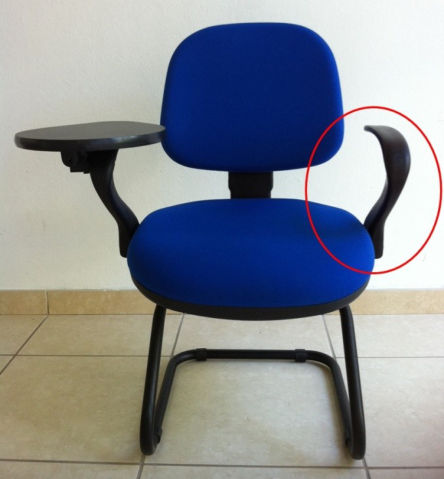
A questionnaire was used as a measuring instrument, containing identification data and questions about students’ perception about their staying for more than half the time of a class with trunk leaned (laterally or anteriorly) over the tablet arm and the preference of students as to the existence of armrest (at the opposite side to the tablet arm) in school furniture (see Figure 2).
Figure 2. School furniture armrest (Authors)
Data collection occurred in 30 classrooms. Two chair models with tablet arm (with and without armrest) were investigated. By answering the questions, the students were sitting on the chair for at least one class (~ 50 minutes).
Statistical analysis was performed with SPSS® for Windows version 17.0 (SPSS Inc., Chicago IL , USA) software. Descriptive statistics with frequency, mean and standard deviation was used. To facilitate the statistical analysis, variable age was categorized by age groups: 18-30 years and older than 30 years.
To investigate the association between body posture adopted when using the chair with tablet arm and the students’ preference for chair with armrest and these variables with sex, age group, course shift and existence of chair armrest, the chi-square test with p ≤ 0.05 was used.
RESULTS
It was found that 63.6% of students mentioned staying more than half the time of a class with the trunk leaning over the tablet arm.
Table 1 shows the frequencies, percentages and associations between body posture adopted by students (not leaned and leaned) and the following variables: sex, age, course shift and preference for chair with armrest.
According to data shown in Table 1, it was observed that the majority of college students were female, aged less than 30 years, had preference for chair with armrest at the opposite side of the tablet arm, and also that the number student by course shift was equivalent .
There was association between body posture and sex (p = 0.003), in which women mentioned leaning more the trunk laterally and/or anteriorly than men and with the current school furniture design (p = 0.003), and most students who used chair without armrest realized that they leaned the trunk over the tablet arm (66.3%), while 54.5% of those who used chair with armrest did not lean the trunk.
Table 1: Distribution of frequency, percentage and association of body posture of college students with variables sex, age, course shift and preference for chair with armrest (Authors)
Table available in the original PDF paper.
Body posture
Total Variables No leaning Leaning p n % n % n %
Sex Female 268 63.8 84 54.9 184 68.9 0.003* Male 152 36.2 69 45.1 83 31.1
Age 18-30 years 391 93.1 141 92.2 250 93.6 0.349 > 30 years 29 6.9 12 7.8 17 6.4
Preference for chair with armrest Yes 285 67.9 106 69.3 179 67.0 0.359 No 135 32.1 47 30.7 88 33.0
Chi-square test; * p ≤ 0.05
It was found that 67.9% of students preferred school furniture with armrest at the opposite side to the tablet arm; however, there was no association between the preference of students for chair with armrest and variables sex (p = 0.385), age group (p = 0.308) and course shift (p = 0.796). However, there was association with the school furniture model (p < 0.001), i.e., it was observed that 64.1% of students who used chair without armrest and 92.7% with this accessory had preference for chair with armrest, and the proportion of students who used chair with armrest was higher.
DISCUSSION
The results of this study indicate that students distributed much of their body weight on the tablet arm, since it was found that most leaned their trunk on it for more than half the time of a class. As reported by Chaffin et al. (2006), one of the factors that can interfere with the sitting posture is the presence of supports. In this study, that was confirmed by the presence of association between body posture and school furniture design, since a high number of students leaned their trunk on the tablet arm in chair without armrest.
In a study with 16 college students who participated in practical classes in a laboratory, it was found that the spine Ergonomics In Design, Usability & Special Populations II was the body region with more complaints, which suggests preventive measures to reduce the load on their back such as the exchange of seats by chairs with backrest and also the students’ arms should be supported on the table or on the chair armrest, reducing fatigue and muscle pain (Massambani and Santos, 2001).
The sitting posture adopted by individuals when performing tasks can interfere with pressure area, since Makhsous et al. (2003) measured this variable in 15 workers with and without support in the tuberosity of hamstring muscles and found that there was difference in conditions with straight spine with and without support on the backrest in the relaxed position and working with the trunk leaned forward using the table as arm rest. However, there was no difference in peak pressure in the seat in the relaxed (p = 0.188) and working posture (p = 0.131). That is, when individuals sat without support for hamstring muscles, variables were smaller in the seat in three conditions; but, variables were higher in the backrest in two conditions in which this chair subsystem was used (upright and relaxed with the use of the backrest). These results indicate that the forces applied to the chair supports vary according to the posture adopted and the use of supports; therefore, the chair armrest can influence the distribution of the body mass on the hamstring muscles, and posture less leaned laterally over the tablet arm can balance the pressure between tuberosities of hamstring muscles.
The present study showed that women perceived that they leaned the trunk over the tablet arm more than men, this fact corroborates the results of Silva et al. (1999), who reported that school-age girls like to write more and are more detail-oriented than boys. According to Pajares and Valiante (2001), the writing process is associated with a feminine orientation, as writing is seen by most students, especially by younger ones, to be mainly associated with female domain. The same authors state that there is an appreciation of the writing process by female students.
According to Womersley and May (2006), a relaxed sitting posture leaning forward may be associated with low back pain. Soares (1998) found that when college students lean their trunk forward to be able to satisfactorily perform the writing and reading activities in the chair with tablet arm did not remain with their back against the backrest, a fact that occurred due to the mismatch between distance from the tablet arm and the students’ eyes (around 30 cm). The same author reported that the trunk rotation occurred when the student talked or gave material to a classmate, and also the non-influence of the tablet arm positioning on the lateral flexion (inclination) of the trunk during the performance of activities in classroom.
The study of Khanam et al. (2006a) showed 12 opinions of students aged from 18 to 22 years on the features that they wanted the school furniture to have, it was found that no student mentioned armrest at the opposite side of the tablet arm. However, between two school furniture models investigated (sled desk, chair with tablet arm), 62% of the students preferred chair with tablet arm.
In this study, the preference for chair with armrest at the opposite side of the tablet arm was higher in both groups of students (chair with and without armrest). In contrast, Khanam et al. (2006b) studied the opinion of 30 students on the design of three chair models with tablet arm and found that most students (70%) felt uncomfortable and mentioned that this accessory interfered with the body movement when entering and leaving the desk.
In a review study, Grimes and Legg (2004) found that the relationship between musculoskeletal disorders among adult workers and inadequate school posture and the development of neck and/or back pain is not clear and point out that a study of longitudinal, coordinated and cooperative approach should be conducted to confirm this goal.
Bettany-Saltykov and Cole (2012) conducted a study with 25 college students and evaluated the effects of the way they carried their bags (in front of the body, on one shoulder and on one hand); each bag weighted 15% of the student’s body mass. It was found at the time of data collection that all ways of carrying the bag produced postural disorders, and the unilateral transportation of the bag caused deviation significantly higher than the symmetric bag transportation. The authors concluded that carrying bags unilaterally produced deviations in all planes, which can cause damaging stress and tension on the spine structures and ultimately pain and progressive postural scoliosis.
Due to the results of this study, further studies should be carried out with postural assessments of college students when entering and graduating in order to have control of internal and external variables that can affect the onset of postural disorders. Only this way, it will be possible to demonstrate the association between the use of the chair with tablet arm without armrest and the occurrence of postural disorders.
CONCLUSIONS
Based on the results of this study, it is concluded that most students lean the trunk over the tablet arm during class and it was also found that most students mentioned that they would like to have chair with armrest. It is noteworthy that most students who preferred this model were those that used chair with armrest.
There was an association between body posture and sex and the school furniture design, and the trunk inclination over the tablet arm was more reported by women than by men, and most students who used chair without armrest leaned their trunk over the tablet arm, unlike what was observed for chair with armrest.
Thus, further studies should be conducted, investigating the reasons for the trunk inclination over the tablet arm, the presence of body discomfort during use, especially on the spine, and the effect of the use of chair with and without armrest on the onset of postural disorders. Furthermore, the factors that determine the preference of students for this school furniture model and the implications of the armrest on its usability should also be investigated. Finally, postural education programs should be included in undergraduate courses, emphasizing the most appropriate body posture while sitting and using the school furniture in order to avoid damage to the health of students.
REFERENCES
Bettany-saltikov, J., Cole, L. (2012), “The effect of frontpacks, shoulder bags and handheld bags on 3D back shape and posture in young university students: An ISIS2 study”, STUDIES IN HEALTH TECHNOLOGY AND INFORMATICS. Volume 176. pp. 117-124. Brasil. (1982), Ministério da Educação e Cultura CEDATE. “Mobiliário escolar; carteira universitária”. Rio de Janeiro, 1982.
35p. (Equipamentos escolares 2)/ Critérios para projetos/ mobiliário escolar/ utilização/ lateralidade/ aluno/ técnica de construção/ produção/ ergonomia/ antropometria/ método de avaliação/ segurança/ postura física/ conforto. Brewer, J.M., Davis, K.G., Dunning, K.K., Succop, P.A. (2009), “Does ergonomic mismatch at school impact pain in school children?” WORK. Volume 4. pp. 455-464. Castellucci, I., Gonçalves, M.A.; Arezes, P., (2009), “Consideraciones Ergonómicas de las Salas de Clases en Escuelas
Portuguesas de Primer Ciclo”, CIENCIA & TRABAJO. Volume 11. No. 34. pp. 184-187. Castilho, A.S., Leme, C.C.A., Padula, R.S. (2012), “Analysis of the suitability of furniture university – anthropometric characteristics of user”, WORK. Volume 41. pp. 5411-5412. Chaffin, D.B., Andersson, G.B.J., Martin, B.J. (2006), “Occupational biomechanics”, 4. ed. NJ: Wiley. Chung, J.W.Y., Wong, T.K.S., (2007), “Anthropometric evaluation for primary school furniture design”, ERGONOMICS.
Volume 50. No. 3. pp. 323-334. Corlett, E.N. (2008), “Sitting as a harzard”, SAFETY SCIENCE. Volume 46. pp. 815-821. Dianat, I., Karimi, M.A., Hashemi, A.A., Bahrampour, S., (2013), “Classroom furniture and anthropometric characteristics of Iranian high school students: Proposed dimensions based on anthropometric data”, APPLIED ERGONOMICS. Volume 44. pp. 101-108. Khanam, C.N., Reddy, M.V., Mrunalini, A. (2006a), “Designing Student's Seating Furniture for Classroom Environment”,
JOURNAL OF HUMAN ECOLOGY. Volume 20. No. 4. pp. 241-248. Khanam, C.N., Reddy, M.V., Mrunalini, A. (2006b), “Opinion of Students on Seating Furniture Used in Classroom”, JOURNAL OF HUMAN ECOLOGY. Volume 20. No. 1. pp. 15-20. Gouvali, M.K., Boudolos, K. (2006), “Match between school furniture dimensions and children’s anthropometry”, APPLIED
ERGONOMICS. Volume 37. pp. 765-773. Grimes, P., Legg, S. (2004), “Musculoskeletal Disorders (MSD) in School Students as a Risk Factor for Adult MSD: A Review of the Multiple Factors Affecting Posture, Comfort and Health in Classroom Environments”, JOURNAL OF THE HUMAN- ENVIRONMENTAL SYSTEM. Volume 7. No. 1. pp. 1-9. Jung, H.S., (2005), “A prototype of an adjustable table and an adjustable chair for schools”, INTERNATIONAL JOURNAL OF
INDUSTRIAL ERGONOMICS. Volume 35. pp. 955-969. Lutes, L., Davies, R. (2013), “Comparing the Rigor of Compressed Format Courses to Their Regular Semester Counterparts”, INNOVATIVE HIGHER EDUCATION. Volume 38. pp. 19-29. Massambani, E.M., Santos, S.R.S.R. (2001), “Estudo das implicações na postura sentada durante análise microscópica em um
laboratório de universidade”, PRODUÇÃO ONLINE. Volume 1. pp. 1-8. Makhsous, M., Lin, F., Hendrix, R.W., Hepler, M., Zhang, L. (2003), “Sitting with Adjustable Ischial and Back Supports: Biomechanical Changes”, SPINE. Volume 28. No. 11. pp. 1113-1122. Murphy, S., Buckle, P., Stubbs, D. (2004), “Classroom posture and self-reported back and neck pain in schoolchildren”,
APPLIED ERGONOMICS. Volume 35. pp. 113-120. Panagiotopoulou, G., Christoulas, K., Papanckolaou, A., Mandroukas, K. (2004), “Classroom furniture dimensions and anthropometric measures in primary school”, APPLIED ERGONOMICS. Volume 35. pp. 121-128. Parcells, C., Stommel, M., Hubbard, R.P. (1999), “Mismatch of Classroom Furniture and Student Body Dimensions”,
JOURNAL OF ADOLESCENT HEALTH. Volume 24. pp. 265-273. Pajares, F., Valiante, G. (2001), “Gender differences in writing motivation and achievement of middle school students: a function of gender”, CONTEMPORARY EDUCATIONAL PSYCHOLOGY. Volume 26. pp. 366-381. Rego, A.R.O.N.; Scartoni, F.R. (2008), “Postural alterations of 5th and 6th grade of the school”, FITNESS & PERFORMANCE
JOURNAL. Volume 7. No. 1. pp.10-15. Reis, P.F., Moro, A.R.P., Da Silva, J., Paschoarelli, L., Nunes Sobrinho, F., Peres, L. (2012), “Anthropometric aspects of body seated in school”, WORK. Volume 41. pp. 907-914. Ruiz-Gallardo, J., Castaño, S., Gómez-Alday, J.J., Valdés, A. (2011), “Assessing student workload in Problem Based Learning:
Relationships among teaching method, student workload and achievement. A case study in Natural Sciences”, TEACHING AND TEACHER EDUCATION. Volume 27. No. 3. pp. 619-627. Savanur, C.S., Altekar, C.R, De. A. (2007), “Lack of conformity between Indian classroom furniture and student dimensions: proposed future seat/table dimensions”, ERGONOMICS. Volume 50. pp. 1612-1625. Silva, C.A.D., Halpern, F.B.S., Silva, L.A.D. (1999), “Good girls, good students; smart boys but misbehaved”, CADERNOS DE
PESQUISA. No. 107. pp. 207-225. Siqueira, G.R., Oliveira, A.B., Vieira, R.A.G. (2008), “Classrooms’ ergonomic inadequacy and discomfort at a private academic institution in Recife-PE”, BRAZILIAN JOURNAL IN HEALTH PROMOTION. Volume 21. No. 1. pp. 19-28. Soares, M. M. (1998), “Contribuições da ergonomia do produto ao design de mobiliários escolares: carteira universitária, um
estudo de caso”, ESTUDOS EM DESIGN. Volume 6. pp. 33-61. Tirloni, A.S. (2013), “School furniture ergonomic survey: validation of an instrument using Item Response Theory (IRT)”.
Thesis (PhD). Florianópolis: Universidade Federal de Santa Catarina, Centro Tecnológico, Programa de Pós-graduação em Engenharia de Produção. Thariq, M.G., Munasinghe, H.P., Abeysekara, J.D. (2010), “Designing chairs with mounted desktop for university students: Ergonomics and comfort”, INTERNATIONAL JOURNAL OF INDUSTRIAL ERGONOMICS. Volume 40. pp. 8-18. Womersley, L., May, S. (2006), “Sitting posture of subjects with postural backache”, JOURNAL OF MANIPULATIVE AND
PHYSIOLOGICAL THERAPEUTICS. Volume 29. No. 3. pp. 213-218.
LISTED IN THE AHFE DIGITAL BOOKSTORE CATALOGUE
Explore the complete digital volume
Advances in Ergonomics In Design, Usability & Special Populations: Part II
Read this individual research paper free through the original publisher, or explore the full digital proceedings book.
ISBN 978-1-4951-2107-4
Explore this ISBN in the AHFE Bookstore ↗Listed in the July 2026 bookstore catalogue; search by ISBN to confirm current availability · Digital book purchase optional