Breno Carvalho, Marcelo Soares, Andre Neves, Gabriel Soares, Anthony Lins (2022). The State of the Art in Virtual Reality Applied to Digital Games: A Literature Review. In: Advances in Ergonomics In Design, Usability & Special Populations: Part I. AHFE Open Access, vol. 18. https://doi.org/10.54941/ahfe100811
The term Virtual Reality (VR) was coined by the artist and computer scientist Jaron Lanier, by which he succeeded in expressing the search for the merger between what is real and what is virtual in the 80s. Based on movies such as Tron, by Steven Lisberger, the concept became known worldwide as a technology for digital games the aim of which was to prompt the user into greater interaction with, immersion in and engagement with the environment and the projected narrative. This study sets out a review the state of the art on the concept of VR used in the universe of digital games, whether in the context of research or entertainment, starting with a re-reading of scientific articles, books and online publications on the subject. In the context of digital games, in the past there was a major difficulty about using equipment such as a helmet with goggles, for ergonomic reasons. Currently, new devices are being enhanced to make their usability better for the user, and there are new applications such as using serious games in support of the fields of education and health and in the future, there will be nanotechnology projects applied to virtualizing reality and overcoming the limitations of the human body within the virtual world.
After the 2nd World War, various studies were conducted to develop simulators for military training with a view to avoiding accidents to humans, besides which this reduced costs and pinpointed design flaws. These simulators did not have a system for obtaining visual feedback. All they did was to simulate the ratio of movements in a three- dimensional spatial perspective when they were being used. With the advances of computer vision technology, the first artifacts were created that enabled reality to be virtualized in a less complex way with regard to rendering graphics more realistic in addition to which they enhanced the user’s experience of immersion. In the 1980s, the term Virtual Reality (VR) was coined by the artist and computer scientist, Jaron Lanier, who thereby succeeded in expressing the search for the merger between what is real and what is virtual (Kirner and Torir, 2004). In mid-1982, the movie Tron by Steven Lisberger, spread this concept massively, by presenting the universe of VR as a technology for digital games, aided by quality graphics in visuals that served as the standard for the digital entertainment industry. As an example, there are the games Crysis and Halo, which provide the user with greater interaction with and immersion in the technology.
Ergonomics In Design, Usability & Special Populations I (2022) https://openaccess.cms-conferences.org/#/publications/book/978-1-4951-2106-7
Virtual Reality is based on three basic principles (Pinho, 2004): Immersion, Interaction and User involvement with the environment and narrative proposed. On using Virtual Reality, software becomes more interactive, through which the user stars to become part of a virtual space, thus enabling data to be manipulated and exploited in real time by using one´s senses in a three dimensional environment. The objective of this study is to review the state of the art on the concept of VR used in the universe of digital games, whether in the context of research or entertainment, and to do so by setting out from a re-reading of scientific articles, books and online publications on the subject.
In the context of digital games, in the past there was a major difficulty about using equipment such as a helmet with goggles because the ergonomics of these were poor. Currently, we see a new perspective as artifacts with better usability are being developed (Balista, 2013; Dias and Zorzal, 2013) that seek to improve the user’s experience of digital games e.g. Kinect (Microsoft) and Oculus Rift (Oculus VR), together with other interaction mechanisms, such as gloves and the Omini Treadmill platform.
This article is divided into four Sections. First a re-reading of what Virtual Reality is and its aspects will be presented. Then we present the evolution of VR games without immersion, including the evolution of input artifacts that lead to greater playability and immersivity on comparing the 1980s with the 1990s. The third Section describes some serious games applied to several areas that are not entertainment, which demonstrates the extent to which VR games are used. Finally we present some input artifacts for VR with immersion that were developed for the use of researchers, and others that have been developed for the purposes of entertaining the general public.
As to future prospects for using VR in digital games, what are being sought are the development of low cost devices as well as an increase in research studies on the use of nanotechnology applied to virtualizing reality to overcome the limitations of the human body within the virtual world.
VIRTUAL REALITY: THEORETICAL BASES In the late 1980s, the artist Jaron Lanier presented the term Virtual Reality as a technology that sought to merge the real with the virtual. However, research on this technology date back to the 1960s and 1970s with the development of artifacts in seeking closer to the human senses interactive interfaces. These interfaces were trying to simulate the real world.
Long before the introduction of the term coined by Jaron Lanier, we should highlight the computer scientist Ivan Sutherland who was the forerunner of a series of research and development on artifacts that make the virtual reality applications we know today possible (Kirner and Tori, 2004). It was in the 1960s he developed the virtual reality helmet, "Ultimate Display" (Packer, 2001). In this section we shall discuss the bases of virtual reality presented by several researchers. It should be remembered that in-depth discussion on Mixed Reality and Hyperreality will not be entered into.
According to (Rebelo et al., 2011), Virtual Reality (VR) is "the use of computer modeling and simulation that allows a person to interact with a three-dimensional (3D) visual artificial environment or to have other sensory involvement. In VR situations, the user is located in a computer-generated environment in which reality is simulated by using interactive devices. These send and receive information and can be used in the form of goggles, ear-phones, gloves or body suits. In a typical VR environment, the user who makes use of a helmet with a stereoscopic screen sees animated images of a simulated environment."
According to (Hand, 1996), VR is the paradigm under which people use a computer to interact with something that is not real, but when they use it, people may consider it to be real. This can be considered as the most advanced digital interface between users and computers, where people can interact with a virtual model in real time (Whyte,
Ergonomics In Design, Usability & Special Populations I (2022) https://openaccess.cms-conferences.org/#/publications/book/978-1-4951-2106-7
2002), which enables them to visualize and manipulate representations of the real world (Aukstakalnis and Blatné , 1992).
Some authors aimed at the concept of virtual reality as a three-dimensional virtual environment receiving human interactions by means of devices (goggles, gloves and clothing) (Coates, 1992). These simulated environments are in general visited with the help of a garment with sensors, which features stereo video goggles and gloves with fingers in optic fibre (Greenbaum, 1992). Virtual reality can also be defined as a real or simulated environment in which an observer experiences telepresence (Steuer, 1993). Through this technology, the user can be given a state of experiencing something that does not exist or is not happening (Piovesan et al., 2011). Other researchers stated that VR is a simulation in which computer graphics are used to create a realistic-looking synthetic world that is not static but which responds to the user’s interaction with the virtual application (Burdea and Coiffet, 2003). The perspective of VR interaction is related to the real-time response, which is an essential feature, and this shows that the computer is able to detect a user's input and modify the virtual world instantaneously (Vilar, 2012). Together with interaction, immersion is another important aspect of VR. This is about the extent to which users’ senses are attracted and motivated by the virtual world as if it were real (Duarte, Rebelo and Wogalter, 2010) , (Ragusa and Bochenek, 2001), (Witmer and Singer, 1998). Generally, immersion in VR is related to artifacts that go beyond a common monitor and input devices, such as a mouse and keyboard. Thus, there are three levels of VR: immersive , non-immersive and semi-immersive (Ramaprabha and Sathik, 2011).
Immersive VR is when the interaction is mediated by a head-mounted display (HMD) and a position sensor of the tracker. The second classification is the non-immersive one, where interaction occurs using a common monitor, replacing the HMD (Gorini, Capideville, De Leo, Mantovani and Riva, 2011). This model is the one most experienced by those who play commercial 3D games. The third category, the semi-immersive one, occurs when the HMD is replaced by multiple televisions or large projection screens, like IMAX movie screens (Gutierrez et al., 2008).
Other studies point out a third basic principle on which VR is based: Involvement (Pinho, 2004). His perspective proposes that the user could be part of the virtual world. On directly interfering in the outcome of the application, the user could navigate the virtual environment passively or actively during the process of exploring a virtual environment. To involve the user, it is extremely important that there is a relationship between immersion and the narrative context because immersion creates an illusion of space while the context creates an experience that will be controlled by the subject’s needs.
In wayfinding studies, virtual reality is always a powerful tool because researchers can manipulate variables while considering more aspects than those used in the traditional media, thus allowing the experiments to be more controlled. The same happens with aspects of mental workload during tests of navigation, numbers, sounds, people moving around the building, time and other variables that could influence wayfinding actions (Vilar, 2012). An important argument about the use of virtual reality is with regard to its flexibility. From this technology, researchers can develop new worlds for the purpose of study in addition to having greater control of the possible variables. Also, with this technology, any changes in the experimental environment can be made at low cost and in less time (Morganti et al, 2007). We should stress that some studies on virtual reality present the concept of Augmented Reality (AR) as a technology that prompts research with users based on real-time interactions with virtual objects inserted into the real context (Medeiros et al, 2008). The basic objective of an AR system is to increase the user's perception and interaction with the real world by means of having the real world interact with virtual 3D objects that appear to coexist in the same space as the real world (Azuma et al., 2001).
Ergonomics In Design, Usability & Special Populations I (2022) https://openaccess.cms-conferences.org/#/publications/book/978-1-4951-2106-7
Another definition for AR is a variation of the Virtual Environment or Virtual Reality as it is more commonly called (Azuma, 1997). Besides defining Augmented Reality, Azuma, Milgram and Kishimojin (Milgram and Kishimojin, 1994) put forward a definition using the Milgram Reality-Virtuality Continuum (see Figure 1). AR simply means "augmented reality", and this process is augmented only by adding some additional data so as to perceive the objects around us that are not visible memory. AR is the artificial, seamless and dynamic integration of a new item of content, or the removal of the existing content of perceptions of the real world (Fahey, 2013).
Figura 1. Milgram Reality-Virtuality Continuum (Adapted from Milgram and Kishimo, 1994).
O the left side of Figure 1 there is a reference to the real world. On the far right is the virtual world. A Virtual Reality (VR) environment is a computer-simulated environment that can simulate the real world or an imaginary world in which the environment is virtual, while in AR the surrounding environment is real. Virtual reality allows participants of the study to join the virtual environment from different perspectives and to interact with virtual objects, even those that would not fit into the real situation. The use of this technology allows participants’ actions to be precisely recorded ranging from small steps to moments of hesitation which would not be perceived in the real world. By studying the actions of a person in virtual reality, extremely difficult observations can be noted such as the movement of the direction in which the eye is observing (Vilar, 2012). Thus, the kind of observations that would be extremely valuable to make in the real world suddenly become possible in the virtual world (Conroy, 2001).
DIGITAL GAMES: HOW INTERACTION ENVIRONMENTS EVOLVED The use of 3-D interfaces
A classic definition of what games are, is presented as a voluntary activity or occupation, performed during certain limits of time and space, with freely consented to and mandatory rules, accompanied by a feeling of tension and delight, as well as an awareness of being different from everyday life (Huizinga, 1993).
Since its emergence as a hobby, as in the classic Pong from Atari, in the 1970s, games has evolved their approaches in terms of the mechanics, human-computer interaction, narratives and characters. Ever since the first versions in 4 bits of information, with the limitations of 2D graphics, the learning atmosphere of the games made interactions possible that led some users to get lost in time and space (Carvalho et al, 2013).
The games industry accompanied the technological advances of the past 40 years, by evolving playabilities for greater interaction and graphics that allowed photographs of characters in a two-dimensional environment to be projected, such as the fight game Mortal Kombat, released in 1992 by the Nintendo Company (Lewis, 2013). In the 1980s, Ed Rotberg, of the Arcades Division of Atari created the first 3D first-person game, Battlezone, in order to simulate a challenge from a tank warfare scenario (UOL, 2014).
Ergonomics In Design, Usability & Special Populations I (2022) https://openaccess.cms-conferences.org/#/publications/book/978-1-4951-2106-7
In 1988, Bruce Artwick and his team launched the game Microsoft Flight Simulator 3.1, in which the player interacted with 3D graphics and acceleration hardware, mediated by input devices that allowed the user to pilot a virtual plane and experience all the control interface of a real aircraft (Wikipedia, 2013). This game was a milestone in the gaming industry, as it stimulated the research and development of artifacts for human-computer interaction, that were closer to the real world e.g. joysticks, steering controls, and so forth.
Another important milestone was the launch of the title Doom, from id Software in 1993 (UOL, 2013), which popularized the style of first-person games. This game, in 32-bits (an innovation for its time began the era of virtual reality games without immersion as it allowed users to interact with realistic graphic elements in a 3D environment with the sound of the virtual environment.
Until 2002 there were no significant innovations in the context of human-computer interaction, except the improvement of the graphic processing of 3D elements. In 2003, with the launch of the multiplayer title Second Life, from Linden Lab, the player could create a virtual copy closer to himself, called an Avatar or virtual humans (Badler, 1997) and explore virtual environments with aspects of a human being’s real and social life. By allowing a transposition of scenarios, emotions and interpersonal interactions of the real world to the metaverse (Azevedo, 2013), this game sparked several discussions about the concept of game, the level the user’s immersion without traditional VR devices, and matters related to socio-political and cultural rules since the platform allowed a second life to be created.
During the E3 event, the Electronic Entertainment Expo 2005, Nintendo revolutionized the way of interacting and playing games with the release of the Wii console and wireless controller Wiimote, which made the experience much more immersive, richer and more fun (Oliveira 2009). Using sensor technology, able to detect movement in three dimensions and an accelerometer, the player controlled his/her character by using buttons and carrying out intuitive movements according to the action of the game. Starting with Wiimote, other devices were developed through research, usability and human-computer interaction.
Microsoft developed the Christmas project so as to recognize gestures and in 2010 launched a Kinect device for the Xbox-360 console, which allowed the player to control his/her character using body movements without using controls . Natural gestures captured by equipment which is currently cheaper and more accessible to the general public, provide commands and functions that are more oriented to human beings, thus making the experience of interaction with (entertainment and serious) games and interactive applications more immersive. Kinect and PrimeSense are examples of artifacts for recognizing 3D gestures. Likewise, Smartboards such as Wiimote, are common to 2D gestures.
These new artifacts of human-computer interaction allowed the use of virtual reality games in other areas such as motor rehabilitation, psychological treatments, sports physiology and business training. Another device that allows human-computer interaction through gesture recognition, at low cost is the Leap Motion Controller. This is a device made to interpret the gestures of the hands and fingers, whether to shoot in a game, turn the page on a tablet or draw in any kind of software. It is able to recognize movements as small as 0.1 millimeters. Recently, Google has been developing a project for the creation of 3D models based on the capture of objects (and environments) from the real world. This project is called Project Tango (Google, 2014).
VIRTUAL REALITY WITH SERIOUS GAMES
The term serious games is a class of games that aims to simulate everyday practical situations, with the objective of providing training for professionals, critical business situations and educating children, teenagers and adults. The games in this category have a specific purpose, i.e., they extrapolate the idea of entertainment and offer other types of experiences, such as those that target learning and training (Machado et al., 2009).
Ergonomics In Design, Usability & Special Populations I (2022) https://openaccess.cms-conferences.org/#/publications/book/978-1-4951-2106-7
The games known as serious games build a graphical interface used in video games to make the software more attractive. In addition, they carry out activities that foster the absorption of concepts and psychomotor skills (Duarte et al., 2012).
The usability of Virtual Reality without immersion is observed in the use of serious games by researchers, scientists and professionals from various fields, such as health and education (Virvou and Katsionis, 2008). Some articles present studies that adapt commercial games; others developg their own digital artifacts.
A survey on the production of articles on serious games in Brazil linked to the correlated area of health shows there are studies on Psychology, with the topics of Learning Disorders, Attention Deficit Disorder and Hyperactivity, Therapy and Autism; on Speech Therapy with topics on Therapy of Speech Disorders, Hearing Loss and Hearing Disorder, Oral Motricity; on Dentistry on Periodontics; and in Physiotherapy in the motor area (Duarte et al., 2012).
Computer games have recently been successfully adapted so as to generate environments and treat specific phobias, e.g., trauma caused by traffic accidents (Motor Vehicle Accident - MVA, including those of a non-serious nature but which increase the risk of severe psychiatric morbidity in survivors (Walshe et al., 2003). According to researchers, the use of Virtual Reality games in offices provides the psychologist with greater control over exposure stimuli and minimizes the exposure of patients to potential embarrassment (Walshe et al., 2003). Also in the field of psychological disorder treatments, there is also the use of Augmented Reality technology, in which the patient is subjected to a simulation with spiders and cockroaches (Medeiros et al., 2008).
In the Laboratory of Virtual Reality applied to Design and Ergonomics, in the Department of Design, Federal University of Pernambuco, studies are being undertaken on the application of this technology as an aid in the rehabilitation of patients with Alzheimer's, work-related musculoskeletal disorders and measuring the strength limits of elderly users.
A growing field is "Cyberpsychology". This discipline can be described in epistemological terms as the study of the connection between psychological processes and virtual action systems (Virole, 2003). When using games in virtual environments, e.g., MMORPGs (Massive Multiplayer Online Role Playing Games) the unconscious representations of the players can be observed because it is considered that when a player is immersed in a section of the game, how he/she chooses his/her avatar is committed to his/her psyche in a unique way (Donard, 2011). According to this researcher, games like RPG Divinity 2 have made positive results with her patients possible (Carvalho, 2014).
Soares and Falcao (2013) define games for learning as those that integrate games or the mechanics of a game in educational experiences. Thus, the authors continue, these games involve assigning scores commonly used in digital games, making students become involved so as to do better and to go on to the next level and finally achieve the goals. Thus, they are motivated to learn in a new learning space, which benefits the students’ cognitive development and skills such as collaboration, communication, problem solving, critical thinking and computer literacy (Johnson et al., 2012).
In education, games developed by the research teams were found, some of which are initial experiments. One such project is the game VR-Engage, similar to the popular game Doom mentioned above. The ultimate goal of a player is to navigate through a virtual world and find the book of wisdom (Virvou and Katsionis, 2008). An interesting project is the game Moon (Lua in Portuguese), which presents a prism of Indigenous Brazilian Culture, with a digital artifact to assist with indigenous education in schools (Tomeis and Corral, 2013).
Another example is a 3D computer game to teach physics. The plot of the game is in the style of an adventure, discovery and rewards. The character aims to survive the various traps scattered around the scenario and it will have to solve physics problems. The setting is a castle, where the player will go through different spaces and secret rooms, a basement, etc (Calegari et al., 2013).
Ergonomics In Design, Usability & Special Populations I (2022) https://openaccess.cms-conferences.org/#/publications/book/978-1-4951-2106-7
Another application example is the game "Legends of Alkhimia" developed by the Learning Laboratory in Sciences of the National Institute of Education Singapore. The digital game supports the chemistry curriculum for secondary education and students learn the subject through investigation, conducting chemical experiments, while working as chemical apprentices (Jan et al., 2010). The State Government of Pernambuco has very successfully held the Olympics of Digital Games and Education which aims to provide elementary school students and teachers with activities using dialogue and fun provided by the web environment, and emphasizes collaborative and cognitive activities by the participants. Many of the learning activities are carried out through simulations using virtual and augmented reality environments.
KinectER is an educational game that aims to train nursing, medicine, dentistry and orthopedics students. This game uses the Kinect device to mediate the interaction between the student and the digital narrative (Lanza et al. 2013). Also developed and commercialized in Brazil we have the game VRUM of an educational character that enables children and adolescents to absorb the main traffic rules in a fun and intuitive way (Alves, 2012).
From the perspective of business and economics, we also found two games that deliver the study of taking decision factors for purchase products online, namely the Ultimatum Game and the Dictator Game. The games use an agent of multimodal communication, a virtual human, to interact with and persuade humans (Nouri and Tram, 2013).
Finally, other games for training are the Celestia game, geared primarily at astronomy, education and planetary exploration, and VT MÄK of VR systems used military and war training (Cerqueira, 2013).
It is important to make clear that in the latest National Technology Plan for Education in the United States, the game was named as an ideal method for assessing a pupil´s understanding of knowledge (Johnson et al., 2012).
In this perspective, simulators for training naval professionals and officers are also being developed. This is a national passageway simulator, with the goal of simulating the Brazilian merchant marine ships, which have important features when compared to other types of vessels (Lage et al., 2012).
INPUT DEVICES FOR VIRTUAL REALITY WITH IMMERSION Since the creation of the first helmet for Virtual Reality by Ivan Sutherland, such artifacts have always been used by private or government companies and research institutes. Due to economic factors this equipment was inaccessible to the general public. There were also ergonomic and usability problems because the helmets were heavy and caused users discomfort or nausea (Cobb et al., 1999). With the advance of research hardware, companies have invested in studies to make Virtual Reality input devices with immersion more ergonomic and, in some cases, they are mass- produced and accessible to society as devices for entertainment. We present below some examples of products that have recently become available in the market.
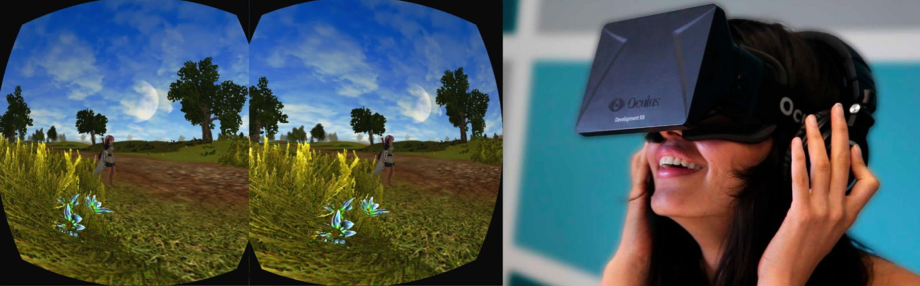
Oculus Rift The Oculus Rift (see Figure 2) is a new headset with a visor for virtual reality. The Rift makes it possible for players to feel they have entered their favorite games and virtual worlds. The Rift uses customized tracking technology, to provide ultra-low latency for 360° head movements, thereby allowing the user to look around the virtual world easily, just as one would do in real life. The Oculus Rift creates stereoscopic 3D viewing with excellent depth, scale, movement and moving scenes. The Oculus Rift provides a high-end virtual reality experience at an affordable price. The combination of a wide field of vision with head-tracking and stereoscopic 3D creates an immersive virtual reality experience.
Ergonomics In Design, Usability & Special Populations I (2022) https://openaccess.cms-conferences.org/#/publications/book/978-1-4951-2106-7
Figure 2. Using the Oculus Rift (Terra, 2014)
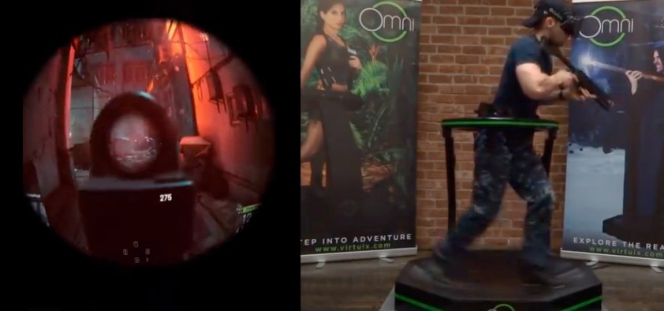
Omni Omni (see Figure 3) is an omni-directional treadmill which can be used in conjunction with other devices for VR, such as Rift Oculus. The Omni treadmills promise to take the process of immersivity a step further than that achieved by current motion controllers such as Wiimote, PlayStation Move and Microsoft Kinect so as to translate movements to an avatar on the screen, such as walking and running in time real. Omni is developed by the company Virtuix and is a treadmill model designed for home users. Its creators have recently demonstrated its use with Oculus Rift, increasing its potential for interactivity so as to provide an immersive virtual reality experience, which allows players to perform real movements.
Figure 3. Gamer interacting with an artifact (Omni, 2014)
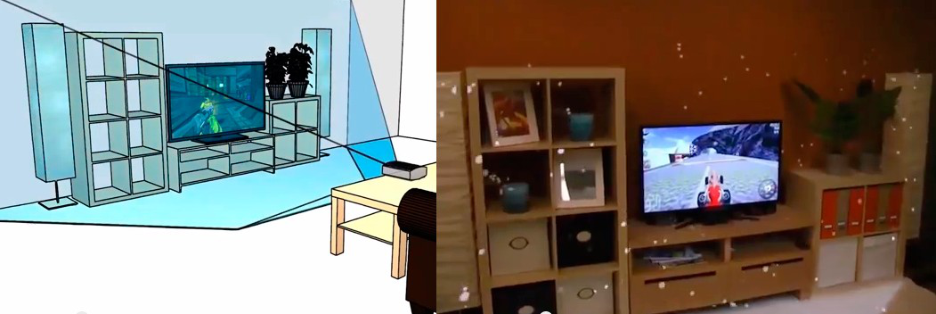
Microsoft IllumiRoom Presented by Microsoft in early 2013, the IllumiRoom (see Figure 4) is a system that is interconnected with Kinect which projects details of games out of the TV, filling the entire room with animations and lots of light. However, the company stated to the press that the product is too expensive to be made viable soon. It also said that the high cost of the system will prevent its becoming popular in the short and medium term.
Ergonomics In Design, Usability & Special Populations I (2022) https://openaccess.cms-conferences.org/#/publications/book/978-1-4951-2106-7
Figure 4. Device promises to change environment as per the context of the game (Microsoft, 2014)
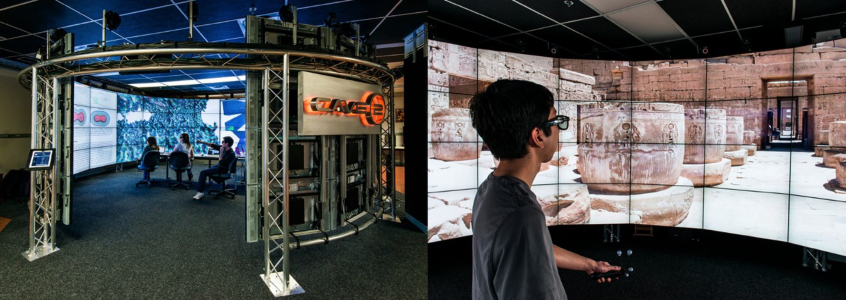
CAVE CAVE (Cave Automatic Virtual Environment) is a virtual reality system with an advanced visualization solution, the size of a room, which combines high resolution, 3D stereoscopic projection and computer graphics so as to create a complete sense of presence in a virtual environment. CAVE (see Figure 5) allows multiple users to have a complete immersive experience, in the same virtual environment, at the same time. This virtual reality system is used to display data or projects, and can be adapted for use with digital games. The name refers to the allegory of the philosopher Plato’s cave, which includes concepts on perception, reality and illusion.
Figure 5. Current version of the Cave system, (Mechdyne 2014)
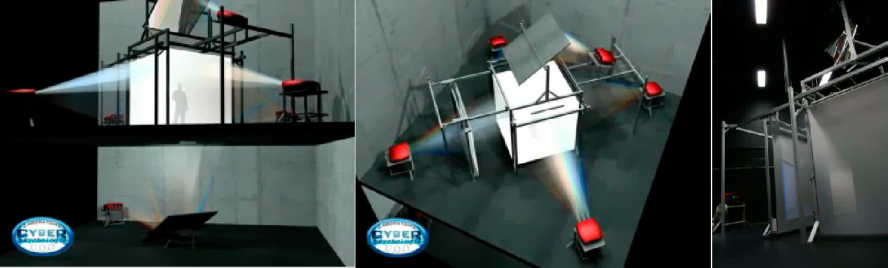
PSYCHÉ Name of the Greek goddess, who represents the human soul, the spirit or the forces that influence thoughts, behaviors, emotions, perceptions and personality. The Psyche project (see Figure 6) of the Cyberpsychology group at the Université du Québec en Outaouais (UQO) developed an immersive environment (often called "CAVE", in reference to another virtual environment project "Chicago Automatic Virtual Environment"). The system works in te form of a cube, and in which the individual uses 3D glasses in a standing position in the center of the cube, and where the virtual environment will be projected on all four walls, the ceiling and floor. The 3D goggles enable pieces of information to be integrated, which leads to the individual finding himself/herself fully "immersed" in the virtual scenes.
Ergonomics In Design, Usability & Special Populations I (2022) https://openaccess.cms-conferences.org/#/publications/book/978-1-4951-2106-7
Figure 6. Presentation of the immersive environment Psyché (Uqo. 2014)
Given the projects that are emerging both in the academic world and in industry, these initiatives demonstrate that people are trying to develop ways to create their own virtual reality, but at an affordable price. They are doing so by using a game console as a low cost tool and this does not require the level of knowledge required to build a complete virtual environment such as CAVE. Considering that most people do not have the financial resources to build their own totally immersive environment, using a game console is presented as a viable option.
CONCLUSION
In just 40 years, digital games have gone through several transformations, evolving from 8-bit 2D graphics into 3D realism found in next-generation consoles in the entertainment industry. The three-dimensional environment, interactions and engagements found in the universe of commercial games fostered a formidable interface for integrating research with immersive Virtual Reality artifacts for other fields of research, whether for health, education , military and corporate training.
Research studies to enhance usability problems within the old traditional VR devices (goggles and gloves) have driven the entertainment industry and new developers of hardware and games to make it possible to have immersion in a parallel universe as seen in science fiction films of the 80s.
The main objective of this work was to conduct a review of the literature on the use of Virtual Reality in digital games in order to guide future research on the subject so as to develop virtual environments with interaction devices that are less and less invasive for the human body, but which increase the quality of immersivity of these applications at low financial cost.
REFERENCES
Alves, P. (2012), “Lançamento do game VRUM”. Games For Change América Latina Website: http://gamesforchange.org.br/2012/12/02/festival-tem-oficinas-test-drive-debates-e-feira-de-trocas-e-doacoes/ Azevedo, T. (2013), “10 anos de “’Second Life’”: relembre a ascensão e a queda do metaverso”. Uol Jogos website:
http://jogos.uol.com.br/ultimas-noticias/2013/06/28/10-anos-de-second-life-relembre-a-ascensao-e-a-queda-do- metaverso.htm Azuma, R., Baillot, Y., Behringer, R., Feiner, S., Julier, S. and MacIntyre, B. (2001), “Recent Advances in Augmented Reality”, Computers & Graphics. Badler, N. (1997), “Real-time virtual humans”, Pacific Graphics. Balista, V. (2013). “PhysioJoy: Sistema de Realidade Virtual para Avaliação e Reabilitação de Déficit Motor”, in Workshop on
Virtual, Augmented Reality and Games at the XII Simpósio Brasileiro de Games e Entretenimento Digital, SBGames, São Paulo. Biocca, F. and Levy, M. and Hillsdale, Eds. (2001), “Recent Advances in Augmented Reality”, in Computers & Graphics, NJ: Lawrence Erlbaum Associates.
Ergonomics In Design, Usability & Special Populations I (2022) https://openaccess.cms-conferences.org/#/publications/book/978-1-4951-2106-7
Calegari, P. F., Quirino, S. S., Frigo, L. B., Pozzebon, E. (2013), “Jogo computacional 3D no ensino de física”, in Art & Design Track do XII Simpósio Brasileiro de Games e Entretenimento Digital, SBGames, São Paulo. Carvalho, B. (2014), “Pesquisadora da França visita o Curso de Jogos Digitais da Unicap”. Jogos Digitais Unicap website:
http://www.unicap.br/tecnologicos/jogos/?p=1799 Carvalho, B. J. A; Soares, M. M., Neves, A. M. M., Medeiros, R. P. (2013), “Interactive Doodles: a Comparative Analysis of the Usability and Playability of Google Trademark Games between 2010 and 2012”, in MARCUS, Aaron (org.). Design, user experience, and usability: health, learning, playing, cultural, and cross-cultural user experience. Proceedings, Part II. Heidelberg: Springer, p. 508-517. Cerqueira, C. S., Santos, W. A., and Ambrosio, A. M. (2013), “Serious Game Interaction Techniques Applied to an Operational
Satellite Simulator”, in Art & Design Track at the XII Simpósio Brasileiro de Games e Entretenimento Digital, SBGames, São Paulo. Cobb, S.V.G., Nichols, S., Ramsey, A., Wilson, J.R. (1999), “Virtual Reality-Induced Symptoms and Effects (VRISE)”. Presence: Teleoperators and Virtual Environments, April 1999, Vol. 8, No. 2, p. 169-186. Dias, D. A., Zorzal, E.R. (2013), “Desenvolvimento de um Jogo Sério com Realidade Aumentada para Apoiar a Educação
Ambiental”, in Workshop on Virtual, Augmented Reality and Games at the XII Simpósio Brasileiro de Games e Entretenimento Digital, SBGames, São Paulo. Donard, V. (2011), “Enjeux identitaires et relationnels des MMORPG”. Pratiques Psychologiques, Editions Elsevier Masson. Duarte, E., Rebelo, F., Wogalter, M. S. (2010), “Virtual Reality and its potential for evaluating warning compliance” Human Factors and Ergonomics in Manufacturing & Service Industries, 20(6), 526-537. Duarte, J. M., Vitti, S. R., Prado, C. S., Domenico, E. B.L. De, Pisa, I. T. (2012), “Revisão de serious games na área de saúde”,
in XIII Congresso Brasileiro em Informática em Saúde – CBIS. Fahey, J. (2013), “Augmented vs Virtual Reality: Contrasting Technologies and Tools”. James Fahey website: http://www.jamesfahey.com/2013/05/30/augmented-vs-virtual-reality-contrasting-technologies-and-tools/ Google. (2014), “The future is awesome”. Projeto Tango website:
http://www.google.com/atap/projecttango/ Gorini, A., Capideville, C. S., De Leo, G., Mantovani, F., Riva, G. (2011), “The Role of Immersion and Narrative in Mediated Presence: The Virtual Hospital Experience”, CyberPsychology, Behavior & Social Networking, 14(3), 99-105 Gutierrez, M., Vexo, F., Thalmann, D. (2008), “Stepping into Virtual Reality”, Springer-Verlag Telos, Santa Clara, CA. Huizinga, J. (1993), “Homo Ludens: o jogo como elemento da cultura”, 4. ed. Tradução João Paulo Monteiro. São Paulo:
Perspectiva. Jan, M.F., Chee, Y.S., Tan, E.M. (2010), “Learning Science via a Science-in-the-making process: The design of a game-basedlearning curriculum”, in S. Martin (Ed.), iVERG 2010 Proceedings – International Conference on Immersive Technologies for Learning: A multidisciplinary approach (pp. 13-25) Stockton: Iverg Publishing. Johnson, L., Adams, S., Cummins, M. (2012), “NMC Horizon Report: 2012 K-12 Edition”. Austin, Texas: The New Media
Consortium. Lage, M., Clua, E., Barboza, D., Taveira, G., Jefferson, W., Ruff, C., Vicente, J., Mourão, P. T., Rivas, F., Roncero, V., Ferreira, L. V., Cutovoi, A., Barreto, C., Rodrigues, F. D., Cabral, M., Belloc, O., Ferraz, R., Zuffo, M., Serpa, A. A., Coreixas, C. (2012), “Simulador de Passadiço”, in Military Simulation Workshop at the XI Simpósio Brasileiro de Games e Entretenimento Digital, SBGames, Brasília. Lanza, F. F., Lacerda, A. J., Souza, A. A. (2013), “KinectE.R.Desenvolvendo um game educacional com o uso do Kinect”, in Art
& Design Track at the XII Simpósio Brasileiro de Games e Entretenimento Digital, SBGames, São Paulo. Lewis, S. (2013), “What it was like to 'go indie' in the 90s”. Gamasutra website: http://www.gamasutra.com/view/news/200148/What_it_was_like_to_go_indie_in_the_90s.php Machado, L.S, Moraes, R. M., Nunes, F. (2009), “Serious Games para Saúde e Treinamento Imersivo”, In: Fátima L. S. Nunes;
Liliane S. Machado; Márcio S. Pinho; Cláudio Kirner. (Org.). Abordagens Práticas de Realidade Virtual e Aumentada. Porto Alegre: SBC, p. 31-60. Mechdyne. (2014), “The next generation in hybrid virtual environments”. Mechdyne Website: http://www.mechdyne.com/cave2.aspx Medeiros, D. C., Silva, W. A., Lamounier, E. A., Ribeiro, M. W., Cardoso, A., Fortes, N. (2008), “Realidade Virtual não-
imersiva como tecnologia de apoio no desenvolvimento de protótipos para o auxílio no tratamento de aviofobia por profissionais de psicologia”, in 8º Workshop de Realidade Virtual e Aumentada, WRVA, São Paulo. Microsoft. (2014), “IllumiRoom: Peripheral Projected Illusions for Interactive Experiences”. Microsoft Research website: http://research.microsoft.com/en-us/projects/illumiroom Nouri, E. and Traum, D. (2013), “A Cross-Cultural Study of Playing Simple Economic Games Online with Humans and Virtual
Humans”, 266-275, in MARCUS, Aaron (org.). Human-Computer Interaction. Applications and Services. Proceedings, Part II. Heidelberg: Springer, 2013. Oliveira, S. (2009), “Top 10: Periféricos e Acessórios em consoles da Nintendo”. Nintendo Blast website: http://www.nintendoblast.com.br/2009/07/top-10-perifericos-e-acessorios-em.html Omni. (2014), “Omini”. Virtuix Omini website:
http://www.virtuix.com Piovesan, S. D., Balestrin, C., Pereira, A. S., Vit, A. R. D., Silva, J., Franciscatto, R. (2011), “Realidade Virtual Aplicada à Educação”, in EATI - II Encontro Anual de Tecnologia da Informação, UFSM, RS. Ragusa, J. M., Bochenek, G. M. (2001), “Collaborative Virtual Design Environments: Introduction”, Communications of the
ACM., 44(12), 40-43. Rebelo, F., Duarte, E.; Noriega, P., Soares, M. (2011), “Virtual reality in consumer products design: methods and applications”, in: Karwowski, W.; Soares, M.; Stanton, N. Human Factors and Ergonomics in Consumer Product Design: Methods and Ergonomics In Design, Usability & Special Populations I (2022) https://openaccess.cms-conferences.org/#/publications/book/978-1-4951-2106-7
Techniques. Boca Raton, CRC Press, p. 381-404, Soares, M.M.; Falcão, C. (2013). “Design, Ergonomia e Novas Tecnologias na educação”, in: Fadel, L.M.; Ulbricht, V.R.; Castro Neto, M. (org.) Hipermídia e acessibilidade na era da inclusão. João Pessoa, Editora Ideia. Steuer, J. (1992), “Defining virtual reality: Dimensions Determining Telepresence”, Journal of Communication 42, 73–93. Terra. (2014), “Futuro dos Games”. Terra Games website:
http://games.terra.com.br/infograficos/futuro-dos-games Tonéis, C. N. and Corral, F. C. C. (2013), “O game como fonte de diálogo no ambiente escolar. LUA: Uma aventura na mata através dos olhos do indígena”, in Art & Design Track at the XII Simpósio Brasileiro de Games e Entretenimento Digital, SBGames, São Paulo. UOL (2013), “História do video game”. Uol Jogos website:
http://jogos.uol.com.br/reportagens/historia/1993.jhtm Uqo. (2014), “PSYCHÉ (Voûte immersive à 6 faces)”. Université du Québec en Outaouais website: http://w3.uqo.ca/cyberpsy/fr/psyche_fr.htm Virole, B. (2003), “Du bon usage des jeux vidéo et autres aventures virtuelles”. Hachette, Paris. Virvou, M., Katsionis, G. (2008), “On the usability and likeability of virtual reality games for education: the case of VR-
ENGAGE”. Computers & Education Volume 50, Issue 1. Walshe, D.G., Lewis, E.J., Kim, S.I., O'Sullivan, K., Wiederhold, B.K.(2003), "Exploring the use of computer games and virtual reality in exposure therapy for fear of driving following a motor vehicle accident", in Cyberpsychol Behav,6(3):329-34. Wikipédia (2013), “Microsoft Flight Simulator”. Wikipédia website:
http://pt.wikipedia.org/wiki/Microsoft_Flight_Simulator Witmer, B. G., Singer, M. J. (1998), “Measuring Presence in Virtual Environments: A Presence Questionnaire”, Presence: Teleoperators and Virtual Environments, 7(3), 225-240.
Ergonomics In Design, Usability & Special Populations I (2022) https://openaccess.cms-conferences.org/#/publications/book/978-1-4951-2106-7
LISTED IN THE AHFE DIGITAL BOOKSTORE CATALOGUE
Explore the complete digital volume
Advances in Ergonomics In Design, Usability & Special Populations: Part I
Read this individual research paper free through the original publisher, or explore the full digital proceedings book.
ISBN 978-1-4951-2106-7
Explore this ISBN in the AHFE Bookstore ↗Listed in the July 2026 bookstore catalogue; search by ISBN to confirm current availability · Digital book purchase optional