Leonard Erb, Gordon Konieczny (2026). Software-based Evaluations of Cabin Processes in Civil Commercial Aircraft. In: Advances in Human Factors of Transportation. AHFE Open Access, vol. 224, pp. 178–190. https://doi.org/10.54941/ahfe1007845
In our research project, RECab (Resource Efficient Cabin), which focuses on the sustainable and resource-efficient design of aircraft cabins, resource-efficient cabin interior and process architectures have been explored. The solutions then support a high degree of design flexibility and usability within the cabin and, above all, in the associated operational processes. All three dimensions of sustainability — ecology, economy, and social acceptance — are considered. A function-oriented approach leads to optimized cabin architectures and process concepts for onboard services. Mission-specific constraints and conditions are considered when defining suitable process concepts. Through simulation — with the goal of creating a digital process twin — suitable process concepts are evaluated, and recommendations are provided for process design and resource allocation. Optimized cabin processes include the evaluation and optimization of directly upstream and downstream processes at the airport, as these are interdependent. There is significant potential for optimization in the aircraft cabin if, e.g., unnecessary variability and complexity can be eliminated from the cabin and shifted, for example, to upstream and downstream processes. In particular, the economic and ecological dimensions of sustainability are influenced by ergonomics, i.e., the appropriate design of the onboard processes for users. We asked ourselves how well work planning simulation software is suited for assessing and optimizing the ergonomics of cabin processes. As a result of a methodological evaluation, EMA Work Designer — originally developed for factory planning — was identified as suitable simulation software for cabin processes. It is used to determine suitable strain metrics, such as, e.g., the EAWS score, considering various users and operators, and to identify process steps critical in terms of strain.Using examples of aircraft cabin process evaluations, we conclude by demonstrating the possibilities and limitations of the simulation software and where further potential for optimization lies in its use. The use of simulation software — such as ema Work Designer in our case — leads to a better understanding of socio-technical systems through the creation of suitable digital process twins and offers the possibility of immediate evaluation, mitigation, and optimization of processes, in our case aircraft onboard service processes.
Commercial aircraft cabins are an example highly dynamic socio-technological systems in which cockpit and cabin crew members, passengers, and physical cabin structures interact continuously. Flight attendants perform physically demanding tasks under time pressure in a confined environment, including handling passenger luggage and operating overhead storage compartments, performing service routines, and safety related cabin processes. Increasing passenger volumes, changes in demographics, and the diversity of cabin configurations and its users further amplify the complexity.
The acceptance of the work environment by users in the aircraft cabin, considering their various roles, the physical environment, the processes, and the physical demands of work, play a key role. Traditional ergonomic assessments often rely on prototyping and manual evaluation techniques based on individual experiences, which are not only time consuming and costly but might become less valid and reliable. In contrast, simulation tools and digital process twins offer the possibility to model human motion, cabin geometry, and process logic in virtual space. This enables reproducible, systematic, and scalable evaluations in the beginning of the design process. This analysis can be used to develop ideas for the design of products, work environments, and organizations that are in line with human performance requirements. (BHM, 2013). The central question is: How well is work planning simulation software suited to evaluating and optimizing the ergonomics of aircraft cabin processes? To answer this, we analyze representative cabin workflow using digital human modelling and EAWS based evaluation.
BACKGROUND
Digital Twins in Cabin Workflows A digital process twin is a virtual representation of a real-world work process that integrates anthropometric data, motion sequences, environmental constraints, and physical interactions. In aircraft cabin context, digital twins allow (Spitzhirn, 2023):
virtual testing of cabin layouts and process variations,
ergonomic load prediction before physical prototyping,
iterative design of resource-efficient operations,
early identification of critical tasks and bottlenecks.
The cabin processes are embedded in an overall aircraft operating system and interact not only with the onboard procedures but also with airport side operations. Reducing unnecessary variability or complexity in cabin tasks can, therefore, reduce system-wide operational burdens.
Ergonomic Task Demands Given the large number of processes in the aircraft cabin, it was necessary to define the scope and breakdown of the overall process. To this end, interviews were conducted with cabin crew, and processes that were particularly prone to errors and very physically demanding were identified, defined and prioritized. These include:
assisting passenger baggage handling,
operating multiple and different OHSC,
serving food and beverages from trolleys to the passengers in the cabin,
recollecting used catering items after service.
For subsequent analysis, the process of loading and unloading Overhead Stowage Compartments (OHSC) with passenger hand luggage has been chosen and investigated. These processes involve:
repetitive overhead lifting and maneuvering luggage of a certain mass,
handling overhead storage compartments
dynamic load-handling involving a significant amount of static manual (holding) work at the same time,
closure of heavy or poor mechanically assisted bin structures,
constrained postures due to narrow aisles and cabin configurations.
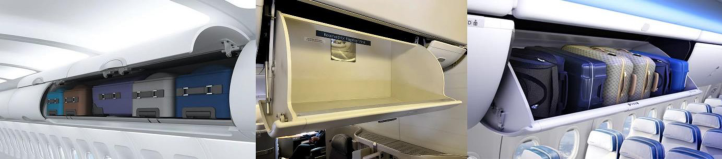
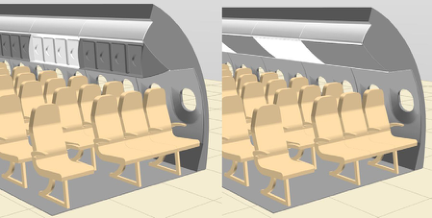
There are two different designs of overhead luggage compartments in aircraft– those with a fixed base (Figure 1, left) and those with a movable base (Figure 1, right) which can be directly compared in terms of their handling (Simmons, 2001).
Fixed OHSC are typically installed in smaller regional and commuter aircraft; the corpus is fixed, only the bin-flap is operated. Movable OHSC systems are installed in wide-body aircraft. As the whole corpus is movable, and needs to be pushed up, including the load of hand baggage, to close it. That results in a higher workload for the operator.
Sustainability Dimensions in Cabin Process Design Sustainability is addressed in three ecological dimensions (reduction of process duration, repetitions, energy use, waste), economic (improved crew efficiency, fewer injuries, shorter turnarounds, reduced crew complement) and social (reduced physical strain, improved working conditions) (Kropp, 2019). Cabin ergonomics directly influence all three dimensions of sustainability. Designing workload optimized processes becomes essential for sustainable aviation. The issue of social acceptance has a direct impact on environmental and economic sustainability and, by extension, on the design of products and processes.
METHODOLOGY
Description of Work Processes The onboard processes under investigation – OHSC handling – involves various types of exertion of forces. The most common types of physical strain will be briefly discussed and described. One type of physical strain involves forced postures. If a posture can only be maintained for a limited time and the effort required increases as a result, this is referred to as a forced posture (BAUA, 2023). Another type of physical strain relates to body forces and action forces. Body forces are all forces generated in connection with the human body. Action forces are a subset of body forces that act outwardly and serve to perform human work. Another type of strain involves load handling (DMK, 2009). This considers the masses, dimensions and forces acting on the body during lifting, holding, and carrying, or pulling and pushing. Repetitive tasks and asymmetric motions represent further types of strain. The strain associated with repetitive tasks arises from repetitive movement sequences. In particular, the combination of static and dynamic postural control work places a significant strain on the performer.
Evaluation Framework for Simulation Software An overview of methods to investigate the workload upon an operator when operating different OHSC systems is provided in Table 1.
Table 1: Work assessment methods.
Table available in the original PDF paper.
Category Assessment Method Posture OWAS-Method
Body forces Assembly-specific force atlas Load handling NIOSH
Repetitive tasks OCRA Energy turnover Energy turnover-tables
Combined method EAWS The evaluation of different methods concluded that the EAWS is suitable for analyzing the OHSC loading process methodology (HSD, 2026). In addition to evaluating the existing process, it should be modified immediately and improved iteratively, for example, regarding tolerability or strain levels. This requires a continuous and, if possible, rapid methodology. Simulation software programs that use suitable digital human models (e.g., Human Builder, Jack, RAMSIS) are well-suited for this purpose - ideally in combination with the work assessment methods.
In particular, the ema Work Designer (EMA, 2023) has been evaluated, as it incorporates several ergonomic work assessment methods and models (e.g., MTM, EAWS). ema Work Designer is software for 3D process and shop floor planning, detailed workstation design, and integrated ergonomic assessment. To analyze the suitability of ema Work Designer for the analysis of cabin processes, a structured evaluation using a utilitybased model (Kühnapfel, 2019) was developed. Twelve criteria, grouped into four categories.
182 Erb and Konieczny They include Technical Compatibility, Assessment Methods, Simulation Characteristics and Quality of the Results.
Priorities were assigned to each criterion, emphasizing simulation realism and result quality. As a result of the benefit analysis – ema work designer provided especially in the category Significance of the presentation of results delivered ema Work Designer with 9,6 out of 10 points very high and promising results.
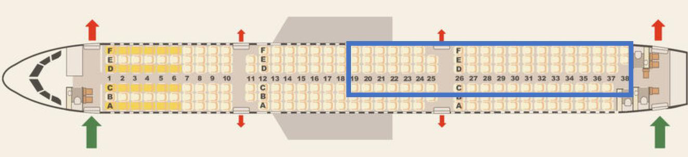
Modeling and Evaluation Approach of the Example Cabin Process A representative Airbus A321 OHSC handling process was selected Figure 2.
Figure 2: Airbus A321 cabin section (own illustration).
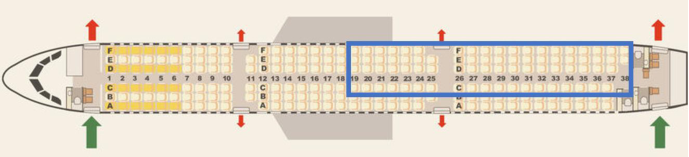
The area marked in blue in Figure 2 is displayed and further investigated. It was necessary to create a simplified process displayed in Figure 3 for the further analysis and simulation:
Figure 3: Simplified OHSC handling process (own illustration).
That process includes the following steps:
Flight attendant’s starting position at the beginning of the process,
Sequence of movements when placing the first suitcase,
Walking to the second suitcase,
Sequence of movements when placing the second suitcase,
Sequence of movements when closing the pivot bins,
Flight attendant’s starting position at the end of the process.
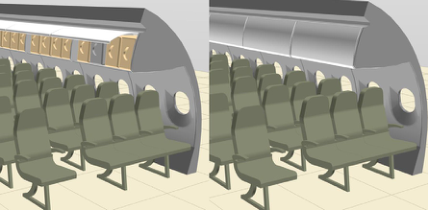
Two OHSC types have been modelled in the ema Work Designer environment:
Fixed OHSC - upward closing with unilateral hand use (Figure 4).
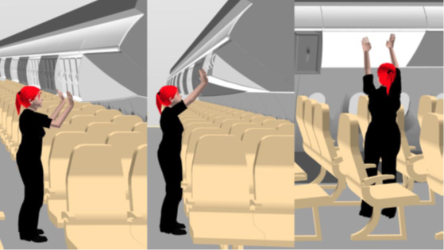
Pivotable OHSC - rotating downward to open and pushing upward for closing (Figure 5).
Figure 4: Cabin section with fixed OHSC.Figure 5: Cabin section with pivot OHSC (own illustration).
Further assumptions were made about the OHSC Handling simulation
Crew member: female, 5th percentile, middle age.
Luggage: two 8kg suitcases per passenger and crew member.
All 15 OHSC must be closed (in sequence) before aircraft taxi.
Motion phases include walking, lifting, maneuvering luggage, sorting & placing items, and OHSC closure.
The ema Work Designer software provides the basic settings and standard manikins commonly used for motion analysis. It also allows users to develop their own manikins. Both the process logic and the cabin geometry were reproduced in the ema Work Designer using a standard CAD software interface (Spitzhirn, 2023).
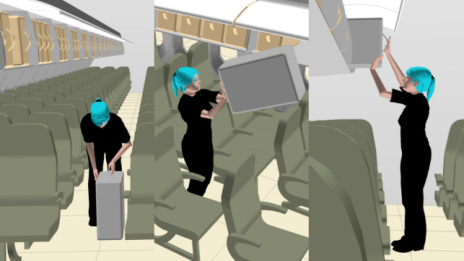
The process (Figure 3) was then developed in simulation software. That included the paths to be followed and detailed handling procedures and movement sequences (e.g., OHSC opening, lifting, and loading the carry-on luggage; OHSC closing) were defined. To do this, it was necessary to analyze movement processes and motion paths in detail to specify the appropriate positioning of among others the body, legs, and feet, as well as the arms, joints, and hands.
Figure 6: Fixed OHSC – Luggage positioning.
Figure 6 shows the motion sequent of the luggage positioning in the OHSC and the implementation in the ema work Suite that includes the following steps:
1. Pick up the suitcase 2. Move the suitcase upwards 3. Place the suitcase in the OHSC
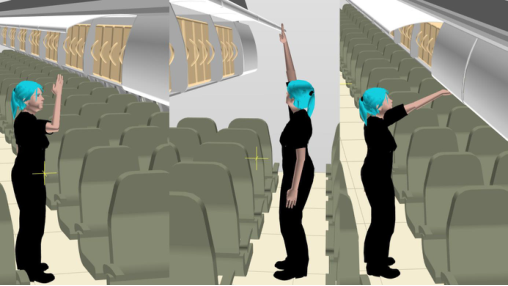
Figure 7 shows the motion sequent of closing the fixed OHSC and the implementation in the ema work Suite that includes the following steps:
1. Move one hand toward the OHSC - flap 2. Closing the OHSC - flap
The EAWS methodology was applied to each process including aspects of:
load handling,
reaching over-heart-line and overhead,
applied forces,
posture and joint angles / positions,
repetition and frequency characteristics.
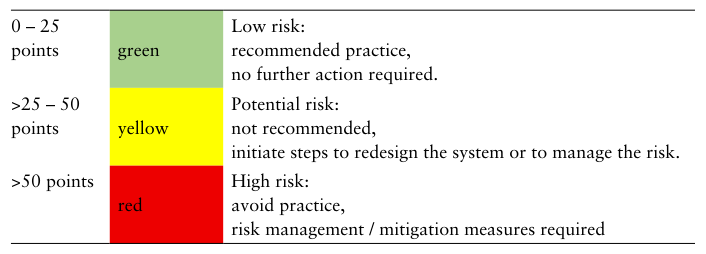
The EAWS scoring scale used for the assessment is organized according to a robot system and is divided into the green, yellow, and red category (Table 2).
Table 2: EAWS – Score system.
Results of Process Analysis The results of the analysis for loading the fixed and pivot OHSC Table 3:
Table 3 shows the summary of the EAWS results for loading process of the fixed OHSC. The loading process for the fixed OHSC was rated with a total of eight points. This is within green zone and is therefore safe and
186 Erb and Konieczny poses a low risk. A variation of users regarding gender (male, female), age (age 20,40,60 years) and percentile (P.5 – P.95) shows that the operation of the fixed OHSC is at low risk for all users. The section Forces was given zero points in both simulations, as well as for the section Extras.
Table 4: Overview EAWS results pivot OHSC handling.
Table available in the original PDF paper.
+ Extras
Whole Body
Equation reproduced from the original PDF.
Table 4 shows the overall EAWS results for the loading process of the pivot OHSC. This was rated with 60.5 points - red zone and indicates a high risk. The overall score was 58.5 points for manual load handling.
A variation of users regarding gender, age and percentile shows that the operation of the pivot OHSC is at higher risk especially for female users who represent many flight attendants. The following ergonomic stressors have been observed:
High shoulder elevation angles,
Repetitive movement and operation above head level,
Unfavorable hand and wrist positions during luggage placement,
Asymmetric force application for fixed bins.
Constrained movement due to narrow aisle width and seat positioning.
Pivot OHSC generally required more upward force during the closure phase, while Fixed OHSC resulted in more wrist strain during luggage placement. The loading process for the fixed OHSC is clearly preferable to that for the pivoted OHSC. Critical load levels and EAWS scores are reached where interventions are recommended. It is possible to optimize the operation of pivot OHSC e.g. for the 5th percentile of middle-aged German women. Two concepts are shown: Concept 1: The pivot OHSC will be closed by two cabin crew members:
Increases the overall duration of the loading process.
Advantages: Disadvantages:
Immediately implementable.
Improved ergonomics,
No additional weight,
Table 5: EAWS-Scores for Concept 1.
Table available in the original PDF paper.
Status Quo Concept 1 EAWS Score 60,5 29
As shown in Table 7, implementing the optimization concept 1 will reduce the EAWS score from 60.5 to 29 points, which is a significant reduction in health risk.
Software-Based Evaluations of Cabin Processes in Civil Commercial Aircraft 187 Concept 2: Integrated Power Assistance The objective is to achieve an EAWS score in the green zone. This requires power assistance to account for 12.5 kg of the total weight of 32 kilograms.
Advantages: Disadvantages:
Ergonomically sound design.
Not directly implementable,
Additional weight and complexity.
Table 6: EAWS-Scores for Concept 2.
Table available in the original PDF paper.
Status Quo Concept 2 EAWS Score 60,5 25
As shown in Table 6, implementing concept 2 will reduce the EAWS score from 60.5 to 25 points to the green zone, a significant reduction in health risk.
Results of Software Evaluation The ema Work Designer is suitable, with some shortcomings, for assessing ergonomics (sustainability) in cabin processes. Table 7.
Table 7: Overall evaluation ema work designer.
Table available in the original PDF paper.
Category Category Weighting [%] Score [points]
1. Technical Compatibility 7,56 7,67
2. Evaluation Methods 12,13 4,61
3. Simulation Capabilities 45,47 5,37
4. Results 34,84 7,81
Overall Score 6,3/10 points
This software demonstrates several notable strengths. It delivers highly valid results that closely align with realworld behavior, making it a reliable tool for the evaluation of aircraft cabin onboard processes applications. Its output is fast, clear, and easy to interpret, which supports efficient decisionmaking. In addition, users can conveniently adjust key parameters such as percentiles, motions steps and paths as well as masses and sizes of objects, allowing for flexible analysis across different scenarios. Despite these advantages, the program also has some limitations. It does not account for environmental factors such as temperature, noise, or pressure, which may affect realism in certain use cases e.g. in aircraft cabin. Unrealistic postures are not automatically detected, and options for anthropometric customization remain limited. Furthermore, while the software provides strong analytical results, it does not automatically suggest optimization strategies, requiring
188 Erb and Konieczny users to interpret and improve outcomes independently. The user must be familiar with and understand the specifics of the processes.
DISCUSSION
Suitability for Application for Processes in Aviation The successful application of ema Work Designer to cabin processes demonstrates that industrial digital human modelling tools can be transferred to aviation use cases. The software effectively simulates ergonomic load, identifies critical process steps, and provides intuitive visualization. However, adaptation to aviationspecific constraints would enhance accuracy – that includes:
More detailed and specific considerations of geometric limitations and structures,
More, enhanced and specific multiactor passenger interactions,
Regulatory and safety protocol integration e.g. from aviation safety agencies such as EASA, FAA and CAA.
Implications for Sustainable Cabin Design All three dimensions of sustainability are supported by the process simulation of the aircraft cabin onboard processes, which were executed:
Social: understanding and reducing crew strain and injury risk in early phases of cabin and cabin process design offering flexibly,
Economic: enabling more efficient processes including optimized crew complements (e.g. fewer staff without overworking them), less waste (fewer delays) and supports employees’ satisfaction
Ecological: reducing turnaround time and onboard energy consumption.
Furthermore, the evaluation according to Environmental, Social and Governance aspects – the ESG criteria. They assess environmental responsibility, social aspects (such as working conditions) and ethical leadership to minimize risks and measure long-term value creation for investors. The study presented can support ESG assessment and might have significant effects on corporate valuation and reputation.
Limitations of the Study It is important to note the following limitations of the study.
Only a single aircraft type (Single Aisle, Airbus A321) and a single cabin and process step were evaluated.
Anthropometric diversity is not fully explored – further manikins and personas need to be developed.
Passenger influence, special passenger groups and crew interactions are not modeled (IMK, 2023; Kropp, 2019).
Environmental conditions are not simulated.
Conclusion and Outlook This study demonstrates that ema Work Designer as an example for process simulation and analysis tools provides substantial value for evaluating and optimizing onboard aircraft cabin processes. The development of a digital process twin enables detailed analysis and clear identification of straincritical tasks and process limitations. Optimization concepts derived from simulation show significant ergonomic improvements. Future research activities shall include:
Integration of VRbased cabin interaction testing,
Use of motion capture for greater anthropometric realism,
Simulation of additional cabin workflows (galley, catering, service),
Development of aviationspecific digital human modeling modules and libraries,
Integration of operational variability into process twins.
Digital simulation offers a path toward ergonomically optimized, resourceefficient cabin environments and will play a significant role in the design of future aircraft, aircraft cabins and onboard processes aiming towards optimized socio-technical systems with fewer errors, less strain, a higher efficiency towards a more satisfied workforce.
ACKNOWLEDGEMENT
This work was supported by the LuFo VI-2 project “Hollistische Untersuchungen zur ressourceneffizienten Kabinen- HEUREKA” (engl.: Holistic studies on resource-efficient cabins, project number 20K2103D) funded by the Federal Ministry for Economic Affairs and Climate Action based on the decision of the German Bundestag.
The article has been proofread using artificial intelligence (www.deepl.com).
REFERENCES
BAUA (2023): Bundesanstalt für Arbeitsschutz und Arbeitsmedizin (Hrsg.): Belastungsarten, https://www.baua.de/DE/Themen/Praevention/Koerperliche- Gesundheit/Gesundheit-und-koerperliche-Belastung/Belastungsarten/ Belastungsarten_node.html (accessed: 2023-12-03). BHM (2013): Berufsgenossenschaft Holz und Metall (Hrsg.) - Mensch und
Arbeitsplatz in der Holz- und Metallindustrie (2013), https://www.bghm.de/ fileadmin/user_upload/Arbeitsschuetzer/Gesetze_Vorschriften/Informationen/ BGHM-I_101.pdf (accessed: 2023-10-18).
Entwicklung (Hrsg.) (2023): Nachhaltigkeit (nachhaltige Entwicklung), https:// www.bmz.de/de/service/lexikon/nachhaltigkeit-nachhaltige-entwicklung-14700 (accessed: 2023-10-18). Boeing (2024): Retrofit 737 fleet to increase overhead bin storage by 50% https:// services.boeing.com/maintenance-engineering/modifications/interiors/737-space- bins (accessed: 2024-01-03). DMK (2009): Der montagespezifische Kraftatlas, 2009, 3, März, St. Augustin:
Deutsche Gesetzliche Unfallversicherung, Institut für Arbeitsschutz, 2009. EMA (2023): imk Industrial Intelligence GmbH (Hrsg.) (Hrsg.): Virtual Planning.
Real Value. ema Software Suite: Software zur Planung von nachhaltigen Fabriken & produktiven Arbeitsplätzen., https://imk-ema.com/ (accessed: 2023-11-13). HSD (2016): Homo sapiens digitalis: Virtuelle ergonomie und digitale, [Place of publication not identified]: Morgan Kaufmann, 2016 IMK (2023): imk Industrial Intelligence GmbH (Hrsg.): Funktionen und
Anforderungen: Unterstützte Dateiformate, https://imk-ema.com/angebot/preise- editionen/funktionsuebersicht/ (accessed: 2023-12-17). Kropp (2019): Grundlagen der Nachhaltigen Entwicklung: Springer Fachmedien Wiesbaden, 2019. Kühnapfel (2019): Nutzwertanalysen in Marketing und Vertrieb: Springer Fach-
medien Wiesbaden, 2019 Safran S.A. (2024): Quickly increase the bag capacity of your B737 or A320 aircraft with the Pillow Door System by Safran Cabin: https://www.safran-group.com/ products-services/quickly-increase-bag-capacity-your-b737-a320-aircraft-pillow- door-system-safran-cabin (accessed: 2024-01-03). Simmons, Gary/Worden, Laurie (2001): Advancements in Overhead Stowage Bin
Article Retention, in: Aero 2001, Issue 15, https://www.boeing.com/commercial/ aeromagazine/aero_15/overhead.pdf (accessed: 2023-10-06). Spitzhirn, Michael (2023): Digitale Planungswerkzeuge zur prospektiven Arbeitsgestaltung: 1. Einführung zur digitalen Arbeitsplanung mittels digitaler Menschmodelle am Beispiel des Planungssystems ema Work Designer.
LISTED IN THE AHFE DIGITAL BOOKSTORE CATALOGUE
Explore the complete digital volume
Advances in Human Factors of Transportation
Read this individual research paper free through the original publisher, or explore the full digital proceedings book.
ISBN 979-8-950676-00-0
Explore this ISBN in the AHFE Bookstore ↗Listed in the July 2026 bookstore catalogue; search by ISBN to confirm current availability · Digital book purchase optional