Zhuoman Liu, Yan Luximon, Wei Lin Ng, Eric Chung, Jie Zhang (2023). Anatomical Landmark-Guided Deformation Methods for Cranial Modeling. In: Creativity, Innovation and Entrepreneurship. AHFE Open Access, vol. 74, pp. 46–52. https://doi.org/10.54941/ahfe1003304
Automatic cranial model deformation has a significant impact on the ergonomic design of headgears. It benefits product design by providing accurate human cranial measurements while automatically deforming to target shapes. With the development of automatic deformation methods, cranial modeling can now be handled efficiently rather than manually customized. Furthermore, previous studies have shown that integrating anatomical landmarks in deformation methods can improve modeling accuracy. Hence, this study provides anatomical definitions of cranial landmarks, including 51 skull landmarks and 14 mandible landmarks.This study compares three different landmark-guided deformation methods using the above anatomic landmarks, including Landmark-Guided Coherent Point Drift (LGCPD), Neural Deformation Pyramid (NDP), and the registration part in SCULPTOR (S-ARAP). These three methods treat the automatic deformation problem as a task of probability density estimation, hierarchical deformation decomposition, and local rigidity preservation, respectively. However, LGCPD is computationally intensive, which means once the cranial model has many vertices, the computation consumes a large memory and runs slowly. Additionally, LGCPD is sensitive to obtain a suboptimal solution and results in a deformed model with a high shape variation. NDP simplifies the deformation problem by decomposing it into several sub-deformations. With Multi-Layer Perception (MLP), NDP can perform the deformation approximately 10 times faster than LGCPD. However, without the constraint of local rigidity, partial-to-partial deformation accumulates minor deformation errors from each sub-step, leading to unsatisfactory deformation results. S-ARAP uniformly samples control nodes and computes their influence weights on the source model's vertices using Radial Basis Function (RBF). The larger the distance between the node and the vertices, the higher the weight with a stronger influence. The as-rigid-as-possible (ARAP) term is then introduced to preserve the local rigidity of the deformed model with the calculated influence weights for the local regions. Therefore, S-ARAP can automatically deform the cranial model, particularly the skull part with complex geometries, to achieve a well-structured result. Moreover, the control node sampling speeds up the execution of deformation while using less memory than LGCPD. Instead of the decomposition in NDP, S-ARAP increases the number of control nodes in several stages to perform hierarchical deformation.Finally, with quantitative and qualitative experimental results, the study discusses and compares the suitability of these three deformation methods for automatic cranial modeling. The study computes Chamfer-Distance (CD) and Point-to-Plane Distance (PTPD) on the deformed results for quantitative comparisons. CD determines the distance between deformed vertices and the nearest vertices on the target model and vice versa. PTPD calculates the distance between the deformed vertices and the nearest plane on the target model to calculate the shape error. The maximum value in PTPD can help identify outliers in deformed results. Lower CD and PTPD values suggest a better match with the target. According to the experimental results, S-ARAP outperforms LGCPD and NDP in terms of CD and PTPD. Furthermore, the deformed data are visualized with a heatmap revealing the large deformation error, and S-ARAP shows the lowest fitting error on the deformed results. Thus, S-ARAP is a suitable method for automatic deformation on cranial modeling.
Wearable headgears are designed to minimize the impacts to protect people from driving accidents, sport injuries, etc. An accurate modeling of cranial structure is crucial for designing a suitable headgear that can both fit the human head and effectively reduce the impacts. More and more modeling methods (Du et al., 2013, Danckaers et al., 2017, and Shui et al., 2020) are proposed to construct parametric models (Li et al., 2017) for further headgear customization or impact simulation. After collecting 3D data from Compu- ted Tomography (CT) scan of human cranial, such a parametric model is built from the matching between the template model and the 3D mesh of human cranial, which is named 3D registration. Most of the modeling meth- ods first apply rigid registration according to the pre-defined feature points to obtain an initial transformed template model. Then, non-rigid registration, i.e., 3D deformation, is adopted to obtain a fine registration between tem- plate model and individual cranial mesh. However, due to the high complex
Anatomical Landmark-Guided Deformation Methods for Cranial Modeling 47
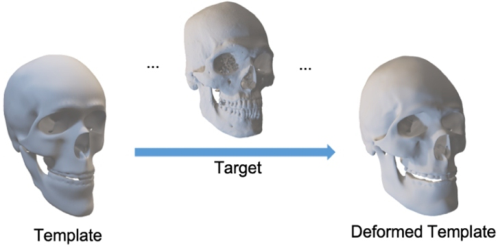
Figure 1: Illustration of cranial deformation on the template to fit a target mesh.
geometry of human cranial, it is challenged for some deformation methods to handle the cranial modeling. Moreover, ill-defined feature points also lead to inaccurate matching correspondences. The deformed template model the- refore has a large gap with the shape of individual cranial mesh. Hence, anatomical landmarks and suitable deformation methods are both vital for a fine-grained cranial modeling. This study investigates the performance of three different deformation methods on cranial models, given a anatomically defined landmark set.
DEFORMATION METHODS The automatic cranial deformation is facing two major challenges. Firstly, the geometry of cranial meshes reconstructed from CT scans is complex with plenty of small fragments, which may introduce noises to the deformation procedure. Second, the huge number of vertices of cranial meshes, especially the skull part, will significantly increase the deformation runtime and raise the requirement of large memory occupation. In this study, we introduce three landmark-guided deformation methods for cranial modeling to against the above difficulties.
LANDMARK-GUIDED COHERENT POINT DRIFT (LGCPD) LGCPD (Hu et al., 2010) is a combination of vanilla Coherent Point Drift (CPD) (Myronenko et al., 2010) and anatomical landmarks. Vanilla CPD is a probabilistic method that treat the alignment of two models as a pro- bability density estimation problem based on a Gaussian Mixture Model (GMM) (Reynolds, 2009). And it additionally introduces a regularization term on the displacement field for non-rigid case. Based on the vanilla CPD strategy, LGCPD additionally takes the paired corresponding source and target landmarks as inputs, which are useful for orienting the source and target more accurate than CPD. The utilization of landmarks highlights the potential advantage of combining deformation methods with anatomical lan- dmarks for cranial modeling. However, LGCPD is computationally intensive, which means once the cranial model has many vertices, the computation consumes a large memory and runs slowly. Additionally, since LGCPD is a
probability-based solution, it is sensitive to obtaining a suboptimal solution and results in a deformed model with high shape variation.
NEURAL DEFORMATION PYRAMID (NDP) To relief the high complexity problem in current non-rigid registration, NDP (Li et al., 2022) treats the automatic deformation problem as a task of hierarchical deformation decomposition. Specifically, NDP uses a pyramid architecture implemented by Multi-Layer Perceptron (MLP) (Haykin, 1998) to imitate the non-rigid deformation procedure. For each pyramid level, the encoded 3D points from template model will be taken as input and the defor- mation increments of the points from the previous level will be predicted. With this hierarchical decomposition mechanism, NDP can achieve advanced partial-to-partial non-rigid registration results by minimizing the Euclidean error between the incrementally deformed vertices and the target vertices. NDP simplifies the deformation problem by decomposing it into several sub-deformations. With the benefit of MLP, NDP can perform the defor- mation faster than CPD-based methods. Moreover, since MLP is available for taking input point sets in arbitrary shapes, it is straightforward for NDP to take anatomical landmark pairs as additional supervision and improve the deformation accuracy. However, without the constraint of local rigidity, partial-to-partial deformation accumulates minor deformation errors from each sub-step, leading to unsatisfactory deformation results in some cases.
AS-RIGID-AS-POSSIBLE IN SCULPTOR (S-ARAP) The registration part in SCULPTOR (S-ARAP) (Qiu et al., 2022) introduces a novel energy term to preserve the local rigidity so as to achieve high qua- lity in cranial deformation. S-ARAP uniformly samples control nodes and computes their influence weights on the source model’s vertices using Radial Basis Function (RBF) (Rhee et al., 2007). The larger the distance between the node and the vertices, the higher the weight with a stronger influence. The As-Rigid-As-Possible (ARAP) (Huang et al., 2021) term is then introduced to preserve the local rigidity of the deformed model with the calculated influence weights for the local regions. Along with ARAP term, S-ARAP also introdu- ces the Euclidean distance error between the deformed vertices and the target vertices, as well as the error between landmark pairs for optimization. As a result, S-ARAP can automatically deform the cranial model, particularly the skull part with complex geometries, to achieve a well-structured model. Moreover, the proposed control node sampling strategy speeds up the exe- cution of deformation while using less memory than LGCPD. Instead of the decomposition in NDP, S-ARAP increases the number of control nodes in several stages to perform hierarchical deformation.
DATA ACQUISITION AND VALIDATION CRITERIA To obtain the individual cranial mesh, we use Materialise Mimics software to process a set of 2D CT images. We then construct the templates of skull and mandible (see Figure 1) using Autodesk Maya. Furthermore, we define 51
Anatomical Landmark-Guided Deformation Methods for Cranial Modeling 49
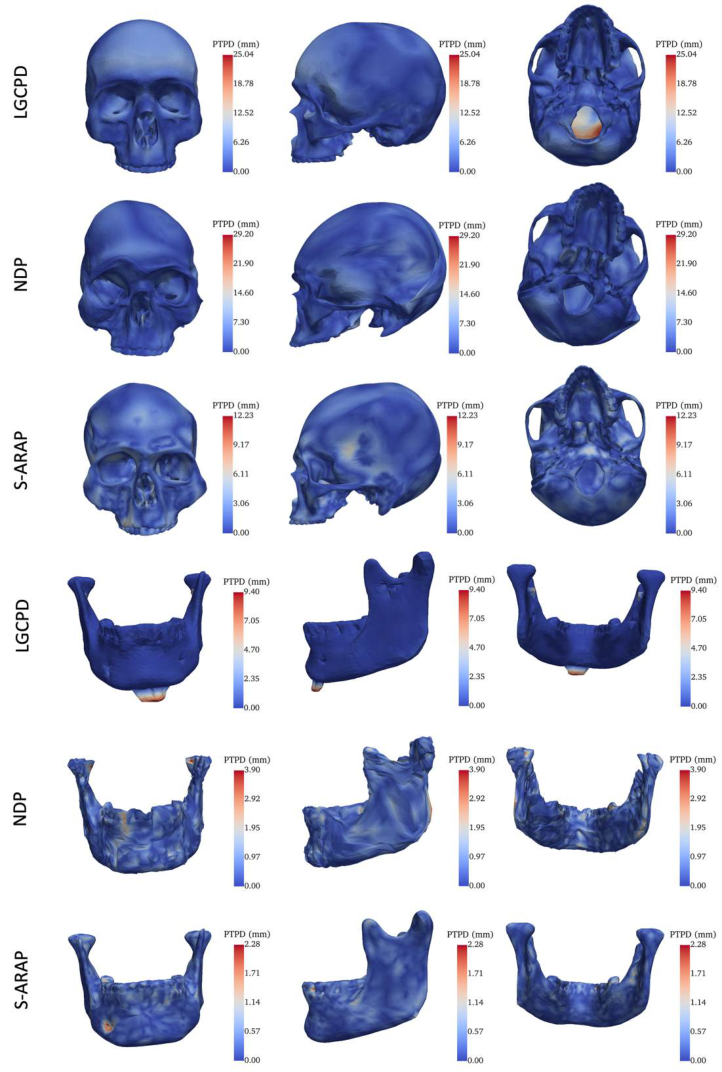
Figure 2: PTPD visualization of different deformation methods for skull and mandible.
anatomical landmarks for the skull and 14 for the mandible (Bermejo et al., 2021). For quantitative comparisons, we introduce the following two metrics, i.e., Chamfer-Distance (CD) (Fan et al., 2017) and Point-to-Plane Distance
(PTPD) (Low, 2004). CD determines the distance between deformed vertices and the nearest vertices on the target model and vice versa. For each point in each point set, CD searches the nearest point in the other point set and sums the square of distance up. Different from CD, PTPD calculates the distance between the deformed vertices and the nearest plane on the target model to calculate the shape error. The maximum value in PTPD, denoted as PTPDmax, can help identify outliers in deformed results. Lower CD and PTPD values suggest a better matching with the target. These two metrics can measure the pointwise and shape error of the deformation results, respectively.
DISCUSSION
In this section, we compare the performance of the above three anatomi- cal landmark-guided deformation methods on cranial modeling with both quantitative and qualitative experimental results. In Tables 1 and 2, S-ARAP outperforms LGCPD and NDP in terms of CD and PTPD on both skull and mandible. In particular, for skulls with complex geometry and a mass of fra- gments, the deformation results of LGCPD and NDP have higher CD and PTPDmax values, indicating that these two methods are more susceptible to failure by noises, while S-ARAP is more robust. Besides, although NDP has the lowest runtime on the skull and mandible, the runtime of S-ARAP is not significantly affected by the increased number of vertices compared to LGCPD. The relatively stable runtime of S-ARAP is achieved by the proposed control node mechanism.
Furthermore, the deformed skulls and mandibles by different deformation methods are visualized with a heatmap revealing the large deformation error. As shown in Figure 2, the color from blue to red indicates the PTPD error is from small to large. The deformations from LGCPD are always affected by the outliers, e.g., the inner layer of skull and the bottom part of mandible. Meanwhile, the deformed meshes from NDP are coarse, because NDP tends to transform the point set of template model in a free way without the local
Table 1. Quantitative comparisons of different deformation methods on skull. ↓indicates the lower the metric value, the better the performance of the method.
Table 2. Quantitative comparisons of different deformation methods on mandible. ↓ indicates the lower the metric value, the better the performance of the method.
Anatomical Landmark-Guided Deformation Methods for Cranial Modeling 51
rigidity constraint. S-ARAP shows the lowest fitting error on smoother defor- med results compared to LGCPD and NDP. Therefore, S-ARAP is a suitable method for automatic deformation on cranial modeling with the guidance of anatomical landmarks.
CONCLUSION
For fine-grained cranial modeling, it is efficient to combine anatomical lan- dmarks with adequate 3D deformation methods. In this study, we introduce the well-defined anatomical landmarks as well as three deformation meth- ods, including probability-based method (LGCPD), hierarchical deformation method (NDP), and local rigidity preserving method (S-ARAP). We demon- strate the robustness of S-ARAP on both skull and mandible deformation. Furthermore, we illustrate two qualified criteria, CD and PTPD, to validate the performance of deformation, providing a straightforward evaluation for headgear design.
ACKNOWLEDGMENT
The work described in this paper was supported by a grant from the Resea- rch Grants Council of the Hong Kong Special Administrative Region, China (Project No. GRF/PolyU 15606321) and a grant from The Hong Kong Polytechnic University (Project No. P0031501).
REFERENCES
Bermejo, E., Taniguchi, K., Ogawa, Y., Martos, R., Valsecchi, A., Mesejo, P.,... & Imaizumi, K. (2021). Automatic landmark annotation in 3D surface scans of skulls: Methodological proposal and reliability study. Computer Methods and Programs in Biomedicine, 210, 106380. Besl, P. J., & McKay, N. D. (1992). Method for registration of 3-D shapes. In Sensor
fusion IV: control paradigms and data structures (Vol. 1611, pp. 586–606). Spie. Danckaers, F., Lacko, D., Verwulgen, S., De Bruyne, G., Huysmans, T., & Sijbers, J.
(2017). A combined statistical shape model of the scalp and skull of the human head. In International Conference on Applied Human Factors and Ergonomics (pp. 538–548). Du, H., Geng, G., Li, K., & He, Y. (2013). 3D skull registration based on registration points automatic correspondence. In 2013 International Conference on Virtual Reality and Visualization (pp. 293-296). IEEE. Fan, H., Su, H., & Guibas, L. J. (2017). A point set generation network for 3D
object reconstruction from a single image. In Proceedings of the IEEE conference on computer vision and pattern recognition (pp. 605–613). Haykin, S. (1998). Neural networks: a comprehensive foundation. Prentice Hall, NJ, U. S. Hu, Y., Rijkhorst, E. J., Manber, R., Hawkes, D., & Barratt, D. (2010). Deformable
vessel-based registration using landmark-guided coherent point drift. In Interna- tional Workshop on Medical Imaging and Virtual Reality (pp. 60–69). Springer, Berlin, Heidelberg.
Huang, Q., Huang, X., Sun, B., Zhang, Z., Jiang, J., & Bajaj, C. (2021). Arapreg: An as-rigid-as possible regularization loss for learning deformable shape genera- tors. In Proceedings of the IEEE/CVF international conference on computer vision (pp. 5815–5825). Li, T., Bolkart, T., Black, M. J., Li, H., & Romero, J. (2017). Learning a model of
facial shape and expression from 4D scans. ACM Trans. Graph., 36(6), 194–1. Li, Y., & Harada, T. (2022). Non-rigid Point Cloud Registration with Neural Deformation Pyramid. ArXiv Preprint ArXiv:2205. 12796. Low, K. L. (2004). Linear least-squares optimization for point-to-plane icp surface
registration. Chapel Hill, University of North Carolina, 4(10), 1–3. Qiu, Z., Li, Y., He, D., Zhang, Q., Zhang, L., Zhang, Y.,... & Yu, J. (2022).
SCULPTOR: Skeleton-Consistent Face Creation Using a Learned Parametric Generator. arXiv preprint arXiv:2209.06423. Reynolds, D. A. (2009). Gaussian mixture models. Encyclopedia of biometrics, 741(659–663). Rhee, T., Lewis, J. P., Neumann, U., & Nayak, K. (2007, October). Soft-tissue defor-
mation for in vivo volume animation. In 15th Pacific Conference on Computer Graphics and Applications (PG’07) (pp. 435–438). IEEE. Shui, W., Zhou, M., Maddock, S., Ji, Y., Deng, Q., Li, K.,... & Wu, X. (2020). A computerized craniofacial reconstruction method for an unidentified skull based on statistical shape models. Multimedia Tools and Applications, 79, 25589–25611.
LISTED IN THE AHFE DIGITAL BOOKSTORE CATALOGUE
Explore the complete digital volume
Creativity, Innovation and Entrepreneurship
Read this individual research paper free through the original publisher, or explore the full digital proceedings book.
ISBN 978-1-958651-50-6
Explore this ISBN in the AHFE Bookstore ↗Listed in the July 2026 bookstore catalogue; search by ISBN to confirm current availability · Digital book purchase optional