Yingli Gong, Ao Jiang, Wei Wang, Yinhe Zhu, Gaoshan Zhang, Jinjin Zhu, Junyi Huang (2023). School teachers' and students' behaviors and attitudes toward recycling waste paper - a focus group experience. In: Usability and User Experience. AHFE Open Access, vol. 110, pp. 64–76. https://doi.org/10.54941/ahfe1003178
There are differences in the ways and attitudes of recycling waste paper between schools in urban and rural areas at different levels of development in China. The purpose of this study was to discover the role of interactive mechanisms of waste paper recycling on students' behaviors and attitudes toward waste paper in the campus recycling process. To complete this study, urban school classes and rural school classes in the same city, which have different waste management and recycling systems. Compare before and after recycling processing systems that incorporate interactive mechanisms. Data were obtained from interviews with students, questionnaires, and focus groups. Students in 10 urban schools and 10 rural schools in the same urban area of Guangdong Province, China, were surveyed online using Questionnaire Star, and the data were examined using SPSS statistical software. In the whole system, town schools are used as the main scenario, where teachers and students put waste paper into the converters and get the corresponding items. Due to the large amount of waste paper in town schools, there will be a surplus of items being converted out. Excess items will be transported to rural areas by transport vehicles from the recycling processing plant. The goods will be delivered to children in rural schools, reducing spending on educational items, while the transporters will take away and dispose of waste paper from rural areas. The focus groups discussed attitudes toward the improved waste paper management system, and most participants felt it was beneficial and significantly improved attitudes toward waste paper. After the improvement, the participants will intentionally collect the waste paper and put it into the replacement box. In addition, some participants also mentioned the sense of accomplishment that comes from turning the collected waste paper into usable items. Convenience and a sense of responsibility to protect the environment and the self-satisfaction of helping rural students are also motivations and potentials for improving waste paper management behavior. Participants were quite satisfied with the improved system of waste paper management. Not only is it sustainable, but it also takes into account the fact that it helps schools and school children in rural areas. Greater satisfaction can be obtained from it. This study provides a good starting point for future research on student attitudes toward recycling in both types of schools. A framework is provided for further research on factors influencing positive behaviors and attitudes based on this study.
School Teachers’ and Students’ Behaviors and Attitudes 65
INTRODUCTION
Background of the Study Status of Waste Paper Recycling As a renewable resource and green energy, waste paper is widely used around the world. However, in China, even though various legal regulations have been issued by the relevant Chinese agencies, the recycling rate of waste paper in China has been below 50%. China produces about 14 million tons of waste paper each year, 30% of which is incinerated, and the rest is discarded in landfills or paper mills (Fukazawa et al., 2002). An important bottleneck in the current domestic waste paper recycling is that waste paper raw materials, whether in terms of quality or scale, are difficult to meet the requirements of paper-making enterprises, with limited uniform classification standards for waste paper, and in the form of bulk transported outward from the waste material distribution market. In the absence of industry standards and unified supervision, China’s mixed and small quantities of waste paper transporta- tion, not only difficult to meet the needs of large-scale production of paper enterprises, and the transportation process is cumbersome and the process consumes human and material resources, piling up too many potential costs (Shang et al., 2021). As shown in Figure 1.1, China’s waste paper recycling rate is 46.44% in 2020, a decrease of 2.55 percentage points from 2019. China’s waste paper utilization rate decreases from 71.97% in 2016 to 54.9% in 2020 (Liu et al., 2020). This leads to the waste of a large amount of recyclable waste paper in the market. Waste paper is generally incinerated in the traditional landfill method, which takes up land resources and also causes secondary pollution of the environment (Virtanen and Nilsson, 2013; Terasaki et al., 2007).
Waste Paper Recycling in Urban Schools In urban schools with a good education. Paper resources are easily accessible to urban students, who use a lot of draft paper every day. Every semester, we throw away some of our used books and textbooks. Every time you discard, you have to hold a thick pile of paper and walk to a specific location to discard it or discard it at irregular intervals. Urban schools usually have a well-established recycling mechanism. Urban students are aware of the need to dispose of waste paper in an environmentally friendly manner. The urban student is familiar with the concept of environmental protection, but the benefits are too far away from his life to feel the meaning of sustainable living. Urban schools have a lot of students and generate a large amount of waste paper in a single run, and the cost of centralized disposal is low.
Waste Paper Recycling in Rural Schools In educationally backward rural schools. Economic development affects the development of education and the perception of individuals. Students, seem to be more concerned with meeting their basic needs than living sustainably, and not entirely concerned with how waste paper is recycled. Waste paper resources are relatively scarce for them, and rural schools are scattered with fewer students. The small amount of waste paper generated in a single trip, as
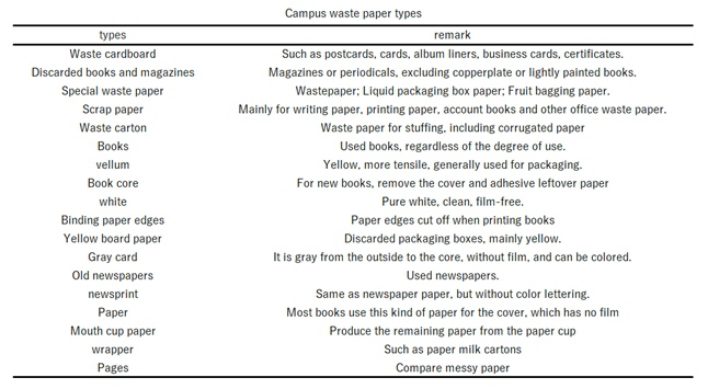
Figure 1: Types of waste paper used in schools.
well as the long distances to the waste paper processing plant, lead to higher costs for recycling waste paper in rural schools.
Types of Waste Paper Used on Campus The categories of campus waste paper arise in a variety of different settings. In the national standards for technical requirements for the reuse of waste paper, the waste paper often produced on campus can be roughly divided into the following categories in Figure 1.
Purpose of the Study The people’s awareness of saving waste paper is weak, and the environ- mental education of saving waste paper has not been paid attention to. To solve this problem priority should be given to optimizing the waste paper recycling system and raising the environmental awareness of society (Mirkovic et al., 2015). The purpose of this study is specifically summarized as shown below.
(1) Reflect the role of students’ behaviors and attitudes toward waste paper in the campus recycling process through better interactive mechanisms. Establish a mechanism for helping interaction between urban and rural schools to recycle waste paper, To change students’ behavior and atti- tude towards waste paper to achieve better recycling of waste paper (Haggar and Baher, 1999). (2) Using the new technologies available, the process of recycling waste paper is transferred from the industrial production system to life (Madu et al., 2002). Enabling the productization of large industrial production. Converting waste paper then it can be returned to people as recycled paper. It eliminates the need to collect waste paper centrally and put it into production and other traditional waste paper recycling links,
School Teachers’ and Students’ Behaviors and Attitudes 67
reducing the cost of transportation, production, and selling (Han et al., 2021). (3) Improve environmental education. Help students receive appropriate environmental education when disposing of waste paper. Students will learn how the waste paper should be recycled, the purpose and impor- tance of waste paper recycling, and the long-term social significance of waste paper recycling (Bahrami and Jafari, 2020; Aperebo et al., 2016; Rathod et al., 2015). (4) Product automation and modularity. Realization of waste paper transfer and drop-off; maintenance and use of machines. The systems for storing finished products, transporting them, etc., and corresponding service processes (Byström and Lönnstedt, 2000).
STUDY DESIGN System Concept
Taking waste paper recycling as an example, we propose a circular system of interactive mechanisms for urban and rural waste paper recycling, which converts waste paper into paper products through a series of processes, ope- ning up a new way for the recycling of waste paper (Cheung and Pachisia, 2015). Using the campus as an application scenario, with teachers and stu- dents as the main stakeholders, students will be able to develop a sustainable mindset in their behavior and transform waste paper into a sustainable pro- cess through pulp molding technology (Olutoye, 2005). We also consider urban and rural areas, improve the efficiency of single transportation to rural schools, and transport the processed waste paper materials to poor areas at the same time when we go to rural schools to collect waste paper so that we can realize the renewable use of waste paper and reduce the educational expenses of poor families.
Interactive Mechanism for Converting Waste Paper Into Objects The conversion of waste paper is a very critical part, it can be converted into other things, such as pen boxes and pen holders, which are more consumed and can also be used to convert into other needed products. The technology of pulp molding by injecting glue into the pulp can effectively complete the conversion.
Interaction Between Urban Schools and Waste Paper Urban schools use a lot of paper supplies and have a lot of waste paper, a large portion of which is discarded casually. At the same time, campus waste paper is highly recyclable and beneficial, and students can develop a sense of sustainability in the process. Urban schools are our main usage scenario. On urban campuses, teachers and students place a waste paper in recycling bins, which are then converted into designated items by recycling machines. Using these items saves students some money on stationery and solves the problem of recycling waste paper that cannot be used for high-value disposal such as industry.
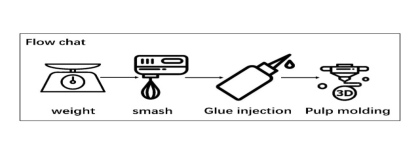
Figure 2: Schematic diagram of the internal principle of the waste paper conversion machine.
Interaction Between Rural Schools and Waste Paper Due to the large amount of waste paper in urban campuses, it was envisi- oned that there would be a surplus of items obtained through waste paper conversion and that the surplus would be transported to rural schools. Rural schools, especially those in remote villages, will have even less investment in education, few school supplies for students, and a smaller amount of waste paper, making it inconvenient to put in the converters. By delivering conversion-generated items to villages, we reduce their learning costs. At the same time, delivery vehicles can bring back and dispose of waste paper from rural areas.
Recycling Treatment Plant The recycling processing plant plays a transport role in the overall system by connecting the village school to the machine, bringing excess items from the machine to the village school, and bringing waste paper from the village school back for processing.
Design of Waste Paper Reuse Machine Waste Paper Converting Machine After the user selects the finished product and puts it in the waste paper, the waste paper converter first weighs the waste paper to make sure there is enough waste paper. The waste paper is then pulped and glue is added to the already pulped pulp to reshape the pulp and glue mixture through pulp- forming technology. The glue increases the hardness and abrasion resistance of the pulp as it cools, extending its service life. Pulp molding technology is the key technology to realize the conversion process, it uses pulp as raw mate- rial, and the production process is completed by pulp making, glue injection, drying, and shaping processes, which is environmentally friendly (Figure 2).
Waste Paper Replacement Machine Due to the limited size of the converter, the waste paper displacer assumes the role of storing the waste paper, into which the user puts the waste paper and the displacer shreds it for easy storage. At the same time, the replace- ment machine is provided with a connection port for connecting with the conversion machine. When the replacement machine is full of storage, the replacement machine will be connected to the conversion machine, and the pulp in the replacement machine will be sent to the conversion machine for
School Teachers’ and Students’ Behaviors and Attitudes 69
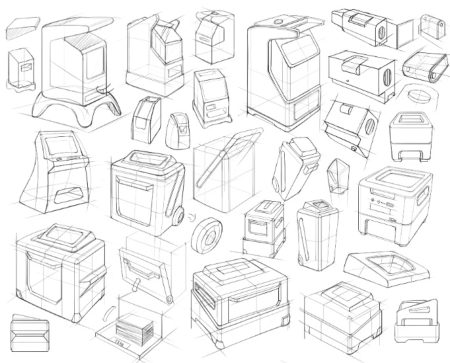
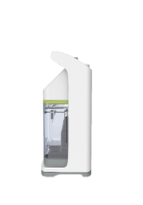
Figure 3: Product design process of the waste paper converter and waste paper replacement box.Figure 4: Product model display of waste paper converter and waste paper replacement box.
conversion. Participants can observe the process of making them (Lu et al., 2021; Jiang et al., 2022).
Styling The size of the waste paper changer is large because it needs to store a large amount of waste paper. In order to better connect with the paper changer, the width is limited and a height-adjustable connection port is designed to take into account the needs of different heights (Figure 3). The choice of colour scheme (Jiang et al., 2022; Jiang et al., 2022; Jiang et al., 2023; Jiang et al., 2023).
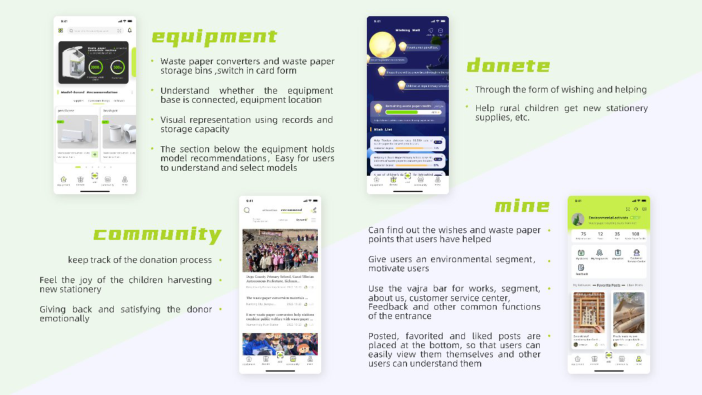
APP The APP, it provides real-time monitoring of the machine, selecting the mach- ine for online reservation, remote operation, and other functions. The choice of colour scheme (Jiang et al., 2022; Lu et al., 2021).
METHOD
Statistical Data Collected from the Guangdong Bureau of Statistics Information about the same city under the urban school category and rural school category, and statistics on the amount of waste paper in the country and the recoveries of different parts of waste paper (Yang et al., 2020). Collected a comparison of research figures before and after the introduction of the “new” interactive system.
Interviews With Stakeholders Before the focus group, the researchers interviewed stakeholders in two types of schools, to understand the interactive mechanism and technical structure of each waste paper treatment system. The interviews took the form of informal, loosely structured meetings and conversations, based on a list of questions that you want to be answered.
Focus Groups Renn et al. (1995) emphasize that public participation mechanisms are communication forums organized to facilitate communication among actors for the following purposes The selection of focus groups for deliberation allows citizens to express their views in their own words and to show how much importance they attach to an issue (Renn et al., 1995). This appro- ach was originally used by Burgess and Harrison (1998) for environmental issues (Burgess and Harrison, 1998). Focus groups are what is referred to as“organized group communication or discussion”and are used as a commu- nication process to gain insight into the rationa bvvc le for framing people’s attitudes and behaviors, the impact of the group, and the sense of finding compromise (Burgess and Harrison, 1998; Burgess et al., 2000). (2003) report that there is a growing body of common “good practices” regarding these processes (Davies et al., 2003). These processes can also be used to measure public opinion and underlying values, issues, and concerns. In expe- diency studies, focus groups are often used in the exploratory phase as a basis for developing hypotheses and designing questionnaires (Brouwer et al., 1999) (Brouwer et al., 1999). This is consistent with answering a questionnaire that elaborates on the impact of a positive interaction mechanism on school students’ behaviors and attitudes toward recycling waste paper. The majority of students con- sidered recycling to be a “positive thing”, although what is “positive” may vary between groups. Therefore, What can be expected is, Compared to indi- vidual questionnaires, People appear to be more active in recycling in a group setting (Ball and Tavitian, 1992).
Investigation Process The six groups in this study ranged in size from four to six members. Because of the size of the group, we can expect the results that the participants want and reach an agreement with the other members of the group.
School Teachers’ and Students’ Behaviors and Attitudes 71
In the fall of 2021, two focus groups were conducted in two types of sch- ools. Participants were recruited from schools through a random sample of phone book registrants. About 88% of those called were willing to parti- cipate. Limited information about the issues was provided in the telephone interviews to avoid including any participants who already had a significant interest in waste paper management. Each group consisted of four to seven males and females between the ages of 12 and 18. Each focus group met together in one evening for about three hours. The focus groups were faci- litated by one researcher as the moderator, with another researcher taking notes, asking follow-up questions, and helping with multi-criteria mapping. The focus group guide was used as the basis for the group discussions. The following topics related to waste management were covered.
Behavior of both types of schools in the presence or absence of parti- cipation in interactive mechanisms of waste management, sorting, and recycling.
Attitudes toward local school waste paper management systems.
On ways to handle waste paper more efficiently.
Motivations and potential for change in waste paper-related behavior.
Mapping of criteria for analyzing priorities and seeking compromises through individual and group discussions.
The facilitator leads the discussion by asking introductory questions and then asking each person individually to ensure that all people have expressed their views and that all topics are covered in the four-hour session. Within these constraints, we left most of the discussion to the participants to learn what they found interesting and important.
Individual Questionnaires Before and After Focus Group Sessions The questionnaire was short and simple, consisting of two pages of statemUents in which respondents were supposed to answer whether they “completely agree,” “somewhat agree,” “somewhat disagree,” “completely disagree,” or “don’t know/not relevant. The first section deals with how sati- sfied or dissatisfied respondents are with their school’s interactive system for recycling paper. The next section includes the following questions: Do peo- ple have feelings about urban and rural campuses helping each other achieve more effective waste paper recycling, and if so, how much, and what are people’s overall attitudes toward sorting and recycling, whether people are satisfied with their school’s waste paper disposal system. Attitudinal questi- ons about recycling interaction mechanisms and whether they have a positive or negative attitude towards waste incineration. Three weeks after partici- pating in the focus groups, all participants received a two-page follow-up questionnaire. The questionnaire included a short version of the attitude questions asked in the first questionnaire, some questions related to their experience of participating in the focus group, and whether they had learned something or changed their behavior or attitude as a result of participating in the focus group.
RESULT
Focus Group Discussion Attitude Toward Improving the Waste Management System In the focus group discussion on the improved waste paper management system, most participants found it beneficial. Significantly improved parti- cipants’ attitudes toward the waste paper. Before that panelist’s considered waste paper as useless garbage and discarded them at will. But after the improvement, participants collect the waste paper and put it into the repla- cement box. Meanwhile, some participants mentioned that collecting waste paper, and turning it into usable items gave them a sense of accomplishment (Reuter, 2011).
Motivation and Potential for Improving Waste Paper Management Methods Participants were generally positive about paper recycling efforts. Partici- pants seemed to think that waste paper still had value. Participants also indicated that it was important that the system was easy to use. Most of them want to do things that are good for the environment, but participants don’t want the recycling process to take up too much of their time. This is one of the reasons why traditional recycling methods are not a good solution for waste paper recycling. Besides convenience, the sense of responsibility for protecting the environment, and obtaining goods through waste paper are the reasons why participants actively engage in waste paper recycling. At the same time, the system has the attribute of urban-rural help, which respon- dents said was one of the reasons participants were happy to go for better behavior.
About How to Organize System Processes In the whole system, the town school is the main use scenario, where most of the waste paper raw materials come from. Teachers and students put the waste paper into the conversion machine and get the corresponding items. The large amount of waste paper in the town’s schools may lead to the over- production of machines. Excess items will be transported to rural areas by transport trucks, these items will be delivered to children in rural schools. At the same time, the transport truck will take away the waste paper from the rural areas and dispose of it. (As shown in Figure 5).
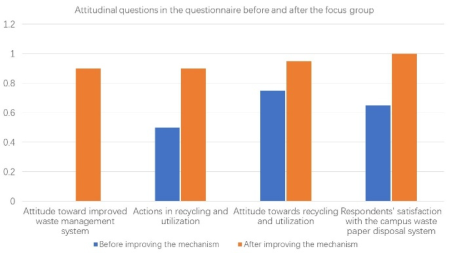
Questionnaire Results Before and After the Focus Group All respondents answered the questionnaire, Participants summarize the sta- tements about attitudes and behaviors below. Could the role of students’ behaviors and attitudes in the waste paper recycling process be reflected through better interactive mechanisms? Participants compared the results of similar questions before and after the questionnaire. The main results are shown in Figure 6.
Respondents’ Attitudes Toward Improving the Waste Paper Management System The majority of respondents agreed with the improved waste paper management system, saying that it was beneficial and reliable.
School Teachers’ and Students’ Behaviors and Attitudes 73
Figure 5: Interface diagram.Figure 6: Interaction mechanism system flow diagram.Figure 7: Attitude questions in the questionnaire before and after the focus group.
Behavior in Recycling and Utilization Before the system was improved, most respondents said they knew that recycling waste paper was a practice to protect the environment. However, respondents tend not to make much effort in their actions. Because traditi- onal recycling methods require a lot of time and effort. With the improved system, recycling has become faster, easier, and more meaningful, so students are more conscientious about recycling.
Attitudes Toward Recycling and Utilization After the improvement of the waste paper management system, most respon- dents said their attitude towards waste paper has improved. However, respondents also said that the previous recycling process was not convenient, so they rarely fulfilled the original system.
Respondents’ Satisfaction With the Campus Waste Paper Waste Disposal System Respondents are quite satisfied with the improved system of waste paper management. Respondents believe the system is not only sustainable but also helps schools and school children in rural areas. Students can derive greater satisfaction from the system.
CONCLUSION
The sample size of the six focus groups was too small, and the focus groups had too little data from the participants’ questionnaires. Therefore, we must be careful before drawing strong conclusions. Nonetheless, Nevertheless, some useful information was obtained in this study, including the relationship between school interaction mechanisms and waste paper disposal systems. By exploring situations and preferences in different economic and educatio- nal contexts, participants found that different ways of collecting information may affect the research results. Adopting a design approach, combined with social research, through more detailed target user classification. The inno- vative combination of pulping technology and pulp modeling technology through miniaturization. Complete the design practice of reusing waste paper. The design practice is an effective verification of the previous theoretical study and provides a case reference for subsequent designers in the same industry.
ACKNOWLEDGMENT
Thank you to Mr. Jiang Ao from Imperial College, UK for his guidance.
Thank you to all the staff and students of urban and rural schools for their patience and efficient cooperation with the research as participants.
Thank you to all the partners of the focus group.
REFERENCES
Aperebo, E. M., Onilude, M. A., & Komolafe, O. O. (2016). Design of waste paper recycling machines. Journal of Emerging Trends in Engineering and Applied Sciences, 7(2), 69–73. Bahrami, B., & Jafari, P. (2020). Paper recycling, directions to sustainable landscape.
International Journal of Environmental Science and Technology, 17, 371–382. Ball, R., & Tavitian, N. (1992). Public response to waste paper recycling schemes.
Resources, conservation and recycling, 6(2), 117–131. Brouwer, R., Powe, N., Turner, R. K., Bateman, I. J., Langford, I. H., 1999. Public attitudes to contingent valuation and public consultation. Environmental Values 8 (3), 325e347.
School Teachers’ and Students’ Behaviors and Attitudes 75
Burgess, J., Harrison, C., 1998. Environmental communication and the cultural politics of environmental citizenship. Environment and Planning A 30, 1445e1460. Byström, S., & Lönnstedt, L. (2000). Paper recycling: a discussion of methodological
approaches. Resources, Conservation and Recycling, 28(1-2), 55–65. Cheung, W. M., & Pachisia, V. (2015). Facilitating waste paper recycling and repurposing via cost modelling of machine failure, labour availability and waste quantity. Resources, Conservation and Recycling, 101, 34–41. Davies, F., Burgess, J., Eames, M., Mayer, S., Staley, K., Stirling, A., et al., 2003.
Deliberative Mapping: Appraising Options for Addressing ‘the Kidney Gap’. Final Report. Submitted Under the Welcome Trust’s Programme for Novel Meth- ods in Public Consultation (2000e2003). Grant no: 064492. www.deliberative- mapping.org. Fukazawa, H., Watanabe, M., Shiraishi, F., Shiraishi, H., Shiozawa, T., Matsushita, H., & Terao, Y. (2002). Formation of chlorinated derivatives of bisphenol A in waste paper recycling plants and their estrogenic activities. Journal of Health Science, 48(3), 242–249. Haggar, S. E., & Baher, R. A. (1999). Design, manufacture and testing of a waste
paper recycling system. International Journal of Environment and Pollution, 11(2), 211–227. Han, J., Gu, L., & Chen, D. (2021). Application of Innovative Design Thinking in Product Design* Intelligent Waste Paper Recycling Machine Design Case. In E3S Web of Conferences (Vol. 236, p. 04062). EDP Sciences. Jiang, A., Foing, B. H., Schlacht, I. L., Yao, X., Cheung, V., & Rhodes, P. A. (2022).
Colour schemes to reduce stress response in the hygiene area of a space station: a Delphi study. Applied Ergonomics, 98, 103573. Jiang, A., Gong, Y., Yao, X., Foing, B., Allen, R., Westland, S.,... & Zhu, Y.
(2023). Short-term virtual reality simulation of the effects of space station colour and microgravity and lunar gravity on cognitive task performance and emotion. Building and Environment, 227, 109789. Jiang, A., Schlacht, I. L., Yao, X., Foing, B., Fang, Z., Westland, S.,... & Yao, W.
(2022). Space Habitat Astronautics: Multicolour Lighting Psychology in a 7-Day Simulated Habitat. Space: Science & Technology. Jiang, A., Yao, X., Hemingray, C., & Westland, S. (2022). Young people’s colour preference and the arousal level of small apartments. Color Research & Applica- tion, 47(3), 783–795. Jiang, A., Zhu, Y., Yao, X., Foing, B. H., Westland, S., & Hemingray, C. (2023). The
effect of three body positions on colour preference: An exploration of microgravity and lunar gravity simulations. Acta Astronautica, 204, 1–10. Lu, S., Jiang, A., Schlacht, I., Foing, B., Westland, S., Hemingray, C.,... & Guo, Y.
(2021, June). Effects and challenges of operational lighting illuminance in space- craft on human visual acuity. In Advances in Human Aspects of Transportation: Proceedings of the AHFE 2021 Virtual Conference on Human Aspects of Tran- sportation, July 25–29, 2021, USA (pp. 582–588). Cham: Springer International Publishing. Lu, S., Jiang, A., Schlacht, I., Ono, A., Foing, B., Yao, X.,... & Guo, Y. (2021, June).
The effect on subjective alertness and fatigue of three colour temperatures in the spacecraft crew cabin. In Advances in Human Aspects of Transportation: Procee- dings of the AHFE 2021 Virtual Conference on Human Aspects of Transportation, July 25-29, 2021, USA (pp. 632–639). Cham: Springer International Publishing.
Madu, C. N., Kuei, C., & Madu, I. E. (2002). A hierarchic metric approach for integration of green issues in manufacturing: a paper recycling application. Journal of environmental management, 64(3), 261–272. Mirkovic, I. B., Majnaric, I., & Bolanca, Z. (2015). Ecological sustainability and
waste paper recycling. Procedia Engineering, 100, 177–186. Olutoye, M. A. (2005). Design of a manually operated paper-recycling machine.
Leonardo Electronic Journal of Practices and Technologies, 4(7), 49–54. Rathod, V. R., Rathod, S. R., & Wankhede, N. H. (2015). Design of Manually Operated Portable Paper Recycling Machine. International Journal on Recent and Innovation Trends in Computing and Communication, 3(2), 050–054. Renn, O., Webler, T., Wiedeman, P., 1995. Fairness and Competence in Citizen Par-
ticipation. Evaluating Models for Environmental Discourse. Kluwer Academic Publishers, Dordrecht, The Netherlands. Reuter, M. A. (2011). Limits of design for recycling and “sustainability”: A review.
Waste and Biomass Valorization, 2(2), 183–208. Terasaki, M., Shiraishi, F., Fukazawa, H., & Makino, M. (2007). Occurrence and estrogenicity of phenolics in paper-recycling process water: Pollutants originating from thermal paper in waste paper. Environmental Toxicology and Chemistry: An International Journal, 26(11), 2356–2366. Virtanen, Y., & Nilsson, S. (2013). Environmental impacts of waste paper recycling.
Routledge. Yang, G., Zhou, C., Wang, W., Ma, S., Liu, H., Liu, Y., & Zhao, Z. (2020). Recycling sustainability of waste paper industry in Beijing City: An analysis based on value chain and GIS model. Waste Management, 106, 62–70. Jiang, A., Yao, X., Westland, S., Hemingray, C., Foing, B., & Lin, J. (2022). The
Effect of Correlated Colour Temperature on Physiological, Emotional and Subje- ctive Satisfaction in the Hygiene Area of a Space Station. International Journal of Environmental Research and Public Health, 19(15), 9090. Liu, M., Tan, S., Zhang, M., He, G., Chen, Z., Fu, Z., & Luan, C. (2020). Waste paper recycling decision system based on material flow analysis and life cycle assessment: A case study of waste paper recycling from China. Journal of environmental management, 255, 109859. Shang, D., Diao, G., Liu, C., & Yu, L. (2021). The impact of waste paper recycling on
the carbon emissions from China’s paper industry. Environmental Management, 67, 811–821.
LISTED IN THE AHFE DIGITAL BOOKSTORE CATALOGUE
Explore the complete digital volume
Usability and User Experience
Read this individual research paper free through the original publisher, or explore the full digital proceedings book.
ISBN 978-1-958651-86-5
Explore this ISBN in the AHFE Bookstore ↗Listed in the July 2026 bookstore catalogue; search by ISBN to confirm current availability · Digital book purchase optional