Emad Bataineh, Mohamed Baesl Almourad (2026). Enhancing Digital Advertisement Design: Eye-Tracking Analysis of Spatial Layout Influence on Viewer Attention. In: Human Factors, Business Management and Society. AHFE Open Access, vol. 215, pp. 295–304. https://doi.org/10.54941/ahfe1007610
This research aims to discover how the spatial proximity between two crucial advertisement features—specifically, a product’s price and the “BUY NOW” prompt—shapes the purchase intentions of female university students. Using eye-tracking technology, the study analyses the viewing patterns generated by two nearly identical ads from a fictional brand selling women's heels. The layout is the sole variation between the two versions of the advertisements: in one, the price and call to action are displayed next to each other, while in the other, they are farther apart on the screen. The study examines whether a closer distance between the price and the call-to-action results in a greater visual focus and, consequently, a higher desire to purchase the shoes by comparing eye movement data. This analysis, based on consumer psychology and advertising practice, aims to offer evidence-based recommendations on how the placement of persuasive elements can influence choices across print and digital media
Digital marketing is a constantly evolving field that adapts to societal, technological, and customer preferences (Guoqiang and Bhaumik, 2024). Digital marketing, influenced by social media platforms, has expanded beyond sales to include product distribution, advertising, software programs, online auctions, stock trading, and dating services (Aslam et al., 2021). Digital marketers face challenges maintaining consumer attention span due to information overload, multitasking, and digital distractions (Somani et al., 2025). In fact, according to a Microsoft study, people’s attention spans have decreased to eight seconds, an almost 25% decrease since 2000 (Jung, 2021). The human brain adapts to fast-paced culture, making it crucial to create engaging content that leaves a lasting impression.
Influence and persuasion are crucial for digital marketers to create compelling advertising campaigns, persuasive messaging, and sales strategies (Braca and Dondio, 2023). Rhetorical strategies, social proof, and product price placement are essential for influencing customer decisions. Spatial positioning, such as the Call to Action (CTA) button and product price, helps digital marketers interact effectively with customers (Almaghlouth and Almeshal, 2024). These components are essential to consumers’
296 Bataineh and Almourad decision-making because they act as motivating and informative cues. According to psychology, combining related parts can make cognition easier and speed up the process, leading to better customer reactions (Nuseir et al., 2023). While spatial layout is essential for assembling components to create customer-attracting advertisements, its importance for consumer engagement and behavior is frequently overlooked in the literature on digital marketing.
Although much research has been conducted on persuasive messaging and visual attention in digital marketing (Santoso et al., 2022; Millagala and Gunasinghe, 2024; Chen et al., 2025), little empirical research has examined how the spatial placement of product price and CTA elements in advertisements affects consumer reactions. The spatial relationships among the main factors that influence consumers’ buying decisions are still poorly understood, with the majority of research focusing on the content quality, color, font, or animation of digital advertisements. Additionally, there is a lack of data-driven understanding of how these design elements affect specific target populations by gender, age, or other demographics.
One important technique for measuring visual fixation patterns and tracking attentional allocation is eye tracking, which provides insights into the information the brain is actively processing (Gheorghe et al., 2023). Eye tracking offers visual information that can be utilized for additional analysis and research by identifying consumer reactions and attractions (Almourad et al., 2025). Digital marketers struggle to find the best framework for optimizing visual engagement and piquing consumer interest.
The primary objective of the research is to examine the influence of the spatial proximity of elements like product pricing and “BUY NOW” CTA buttons in digital advertisements on the purchase intention of female university students. The study uses eye-tracking methodology to compare self-reported purchase intention and visual attention to two ad designs with distinct advertising stimuli of a fictional shoe brand promoting women’s heels that differ solely in the spatial arrangement of these elements: in one version, these elements are placed near each other, while in the other version, they are positioned far apart within the visual layout. This study aims to bridge the existing gap by providing empirical evidence of how strategic layout choices can enhance the efficacy of advertisements and directly improve design practices in digital marketing. The study aims to ascertain whether a closer spatial proximity between the call-to-action and the product price increases visual engagement and, consequently, the reported greater intention to buy. This study aims to provide empirical insights into how the placement of persuasive elements in an advertisement may affect consumer decision- making processes and behavioral intentions.
Section 2 presents a detailed literature review on digital marketing and purchase intention. Section 3 presents the research design and methodology. Section 4 discusses the results and findings of the experiments. Section 5 concludes the paper.
LITERATURE REVIEW
The digital marketing landscape has transformed significantly due to technological advancements and shifts in consumer behavior. Companies are vying for consumers’ attention, as consumers are continually exposed to
Enhancing Digital Advertisement Design: Eye-Tracking Analysis of Spatial Layout 297 external stimuli, and new advertising formats are being created (Loikkanen, 2023). The advent of new platforms, data analytics, AI, and social media has revolutionized customer engagement, enabling personalized experiences, real-time interactions, and targeted advertising campaigns (Dyana, 2024). Digital marketers have recently favored high-impact advertising to engage consumers, yet there remains a dearth of thorough research on this topic.
Visual Attention and Eye-Tracking in Digital Marketing Digital technologies have revolutionized advertising by offering computational approaches to tracking consumer behavior. One of the most critical technologies for capturing and maintaining attention is eye tracking, which helps advertisers optimize their commercials for deeper processing and greater effectiveness (Al-Azawai, 2019; Li et al., 2025). Advertisers should ensure their ads receive adequate initial attention and are optimized to sustain consumers’ attention long enough to encourage deeper processing and improve ad effectiveness by providing trustworthy metrics for gaining and retaining attention (Segijn, 2025). Eye-tracking remains the most reliable method for measuring visual attention because it provides multiple indicators and detailed insights into viewing behaviour and processing depth. Eye-tracking metrics, including fixation duration, fixation count, and gaze duration—all strongly correlated with cognitive processing and purchase intention—impact attention maintenance during advertisements (Singh and Sarkar, 2025). Consumer buying intention can be inferred from additional eye-tracking measures, such as fixation time on prices, photos, and product reviews (Li et al., 2025). These studies make it abundantly clear how crucial it is to correctly place these elements alongside the ad content to effectively influence customers’ purchase intent.
Effectiveness of Advertising and Spatial Layout Consumer purchase intention and behaviour are significantly influenced by the spatial layout of visual advertising components, such as product images, pricing details, and CTA buttons (Ramdani and Belgiawan, 2023). The Gestalt principles of visual perception suggest that objects that are closer together appear more related, with significant implications for advertising design (Nada and Azmy, 2023). The spatial layout of these digital elements in marketing ads can enhance enrichment and increase clutter perceptions, requiring distinct cognitive resources. Despite extensive research on visual clutter and symmetry (Im et al., 2021; Stoimenova, 2022), few studies have examined the spatial relationships among persuasive components, such as pricing and CTAs, in digital advertisements.
Purchase Intention, Cost Significance, and Impulsive Behavior Efficient digital marketing ads use visual elements to influence impulsive buying behavior, especially among Generation Z (Ngo et al., 2024). Effective visual merchandising, including themes, forms, colors, and lighting, can significantly impact consumer behavior. Visual design, including vibrant colors, dynamic lighting, and aesthetically pleasing product arrangements, can create an immersive shopping experience that captivates consumers and encourages spontaneous purchases (Bashirzadeh et al., 2022). Customers
298 Bataineh and Almourad may focus more on the product’s emotional or impulsive features when the price is less noticeable or farther from action triggers (such as the CTA). This is consistent with (Pozharliev et al., 2015), which shows that emotional reactions mediated by visual stimuli can take precedence over logical cost- benefit analyses, particularly in fashion or lifestyle advertising.
Although earlier research has contributed to understanding visual focus, ad-driven impulsive purchases, and the psychology of ad layout, little is known about how the spatial layout between a product price and a CTA affects consumers’ purchase intention. Most literature focuses on message framing, design colour, or content relevance rather than considering layout composition as a design-inherent factor. Furthermore, a research gap exists in applying biometric eye-tracking technology to design for a particular audience segment.
Addressing these gaps, this research explores the purchase behaviour of female university students who advertise digitally by analysing the impact of proximity between price and the “BUY NOW” call-to-action on purchase intention. The study uses eye tracking to measure visually guided attention, and participants’ eye movements and gaze are compared with their self- reported intention to purchase. Since the only change in the controlled ad is the price’s position relative to the CTA, the rest of the ad elements remain constant. Thus, any changes in the participants’ engagement and intent result from the layout changes.
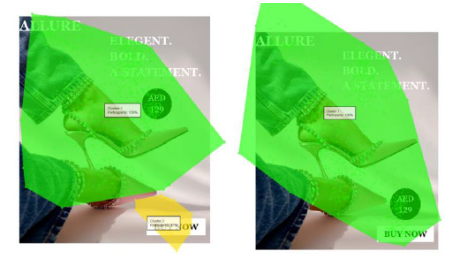
DESIGN AND METHODOLOGY Two visual stimuli were created for a fictitious ad promoting women’s heels (see Figure 1). The location of the pricing and CTA components was the primary distinction between the two stimuli. The price and CTA were positioned next to each other in one version and separated in the other. Neither stimulus was presented consecutively or back-to-back to minimize potential bias and avoid order effects. As an alternative, they were broadcast at different times throughout the experiment, with several irrelevant filler ads to counteract any memory or comparison effects. This study involved female undergraduate students at Zayed University in the UAE, ensuring demographic consistency in the sample.
Figure 1: Stimuli used in the experiment.
Enhancing Digital Advertisement Design: Eye-Tracking Analysis of Spatial Layout 299 Each stimulus had five predetermined Areas of Interest (AOI): the CTA element, brand name/logo, price, product image, and product information. These elements were chosen because they appear frequently in digital marketing materials and may impact consumers’ attention spans and decision-making. Product images and model elements in advertising serve as visual engagement aids that help consumers retain their visual attention (Riswanto et al., 2024; Mikalef et al., 2023).
RESULTS AND DISCUSSION
The experiment has 5 AOIs – price, brand name/logo, product info, CTA, and product image to evaluate visual engagement and preference, as visual engagement with product elements is a significant indicator of purchase intention. Visual attention directed towards product elements has also been identified as an essential indicator of purchase intention. Zhang and Yuan (2018) reported that consumers with an extended average gaze duration per fixation on product elements demonstrated a 1.83 times higher purchase intention than those with a shorter average gaze duration per fixation on the same elements. This finding underscores the influence of focused visual engagement with the product on consumer inclination to purchase.
Heatmaps According to the eye-tracking heatmap analysis (see Figure 2), the visual attention patterns for the two advertisement stimuli differed noticeably. In particular, participants showed longer total fixation duration and more fixations throughout the advertisement when the “BUY NOW” CTA element was farther from the price element. These metrics indicate a higher interest in the promoted product and a stronger buying intention. They are typically linked to increased cognitive engagement.
Quantitative Analysis The quantitative analysis examines eye-tracking metrics like fixation count, fixation duration, and total visit duration to measure viewers’ cognitive engagement, visibility of branding features, and the speed at which a specific area draws attention.
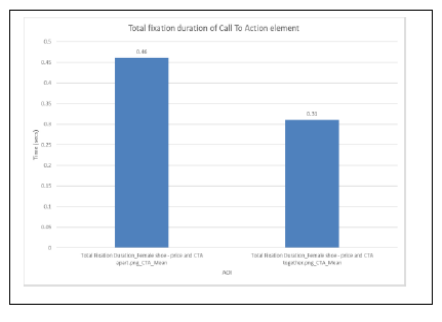
300 Bataineh and Almourad The analysis of eye-tracking data revealed notable differences in visual attention patterns between the two advertisement stimuli. Specifically, when the “BUY NOW” CTA element was positioned farther from the price element, participants exhibited a longer total fixation duration and more fixations across the advertisement (see Figure 3). These metrics are generally associated with increased cognitive engagement and suggest heightened interest in the advertised product and a stronger purchase intention. These visual metrics were considered in previous experiments in (Barbierato et al., 2023), where authors employed an eye-tracking experiment to evaluate various wine labels and their correlation with consumer preferences, revealing that the total number of fixations, total time to first fixation, and maximum number of consecutive fixations are key visual metrics that exhibit a direct proportionality to user preferences. These results align with the observations in (van der Laan et al., 2015; Merdian et al., 2021), which also established a close relationship between fixation duration and consumer preference.
Figure 3: Total fixation duration of the CTA element.
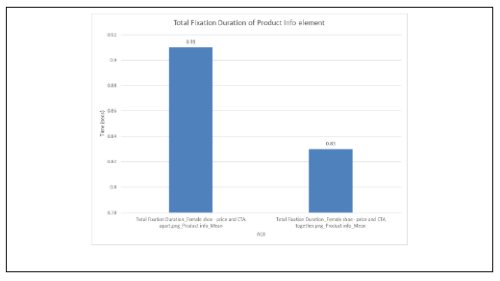
Previous research (Mikalef et al., 2023) concluded that certain elements, such as images, prices, reviews, and other informational cues, are significant, as they are the deciding factors in a consumer’s purchasing decision. A critical observation was the increased total fixation duration on the product information area in the stimulus where the CTA and price were spatially separated. This contrasts with the stimulus in which the price and CTA were placed nearby, where the fixation duration on the product information area was comparatively lower. This suggests that, without immediate visual access to the price near the CTA, participants may have relied more heavily on product-related details to form their purchase decisions.
Figure 4: Total fixation duration of the product info element.
Drawing on the findings of (Zhang and Yuan, 2018) on the determinants of advertising recall effectiveness, their research highlighted the preeminent role of product elements in influencing this cognitive outcome (see Figure 4). Specifically, their analysis revealed a significant association between the duration of visual engagement with the product element, measured as the average gaze duration per fixation count, and the likelihood of ad recall. The reported effect indicated that individuals who exhibited more fixations on the product element, relative to the number of fixations, were 2.97 times more likely to recall advertising information than those who demonstrated briefer visual attention to the same element. This outcome underscores the critical importance of strategically emphasizing product elements within advertising design to enhance memory retention of the advertised message [29].
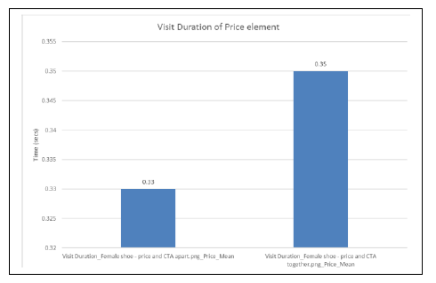
Figure 5: Visit duration of the price element.
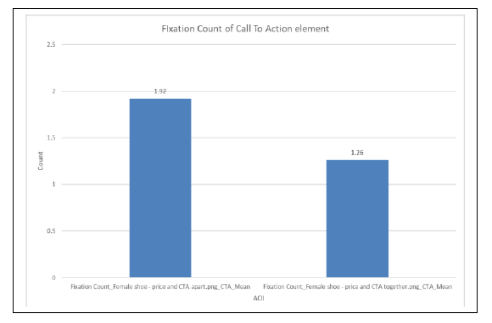
Extended average gaze duration directed towards product objects has been found to correlate positively with enhanced recall performance (Zhang and Yuan, 2018). This observation likely reflects the goal-oriented nature of consumers’ memory processing when engaging with video advertisements, suggesting that extended visual attention to the advertisement’s central subject facilitates stronger encoding and subsequent retrieval of its content. Furthermore, the visit duration (see Figure 5) and fixation metrics for the price element (see Figure 6) were lower when the price was positioned away from the CTA. This indicates that participants spent less time consciously considering the product’s cost. The reduced visual attention to price suggests
302 Bataineh and Almourad that it was not a primary factor in the decision-making process and that participants may have been less cognitively focused on evaluating the item’s cost. This finding aligns with theories in consumer psychology that propose physical or visual distancing of price can minimize the “pain of paying,” thereby promoting more impulsive purchasing behavior. These findings imply that the spatial separation between price and CTA may foster a more favorable environment for impulse purchases by shifting attention away from cost considerations and toward product features and the act of purchase.
CONCLUSION
This study uses eye tracking to investigate how the price and the “BUY NOW” CTA, two critical advertising components, are spatially close to one another and how this influences female university students’ attention spans and intention to buy. Eye-tracking metrics, such as fixation duration on the product image, attention to price, and time spent on product reviews, emerged as salient indicators of underlying decision-making processes. These visual metrics were incorporated into the experimental design to better understand how customers interact with various ad layouts, as they provided insightful empirical data.
Figure 6: Fixation count of the CTA element.
The findings imply that increasing the spatial separation between price and CTA elements might create a more favourable environment for impulse buying. Persuasive components, such as price and CTA, may be strategically positioned farther apart to increase ad effectiveness, given the proven positive correlation between visual attention to product-related elements and purchase preference. Future research can build on these findings by investigating the effects of spatial arrangement across various demographic groups, product categories, and device formats (e.g., mobile vs. desktop). Understanding emotional engagement with advertisements could be further enhanced by incorporating additional biometric data, such as skin conductance, heart rate, and pupil dilation.
ACKNOWLEDGMENT
The authors would like to acknowledge everyone who supported and contributed to this research work.
REFERENCES
Al-Azawai, M. (2019). The application of eye-tracking in consumer behaviour. International Journal of Engineering and Technology, 8(12), 83–86. Almaghlouth, A., & Almeshal, S. (2024). Role of Digital Marketing Content Strategy on User Experience Toward Cultural Venues in Saudi Arabia. International Journal of Business, Marketing and Communication, 4(37), 25–35. Almourad, M., Bataineh, E., Hussein, M., & Wattar, Z. (2025). Strategic Placement
of Branding Elements in Digital Marketing: Insights from Eye-Tracking Data. In Proceedings of the 27th International Conference on Enterprise Information Systems (pp. 417–423). Aslam, H., Rashid, M., & Chaudhary, N. (2021). Impact of personalized social media advertising on online impulse buying behavior. SEISENSE Business Review, 1(3), 12–25. Barbierato, E., Berti, D., Ranfagni, S., Hernández-Álvarez, L., & Bernetti, I. (2023).
Wine label design proposals: an eye-tracking study to analyze consumers’ visual attention and preferences. International Journal of Wine Business Research, 35(3), 365–389. Bashirzadeh, Y., Mai, R., & Faure, C. (2022). How rich is too rich? Visual design elements in digital marketing communications. International journal of research in marketing, 39(1), 58–76. Braca, A., & Dondio, P. (2023). Developing persuasive systems for marketing:
The interplay of persuasion techniques, customer traits and persuasive message design. Italian Journal of Marketing, 2023(3), 369–412. Chen, X., Yang, Y., Bilgihan, A., & Liu, W. (2025). Eyeing the pun: an eye-tracking study on the synergistic effects of visual and textual elements in tourism advertising. Journal of Hospitality and Tourism Technology, 16(4), 684–704. Dyana, P. F. N. (2024). An empirical analysis of emerging trends in digital
marketing”. Innovatus: An Ivanian Journal of Economics and Business Studies, 17–21. Gheorghe, C. M., Purcărea, V. L., & Gheorghe, I. R. (2023). Using eye-tracking technology in Neuromarketing. Romanian journal of ophthalmology, 67(1), 2. Guoqiang, Z., & Bhaumik, A. (2024). The Influence of Social Media on
Consumer Behavior and Digital Marketing Strategies: A Comprehensive Review. Advancement in Management and Technology (AMT), 5(2), 30–38. Im, H., Ju, H. W., & Johnson, K. K. (2021). Beyond visual clutter: the interplay among products, advertisements, and the overall webpage. Journal of Research in Interactive Marketing, 15(4), 804–821. Jung, B. (2021). Attention as a scarce resource in the platform economy. In Disruptive
Platforms (pp. 130–143). Routledge. Li, J., Behe, B., Huddleston, P., & Thatcher, S. (2025). The role of price in display complexity’s impact on horticultural plant purchase intention: An eye-tracking study. Journal of Retailing and Consumer Services, 82, 104124. Li, X., Tse, Y. K., & Bu, X. (2025). Examining corporate social irresponsibility in
manufacturing: An eye-tracking study of social media news. International Journal of Production Economics, 281, 109539. Loikkanen, L. (2023). Capturing attention with video marketing: effectiveness of high impact formats in online advertising.
304 Bataineh and Almourad Merdian, P., Piroth, P., Rueger-Muck, E., & Raab, G. (2021). Looking behind eye-
catching design: An eye-tracking study on wine bottle design preference. International Journal of Wine Business Research, 33(1), 134–151. Mikalef, P., Sharma, K., Chatterjee, S., Chaudhuri, R., Parida, V., & Gupta, S.
(2023). All eyes on me: Predicting consumer intentions on social commerce platforms using eye-tracking data and ensemble learning. Decision Support Systems, 175, 114039. Millagala, K., & Gunasinghe, N. (2024). Neuromarketing as a digital marketing strategy to unravel the evolution of marketing communication. In Applying business intelligence and innovation to entrepreneurship (pp. 81–105). IGI Global Scientific Publishing. Nada, M., & Azmy, A. (2023). Eye-tracking in out-of-home advertising: Exploring
the application of Gestalt principles. International Design Journal, 13(6), 437–446. Ngo, T. T. A., Nguyen, H. L. T., Nguyen, H. P., Mai, H. T. A., Mai, T. H. T., & Hoang, P. L. (2024). A comprehensive study on factors influencing online impulse buying behavior: Evidence from Shopee video platform. Heliyon, 10(15). Nuseir, M. T., El Refae, G. A., Aljumah, A., Alshurideh, M., Urabi, S., & Kurdi, B.
A. (2023). Digital marketing strategies and the impact on customer experience: A systematic review. The effect of information technology on business and marketing intelligence systems, 21–44. Pozharliev, R., Verbeke, W. J., Van Strien, J. W., & Bagozzi, R. P. (2015). Merely being with you increases my attention to luxury products: Using EEG to understand consumers’ emotional experience with luxury branded products. Journal of Marketing Research, 52(4), 546–558. Ramdani, M. A., & Belgiawan, P. F. (2023). Designing Instagram Advertisement
Content: What Design Elements Influence Customer Attitude and Purchase Behavior?. Contemporary Management Research, 19(1), 1–26. Riswanto, A. L., Ha, S., Lee, S., & Kwon, M. (2024). Online Reviews Meet Visual Attention: A Study on Consumer Patterns in Advertising, Analyzing Customer Satisfaction, Visual Engagement, and Purchase Intention. Journal of Theoretical and Applied Electronic Commerce Research, 19(4), 3102–3122. Santoso, I., Wright, M. J., Trinh, G., & Avis, M. (2022). Mind the attention gap: how
does digital advertising impact choice under low attention?. European Journal of Marketing, 56(2), 442–466. Segijn, C. M. (2025). Eye-Tracking Research in Advertising Scholarship: A Review and Practical Guide. Journal of Advertising, 1–18. Singh, J., & Sarkar, P. (2025). Understand and quantify the consumers’ cognitive
behavior for the appropriateness features of product aesthetics through the eye- tracking technique. International Journal on Interactive Design and Manufacturing (IJIDeM), 19(2), 1263–1296. Somani, P. P., Iyer, V., Wani, P. S., & Tambuskar, D. P. (2025). Engagement in an Age of Distraction: Addressing Declining Attention Spans. In Motivating Engagement, Belonging, and Success in Higher Education Student Experience (pp. 269–302). IGI Global Scientific Publishing. Stoimenova, B. (2022). Visual marketing elements in digital media: A tool for
planning. van der Laan, L. N., Hooge, I. T., De Ridder, D. T., Viergever, M. A., & Smeets, P.
A. (2015). Do you like what you see? The role of first fixation and total fixation duration in consumer choice. Food Quality and Preference, 39, 46–55. Zhang, X., & Yuan, S. M. (2018). An eye tracking analysis for video advertising: Relationship between advertisement elements and effectiveness. IEEE access, 6, 10699–10707.
LISTED IN THE AHFE DIGITAL BOOKSTORE CATALOGUE
Explore the complete digital volume
Human Factors, Business Management and Society
Read this individual research paper free through the original publisher, or explore the full digital proceedings book.
ISBN 978-1-964867-91-5
Explore this ISBN in the AHFE Bookstore ↗Listed in the July 2026 bookstore catalogue; search by ISBN to confirm current availability · Digital book purchase optional