Allan Chung, Yo-wen Liang (2025). Exploring Key Virtual Reality Features to Enhance Efficiency Communication in Spatial Design. In: Accessibility, Assistive Technology and Digital Environments. AHFE Open Access, vol. 162, pp. 117–126. https://doi.org/10.54941/ahfe1006019
Virtual reality (VR) technology has emerged as a promising tool for enhancing communication efficiency in spatial design by providing immersive and interactive environments. This study investigates the impact of specific VR features implemented through the KeyVR platform on design-related communication processes. Using a mixed-method approach involving pre- and post-test communication efficiency questionnaires and the Kano Model analysis, the research evaluates how functionalities such as teleportation, material switching, and interactive sketching contribute to discussion quality, communication richness, and openness. Results indicate that VR-based communication improves several dimensions of interaction compared to traditional face-to-face methods, though challenges like contextual applicability of the experiment remain. This study highlights the importance of VR features and proposes further research directions to optimize VR tools for spatial design communication efficiency.
In the spatial design field, virtual reality (VR) technology facilitates a more effective communication process between designers and clients by providing a shared virtual space where design elements can be explored and modified in real-time. This reduces misunderstandings and enhances the accuracy of conveying design intentions. An interior design research example by Lee et al. shows that VR plays a vital role in spatial understanding; especially, usually the interior design has to meet standards like standards for accessibility (Lee et al., 2023). Not only do the design industries adopt VR in design discussions, but the technology is gradually being used in education. In educational settings, VR has improved understanding of spatial dimensions and scale, critical competencies in architectural design (Angulo, 2015).
Furthermore, VR supports participatory design processes by enabling end- users to engage directly with design models, providing feedback that can be incorporated into the design, thus ensuring that the outcome aligns more closely with user preferences and needs (Chang et al., 2024).
However, communication effectiveness has been widely recognized as a challenge when people use virtual reality (VR) for discussions. One significant issue is that the extended use of a VR headset requires muscle fatigue, pain, and joint stiffness despite reduced mental effort (Wang and Dunston, 2011). Thus, while VR has potential, the effectiveness of communication must be improved. Fortunately, the head-mounted VR device became more affordable, and the software built a more immersive virtual environment for users, and more researchers have proven the benefits of communication through VR (Wang and Dunston, 2011). However, only a few papers present specific features that can influence design-related spatial or interior design communication in VR. An example from Research by Xu et al. found that the requirements can be categorized into visual, interactive, and content experiences and highlighted that having a gauge tool in the virtual space, multiple triggerable objects and the ability to view the location quickly are the essential elements (Xu et al., 2019). To unveil a more fundamental requirement that can benefit communication in VR, this research examines a great number of features presented in the articles reviewed and popular market-ready VR platforms for spatial design to analyze how the functions can enhance communication effectiveness.
LITERATURE REVIEW
Virtual Reality for Spatial Design Virtual reality has significantly transformed various industries by offering immersive and interactive experiences, notably spatial design. One fundamental feature of such systems is an interactive display that allows users to adjust observation points and view interior landscapes from varied perspectives. This capability helps users better visualize spatial arrangements in detail. Specifically, VR systems support navigational functions like automatic and walking roaming, enabling intuitive exploration of spaces and access to hidden corners (Lee, 2023; Guo, 2023). Another proposal that people would apply VR to spatial design is customization elements. Features such as the ability to change furniture, adjust lighting, and modify wall or floor decorations provide users with control over the virtual environment, enhancing their immersion and satisfaction; also, the option to restore personal color schemes further allows for design personalization, making the virtual space reflect individual preferences (Guo, 2023). These customization options contribute to a more user-centric and engaging experience to create spaces that closely align with their vision and optimize design decisions by evaluating the impact on costs (Juan et al., 2019).
Despite its advantages, using VR in spatial design is not without challenges, which can affect the effectiveness and efficiency of design processes and outcomes. One significant issue is cybersickness, which is caused by the immersive nature of VR and leads to nausea and dizziness (Joel et al., 2022). This discomfort can shorten session durations and negatively impact the overall user experience. Additionally, the adoption of VR in design education and practice has been hindered by a steep learning curve for mastering new tools and systems, coupled with the high hardware and software costs.
Exploring Key Virtual Reality Features to Enhance Effective Communication 119
These barriers can be particularly challenging for smaller design firms or educational institutions with limited resources.
Fortunately, advancements in VR technology have gradually addressed many of these issues. Modern VR headsets, such as the HTC Vive and Oculus Rift, have become more comfortable and affordable, making them suitable for extended professional use. Stand-alone devices like the Meta/Oculus Quest 2 offer a cost-effective, user-friendly alternative to tethered headsets, which require powerful computers, thus increasing their appeal in educational and professional settings. Furthermore, rendering techniques such as multi-level detail (LOD) and pre-processed scenarios, like radiometric methods, have reduced computational demands while preserving visual quality (Zhu and Du, 2021). From a user perspective, nowadays, compared with Unity or Unreal Engine, various developed rendering platforms for spatial design, such as Enscape, Twinmotion, or D5 render, also support the detailed and realistic virtual experience without programming usage. Overall, these platforms include features like Teleport Body, Change Environment, Change Material, and Screenshot. However, another platform, KeyVR, offers a versatile set of functions and an efficient rendering environment, providing most functions that can be edited or used while using VR. These technological advancements demonstrate the potential for VR to overcome its initial drawbacks and transform spatial design practices effectively.
Communication Experience in VR Communication in virtual reality is a multifaceted process where users interact through immersive environments. Several elements affecting the communication experience while using VR have been recognized, and studies have extended the border of its measurement.
Most research in this field focuses on broader themes that universally impact the VR experience: immersion and presence, comfort, and usability. Immersion refers to the objective technological capability of a VR system to deliver a comprehensive and engaging sensory experience, which includes visual, auditory, and sometimes haptic feedback, creating a sense of being enveloped by the virtual environment. These virtual environments provide a safe space for practice, where users can receive immediate feedback, improving self-efficacy and interpersonal communication. Such training helps learners build confidence and refine their skills in a controlled, risk-free setting. Presence, on the other hand, is the subjective psychological response of the user, characterized by the sensation of ‘being there’ within the virtual environment despite being physically located elsewhere. It measures how effectively the VR system can convince users that they are part of the virtual world. The difference between immersion and presence lies in their nature; immersion is a property of the VR system itself, while presence is the user’s experience and perception of that system.
Comfort and usability in VR are critical factors that influence user experience and the effectiveness of VR applications. Comfort in VR often relates to the physical and psychological ease experienced by users while
120 Chung and Liang
interacting with virtual environments. For instance, a study noted that the comfort level of a VR headset exceeded that of other stimulation devices, although some users reported moderate dizziness, which was deemed acceptable by the experimenters (Wang, 2024). This highlights the importance of minimizing discomfort, such as motion sickness, to enhance user satisfaction and engagement. For usability, it refers to how easily users can interact with VR to achieve their goals. A bright interior designing application using VR demonstrated usability by allowing users to interact with home components like furniture and gates, emphasizing a user-friendly interface that facilitates easy understanding and interaction on both desktop and VR platforms (Siddiqui et al., 2023).
While there is an issue with interacting with other people, the lack of non-verbal cues, such as facial expressions and gestures, can hinder communication accuracy and appropriateness in VR settings. Therefore, some researchers adopt quantitative measures, such as accuracy and reliability tests, that can be used to evaluate the performance of VR communication systems. These metrics help assess how well the system supports effective communication. Some would practice qualitative assessments, including user feedback and expert evaluations, to provide insights into the subjective experiences of participants and the perceived effectiveness of communication in VR. In research from Lowry et al., questionnaires designed to measure communication effectiveness with computers often include items that assess various dimensions such as discussion quality, communication richness, and appropriateness (Lowry et al., 2006). In a study by Abbas et al., specific criteria such as discussion quality, appropriateness, richness, openness, and accuracy are used to evaluate communication behaviors and effectiveness in VR settings (Abbas et al., 2019).
RESEARCH METHOD According to the reviews, several essential functions have been proven to improve immersion, satisfaction, and experience. Embracing these functions, such as changing elements, gauging or moving in the room, this research found that the software KeyVR has a range of tools for designers within VR environments and supports multi-players in a room. With no extra development required, it provides 16 core functions for users including (1) Teleport Body, (2) Switch Model Set, (3) Object Info: show the object’s material and name, (4) Switch Material, (5) Switch Environment (HDRI), (6) Animation, (7) Move Object, (8) Physics: the switch of the gravity, (9) Precise Move Object: Moving object with snap and axis support, (10) Screenshot, (11) Fly: freely moving in the space, (12) Measure, (13) Pointer, (14) Sketch, (15) Scale: can scale user’s body size in the virtual environment and (16) Plane Cut: being able to see the segment. These functions will be examined in a KeyVR beginner platform with HTC Vive Pro VR headsets to determine their influence on the discussion of communication.
To realize the impact, 20 participants studying or working in interior or spatial design-related fields attended this experiment without experiencing
Exploring Key Virtual Reality Features to Enhance Effective Communication 121
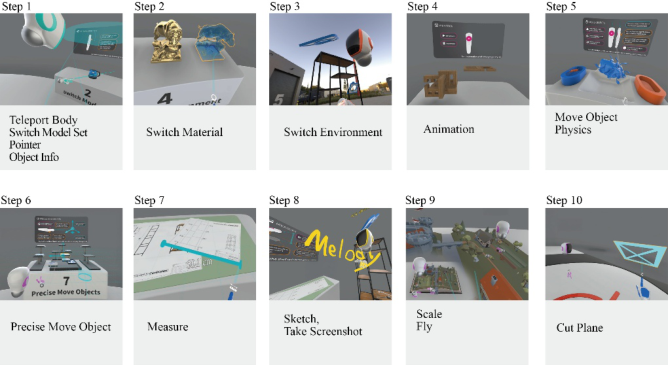
KeyVR experiencing VR before. First, to determine the communication condition of each participant, the study conducted a communication effectiveness questionnaire (see Table 1), evaluating their face-to-face communication experience. Then, participants followed all instructions shown in Figure 1. Two participants will simultaneously wear VR headsets in each session and know at the beginning that another person in the same virtual space is performing the same activities together. The tasks are designed to include scenarios where they will need to use the tools within the software to solve specific challenges collaboratively. After the experience, the participants filled out the Kano model questionnaire with positive and negative questions to evaluate the degrees and the types of demands on each function. To quantify the quality of the functions, the count of Attractive quality (A), One-dimensional quality (O), Must-have quality (M), Indifferent quality (I), Reserve quality (R), and skeptical (Q) determine a function’s quality, and the satisfied impact (SI) and dissatisfied impact (DSI) are able to show via (1) and (2). With these parameters, the priority can be visualized with a sensitivity matrix.
Satisfied Impact (SI) = (A + O)/(A + O + M + I) (1) Dissatisfied Impact (DSI) = −1 × (O + M)/(A + O + M + I) (2)
Eventually, the participant will fill out the communication effectiveness questionnaire again as a post-test in the experiment.
Table 1: Communication effectiveness questionnaire (Abbas et al., 2019).
Table available in the original PDF paper.
Topics Question Questionnaire Used Discussion Quality Issue Understanding I correctly understood the issue that I had to discuss. Knowledge Sharing
The group members effectively shared information about the project. Satisfactory Solution
The solution produced by the group discussion was satisfactory. Discussion Effectiveness
The overall group discussion was an effective means of finding a solution. Communication Appropriateness
Concentration on others
I focused on other members when they were speaking. Concentration from others
Other members focused on me when I was speaking. Politeness to others
I treated other members politely during communication. Politeness from others
Other members treated me politely during communication. Communication Richness
A rich amount of information was shared during the discussion.
Overall information quantity Others provided me with enough information when they spoke.
Information quantity from others
Continued
122 Chung and Liang
Table 1: Continued Topics Question Questionnaire Used
Table available in the original PDF paper.
Information quality to others I could provide detailed information on the subject when needed.
I could provide vivid information on the subject when needed. Information quantity to others Communication Openness Open- mindedness It was easy to communicate openly with all group members. Enjoyableness I found it enjoyable to talk to other group members. Communication Accuracy
Communication accuracy
I often had to go back and check the information I received. Misunderstanding others
I often did not understand what others were saying. Misunderstood by others
I often had to re-explain statements I had previously made.
A non-parametric statistical approach was adopted because the sample size was fewer than 30 participants. To assess the dimensions of Discussion Quality, Communication Appropriateness, Communication Richness, Communication Openness, and Communication Accuracy, the pre- and post-test item scores for each dimension were averaged to compute the respective dimension scores. For Communication Accuracy, as it contained reverse-scored items, the correct score for each item was calculated by subtracting the obtained score from the sum of the maximum score (5) and the minimum score (1). Subsequently, reliability analysis, descriptive statistics (mean calculation), and a paired samples Wilcoxon test were conducted to evaluate the differences between the pre-and post-test scores.
Figure 1: The flow of the experiment.
Exploring Key Virtual Reality Features to Enhance Effective Communication 123
RESULTS AND DISCUSSIONS The Results of Communication Effectiveness
Overall, 21 people attended this research and completed the communication effectiveness questionnaires, but only 17 returned the valid Kano Model questionnaires. The reliability of the former questionnaires was confirmed using Cronbach’s Alpha. The pre-test yielded a reliability coefficient of 0.842, indicating strong internal consistency, while the post-test achieved a slightly lower coefficient of 0.81. Additionally, the paired samples Wilcoxon test was applied to evaluate the differences between face-to-face (F2F) and immersive virtual reality-based communication channels, as presented in Table 2. Among the five factors, quality of discussion, openness, richness, and accuracy demonstrated statistically significant differences between the two modes of communication. However, no statistically significant differences were observed for the factor appropriateness.
Interestingly, some questions illustrate significant improvement, including the questions of the Satisfactory Solution (p = 0.001), the Information Quantity from Others (p = 0.002), the Open-Mindedness (p = 0.008), and the Enjoyableness (p = 0.001). In contrast, the standard deviations of the Communication Accuracy and the Misunderstood by Others are relatively higher than the other in both F2F and VR, with a relative standard deviation between approximately 1 and 0.9. Perhaps increasing the sample size would stabilize the tendency of the choice, but it seems that participants show various perceptions in these aspects. These questions deserve further study in the future.
Table 2: The result of paired samples Wilcoxon test.
Mean (Standard deviation) b. * p < 0.05, ** p < 0.01, *** p < 0.001
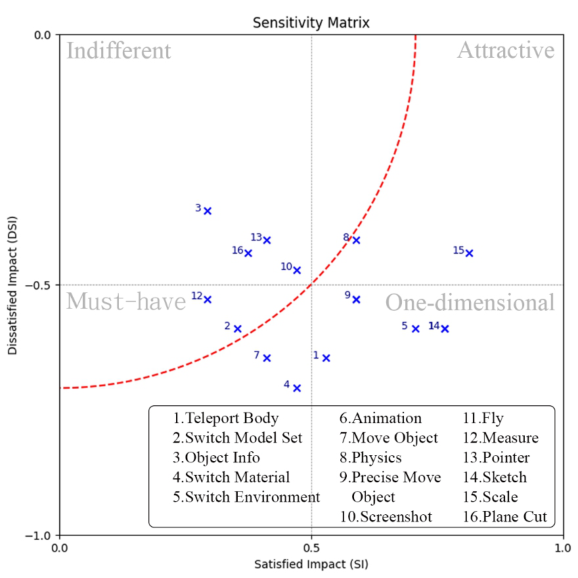
The Results of the Kano Model Analysis Regarding the results of Kano’s questions, by removing the invalid questionnaires, a majority of the functions are classified as one-dimensional attributes followed by the number of indifferent quality functions, and a Kano model sensitivity matrix presented in Fig. 2.
For the quality classification based on the count of A, O, M, I, R and Q qualities, half of the functions are arranged into the on-dimensional attribute, including the Teleport body, the Switch Environment, the Animation function, the Physics stimulation function, the Precise Move Object, the Fly function, the Sketch, and the Scale adjustment. However, five features are decided as indifferent quality: the Object information, the Screenshot, the Measure, the Pointer, and the Plane Cut. Only three Must- have functions, the Switch Material, the Switch Model Set, and the Move Object, are recorded.
124 Chung and Liang
According to the sensitivity matrix, the sketch takes more weight in the experience, and the ability to view a model’s information is least interesting. The result can be observed from the video recordings that the experiment showed participants were particularly excited and interested in the process of drawing and sharing screenshots with each other. They even attempted to create content beyond the task requirements. Therefore, we posit that the high score for enjoyableness observed earlier is strongly associated with the functionality of the sketch. However, further research is needed to determine whether preferences are based on the activities’ functions or enjoyment, as the task’s enjoyability and the function’s usability may differ. Additionally, understanding whether enjoyability plays a dominant role in shaping experimental outcomes is a relevant topic for design discussions.
Figure 2: Domains of human systems integration.
Undoubtedly, most specific functions shown in past studies are in the Must-have and the One-dimensional areas, such as the Teleport, the Switch Model and Material (Juan et al., 2019). Although the measure tool, from a descriptive statistics view, is categorized into indifferent quality, accounting for 40%, both one-dimensional and must-have selections account for 45%, so satisfied and dissatisfied impacts demonstrate 0.29 and −0.58. As the method used in a study by Li et al., it can still be viewed as a must-have requirement, and if the sample scales up, this tendency would be more apparent (Li et al., 2023).
Exploring Key Virtual Reality Features to Enhance Effective Communication 125
However, focusing on the limitations of this experiment, the context practiced must be addressed. As mentioned, the purpose of the VR design communication platform is to demonstrate its functions and give the member a trial experience, which is different from an actual design context, while this study still provides valuable insights for further experimental design. In the future, the next phase of experiments can focus on features with non- indifferent quality, designing a series of comprehensive tasks for participants to experience. These tasks should include more in-depth interactive activities to enhance engagement.
CONCLUSION
This study underscores the potential of VR as a transformative tool for enhancing communication effectiveness in spatial design. VR platforms like KeyVR significantly improve discussion quality, communication richness, and openness by leveraging features such as teleportation, material switching, and interactive sketching. While there is no difference between face-to- face interactions in terms of appropriateness, VR demonstrated notable advantages in fostering satisfaction and potentially providing an efficient communication environment for participants.
The findings reveal that features, particularly changing material, models or the ability to move objects and gauge, play a pivotal role in developing communication experiences, as evidenced by their indispensable position among participants. However, challenges such as the variability in user perceptions with a small sample size and the need for contextual relevance highlight the importance of tailoring VR applications to real-world design scenarios.
Future research should explore more comprehensive task designs and larger participant samples to validate and expand upon these insights. By focusing on functions with the highest impact, VR can further bridge the gap between technological innovation and practical application in spatial design, ultimately redefining how designers and clients communicate and collaborate.
ACKNOWLEDGMENT
This research was partially supported by the National Science and Technology Council (NSTC) and the Ministry of Education (MOE) through the National Taipei University of Technology (NTUT)’s “NSTC Research Program” and “MOE Teaching Practice Research Program.” The specific grant numbers associated with this support are NSTC 112-2221-E-027-081- MY2 and MOE-113-TPRHA-0025-005Y1.
REFERENCES
Abbas, A., Choi, M., Seo, J., Cha, S. H. and Li, H. (2019). Effectiveness of immersive virtual reality-based communication for construction projects. KSCE Journal of Civil Engineering, 23. Available at: https://doi.org/10.1007/s12205-019-0898-0.
126 Chung and Liang
Angulo, A. (2015). Rediscovering virtual reality in the education of architectural design: The immersive simulation of spatial experiences. Ambiances, 1. Available at: https://doi.org/10.4000/ambiances.594. Chang, E., Lee, Y., Billinghurst, M. and Yoo, B. (2024). Efficient VR-AR
communication method using virtual replicas in XR remote collaboration. International Journal of Human-Computer Studies, 190, Article 103304. Available at: https://doi.org/10.1016/j.ijhcs.2024.103304. Guo, L. (2023, February). Simulation evaluation of virtual reality in interior design effect display and practice mode innovation. Research Square. Available at: https:// doi.org/10.21203/rs.3.rs-2550113/v1. Juan, Y.-K., Chi, H.-Y. and Chen, H.-H. (2019). Virtual reality-based decision
support model for interior design and decoration of an office building. Engineering, Construction and Architectural Management. Available at: https:// doi.org/10.1108/ECAM-03-2019-0138. Lee, J., Miri, M. and Newberry, M. (2023). Immersive virtual reality, tool for accessible design: Perceived usability in an interior design studio setting. Journal of Interior Design, 48(4), pp. 242–258. Available at: https://doi.org/10.1177/ 10717641231182981. Li, Y., Sha, K., Li, H. et al. (2023). Improving the elicitation of critical
customer requirements through an understanding of their sensitivity. Research in Engineering Design, 34, pp. 327–346. Available at: https://doi.org/10.1007/ s00163-023-00410-w. Lowry, P., Paul, B., Roberts, T. L., Romano, N. C., Cheney, P. and Hightower, R. (2006). The impact of group size and social presence on small group communication: Does computer-mediated communication make a difference? Small Group Research, 37, pp. 631–650. Siddiqui, A., Siddiqui, R., Noor, S. and Saleem, M. (2023, May). Smart interior
designing application using VR. International Conference on Recent Academic Studies, 1, pp. 238–245. Available at: https://doi.org/10.59287/icras.711. Teixeira, J., Miellet, S. and Palmisano, S. (2022). Unexpected vection exacerbates cybersickness during HMD-based virtual reality. Frontiers in Virtual Reality, 3, Article 860919. Available at: https://doi.org/10.3389/frvir.2022.860919. Wang, X. and Dunston, P. (2011). Comparative effectiveness of mixed reality-based
virtual environments in collaborative design. IEEE Transactions on Systems, Man, and Cybernetics, Part C: Applications and Reviews, 41(3), pp. 284–296. Available at: https://doi.org/10.1109/TSMCC.2010.2093573. Wang, Y. (2024). Indoor soft decoration system using virtual reality technology.
Third International Conference on Distributed Computing and Electrical Circuits and Electronics (ICDCECE), pp. 1–4. Available at: https://doi.org/10.1109/ ICDCECE60827.2024.1054882. Xu, K., Chen, Y. V., Zhang, L. and Rui, L. (2019). Improving design software based on fuzzy Kano model: A case study of virtual reality interior design software. The Design Journal, 22(sup1), pp. 1983–1992. Available at: https://doi.org/10.1080/ 14606925.2019.1594923. Zhu, Z. and Du, Y. (2021). Research on interior design optimization based on virtual
reality technology. Journal of Physics: Conference Series, 1746(1), Article 012063. Available at: https://doi.org/10.1088/1742-6596/1746/1/012063.
LISTED IN THE AHFE DIGITAL BOOKSTORE CATALOGUE
Explore the complete digital volume
Accessibility, Assistive Technology and Digital Environments
Read this individual research paper free through the original publisher, or explore the full digital proceedings book.
ISBN 978-1-964867-38-0
Explore this ISBN in the AHFE Bookstore ↗Listed in the July 2026 bookstore catalogue; search by ISBN to confirm current availability · Digital book purchase optional