Michiko Inoue, Shunsuke Yoneda, Masashi Nishiyama (2025). How Face Display and Clothing Affect User Impressions of Robotic Virtual Reality Agents Introducing Products. In: Accessibility, Assistive Technology and Digital Environments. AHFE Open Access, vol. 162, pp. 12–20. https://doi.org/10.54941/ahfe1006008
This study investigated the effects of adding faces and clothing to robotic virtual reality (VR) agents that introduce users to products within a VR space on the users’ evaluative impressions. Research has shown that users expect human-like behavior and social cues when interacting with computers. Furthermore, human-like agents in VR environments have been shown to evoke positive impressions and encourage prosocial behavior. In this study, we designed moderately human-like VR agents to encourage favorable product impressions. The literature on human-like agents has reported that robotic agents can effectively temper user expectations, while computer graphics (CG) animated agents excel at building user trust. In our earlier study, we found that users have a more positive impression of the product guidance by CG animated agents compared with that from robotic agents. However, we argue that each design has unique strengths and that the blanket dismissal of robotic agents is unwarranted. Therefore, we explored the potential of enhancing user impressions by incorporating CG animated features into robotic agents. Specifically, this study focused on “face display” and “clothing” as important human-like components and investigated the effect of these components on users’ evaluative impressions of robotic VR agents. In this experiment, robotic agents were presented in six conditions based on their face display (i.e., absent face and present face) and clothing (i.e., none, female clothing, and male clothing). The participants evaluated the robotic VR agents in each condition based on their impressions of their human-like and friendly qualities. The agent’s face was designed to be neutral, with minimal emotional expression, and consisted of simple geometric shapes. We chose student uniforms as clothing because the participants were likely to be familiar with them. In all conditions, the VR agent performed motions, such as bowing and pointing to products, and providing voice guidance. Twelve male participants (average age, 22.6 years) took part in this experiment. They wore the HTC VIVE Pro Eye to observe the VR agent introducing the product. The analysis of variance results for the participants’ subjective evaluations revealed a significant main effect for face display (F = 6.159, p < .016) and clothing (F = 12.419, p < .000) on their impressions of the human-like agent. Multiple comparisons indicated that the absence of a face was rated as more human-like (p < .048) and that wearing male clothing significantly increased the human-like impression of the robotic VR agent compared with none (p < .000). A significant trend (F = 3.567, p < .063) was observed for the main effect of face display on the impression of friendliness. These results suggest that incorporating male clothing into the design of robotic VR agents can enhance their human-like impressions. However, the results also suggested that very human-like agent designs are not always desirable. For example, agents with faces can potentially reduce their human-like impression. It is anticipated that these findings will contribute to the design of robotic VR agents that are perceived by users as being more human-like.
In product introduction in virtual reality (VR) spaces, VR agents are increasingly interacting with users instead of humans. Research (Moon et al., 2013) has shown that product introduction by VR agents effectively improves users’ willingness to buy and their brand orientation toward the company. Research (Gao et al., 2023) has shown that users’ liking of VR agents contributes to their willingness to buy. These findings suggest the importance of VR agent design that not only introduces VR agents but also takes into account the impression they give to users. In this paper, we investigate the effect of agent design in VR product introduction on users’ impression evaluation.
To the best of our knowledge, few systematic studies have been conducted on the evaluation of impressions of product introduction agents in VR spaces. However, in the field of human-computer interaction, it is well known that users expect human and social behaviors when they interact
How Face Display and Clothing Affect User Impressions 13
with computers. Specifically, researchers (Nass et al., 2000) have reported that users expect social behaviors, such as politeness and reciprocity, from computers. Researchers (Gong, 2008) have reported that the more human-like the computer, the stronger the user’s social response. Even in VR space, researchers (Song et al., 2024; Yousefi et al., 2024) have confirmed that realistic human-like agents give users positive impressions and induce pro-social behaviors in users. These findings suggest that the design of VR agents that take on a human-like appearance may be an important component in the evaluation of user impressions in product introduction.
However, several researchers (MacDorman et al., 2006; Paiva et al., 2021; Song et al., 2024) have shown that VR agents with an overly human-like appearance may cause the uncanny valley phenomenon. Uncanny valley refers to the phenomenon in which, when a robot or anthropomorphic agent is extremely human-like, the slightest unnaturalness stands out and the user’s impression evaluation declines. Therefore, we focus on the design of a VR agent with moderate human-like qualities. Specifically, the target agents are robotic VR agents classified as “Figure 02” (Open AI) and CG- animated VR agents classified as “Unity-chan” (Unity). Researchers on robotic agents (Doorn et al., 2017) have reported a moderately suppressive effect on users’ service expectations and increased tolerance. By contrast, researchers on CG-animated agents (Gao et al., 2023) have reported effects on gaining user trust and eliciting social responses. In our previous study (Inoue et al., 2024), we showed that an animated CG-animated agent made a better impression than robotic agents in product introduction. However, we argue that simply rejecting robotic agents when introducing products in VR space is unsuitable, considering the merits of the effect of suppressing users’ service expectations moderately and of increasing tolerance (Doorn et al., 2017; Gao et al., 2023).
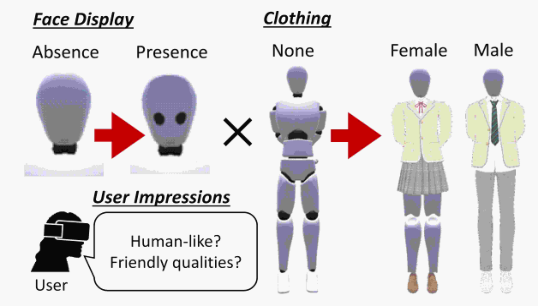
Figure 1: Aim to this paper.
In this paper, we investigate whether adding the appearance features of a CG-animated agent to a robotic VR agent improves or degrades the
user’s impression of the robotic VR agent. As specific appearance features, we focus on “face display” and “clothing,” which are important elements that constitute the human-like appearance of CG-animated agents, but are not present in robotic agents. These are important biological and social elements that constitute human-like qualities. Fig. 1 shows an example design of the robotic VR agent with the elements added. The effect of face display and clothing on the user’s impression of the robotic VR agent has not been systematically investigated to date. Based on the above, we verify the following hypotheses about the user’s impression of the robot VR agent’s presence given face display or clothing.
H1: Improves the user’s impression of the robot VR agent’s human-like qualities.
H2: Improves the user’s impression of the robot VR agent’s friendly qualities.
Table 1: Six comparison condition combinations of face display and clothing.
Table available in the original PDF paper.
Comparison C1 C2 C3 C4 C5 C6 Condition Face display Absence Absence Absence Presence Presence Presence Clothing None Female Male None Female Male
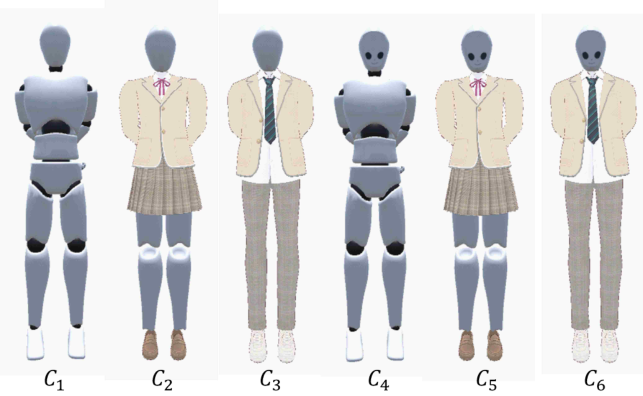
Figure 2: Example of the robotic VR agent applying the comparison conditions.
EXPERIMENTAL DESIGN FOR SUBJECTIVE EVALUATION The target product introduction is a one-to-one interaction between a robotic VR agent and a user. The reason for this is to eliminate the influence of the relationship between users on the subjective evaluation. In the following, users are referred to as participants.
How Face Display and Clothing Affect User Impressions 15
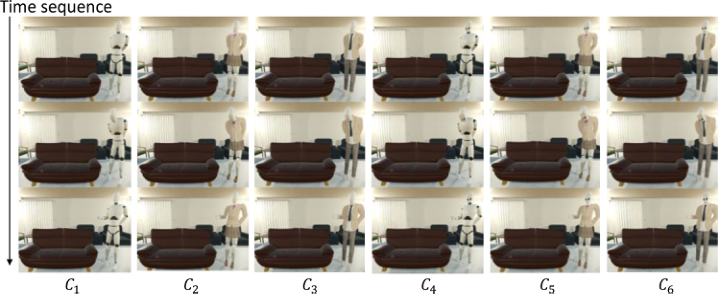
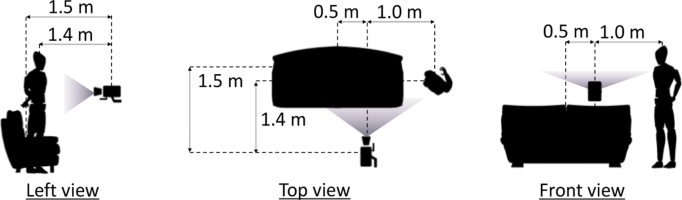
Figure 3: Examples of stimuli in which the robotic VR agent introduces products.Figure 4: Positional relationship between the participant, the product, and the robotic VR agent.
Comparison Conditions and Examples of Robotic VR Agents The six comparison conditions we use for the robotic VR agent in the hypothesis verification are the combination of two face display conditions (absent face and present face) and three clothing conditions (none, female clothing, and male clothing). Table 1 shows the six comparison conditions. Figure 2 shows an example of the robotic VR agent applying these comparison conditions. We use the same face in C4, C5, and C6. We use simple circles and simple curves to represent the eyes and mouth. We keep facial expressions neutral. We set the sizes of the eyes and mouth, and the positional relationship between the facial features, to be the same as those of the CG-animated agent used in our previous study (Inoue et al., 2024). We use the same clothing in comparison conditions C2 and C5, and C3 and C6. As clothing, we use uniforms for each gender because we consider that all participants are likely to have worn these uniforms when they were students or had seen them at least once. Under all comparison conditions, the robotic VR agent bows and points to the product. The timing of the gestures is identical under all comparison conditions. The gestures of the robotic VR agent apply motion capture data from a real human. The product that the VR robot agent introduces into VR space is a two-seater sofa. Figure 3 shows examples of stimuli in which the robotic VR agent introduces products under six comparison conditions. We obtained three-dimensional (3D) data for the ZT8303DS and WT5603AS sofas and the LSJ-3_NK light bulb from Karimoku Freebank, and obtained various tables and other sofas from Digital-Architex. Figure 4 shows the positional relationship between
the participants, the product, and the robotic VR agent in VR space. In the front view, the participant is located 0.5 m to the right of the center of the product and the robotic VR agent is located 1.5 m to the right of the center of the product. In the left view, the participant is located 1.5 m to the right of the center of the product and the robotic VR agent is located 0.1 m to the right of the center of the product. We use the same voice guidance for all comparison conditions. Specifically, “Welcome! Today’s recommendation is this two-seater sofa. Please take a look at it.”
Subjective Evaluation Method In the hypothesis verification, we ask the participants the following questions.
Q1: Did you feel the robotic VR agent was human-like? Q2: Did you feel the robotic VR agent had friendly qualities? To prevent the participants from inferring the intention of the experiment, we ask them the following dummy question.
bQ1: Do you feel the appearance of the product is incongruous? We create opposition question items corresponding to question items Q1 and Q2 and dummy item bQ1, and present a total of six questions to the participants. We use a four-point scale, where 1 is Strongly Disagree, 2 is Disagree, 3 is Agree, and 4 is Strongly Agree. The value obtained is called the subjective score. We present the question items to all participants in random order for all stimuli. We reverse and record the opposition question items, and do not record the dummy items.
Experimental Procedure for Subjective Evaluation The experimental procedure is as follows:
P1: The participant puts on VR goggles. P2: We explain the experimental scenario to the participant. P3: We randomly select one stimulus from the six stimuli. P4: We present a red sphere to the participant and the participant observes the red sphere.
P5: The participant observes the selected stimulus for 10 seconds. P6: The participant answers the six question items verbally. P7: We repeat procedures P3 to P6 until all stimuli have been observed by the participants.
The reason that we explain the experimental scenario in procedure P2 is to immerse the participants in a pseudo-situation in which they have the decision-making authority to purchase the product. Specifically, we explain the following to the participants: “You work for a particular company. You have come to purchase a two-seater sofa that your company plans to install in its virtual space. You have the authority to make the purchase decision.” In procedure P4, all participants are controlled so that they observe the same location at the beginning of all stimulus introductions. We position the red sphere so that it does not overlap with the robotic VR agent or the product. In procedure P6, we do not present the robotic VR agent and the product to the participants to avoid influencing the results of the subjective evaluation. Instead, we place a whiteboard with questions in front of the participants and present the question items individually in random order. The participants read the question items silently and respond verbally. If the participants ask a
How Face Display and Clothing Affect User Impressions 17
question about what is contained in the question item, we provide an answer verbally.
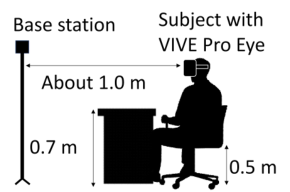
Figure 5: Experimental setting.
Experimental Conditions Twelve participants (12 males) participated in the experiment and the average age was 22.6 years old. We used VIVE Pro Eye (HTC) to display the VR space and mocopi (SONY) for motion capture. The mocopi motion capture system performs 3D full-body tracking using six sensors attached to the human body. To generate the voice guidance data, we used speech synthesis software VOICEVOX: HARUNE. Ritsu. The participant sat at a desk in a comfortable position. Figure 5 shows the participant’s position in the real space of the experiment.
Table 2: Results of analysis of variance ( + : p < .1,*: p < .05,**: p < .01).
Table available in the original PDF paper.
Question Variable Factor F-Value p-Value
0.928 0.400
Q1 Face Display 6.159 0.016 * Clothing 12.419 0.000 ** Face Display × Clothing
0.851 0.432
Q2 Face Display 3.567 0.063 + Clothing 0.449 0.640 Face Display × Clothing
Figure 6: Average subjective score for the human-like quality (Q1).
EXPERIMENTAL RESULTS OF THE SUBJECTIVE ASSESSMENT Results of the Verification of Hypothesis H1 on the Human-Like Quality
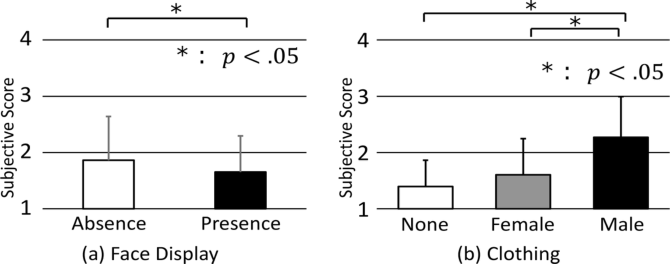
We conducted subjective evaluations to verify hypothesis H1 and obtained subjective scores assessed by the experimental participants. We performed the Shapiro–Wilk test on the subjective scores rated by the participants and could not assume normality. Therefore, we applied an aligned rank transform (Wobbrock et al., 2011; Elkin et al., 2021) and performed an analysis of variance on the face display and clothing conditions of the robotic VR agent. The results are listed in Table 2(Q1). We found a main effect for face display (F = 6.159, p < .016). Figure 6(a) shows the average subjective score for each face display. The average subjective score was higher for the robotic VR agent with an absent face than for one with a present face.
Figure 7: Average subjective score for friendly qualities (Q2).
Next, we also found a main effect for clothing (F = 12.419, p < .000). Figure 6(b) shows the average subjective score for each type of clothing. The type of clothing with the highest subjective score was male clothing, followed by female clothing, and finally none. We performed a Wilcoxon signed rank test as a multiple comparison, followed by Bonferroni’s correction. The results showed a significant difference between no clothing and male clothing (p < .000), and between female clothing and male clothing (p < .000). Finally, there was no interaction between face display and clothing (F = 0.928, p < .400).
These results suggest that participants perceived the robotic VR agent as making a less human-like impression when the agent had a present face compared with when it had an absent face. Additionally, participants perceived the robotic VR agent as more human-like when it wore male clothing than when it wore none, and there was no difference in the degree to which participants perceived it as more human-like when it wore female clothing and when it wore none. Therefore, hypothesis H1 holds when the robotic VR agent wears male clothing.
How Face Display and Clothing Affect User Impressions 19
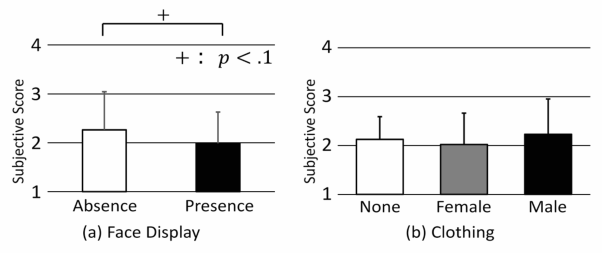
Results of the Verification of Hypothesis H2 on Friendly Qualities We conducted subjective evaluations to verify hypothesis H2 using the same procedure as in the previous section to perform a two-factor analysis of variance. The results are listed in Table 2 (Q2). We did not find a main effect for face display (F = 3.567, p < .063). Figure 7(a) shows the average subjective score for each face display. The average subjective score was slightly higher for the robotic VR agent with an absent face than for that with a present face.
Next, we also did not find a main effect for clothing (F = 0.449, p < .640). Figure 7(b) shows the average subjective score for each type of clothing. The clothing with the highest subjective score was male clothing, followed by none, and finally female clothing. Finally, there was no interaction between face display and clothing (F = 0.851, p < .432).
These results suggest that displaying the face of the robotic VR agent may reduce the impression of friendly qualities. The results also showed that the VR robot agent wearing clothing had no significant effect on the impression of friendly qualities that participants perceived. Therefore, hypothesis H2 does not hold.
DISCUSSION
In this section, we discuss the results of the subjective evaluation of face display with reference to the content of a free verbal questionnaire given to each participant after the experiment. Several participants commented that when they were introduced to the product by the robotic VR agent with a present face, they felt the agent was an alien (e.g., Martian). As a result, the robotic agent’s present face may have appeared less human-like. Therefore, we believe it is necessary to design the face of the VR robot agent so that it does not resemble an alien.
Next, we discuss the results of the subjective evaluation of female clothing. Participants’ comments about the robotic VR agents that wore female clothing indicated that the agents did not feel particularly human-like in the leg area compared with the clothing area. These comments suggest that the non-human-likeness of the VR robot agent’s legs may have led to a decrease in the human-like impression of the robotic VR agent that wore female clothing. Therefore, we believe that when robotic VR agents wear long pants or long skirts for females, they can give a more human-like impression, even when they wear female clothing.
CONCLUSION
In this paper, we verified the hypothesis that the user’s impression of a robotic VR agent introducing a product in VR space can be improved by adding the appearance features of the CG-animated agent and investigated the effect on the user’s impression evaluation. We added faces and clothing as the appearance features of the CG-animated agent. The participants evaluated their impressions of VR agents in terms of human-like and friendly qualities. In the participants’ subjective evaluation, the results indicated that the
addition of male clothing significantly improved the human-like impression of the robotic VR agent. Conversely, the addition of face display did not result in a statistically significant improvement. The friendly impression given by robotic VR agents’ with a present face and clothing did not improve. These results indicate that the type of clothing is an important factor in the design of robotic VR agents with human-like qualities. The contribution of this paper is to partially show the agent design for effective VR product introduction.
In the future, we should ask not only male but also female participants for a subjective evaluation. We should also investigate what type of clothing can achieve the effect of the human-like quality.
REFERENCES
A. Paiva, F. Correia, R. Oliveira, F. Santos, P. Arriag (2021). Empathy and Prosociality in Social Agents. Association for Computing Machinery, No. 48, pp. 385–432. C. Nass, Y. Moon (2000). Machines and Mindlessness: Social Responses to
Computers. Journal of Social Issues, Vol. 56, No. 1, pp. 81–103. J. H. Moon, E. Kim, S. M. Choi and Y. Sung (2013). Keep the Social in Social Media: The Role of Social Interaction in Avatar-Based Virtual Shopping. Journal of Interactive Advertising, Vol. 13, No. 1, pp. 14–26. J. O. Wobbrock, L. Findlater, D. Gergle, J. J. Higgins (2011). The aligned rank
transform for nonparametric factorial analyses using only anova procedures. Proceedings of the SIGCHI Conference on Human Factors in Computing Systems, No. 4, pp. 143–146. J. v. Doorn, M. Mende, S. M. Noble, J. Hulland, A. L. Ostrom, D. Grewal, J. A. Petersen (2017). Domo Arigato Mr. Roboto: Emergence of Automated Social Presence in Organizational Frontlines and Customers’ Service Experiences. Journal of Service Research, Vol. 20, No. 1, pp. 43–58. K. F. MacDorman, H. Ishiguro (2006). The uncanny advantage of using androids
in cognitive and social science research. Interaction Studies. Social Behaviour and Communication in Biological and Artificial Systems, Vol. 7, No. 3, pp. 297–337. L. A. Elkin, M. Kay, J. J. Higgins, J. O. Wobbrock (2021). An Aligned Rank Transform Procedure for Multifactor Contrast Tests. The 34th Annual ACM Symposium on User Interface Software and Technology, No. 15, pp. 754–768. L. Gong (2008). How social is social responses to computers? The function of the
degree of anthropomorphism in computer representations. Computers in Human Behavior, Vol. 24, No. 4, pp. 1494–1509. M. Inoue, S. Hioki, F. Iwasaki, S. Yoneda, M. Nishiyama (2024). Investigation of the Impression Given by the Appearance and Gestures of a Virtual Reality Agent Describing a Display Product. HCII 2024, No. 12, pp. 179–190. M. Yousefi, S. E. Crowe, S. Hoermann, M. Sharifi, A. Romera, A. Shahi, T.
Piumsomboon (2024). Advancing prosociality in extended reality: Systematic review of the use of embodied virtual agents to trigger prosocial behaviour in extended reality. Frontiers in Virtual Reality, Vol. 5. S. W. Song, M. Shin (2024). Uncanny Valley Effects on Chatbot Trust, Purchase Intention, and Adoption Intention in the Context of E-Commerce: The Moderating Role of Avatar Familiarity. International Journal of Human– Computer Interaction, Vol. 40, No. 2, pp. 441–456. W. Gao, N. Jiang, Q. Guo (2023). How do virtual streamers affect purchase intention
in the live streaming context? A presence perspective. Journal of Retailing and Consumer Services, Vol. 73, p. 103356.
LISTED IN THE AHFE DIGITAL BOOKSTORE CATALOGUE
Explore the complete digital volume
Accessibility, Assistive Technology and Digital Environments
Read this individual research paper free through the original publisher, or explore the full digital proceedings book.
ISBN 978-1-964867-38-0
Explore this ISBN in the AHFE Bookstore ↗Listed in the July 2026 bookstore catalogue; search by ISBN to confirm current availability · Digital book purchase optional