Wenshu Sun, Yeshan Qiu, Bingqin Yu, Yun Wang (2024). Inclusive Design of Smart Landscape in Community Parks for The Migrant Elderly. In: Human Factors in Design, Engineering, and Computing. AHFE Open Access, vol. 159, pp. 359–371. https://doi.org/10.54941/ahfe1005601
This study identifies the coexisting spaces of the migrant and local elderly in three community parks in Shanghai and achieves spatial inclusiveness grading based on the proportion of the migrant elderly in these spaces. By using the image recognition method in smart landscapes, landscape elements and spatial interfaces of the coexisting spaces were identified and analyzed, enabling more scientific and effective spatial characteristic analysis. Further analysis was conducted on the recreational behaviors of both types of elderly in spaces that exclude the migrant elderly and have relatively poor and poor inclusiveness levels, summarizing the inclusivity issues as: 1) landscape elements and spatial interfaces do not meet the recreational needs of the migrant elderly, 2) conflicts in recreational behavior between the migrant elderly and the local elderly, and 3) cultural inclusiveness issues. Targeted inclusive design approaches of the smart landscape were proposed, including the application of intelligent sensing technology, human-computer interaction technology, multidimensional experiences, and multimedia displays. This study provides new insights into spatial characteristic analysis through interdisciplinary methods. By analyzing the spatiotemporal distribution characteristics of both types of elderly, a new method for spatial inclusiveness grading is provided. By comparatively analyzing the recreational behaviors of both types of elderly and spatial characteristics, the inclusivity issues of spaces are examined. The research provides theoretical and practical references to meet the recreational needs of the migrant elderly, promote the construction of age-friendly community parks, and develop smart and inclusive designs.
In 2021, the global elderly population exceeded 1 billion, accounting for approximately 13.5% of the world’s population. By 2030, one in six people will be aged 60 or above. At the end of 2019, the elderly population in China reached 254 million, making it the country with the largest elderly population in the world. Actively addressing population aging has become a long-term strategic task for China. The total population of Shanghai is about 25 million. As of 2020, the elderly population aged 65 and above accounted
for 16.28%, indicating that Shanghai has entered the stage of moderate aging. The “China Migrant Population Development Report 2018” published by the National Health Commission of the People’s Republic of China shows that the number of migrant elderly in China has been continuously growing, increasing from 5.03 million in 2000 to 13.04 million in 2015, with an average annual growth rate of 6.6% (Zhou, 2020). This group of elderly people, who leave their original living environment to follow their children for reasons such as caregiving or retirement, are known as migrant elderly (Kong et al., 2020). With the strengthening of Shanghai’s talent attraction policies and the expansion of the highly educated talent pool, their parents are potential migrant elderly, thus the number of migrant elderly in Shanghai is expected to further rise (Wang and Ye, 2018).
The migrant elderly face certain issues in cultural, social, and psychological adaptation when they move from their long-term homeland to a new environment (Jiao et al., 2020; Zhang et al., 2014). Park environments positively impact elderly health, serving as key venues for relieving mental stress, reducing fatigue, enhancing physical well-being, and promoting social interactions (Hartig and Kahn, 2016; Tan, 2009). They foster individual physical and mental health and improve social adaptation capabilities (Torma, 2006; Lachowycz and Jones, 2013; Tan et al., 2020). For the elderly, community parks, as small-scale public open spaces within urban green areas, are primarily located around residences or nearby communities, with high community engagement. They have become the main places for outdoor activities (Chen et al., 2017), enabling the elderly to connect with nature, exercise, release emotions, engage in neighborly interactions (Sugiyama and Thompson, 2007), and maintain good social relationships.
In recent years, landscape justice research on urban park use has gradually shifted from the “spatial equity stage,” influenced by egalitarian ideas of equal distribution, to the “social equity stage,” which emphasizes the abilities and needs differences among various social groups, particularly special groups (Zhou and Lin, 2018). Empirical research indicates that the internal visitor demographics and spatial distribution in urban parks display social differentiation (Wu et al., 2017), and the current development of urban parks fails to satisfy the diverse usage needs of different residents. As a special elderly group, migrant elderly are considered a vulnerable group in the new city. Paying attention to their specific recreational needs in community parks can facilitate their social integration and alleviate social issues.
Smart landscape aims to digitize, network, and visualize landscape projects using data-driven approaches (Zou et al., 2023a). This enables efficient information interaction between landscape and people (Sun et al., 2010), enhancing the precision and scientific approach of landscape projects (China Landscape Architecture Network, 2019). The smart landscape is increasingly becoming a research hotspot. This study aims to analyze spatial characteristics from the perspective of smart landscapes using computer vision analysis of image recognition methods. Furthermore, it dissects inclusiveness issues and proposes inclusive landscape design approaches for community parks. This research provides theoretical and practical references
Inclusive Design of Smart Landscape in Community Parks for the Migrant Elderly 361
to meet the recreational needs of the migrant elderly and promote the construction of age-friendly community parks.
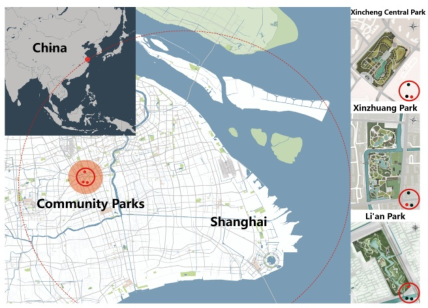
INCLUSIVITY LEVELS OF ACTIVITY SPACES FOR MIGRANT AND LOCAL ELDERLY As a megacity with an urban population exceeding 10 million, Shanghai attracts a substantial number of permanent migrants due to its high-quality public resources and excellent employment opportunities. According to the data from the seventh national census, the total number of permanent migrants in Minhang District, Shanghai, is 1.24 million, among which 60,000 are migrant elderly who moved to care for their grandchildren. This study selects Minhang District as the primary research area. Considering factors such as the daily accessibility of community parks for the elderly in Minhang District, the proportion of activities by migrant elderly in these parks, the size and diversity of activity areas, and the distribution of surrounding residential areas, three community parks were selected for this study. These parks, differing in design style but frequented mainly by elderly visitors, with diverse activity spaces and good accessibility, are Xinzhuang Park, Xincheng Central Park, and Li’an Park, as shown in Figure 1.
Figure 1: Community parks distribution.
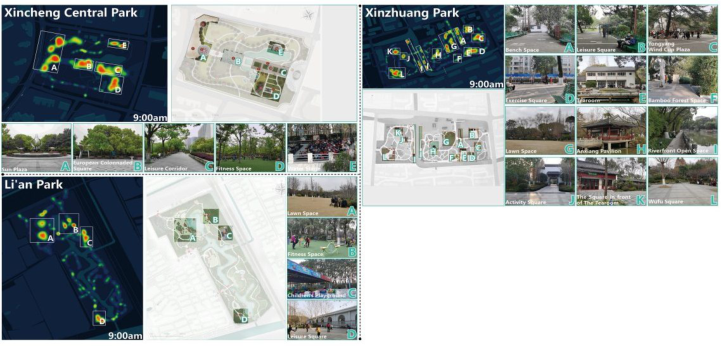
This study was conducted from October 2020 to July of the following year, covering four seasons and including both weekdays and weekends, with a total of 16 surveys. The spatiotemporal distribution map of elderly recreational activities for all seasons was obtained using the Cat’s Eye Quadrant Method and Excel’s Datamap plugin. Analysis revealed that 9 a.m. is the most active time for the elderly throughout the day, with the highest number of elderly people and the most diverse spatial distribution, generally covering the spatial distribution of other times of the day. Therefore, the spaces where the elderly are concentrated at 9 a.m. in the three community parks were selected as the preferred spaces for the elderly to conduct the study. Since it is necessary to distinguish between migrant elderly and local elderly, whose behaviors influence each other, the concept of coexisting spaces was
proposed. The five coexisting spaces in Xincheng Central Park were labeled A-E, the twelve in Xinzhuang Park were labeled A-L, and the four in Li’an Park were labeled A-D, as shown in Figure 2.
Figure 2: Community parks’ coexisting spaces.
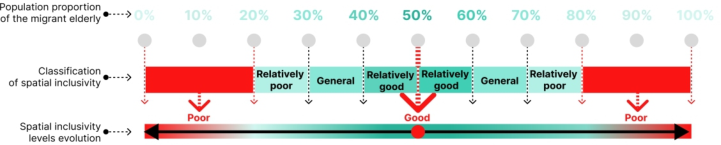
Scholars have explained spatial inclusivity by introducing the concept of design exclusion from the product design field into the landscape design field. They propose that design exclusion in spaces leads to recreational activity differentiation among different user groups in community parks (Zhou and Lin, 2021). The excluded groups have significantly fewer people engaging in recreational activities in space compared to the dominant user groups. In this study, the levels of spatial inclusivity are classified based on the proportion of the migrant elderly in different spaces, with inclusivity levels divided into five grades: good, relatively good, general, relatively poor, and poor, as shown in Figure 3.
Figure 3: Population proportion of the migrant elderly and inclusivity levels.
To assess the inclusivity levels of coexisting spaces in three community parks, in August 2021, a month with high outdoor recreation rates among the elderly, this study recorded the number and types of recreational activities of two types of elderly in different coexisting spaces in three community parks at six different times of the day using behavioral observation and interview methods, and subsequently calculated the total number of elderly people for the entire day. Furthermore, the proportion of migrant elderly in different
Inclusive Design of Smart Landscape in Community Parks for the Migrant Elderly 363
spaces was analyzed to classify the inclusivity levels of coexisting spaces. These spaces were categorized as preference spaces for the migrant elderly, preference spaces for the local elderly, and preference spaces for the two types of elderly, as shown in Table 1. According to the analysis of the results, the coexisting spaces that exclude the migrant elderly and have a relatively poor inclusivity level are XZ-G, XC-D, and XZ-E, and the coexisting space that excludes the migrant elderly and has a poor inclusivity level is XC-E.
Table 1. Classification of coexisting space and corresponding inclusivity level.
Table available in the original PDF paper.
Coexisting Space Specific Space
Proportion Interval Inclusivity Level The Excluded Population
Population Proportion of the Migrant Elderly
Preference spaces for the migrant elderly
XZ-F 70% 70%≤n<80% General The local elderly LA-D 70% XZ-A 72% XZ-C 73% XZ-D 80% 80%≤n<90% Relatively poor XC-B 83% LA-C 93% 90%≤n<100% Poor Preference spaces for the local elderly
LA-B 36% 30%≤n<40% General The migrant elderly XZ-B 35% XZ-L 33% XZ-G 27% 20%≤n<30% Relatively poor XC-D 25% XZ-E 21% XC-E 17% 10%≤n<20% Poor Preference spaces for the two types of elderly
XZ-H 44% 40%≤n<50% Relatively good Not exclude LA-A 45% XC-C 48% XZ-K 50% 50% Good XZ-J 52% 50%≤n<60% Relatively good XC-A 53% XZ-I 57%
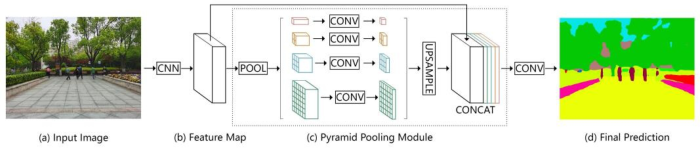
ANALYSIS OF THE LANDSCAPE ELEMENT AND SPATIAL INTERFACE IN THE ACTIVITY SPACES OF MIGRANT AND LOCAL ELDERLY In the context of smart landscapes, combining IoT technology with spatial information analysis and computer vision technology can enhance data processing and analysis capabilities, thereby promoting spatial informatization (Zou et al., 2023b). To further analyze the structural differences of different coexisting spaces, the image recognition method was used to perform image semantic segmentation on pictures of three types of coexisting spaces. The image semantic segmentation process is shown in Figure 4. The proportions of different landscape elements and spatial interface differences in spaces preferred by migrant elderly, local elderly, and both types of elderly were summarized. This study adopted the Tensonflow and Keras model frameworks and the ADE20k open image dataset for image recognition. Each type of landscape element output by the deep learning algorithm was labeled with the corresponding color in the dataset, and detailed area proportions were calculated using open-cv.
Figure 4: Image semantic segmentation process.
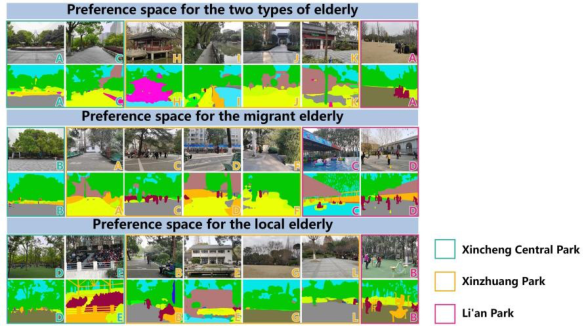
Coexisting Spaces Image Recognition Image recognition was performed on the pictures of the coexisting spaces in Xincheng Central Park, Xinzhuang Park, and Li’an Park. The results of the image recognition are shown in Figure 5. Xincheng Central Park identified 16 types of landscape elements, Xinzhuang Park identified 26 types, and Li’an Park identified 15 types. The top 5 landscape elements by area proportion in the three community parks were combined to summarize 9 landscape elements: tree, road, sky, sidewalk, plant, building, grass, water, and facility. The color-filled map of landscape elements after image recognition can be used to further analyze the spatial interface. The spatial interface includes the top interface, middle interface, bottom interface, and side interface (Hu and Li, 2019). The landscape elements of the top interface affect the openness of the space. The area size of the middle interface affects the types of recreational activities and activity experiences. The area size of the bottom interface affects the carrying capacity of recreational activities, and the material affects the activity experience. The side interface affects the privacy and noise reduction.
Figure 5: Coexisting spaces image recognition.
Inclusive Design of Smart Landscape in Community Parks for the Migrant Elderly 365
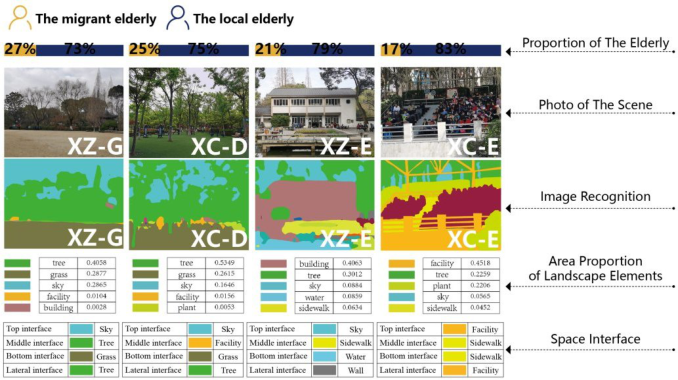
Spatial Characteristics Analysis of Spaces That Exclude Migrant Elderly Spatial characteristic analysis was conducted on the coexisting spaces XZ-G, XC-D, XZ-E, and XC-E, which exclude migrant elderly and have relatively poor and poor inclusivity levels. The analysis includes two aspects: the area proportion of landscape elements and spatial interface analysis. The results are shown in Figure 6.
XZ-G space is a lawn space, its main landscape elements include trees, grass, sky, facility, and building. The top interface of this space predominantly consists of sky elements, resulting in high openness and a wide view. The middle interface features trees, with a small number of shrubs and trees scattered across the grass, offering aesthetic appeal while providing shaded resting spots for elderly individuals participating in recreational activities. The bottom interface is characterized by a large expanse of grass, offering a high capacity for recreational activities. The side interface consists of trees surrounding the lawn space, delineating it from other areas within the park and providing a degree of privacy.
XC-D space serves as a fitness area, with key landscape elements including trees, grass, sky, facility, and plants. The top interface of this space features a small proportion of sky elements, with a high canopy density, offering excellent shading. The middle interface is primarily occupied by fitness facilities, offering abundant spaces for elderly individuals to engage in exercise activities. The bottom interface is a large area of grass, which is soft in texture and provides good capacity for activities. The side interface consists of trees, which separate the fitness space from other areas in the park, creating a relatively private enclosed space.
XZ-E space is a tea house, with the main landscape elements being buildings, trees, sky, water, and sidewalk. The top interface of this space has a large exposed sky area, providing high openness. The middle interface consists of a sidewalk distributed over the water, forming a scenic passageway for elderly people to stroll and rest. The bottom interface is water, providing a comfortable tea-drinking and resting environment for elderly people. The side interface consists of walls, clearly delineating the tea house space, creating an enclosed area with high privacy and effective noise reduction.
XC-E space serves as a water stage, featuring facilities, trees, plants, sky, and sidewalk as its primary landscape elements. The top interface of this space is a canopy that provides shade and rain protection. The middle and bottom interfaces are walkways and seating areas, providing ample recreational space for elderly people to rehearse activities. The side interface consists of railings, separating the water stage from the water and ensuring the safety of the elevated water stage.
Figure 6: Analysis of the landscape element area proportion and spatial interface.
RELATIONSHIP BETWEEN RECREATIONAL ACTIVITIES OF THE ELDERLY AND SPACE INCLUSIVITY ISSUES Through field research and interviews, observation records of two types of elderly recreational activities were obtained. The main recreational activities of elderly people were analyzed in spaces that exclude migrant elderly and have relatively poor and poor inclusivity levels. The characteristics and patterns of the recreational activities of the two types of elderly were summarized, and their recreational behavior relationships were classified into three types: non-interference, observation and participation, and interference and conflict. Issues of space inclusiveness were analyzed based on the recreational behavior relationships of the two types of elderly, landscape elements, spatial interfaces, and cultural inclusiveness.
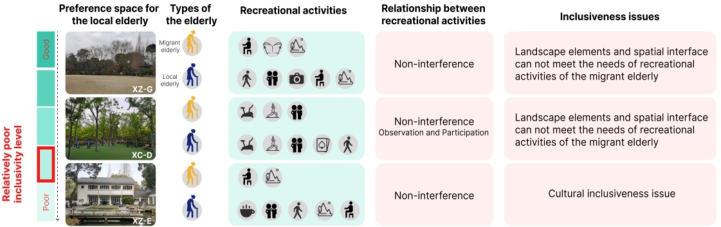
Analysis of the three spaces with a relatively poor inclusivity level (as shown in Figure 7) indicated the following results: XZ-G and XC-D are both spaces with grass as the bottom interface. In these two spaces, the number and types of recreational activities of migrant elderly are significantly fewer than those of local elderly. The recreational behavior relationship between migrant elderly and local elderly is either non- interfering or observation and participation, with no mutual interference or conflict. Further investigation through interview results explored the reasons for the design exclusion of migrant elderly in this space. It was concluded that migrant elderly prefer to engage in recreational activities on hard surfaces, as it is more convenient for pushing strollers or accompanying children in play. However, in soft grassy spaces, it is inconvenient to carry out activities with children.
XZ-E space is a tea room area, and most of the elderly people drinking tea, socializing, and chatting there are the local elderly. The Migrant elderly cannot integrate into the local elderly community, their main recreational
Inclusive Design of Smart Landscape in Community Parks for the Migrant Elderly 367
activities are sitting, resting, and enjoying the scenery. The design exclusion in this space is because local elderly people have established a fixed local tea culture circle, making it difficult for migrant elderly people to integrate into this new cultural circle. Therefore, the inclusiveness issue of this space is essentially a cultural inclusiveness issue.
Figure 7: Analysis of inclusiveness issues in the space with a relatively poor inclusivity level.
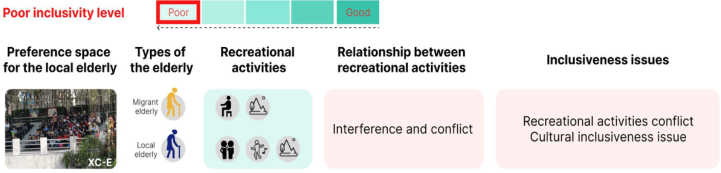
In space XC-E,which has a poor inclusivity level, the proportion of migrant elderly people is the lowest, and their recreational activities mainly involve sitting, resting, and enjoying the scenery. However, local elderly people conduct organized choir practices at fixed times, occupying the entire space. The large number of local elderly people participating in choir practices for extended periods causes interference and conflict with migrant elderly people who wish to engage in recreational activities in this space. The inclusiveness issues of this space are manifested as a conflict in recreational activities and cultural inclusiveness problems, as the migrant elderly cannot integrate into the local elderly’s choir (as shown in Figure 8).
Figure 8: Analysis of inclusiveness issues in the space with a poor inclusivity level.
In summary, the inclusiveness issues of spaces that exclude the migrant elderly can be summarized in three aspects: 1) landscape elements and spatial interfaces do not meet the recreational needs of the migrant elderly, 2) conflicts in recreational behavior between the migrant elderly and the local elderly, and 3) cultural inclusiveness issues.
APPROACHES TO INCLUSIVE DESIGN OF SMART LANDSCAPE IN COMMUNITY PARK Based on the spatial inclusiveness issues summarized in the research, a comprehensive and systematic approach to inclusive design from the perspective of smart landscapes is proposed, divided into three main sections. Firstly, accurately analyze the recreational behavior needs of the migrant elderly and optimize landscape elements and spatial interfaces. Secondly, compare and analyze the temporal and spatial similarities and differences in the recreational activities of migrant and local elderly people in the same space to optimize spatial and temporal utilization. Thirdly, analyze the spiritual needs of the migrant elderly to enhance the humanistic spirit of the space. The design applications of smart landscapes include intelligent sensing technology, human-computer interaction technology, multidimensional experiences, and multimedia displays (as shown in Figure 9).
Figure 9: Approaches to inclusive design of smart landscapes.
Compared to the local elderly, the migrant elderly’s recreational needs are more inclined towards taking care of their grandchildren, which is related to the purpose of their migration to Shanghai. Therefore, in terms of landscape elements, the application of intelligent sensing technology highlights smart intergenerational-friendly design. Firstly, in the areas where migrant elderly people care for their grandchildren, the paved area should be increased, and an intelligent sensor lighting system should be installed on the paving. This system can create boundary-less divisions of the activity space, guiding elderly people and children to orderly engage in recreational activities in different spaces. Secondly, intelligent seating can automatically adjust the height according to the height of migrant elderly people and their grandchildren, to meet the needs of different users.
The primary causes of recreational behavior conflicts between the two types of elderly in the same space are time conflicts and dynamic-static interference conflicts. Therefore, it is crucial to set a reasonable space usage schedule to stagger dynamic and static recreational activities. In coexisting spaces where recreational activities are prone to conflict, multimedia screens can be installed to display the main types of activities for each time slot based on reservation schedules, effectively avoiding concurrent activity conflicts. Multimedia screens can also be used to organize group movie-watching activities for the elderly. Additionally, through human-computer interaction technology, an intelligent music playback system can be designed. It can automatically play soothing music during relatively static activities such as chatting, and play more lively music during dynamic activities such as square
Inclusive Design of Smart Landscape in Community Parks for the Migrant Elderly 369
dancing, accompanied by lighting changes to enhance the elderly people’s activity experience.
To address the issue of migrant elderly people having difficulty integrating into the local cultural circle, smart design should enhance the space with open, exploratory, and immersive cultural experiences, improving the spatial integration of migrant elderly people. Design participatory interactive spaces to make the migrant elderly participants and creators of the cultural space. For example, in a tea culture space, design an original IP interactive exhibition based on the history of tea culture. It can provide cultural voice explanations, video animations, and VR experiences according to the language commands of the migrant elderly.
CONCLUSION
This study obtained the spatiotemporal distribution map of elderly recreational activities for all seasons through the combination of survey records, the Cat’s Eye Quadrant method, and the Excel Datamap plugin. The analysis revealed that 9 AM is the peak time for the largest number of elderly people and the most diverse spatial distribution throughout the day. According to the concentration of elderly people in different spaces of community parks at 9 AM, Xincheng Central Park has 5 coexisting spaces, Xinzhuang Park has 12 coexisting spaces, and Li’an Park has 4 coexisting spaces. Analyze the proportion of the migrant elderly in the coexisting spaces, and divide the coexisting spaces into 5 levels of inclusiveness and 3 types.
The landscape elements of the coexisting spaces were summarized and analyzed through image recognition methods. Xincheng Central Park identified 16 types of landscape elements, Xinzhuang Park identified 26 types, and Li’an Park identified 15 types. Combining the top 5 landscape elements by area proportion in the three community parks, 9 landscape elements were summarized, they are tree, road, sky, sidewalk, plant, building, grass, water, and facility.
Based on the proportion of the migrant elderly in the coexisting spaces, it was found that there are 4 spaces in the three community parks that exclude the migrant elderly and have relatively poor and poor levels of inclusiveness. The recreational activities relationship between the two types of elderly and spatial characteristics were analyzed, and the inclusivity issues of spaces that exclude the migrant elderly can be summarized in three aspects. This study proposes a comprehensive and systematic inclusive design approach from the perspective of smart landscapes, including the application of intelligent sensing technology, human-computer interaction technology, multidimensional experiences, and multimedia displays. The research provides theoretical and practical references to meet the recreational needs of the migrant elderly, promote the construction of age-friendly community parks, and develop smart and inclusive designs.
ACKNOWLEDGMENT
The authors would like to thank Xiangyang Cui, Yuxi Chen, and Pengcheng Yang from the School of Design at Shanghai Jiao Tong University for their
help during the research investigation process and Jiayuan Wu, Ce Sun from the School of Design at Shanghai Jiao Tong University for their helpful discussions on inclusive design of smart landscape. This research was partially supported by the National Social Science Fund of China ‘Public space construction path of aging friendly community towards emotional regulation under the background of population aging’ (No. 21BSH124).
REFERENCES
Chen, LY., Tan, SH. and Dai, Y. (2017) ‘The promotion effect and planning strategy of community greenbel on population health’, Architecture & Culture, 2017(02), pp. 184–185. China Landscape Architecture Network. (2019) Smart Landscape, Design Opens
a New Landscape Experience. Available at: https://chla.com.cn/htm/2019/0617/ 272275.html (Accessed: 21 June 2024). Hu, YK. and Li, J. (2019) ‘Research on the “coexistence” space of urban scenic spots based on the behavior of tourists and daily visitors’, Chinese Landscape Architecture, 35(06), pp. 61–66. Hartig, T. and Kahn, PH. (2016) ‘Living in cities, naturally’, Science, 352(6288),
pp. 938–940. Jiao, C. et al. (2020) ‘The impacts of perceived social support on loneliness among the migrating elderly: The mediating role of mental resilience and cognitive function’, Journal of Yunan Normal University (Humanities and Social Sciences), 52(01), pp. 80–87. Kong, FL. et al. (2020) ‘Research progress on the migrant elderly both domestically
and internationally’, Chinese Journal of Gerontology, 40(11), pp. 2443–2447. Lachowycz, K. and Jones, AP. (2013) ‘Towards a better understanding of the relationship between greenspace and health: Development of a theoretical framework’, Landscape and Urban Planning, 118, pp. 62–69. Sugiyama, T. and Thompson, CW. (2007), ‘Older people’s health, outdoor activity
and supportiveness of neighborhood environments’, Landscape and Urban Planning, 83(2-3), pp. 168–175. Sun, QB. et al. (2010) ‘Internet of things: summarize on concepts, architecture and key technology problem’, Journal of Beijing University of Posts and Telecommu- nications, 33(3), pp. 1–9. Torma, T. (2006) ‘Urban sprawl and public health: Designing, planning, and building
for healthy communities’, Journal of The American Planning Association, 72(1), pp. 123–124. Tan, SH. (2009) ‘Restoration and stress relief benefits of urban park and green space’, Chinese Landscape Architecture, 25(6), pp. 79–82. Tan, SH. et al. (2020) ‘Study on the influence of urban park environment on the
elderly people’s daily communicative activities’, Chinese Landscape Architecture, 36(04), pp. 44–48. Wang, JP. and Ye, JT. (2018) ‘Living conditions and social adjustment of older migrants in Shanghai’, Journal of Huazhong University of Science and Technology (Social Science Edition), 32(2), pp. 8–15. Wu, CZ., Liu, WQ. and Li, SH. (2017) ‘GPS/GIS-based study on the difference
of space distribution of park recreationists——Taking Gongqing forest park in Shanghai as the example’, Chinese Landscape Architecture, 33(09), pp. 98–103. Zhou, XJ. (2020) ‘Literature review on the issues related to China’s migrant elderly’, Society and Public Welfare, 11(10), pp. 81–83.
Inclusive Design of Smart Landscape in Community Parks for the Migrant Elderly 371
Zhang, XW., Du, CL. and Zhao, J. (2014) ‘Research on the integration issues of migrant elderly in urban communities: A two-dimensional analysis framework based on social memory and community integration’, Qinghai Social Sciences, 2014(06), pp. 88–95. Zhou, ZS. and Lin, GS. (2021) ‘Research on the theory of inclusive design for urban
parks resisting design exclusion’, Landscape Architecture, 28(05), pp. 36–41. Zou, SE. et al. (2023) ‘Research progress and prospect of internet of things technology in the context of smart landscape’, Landscape Architecture, 30(08), pp. 64–71. Zhou, ZS. and Lin GS. (2018) ‘Review of the equitable use of urban parks and green
spaces’, South Architecture, 2018(03), pp. 53–59.
LISTED IN THE AHFE DIGITAL BOOKSTORE CATALOGUE
Explore the complete digital volume
Human Factors in Design, Engineering, and Computing
Read this individual research paper free through the original publisher, or explore the full digital proceedings book.
ISBN 978-1-964867-35-9
Explore this ISBN in the AHFE Bookstore ↗Listed in the July 2026 bookstore catalogue; search by ISBN to confirm current availability · Digital book purchase optional