Yujing Wang, Chongfeng Li, Jiawang Wang, Yufei Hou, Yun Wang, Xin Wang (2023). Evaluation of dynamic thermal comfort of virtual reality headsets in motion. In: Human Factors and Wearable Technologies. AHFE Open Access, vol. 85, pp. 66–80. https://doi.org/10.54941/ahfe1003628
Virtual reality (VR) headset has been increasingly applied in various activities with longer wearing time, such as gaming or training. Users no longer stay in a static state but are more likely to perform a series of body movements. This paper focuses on the dynamic thermal comfort of head mounted displays (HMDs) to explore the VR experience in state of motion. Eight participants wore three types of HMDs to conduct thermal comfort tests while doing light exercises. Thermal comfort was quantified by subjective rating and miniature data logger measurement. The results showed that wearing HMDs in motion caused more subjective thermal discomfort than in rest. Low airtightness of HMDs led to a lower increase in temperature and humidity inside the device in motion, yet it would also reduce the immersiveness of the VR experience due to light leakage. Furthermore, there was no significant difference in the subjective discomfort level of the three types of devices. In order to improve the overall user experience, the development of HMDs should consider design tradeoffs in terms of materials, shape, finishing etc., maximizing user comfort while ensuring optimal audiovisual display effect.
Virtual reality (VR) technology has evolved rapidly in recent years and is expected to be widely applied in industrial, public, and domestic environ- ments (Kloskowski et al., 2019). VR systems provide information to the user’s sensory organs through supporting hardware devices to stimulate the human senses of sight, hearing, and touch. Head mounted displays (HMDs) are the most mainstream VR interactive output device.
The convergence of VR and somatosensory technology has driven the deve- lopment of immersive VR (IVR), further broadening the application areas of VR technology. VR technology is increasingly applied in everyday scenarios such as physical games and rehabilitation therapy training (Cho et al., 2014; Hoermann et al., 2015; Jiawei et al., 2015), which sometimes acquires users
Evaluation of Dynamic Thermal Comfort of Virtual Reality Headsets in Motion 67
to wear HMDs in a state of continuous motion. The state of the human body is closely related to heat sensation (Mora-Rodriguez et al., 2008). The increase in metabolic rate during exercise triggers the body’s heat stress and thermoregulatory system, which in turn affects the body’s heat sensation. The muscle contraction caused by movement also generates more heat, affecting the body’s perception of temperature.
Current experiments on the thermal comfort of HMDs mostly keep parti- cipants in a resting state. With this as a prerequisite, the possible influencing factors are explored (Z. Chen et al., 2017; Wang et al., 2020). Less stu- dies focused on the thermal comfort of HMDs in motion. Improving the dynamic thermal comfort of HMDs can potentially enhance the overall user experience and product competitiveness.
EVALUATION OF THERMAL COMFORT Thermal comfort is an important factor affecting user satisfaction with HMDs (de França & Soares, 2017). Existing studies show that influenced by factors such as reduced air circulation on the skin surface, wearing hea- dwear products can cause users’ thermal discomfort (Orsi et al., 2012). This problem not only adversely affect the health of users but also reduce users’ willingness to use the device (Bogerd et al., 2015; Y. Chen & Wu, 2022). HMDs are often designed to fit closely to the head, to enhance the user’s immersive experience. However, such a design inevitably lower the airtigh- tness of the product, thereby reducing users’ thermal comfort. In addition, HMDs’ integrated electronic components generate a certain amount of heat in operation (Costello, 1997), which can also significantly impact users’ thermal comfort.
For headwear products, the microenvironment is the enclosed space for- med between the skin surface of the head and the inner wall of the headwear product while the user wearing the product (Bogerd et al., 2015). The micro- climate temperature (MT) and microclimate relative humidity (MRH) have been proven to influence thermal comfort (Mitchell et al., 2011; Wang et al., 2020), and are the main indicators chosen to evaluate the thermal comfort of headwear products in a resting state (Brühwiler, 2009; Hu et al., 2020; Pang et al., 2013).
In current research on thermal comfort under resting state, instruments such as miniature data loggers and infrared thermography are widely used for MT and MRH measurements (Dotti et al., 2016; Mitchell et al., 2011; Pang et al., 2013), for acquiring objective and accurate experimental data. Besides, subjective evaluation methods of humid-thermal comfort include Likert scale measurement (Dear & Brager, 1998), thermal comfort level evaluation (H. Zhang, 2003; Y. Zhang et al., 2015), thermal acceptability level evaluation and other subjective rating scales (Y. Zhang & Zhao, 2008). Some resea- rchers combine objective data with subjective data to better assess thermal comfort (Arezes et al., 2013). The above methods have been proven effective in the thermal comfort experiment under resting state, thus can be used for quantitative evaluation in the dynamic thermal comfort experiment.
The main objective of this study is to investigate the effect of user motion on the thermal comfort of HMDs. A series of user tests were conducted to analyze the effect of different properties of HMDs’, such as airtightness and goggle material, in order to explore the optimization strategy of the dynamic thermal comfort.
METHOD
Materials
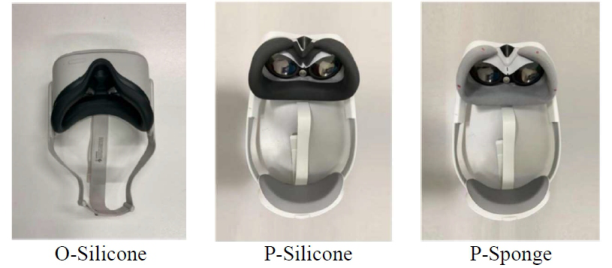
Three types of HMDs were tested: device A and device B had apparent diffe- rences in airtightness and google material, the goggle material of device B was replaced by the similar material of A to create device C. The device A, B and C are hereby named by brand abbreviation and goggle material: O-Silicone, P- Silicone and P- Sponge. O-silicone uses silicone as goggle material and has gaps on both sides of users’ nose, resulting in high airtightness. In terms of wearing method, O-Silicone has three soft loop headbands attached to the top and sides of the monitor, causing more pressure on the user’s face when worn. P-Silicone and P-Sponge are the same product only different in goggle materials. They fit tightly at users’ nose area, providing higher airtightness. In terms of wearing method, P-Silicone and P-Sponge use two rigid retractable straps attached to the sides of the product and a soft strap attached to the bottom, causing less stress on users’ face when worn due to the added coun- terweight design at the rear of the product. The above three types of HMDs are shown in Figure 1. Their physical properties are shown in Table 1.
Airtightness, goggle material, and user’s state were the main factors used in this study to analyze the thermal comfort of HMDs. In order to exclude the effects of other factors, such as heat generated during the operation of the
Figure 1: HMDs used in the experiments.Table 1. Physical properties of the HMDs used in the experiments.
Table available in the original PDF paper.
HMD type Weight Goggle material Counterweight Airtightness O-Silicone 503g Silicone No poor P-Silicone 586g Silicone Yes high P-Sponge 586g Sponge Yes high
Evaluation of Dynamic Thermal Comfort of Virtual Reality Headsets in Motion 69
device, the HMDs were kept powered-off in this experiment. Furthermore, extraneous factors such as screen size, power, and endurance time weren’t analyzed in this paper.
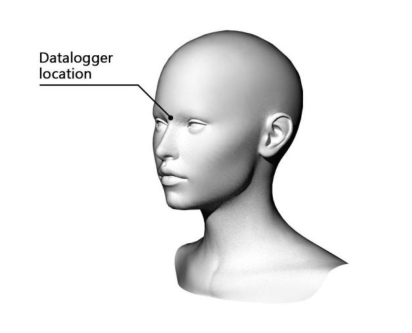
VR Headset Thermal Properties MT and MRH were measured using a miniature data logger (iButton Hygro- chron DS1923). The dimensions of this measuring device were 17 mm in diameter and 5 mm in thickness. The device’s sampling rate was set to 30 seconds, and the specific parameters of the miniature data logger are shown in Table 2. The measurement results were used as objective data on the thermal comfort of the HMDs, and the miniature data logger was set on the HMDs at the position corresponding to the center of the human brow bone, as shown in Figure 2. Through the pre-experiment, it is found that the changes of MT and MRH can be measured obviously at this point without disturbing the user’s feelings.
Ambient Environment and Participants The thermal comfort of HMDs was analyzed through a within-group expe- riment in which eight university students were recruited to participate. To exclude the influence of demographic factors such as gender and age on the experiment, all eight participants were male and within the age range of 22–27 years in good physical condition. All the experiments were condu- cted in the same room, of which the environmental temperature and humidity were monitored in real-time and kept within the appropriate range.
Table 2. Measurement parameters for miniature data logger.
Table available in the original PDF paper.
Parameter Measurement range Measurement accuracy Temperature -40
C—+85
C ±0.5
C Humidity 0—100%RH ±5%RH
Figure 2: Datalogger locations.
Subjective Evaluation Subjective rating is a common method to measure thermal comfort. For HMDs, comfort can be considered as the absence of discomfort (K. Chen, 2018), and the subjective thermal comfort of the users can be acquired by asking participants to rate the current level of subjective discomfort (Elstub et al., 2021). Three questions were presented to the participants: (1) Please assess your current level of thermal discomfort in the head area, with a score of 0 representing no thermal discomfort and 5 representing extreme ther- mal discomfort. (2) Please assess your current sweating level, with a score of 0 representing no sweating and 5 representing profuse sweating. (3) Please assess your current level of heat unacceptability in the head area, with a score of 0 representing no burden of acceptance and 5 representing complete unacceptability.
Participants were asked to give subjective ratings at 5, 10, and 15 minutes of each experiment. All the questions in the experiment were asked in Chinese and translated into English at the time of report writing (Talbert et al., 2013).
Experiment Process The thermal comfort of HMDs was assessed through a within-group user test. Each participant was tested with three devices in a randomized order over three days. The overall duration of the experiment for each participant was approximately 60 minutes. Before each test, participants were asked to confirm that they were in good condition and understood the details of the experiment. In order to unify the initial feelings of different participants in the environment, participants were asked to sit quietly before starting the experiment, during which time they could adjust their clothes (Shimazaki et al., 2016; West et al., 2019).
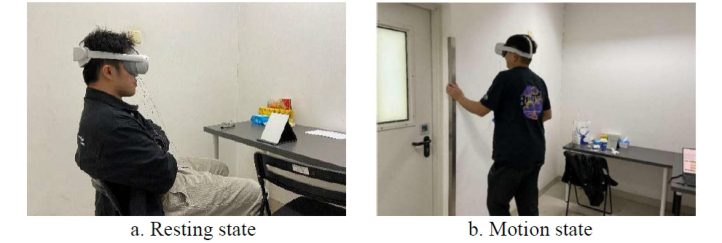
The straps of the HMDs were adjusted to a relaxed state by the participants themselves. After wearing the device, the 15-minute resting state experiment began. The participants’ resting heart rate was monitored by a smart bracelet, and the heart rate criteria for each participant in the exercise state experiment was calculated based on the reserve heart rate formula, thus ensuring that the activity intensity is up to standard (She et al., 2014). A short interval was set between the resting and motion states, with the temperature falling back and remaining stable as the criterion for continuing the experiment. The motion state experiment also lasted 15 minutes, in which the use of 30% - 50% reserve heart rate (from 124 to 163 BPM) was considered as the appropri- ate exercise intensity for participants. All participants could reach the heart rate standard within 100s at the beginning, and kept it until the end of the experiment. The two states of participants are shown in Figure 3.
RESULTS
Data Analysis Descriptive analyses (mean and standard deviation) were used to analyze MT, MRT and subjective ratings over time for all participants with the three types of HMDs. The K-S test was used to verify that the data obeyed a
Evaluation of Dynamic Thermal Comfort of Virtual Reality Headsets in Motion 71
Figure 3: Experimental procedure.
normal distribution (see Appendix A). For normally distributed data, the ANOVA and S-N-K methods were used for the subsequent test of variance. For non-normal distribution data, non-parametric K-W test was used for the subsequent test of variance.
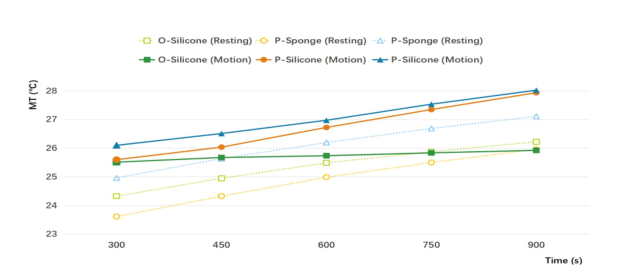
Microclimate Temperature First, the effects of motion on the MT of each type of HMD were analysed. The MT of 8 participants were intercepted at the 30s, 300s, 600s, and 900s, corresponding to the questioning time of subjective ratings, and the mean values were calculated. The MT data from 300s to 900s of the three devi- ces in the resting and motion states are shown in Figure 4. The difference examination of MT is shown in Appendix B.
Based on S-N-K test, the following conclusions can be drawn: (1) In the resting state, the MT of all three types of HMDs no longer increased significantly after about 600s.
(2) In state of motion, the MT of O-Silicone no longer increased signi- ficantly after about 300s; the MT of P-Silicone and P-Sponge continued to increase.
As shown in Fig. 4, there were significant differences in MT between the three types of HMDs after the experiment was carried out up to about 600s
Figure 4: Average microclimate temperatures of three HMDs (◦C).
in state of motion. ANOVA test results show that after 600s of exercise, the MT of O-silicone group was significantly lower than that of the other two groups, and the MT of the other two groups was similar. For the motion state, reducing the air-tightness of HMD can reduce the increase of MT.
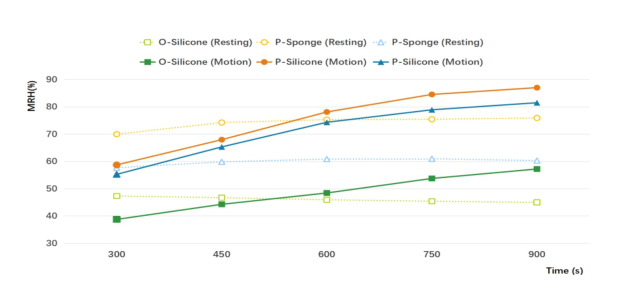
Microclimate Relative Humidity The effects of motion on the MRH of each type of HMD were analysed. Similar to the data analysis method for MT, MRH of 30s, 300s, 600s and 900s were compared. The MRH data from 300s to 900s were of the three devices in the two states are shown in Figure 5. The difference examination of MRH is shown in Appendix C.
S-N-K test found that under resting state, the MRH of O-Silicone did not increase obviously, and P-Silicone and P-Sponge did not increase significan- tly after 300s. In motion, the MRH of O-Silicone, P-Silicone, and P-Sponge increased notably for 300s, 600s, and 600s, respectively.
The MRH’s change pattern was similar to that of the MT, as shown in Figure 5. The MRH of O-Silicone was significantly lower than that of the other two groups, which was verified by the ANOVA test after 600s of the experiment.
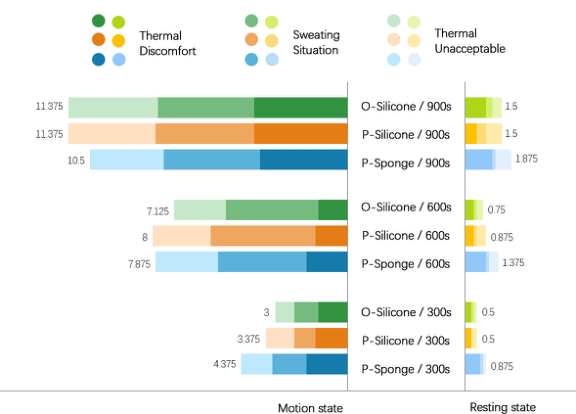
Subjective Evaluation The effect of motion on the subjective perception of users was analyzed, the original data is shown in Appendix D. Subjective ratings were grouped by HMD types, as shown in Figure 6.
The mean subjective discomfort ratings of the three types of HMDs rose with increasing experimental time, and this pattern applied to both resting and exercise states. Meanwhile, for the same type of HMDs, subjective discomfort was significantly higher in state of motion than in the resting state.
To further explore the differences in participants’ subjective perceptions of HMDs, the results of subjective ratings were tested for variability. Although
Figure 5: Average microclimate relative humidity of three HMDs during the course of the experiment (%).
Evaluation of Dynamic Thermal Comfort of Virtual Reality Headsets in Motion 73
Figure 6: Comparison of subjective ratings in resting and motion states.
the MT and MRH of O-silicone were significantly lower than the correspon- ding data of the other two devices when the duration of motion is up to about 600s, K-W test results show that the difference in subjective discom- fort between the three types of HMDs was not significant in the subjective rating dimension (P>0.05).
DISCUSSION
Wearing Time The experimental results showed that the MT and MRH of all three HMDs exhibited an increase over time, which validate the existing studies (Almajid et al., 2021; Z. Chen et al., 2017). The subjective evaluation indicated that the average subjective discomfort of all three types of HMDs in both motion and resting states increased with the wearing time. The level of discomfort in motion can be kept within the acceptable range of the user by controlling the wearing time of the device. The subjective discomfort rating of the three devices was close to the critical value (3 points) at 600s and obviously ten- ded to be negative at 900s. Therefore, for light activities, the wearing time of HMDs is recommended to be controlled within 600s. For more intense activities, the wearing time is suggested to be further shortened to cope with thermal discomfort which is most likely to occur earlier than 600s.
Airtightness In terms of airtightness of HMDs, O-silicone didn’t fit tightly on both sides of users’ nose, hence less airtight compared to P-silicone. The experimental results showed that low airtightness could suppress the rapid increase in MT and MRH of HMDs in motion. Enhancing air exchange capacity can effecti- vely improve the thermal comfort of HMDs both in the resting state (Bogerd
et al., 2015; Wang et al., 2020) and in state of motion. However, low airti- ghtness will interfere with the user’s immersion. However, light leakage and other problems will become serious with the reduction of airtightness, which will further affect the user’s immersion. Strategies such as setting the air vent outside the field of vision or using shading and ventilation materials can play a role in balancing airtightness and immersion.
Goggles Materials In terms of the goggle material of HMDs, existing literature pointed out that unevaporated sweat is an essential factor causing thermal discomfort (Fukazawa & Havenith, 2009). However, in this experiment, there were no significant differences both in MT and MRH between P-Silicone and P-Sponge. Furthermore, users’ subjective discomfort ratings of these two devices did not either exhibit significant distinctions. It can be considered that for silicone and sponge, the change of goggles material will not have a significant impact on thermal comfort, which may be due to the limited sensitivity of human perception. Compared with thermal comfort, material selection based on other properties such as durability or cost may have more potential to improve the comprehensive performance of HMDs.
Objective Measurement and Subjective Perception The objective measurements of the user tests confirmed that the properties of HMDs could affect thermal comfort. However, the subjective ratings showed that neither airtightness nor goggle material of HMDs could significantly affect users’ subjective perception.
The insignificant differences in subjective evaluation might be cause by two reasons: (1) participants’ subjective evaluation of the overall thermal comfort of HMDs could be affected by other factors such as product weight (Kuo et al., 2018; Song et al., 2018; Zhuang et al., 2018), cervical posture (Almajid et al., 2021) etc., which cannot be excluded fully in the user tests; (2) it is challenging for participants to perceive the slight increase in MT and MRH due to our inaccurate and low-resolution temperature and humidity perception abilities.
LIMITATION Different motion intensities bring different degrees of effects on human ther- mal perception and physiological thermal response (Goto et al., 2002; Kenny & McGinn, 2017). This study explored the resting state and the state of light exercises during a relatively short time period. The thermal comfort of HMDs under different motion intensities can be further investigated in subsequent studies.
In addition, human physiological indicators such as respiratory rate, EEG and ECG (K. Chen, 2018; Mansi et al., 2021) can also be used to evaluate exercise quality and intensity (She et al., 2014). In the follow-up study, the assessment method of thermal comfort and motion conditions can be further expanded to form a more detailed relationship between motion and thermal comfort.
Evaluation of Dynamic Thermal Comfort of Virtual Reality Headsets in Motion 75
CONCLUSION
This study aims to analyze the dynamic thermal comfort of HMDs. MT, MRH and subjective evaluation results showed that motion significantly reduced the thermal comfort of HMDs, and with the increase of time of motion, users’ perceived discomfort will become more intense. Low airti- ghtness in state of motion resulted in a lower increase in MT and MRT, but the difference between different goggle materials (silicone and sponge) could not significantly affect the subjective thermal comfort of the devices.
Based on experimental date, it can be found that lowering the airtightness of HMDs could be an effective method to avoid excessive increase in tem- perature and humidity inside the device. However, there was no significant difference in the subjective discomfort ratings of the three types of HMDs. The influencing factors of users’ overall satisfaction with HMDs include immersion, durability, equipment weight, wearing fit etc., design tradeoffs need to be considered in balancing among different aspects to achieve an optimal perceived comfort.
ACKNOWLEDGMENT
This work is supported by the Beige Institute, China.
APPENDIX
Appendix A: Normality Test Results The results of the K-S test are shown in Table A1 and Table A2. The bolded text in the table indicates that the data are normally distributed. The unbol- ded text in the table indicates that the data are not normally distributed. Since the subjective ratings were all zero at the 30s moment, they were not involved in the normality analysis.
Appendix B: Difference Examination of MT Groups were formed based on the type of HMDs, as shown in Table B1. The same text background represents no significant difference in the mean MT value at a particular moment within the group. The experiment used the
Table A1. Normality test of experimental data (Resting state).
Table B1. Comparison of average microclimate temperatures of the same HMD in resting state and motion state.
Device type Time/s MT/
C P Resting state Motion state Resting state Motion state O-Silicone 30 22.9125 25.1750 0.000 0.009 300 24.3250 25.5125 600 25.4875 25.7375 900 26.2250 25.9250 P-Silicone 30 22.5750 25.0000 0.000 0.000 300 23.6125 25.6000 600 24.9875 26.7250 900 25.9625 27.9375 P-Sponge 30 23.5375 25.3000 0.000 0.000 300 24.9625 26.1000 600 26.2000 26.9750 900 27.1125 28.0250
ANOVA test to analyze the MT of different equipment at the same time. The result is shown in Table B2.
Appendix C: Difference Examination of MRH Groups were formed based on the type of HMDs, as shown in Table C1. The same text background represents no significant difference in the mean MRH value at a particular moment within the group. The experiment used ANOVA test to analyze the MRH of different equipment at the same time. The result is shown in Table C2.
Appendix D: Difference Examination of Subjective Rating The average scores of the subjective rating of eight participants were calcu- lated, and the results are shown in Table D1. The subjective rating scores of
Evaluation of Dynamic Thermal Comfort of Virtual Reality Headsets in Motion 77 Table B2. Comparison of average microclimate temperatures of different
three HMDs for 600s and 900s under motion conditions were conducted by the K-W test, and the results are shown in Table D2.
REFERENCES
Almajid, R., Tucker, C., Keshner, E., Vasudevan, E., & Wright, W. G. (2021). Effects of wearing a head-mounted display during a standard clinical test of dynamic balance. Gait & Posture, 85, 78–83. Arezes, P. M., Neves, M. M., Teixeira, S. F., Leão, C. P., & Cunha, J. L. (2013).
Testing thermal comfort of trekking boots: An objective and subjective evaluation. Applied Ergonomics, 44(4), 557–565. Bogerd, C. P., Aerts, J.-M., Annaheim, S., Bröde, P., de Bruyne, G., Flouris, A. D., Kuklane, K., Sotto Mayor, T., & Rossi, R. M. (2015). A review on ergonomics of headgear: Thermal effects. International Journal of Industrial Ergonomics, 45, 1–12. Brühwiler, P. A. (2009). Role of the visor in forced convective heat loss with bicycle
helmets. International Journal of Industrial Ergonomics, 39(1), 255–259. Chen, K. (2018). A Review on Thermal Comfort Evaluation of Head-Worn Devices (pp. 590–598). Springer International Publishing. Chen, Y., & Wu, Z. (2022). A review on ergonomics evaluations of virtual reality.
Work, 1–11. Chen, Z., Peiris, R. L., & Minamizawa, K. (2017). A Thermal Pattern Design for Providing Dynamic Thermal Feedback on the Face with Head Mounted Displays. Proceedings of the Eleventh International Conference on Tangible, Embedded, and Embodied Interaction.
Evaluation of Dynamic Thermal Comfort of Virtual Reality Headsets in Motion 79
Cho, G. H., Hwangbo, G., & Shin, H. S. (2014). The Effects of Virtual Reality-based Balance Training on Balance of the Elderly. Journal of Physical Therapy Science, 26(4), 615–617. Costello, P.(1997). Health and Safety Issues associated with Virtual Reality-A Review
of Current Literature... de França, A. C. P., & Soares, M. M. (2017). Review of Virtual Reality Technology: An Ergonomic Approach and Current Challenges (pp. 52–61). Springer International Publishing. Dear, R., & Brager, G. (1998). Developing an adaptive model of thermal comfort
and preference... Dotti, F., Ferri, A., Moncalero, M., & Colonna, M. (2016). Thermo-physiological comfort of soft-shell back protectors under controlled environmental conditions. Applied Ergonomics, 56, 144–152. Elstub, L. J., Fine, S. J., & Zelik, K. E. (2021). Exoskeletons and Exosuits Could
Benefit from Mode-Switching Body Interfaces That Loosen/Tighten to Improve Thermal Comfort. International Journal of Environmental Research and Public Health, 18(24), 13115. Fukazawa, T., & Havenith, G. (2009). Differences in comfort perception in relation to local and whole body skin wettedness. European Journal of Applied Physiology, 106(1), 15–24. Goto, T., Toftum, J., Dear, R., & Fanger, P. (2002). Thermal sensation and comfort
with transient metabolic rates... Hoermann, S., Ferreira Dos Santos, L., Morkisch, N., Jettkowski, K., Sillis, M., Cutfield, N. J., Schmidt, H., Hale, L., Kruger, J., Regenbrecht, H., & Dohle, C. (2015). Computerized mirror therapy with augmented reflection technology for stroke rehabilitation: A feasibility study in a rehabilitation center. 2015 International Conference on Virtual Rehabilitation (ICVR). Hu, W., Liu, Z., Yuan, M., Peng, Y., Meng, X., & Hou, C. (2020). Composite design
and thermal comfort evaluation of safety helmet with PCM cooling. Thermal Science, 00, 250–250. Jiawei, H., Zhiguo, X., Lingeng, H., Ying, X., Nianfeng, L., & Reika, S. (2015).
A special edutainment system based on somatosensory game. 2015 6th IEEE International Conference on Software Engineering and Service Science (ICSESS). Kenny, G. P., & McGinn, R. (2017). Restoration of thermoregulation after exercise.
Journal of Applied Physiology, 122(4), 933–944. Kloskowski, H., Medeiros, D., & Schoning, J. (2019). OORT: An Air-flow based Cooling System for Long-term Virtual Reality Sessions. 25th ACM Symposium on Virtual Reality Software and Technology. Kuo, S., Chen, Y.-R., Chang, C.-Y., & Lai, C.-W. (2018). Development and Evalua-
tion of Light-Weight Active Noise Cancellation Earphones. Applied Sciences, 8(7), 1178. Mansi, S. A., Barone, G., Forzano, C., Pigliautile, I., Ferrara, M., Pisello, A. L., & Arnesano, M. (2021). Measuring human physiological indices for thermal comfort assessment through wearable devices: A review. Measurement, 183, 109872. Mitchell, M. R., Link, R. E., Dullah, A. R., Guan, Z. W., & Crompton, R. H.
(2011). A Pilot Study on Thermal and Moisture Mapping of the Head-Helmet System Using Micro-Sensor Technology. Journal of Testing and Evaluation, 39(3), 102812. MORA-RODRIGUEZ, R., DEL COSO, J., & ESTEVEZ, E. (2008). Thermoregulatory Responses to Constant versus Variable-Intensity Exercise in the Heat. Medicine & Science in Sports & Exercise, 40(11), 1945–1952.
Orsi, C., Stendardo, A., Marinoni, A., Gilchrist, M. D., Otte, D., Chliaoutakis, J., Lajunen, T., Özkan, T., Pereira, J. D., Tzamalouka, G., & Morandi, A. (2012). Motorcycle riders’ perception of helmet use: Complaints and dissatisfaction. Accident Analysis & Prevention, 44(1), 111–117. Pang, T. Y., Subic, A., & Takla, M. (2013). A comparative experimental study
of the thermal properties of cricket helmets. International Journal of Industrial Ergonomics, 43(2), 161–169. She, J., Nakamura, H., Makino, K., Ohyama, Y., & Hashimoto, H. (2014). Selection of suitable maximum-heart-rate formulas for use with Karvonen formula to calculate exercise intensity. International Journal of Automation and Computing, 12(1), 62–69. Shimazaki, Y., Matsutani, T., & Satsumoto, Y. (2016). Evaluation of thermal forma-
tion and air ventilation inside footwear during gait: The role of gait and fitting. Applied Ergonomics, 55, 234–240. Song, Y., Liu, Y., & Yan, Y. (2018). The Effects of Center of Mass on Comfort of Soft Belts Virtual Reality Devices (pp. 312–321). Springer International Publishing. Talbert, M., Brandt, B. A., McKown, S., Gawlicki, M. C., Heinzman, A., &
Polltiz, A. (2013). Dual Back Translation Versus Single Back-Translation Meth- odology When Translating Patient Reported Outcomes (PRO). Value in Health, 16(7), A596. Wang, Z., He, R., & Chen, K. (2020). Thermal comfort and virtual reality headsets.
Applied Ergonomics, 85, 103066. West, A. M., Schönfisch, D., Picard, A., Tarrier, J., Hodder, S., & Havenith, G.
(2019). Shoe microclimate: An objective characterisation and subjective evalu- ation. Applied Ergonomics, 78, 1–12. Zhang, H. (2003). Human thermal sensation and comfort in transient and nonuniform thermal environments... Zhang, Y., & Zhao, R. (2008). Overall thermal sensation, acceptability and comfort.
Building and Environment, 43(1), 44–50. Zhang, Y., Chen, H., Wang, J., & Meng, Q. (2015). Thermal comfort of people in the hot and humid area of China—impacts of season, climate, and thermal history. Indoor Air, 26(5), 820–830. Zhuang, J., Liu, Y., Jia, Y., & Huang, Y. (2018). User Discomfort Evaluation Rese-
arch on the Weight and Wearing Mode of Head-Wearable Device (pp. 98–110). Springer International Publishing.
LISTED IN THE AHFE DIGITAL BOOKSTORE CATALOGUE
Explore the complete digital volume
Human Factors and Wearable Technologies
Read this individual research paper free through the original publisher, or explore the full digital proceedings book.
ISBN 978-1-958651-61-2
Explore this ISBN in the AHFE Bookstore ↗Listed in the July 2026 bookstore catalogue; search by ISBN to confirm current availability · Digital book purchase optional