Ilona Buchem, Susan Vorwerg, Oskar Stamm (2022). Effectiveness of self-competitive gamification designs in VR exergames. Pilot study results from a 6-week training intervention with senior users. In: Human Interaction & Emerging Technologies (IHIET 2022): Artificial Intelligence & Future Applications. AHFE Open Access, vol. 68, pp. 283–290. https://doi.org/10.54941/ahfe1002744
1 Berlin University of Applied Sciences, Department of Economics and Social Sciences, Luxemburger Str. 10, 13353 Berlin, Germany ↗
2 Charité – Universitätsmedizin Berlin, corporate member of Freie Universität Berlin and Humboldt-Universität zu Berlin, Reinickendorfer Str. 61, 13347 Berlin, Germany ↗
VR exergames, as a form of serious games for physical exercising, have been used to increase motivation to exercise, support long-term adherence and improve health-related outcomes in different populations including senior users [1]. Typically, gamification designs in exergames have incorporated such elements as points, badges, leader boards, levels of difficulty and time limits to benefit users [2]. Gamification designs in exergames have also used the mechanics of both social competition and self-competition to enhance training outcomes. While competition in exergames may be experienced as excitement and thrill by users with a heightened competitive drive to win, it may at the same time negatively affect intrinsic motivation and outcomes of less fit and/or less competitive users [3]. Therefore, it has been argued that self-competition in exergames is a more fair approach as it gives less fit users a better chance to improve one's previous performance and resist quitting. This paper presents the result from a pilot study, in which two prototypes of the VR exergame “ballgame” were tested with 23 users aged 75.8 years (SD: 4.7) during a 6-week training intervention. The ballgame was designed for single-players and incorporated self-competition mechanisms. The VR training system with exergames was designed in the R&D project “bewARe” dedicated to a sensor-supported movement training for senior users and founded by the German Ministry of Research and Education. The 6-week training intervention included a set of VR exergames ranging from strength endurance to endurance exercises like dancing or ballgames. The study investigated the effectiveness of the two designs of the ballgame, using the hit rate as a metric. In ballgame 1 (B1), users had to throw a virtual ball precisely into a ring held by the virtual trainer “Anna”. The users were asked to throw the ball alternately with the right and left hand in a time of 2.5 minutes. The virtual trainer was holding the ring in her hands and changed its position from time to time. In ballgame 2 (B2), the task was to throw the balls against a wall with the right or left hand as fast as possible within 1.0 minute. During B2 the virtual trainer was not interacting with the user through synchronised movement as opposed to B1. All hits to the ring in B1 and against the wall in B2 were counted and displayed for the user in the VR hit counter. The two ball games (B1 and B2) were repeated in 2 to 3 rounds during a training session. The primary goal of our research was to evaluate to what extent the different self-competition designs enhance the improvement of one’s own performance over time. The study was part of the 6-week exergame training for senior patients with hypertension and took place in the laboratory of the Geriatrics Research Group at Charité Universitätsmedizin Berlin. During the period of six weeks, participants had two training sessions each week. Each session lasted approx. 30 minutes and had moderate intensity (40-60% of heart rate reserve). Users were immersed in VR exergames by wearing an HTC Vive Pro headset and interacted using HTC controllers. The study was approved by the Ethics Committee of the Charité (No. EA1/019/20).Mean values were calculated for each training session. Mean hits were 26.46 (SD: 7.02) in B1 and 22.71 (SD: 6.11) in B2. A repeated-measures ANOVA with Greenhouse-Geisser correction showed that over the entire course of training, the average number of hits differed significantly for both ball game variants (B1: F(2.58, 43.90) = 67.09, p<0.001, partial Eta squared = 0.80; B2: F(1.46, 23.32) = 35.90, p<0.001, partial Eta squared = 0.69). From training session 1 to training session 6, the number of hits increased by 20.66 (SDF: 1.59) for B1 and by 15.55 (SDF: 2.19) for B2. Out of 23 study participants, 14 (60.9%) liked the ballgames most compared to all other exergames. The results indicate that self-competitive gamification designs in VR exergames are effective for less fit users such as senior patients with hypertension. In both versions of the ballgame users improved their performance over time as the hit rate increased and the users did not quit the exergame. The paper presents the differences in the gamification designs of both prototypes and discusses possible interdependencies with the different forms of interaction with the virtual trainer and the effects of repeated practice over time. We conclude with recommendations for further research.References[1] Larsen, L.H. et al. (2013). The Physical Effect of Exergames in Healthy Elderly. A Systematic Review. Games for Health, 2(4), 205-12[2] Nor, N.N. et al. (2020). A Review of Gamification in Virtual Reality (VR) Sport. EAI Endorsed Trans. Creative Technol., 6.[3] Michael, A., & Lutteroth, C. (2020). Race Yourselves: A Longitudinal Exploration of Self-Competition Between Past, Present, and Future Performances in a VR Exergame. 2020 CHI Conference on Human Factors in Com. Sys.
Sedentary lifestyle, reduced physical mobility, limited physical fitness and related health problems including hypertension of the population over the age of 65 have an impact both on the healthcare systems and on the quality of life of the aging population. Studies, such as the systematic overview of the effe- cts of physical activity to cardio-respiratory fitness of the elderly by Aksovi´c
et al. (2020), indicate clear benefits of aerobic and endurance training on physical fitness of seniors, including patients with hypertension. Exergames have been used to enhance physical activity by making exercising more appe- aling and engaging (Larsen et al., 2013). VR exergames, as a form of serious games for physical exercising, have been used to increase motivation to exe- rcise, support long-term adherence and improve health-related outcomes in different populations including senior users (Larsen et al., 2013). Typically, gamification designs in exergames have incorporated such elements as points, badges, leader boards, levels of difficulty and time limits to benefit users (Nor et al. 2020). Gamification designs in exergames have also used mechanics of both social competition and self-competition to enhance training outcomes. While competition in exergames may be experienced as excitement and thrill by users with a good level of fitness and/or a heightened competitive drive to win, it may at the same time negatively affect intrinsic motivation of less fit and/or less competitive users (Michael and Lutteroth 2020). Therefore, it has been argued that self-competition in exergames is a fairer approach as it gives less fit users a better chance to improve one’s previous performance and resist quitting.
In this paper we present two different self-competitive gamification desi- gns in VR exergames for senior users and the result from a longitudinal pilot study over six weeks, in which two prototypes of the VR exergame “ball game” were tested with 23 users aged over 75 years. Following this intro- duction, the paper gives a brief overview of the current state of art in VR exergames for senior users, examples of HCI guidelines for designing gamifi- cation in exergames as well as selected research results on social competition vs. self-competition in extergames. After this overview, the paper presents two gamification designs of the VR exergame “ball game” applied in the study described in this paper. Further sections describe methods and results of the study with focus on performance and adherence. The paper ends with recommendations for further research and design.
Virtual Reality Exergames for Senior Users Virtual reality exergames as a form of technology-mediated physical exe- rcising which allows supervised treatment at home, have been designed for different populations including senior users (Larsen et al., 2013). Studies sug- gest that senior users enjoy playing exergames, and that exergames can help improve the quality of life and well-being (Luimula et al., 2017). VR exerga- mes allow to immerse the user in the game play to enhance enjoyment and engagement. Research has indicated that VR exergames may have additional benefits compared to non-VR exergames, such as higher exertion and a more positive experience of challenge, flow and immersion (Xu et al., 2021). VR exergames are usually designed to increase motivation to exercise, support long-term exercise adherence and improve health-related outcomes such as lower hypertension (Larsen et al. 2013). The systematic review of the phy- sical effect of exergames in healthy elderly by Larsen et al. (2013) showed that most studies (approx. 86%) in the review reported positive health effe- cts on the elderly. Some of the key potentials of exergames have been seen in
Effectiveness of Self-Competitive Gamification Designs in VR Exergames 285
multimodal (audio, visual), real-time feedback based on performance, which encourage both social competition and self-competition (Larsen et al. 2013).
HCI Guidelines for Gamification in Exergames Gamification designs in exergames have typically incorporated such elements as points, badges, leader boards, levels of difficulty and time limits (Nor et al. 2020). Gamification designs in VR exergames are often part of multi level playful system design. A number of HCI guidelines have been propo- sed to design playful experiences in exergames, emphasizing the importance of integrating game mechanics with fitness concepts to provide engaging yet effective full-body motion-based experience in VR (Xu et al., 2021; Martin- Niedecken, et al., 2019). The guidelines proposed by Martin-Niedecken, et al. (2019) have focused on the meaningful and holistic engagement of the pla- yer’s body and provision of feedback information about the body movement of the user, which can be both considered as positive predictors for immersion and enjoyment. Natural and body-centered integration of technical control- lers into the gameplay has been seen as an important factor for an immersive experience in VR exergames through a seamless bodily movement input into the virtual world (Xu et al., 2021; Martin-Niedecken, et al., 2019). HCI guidelines on designing gamification in exergames have recommended to use playful design elements directly related to gamification, which includes target group specific game mechanics such as narratives, visual and audi- tory feedback, achievable short-term challenges and visualization of bodily movements, for example by an avatar or a visual trainer (Martin-Niedecken, et al., 2019). Further considerations included matching game-related chal- lenges with players’ skill and fitness levels as well as choosing an optimal level of exercise intensity to enhance the flow and progression over time (Martin-Niedecken, et al., 2019).
Social Competition vs. Self-Competition in Exergames The game mechanics of both social competition and self-competition have been applied in exergames as gamification or game-based design strategies to enhance user experience and training outcomes. Research has indicated that social competition in exergames may be an exciting and thrilling expe- rience for users who are more physically fit and/or competitive, while at the same time it can be a negative and demotivating experience for users who are less fit and/or less competitive (Michael and Lutteroth, 2020). Social compe- tition may have negative effects in the case of failure which may decrease the perception of one’s own competence and in turn diminish self-esteem (Michael and Lutteroth, 2020). Even though exercising with other people can be socially engaging, it can also become too challenging for persons with lower fitness levels and not challenging enough for persons with high fitness levels. Therefore, exergame designs which focus on social competition have to take different levels of physical fitness of individual users into account to ensure a positive user experience and health benefits (Mueller et al., 2012). An alternative gamification strategy has been that of self-competition, which
allows the user to compete with him/herself over time. The study about effe- cts of self-competitive racing exergames in VR by Michael and Lutteroth (2020) showed that self-competition in racing, which increases the chance of winning, may provide a more positive user experience for less fit and less competitive individuals. Similarly, Farrow et al., (2019) showed that self-competitive VR exergames are an effective intervention which increases enjoyment of less fit or untrained users. Exergames based on self-competition, in which users compete against a replay of their previous session, may be even more enjoyable than playing on one’s own or with the virtual trainer (Shaw et al., 2016). Therefore, self-competition in exergames may be applied to help users improve performance over time and resist quitting.
Design of the VR Exergame “Ball Game” The VR exergame ball game applied in the study described in this paper is part of an immersive fitness training setup designed in the research and deve- lopment project bewARe, founded by the Federal Ministry of Research and Education in Germany (2018-2021). The bewARe training system integra- tes motion-tracking, wearable sensors, multimodal design and gamification techniques to support meaningful and effective full-body, immersive and ada- ptive exercising in VR for senior users. The system was specifically designed as a non-drug hypertension therapy for older patients with hypertension. The system allows the adaptation to the individual training needs of senior users based on the sensor data acquired during training, such as blood pressure and heart rate. The training experience is guided by the virtual trainer who was designed as an animated 3D full-body female trainer silhouette. The ball game is an endurance-based mini-exergame in which the participant throws a virtual ball into a virtual ring held by the virtual trainer. It is one of the nine mini-exergames, such as “high five”, “hustle dance”, “overhead press” or “toe raises”, developed in the bewARe project. The virtual trainer explains and keeps the rules of the game. Participants use Valve Index controllers to throw the ball. The study presented in this paper investigated the effectiveness of the two designs of the ball game, using the hit rate as a metric.
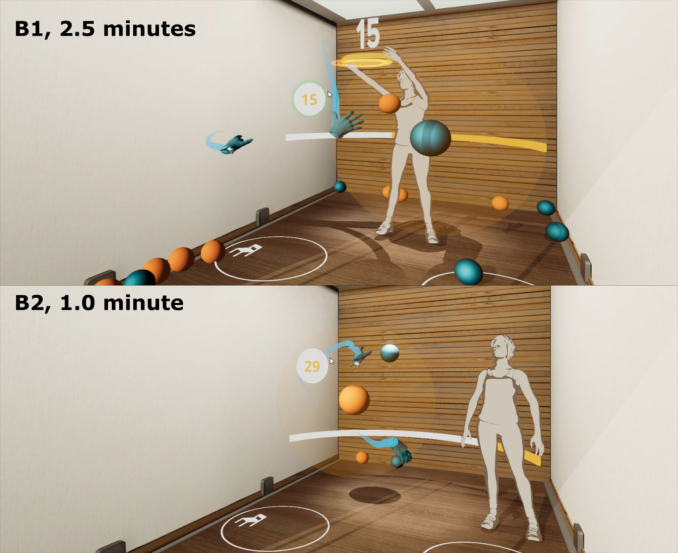
The two prototypes tested in the study differed in duration, throwing target and type of interaction with the virtual trainer (see Figure 1). In ball game 1 (B1), users had to throw a virtual ball precisely into a ring held by the virtual trainer. The users were asked to throw the ball alternately with the right and left hand in a time of 2.5 minutes. The virtual trainer was holding the ring in her hands and changed its position from time to time, requiring the participant to aim at different spots. In ball game 2 (B2), the task was to throw the balls against a wall with the right or left hand as fast as possible within 1.0 minute. During B2 the virtual trainer was not interacting with the user through synchronized movement as she does in B1. In both prototypes the virtual trainer demonstrated and visualized body movements and provided feedback through verbal praising and hand-clapping. All hits to the ring in B1 and B2 were counted and displayed for the user in the VR hit counter. The two ball games (B1 and B2) were repeated in the first sessions in 2 and later in 3 rounds.
Effectiveness of Self-Competitive Gamification Designs in VR Exergames 287
Figure 1: Two prototypes of the ball game exergame in VR for senior users.
METHODS
The study was part of the 6-week exergame training for senior patients with hypertension and took place in the laboratory of the Geriatrics Research Group at Charité - Universitätsmedizin Berlin. During the period of six weeks 23 participants had a regular endurance training. Each session lasted approx. 30 minutes and had moderate intensity (40-60% of heart rate reserve). Parti- cipants were immersed in VR exergames by wearing an HTC Vive Pro headset and interacted using Valve Index controllers. With the controllers, partici- pants had to grab the ball that appeared in front of them by closing the fingers into a fist around the built-in grip sensor in the controller. By spreading the fingers and a simultaneous throwing motion, the ball was thrown from the virtual hand. All participants gave their written informed consent to take part in the study. The study was approved by the Ethics Committee of the Charité (No. EA1/019/20).
Data Analysis The statistical analysis was performed using IBM SPSS Statistics 27. All hits to the ring in B1 and against the wall in B2 were calculated as mean values for each training session. A repeated-measures ANOVA with Greenhouse-Geisser correction was used to determine the significance. The Kolmogorov-Smirnov test indicated a normal distribution. There were no considerable outliers in the data set.
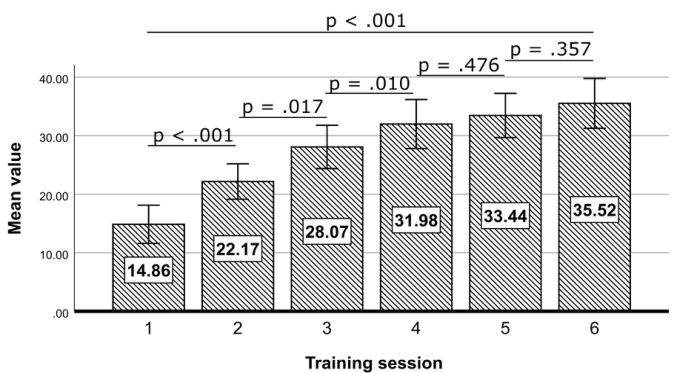
Figure 2: Ball game 1 (B1) mean values and p-values for the six training sessions.
RESULTS
Participants The sample consisted of 23 participants with essential hypertension. The mean age of the participants was 75.8 years (SD: 4.7). The participants had no cognitive impairments and no increased fall risk. 6 participants had prior experience in the use of VR. All participants were recruited from the internal volunteer database of the Geriatrics Research Group of the Charité Berlin.
Hit Rates Ball-Game-1 In B1, an average of 26.46 (SD: 7.02) hits was achieved in all six training sessions. A repeated-measures ANOVA with Greenhouse-Geisser correction showed that over the entire course of training, the average number of hits differed significantly (F(2.58, 43.90) = 67.09, p<0.001, partial Eta squa- red = 0.80). From training session 1 to training session 6, the number of hits increased by 20.66 (SDF: 1.59) for B1. Except for the comparison betw- een training session 4 and 5 and training session 5 and 6, all other pairwise comparisons were significant.
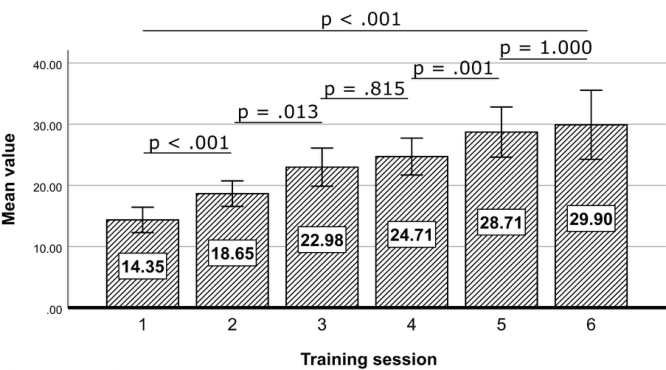
Ball game 2 In B2 the mean hits were 22.71 (SD: 6.11) for all training sessions. A repeated- measures ANOVA with Greenhouse-Geisser correction showed that over the entire course of training, the average number of hits differed significantly (F(1.46, 23.32) = 35.90, p<0.001, partial Eta squared = 0.69). Also in ball game 2 the average number of hits increased from training session 1 to 6 by 15.55 (SDF: 2.19). Except for the comparison between training session 3 and 4 and training session 5 and 6, all other pairwise comparisons were significant.
Effectiveness of Self-Competitive Gamification Designs in VR Exergames 289
Figure 3: Ball game 2 (B2) mean values and p-values for the six training sessions.
CONCLUSION
The primary goal of our research was to evaluate to what extent the different self-competition designs enhance the improvement of one’s own performance over time. In general, the results of the study show that both self-competitive gamification designs in the VR exergame “ball game” were effective for senior patients with hypertension in terms of the increase in the hit rate and adherence: In both versions of the ball game senior users improved their performance over time as the hit rate increased and also did not quit the exergame. The results show that the second prototype (B2) of the exergame, which was shorter in duration (1 minute) and included less interaction with the virtual trainer, was more effective as far as the hit rate is concerned, i.e. 22.71 average hit rate per minutes in B1 compared to 10.5 average hit rate per minute. These results confirm previous research by Shaw et al. (2016), which showed that self-competition may be even more enjoyable and effective than playing with the virtual trainer. Our additional results showed that out of 23 study participants, 14 (60.9%) liked the VR ball games most. This may be related to the positive physical and mental effects of repeated practice over time in both versions of the exergame, since in both B1 and B2 users increased their hit rates from session to session. This improved performance may have possibly contributed to a heightened perception of one’s own competence and increase in enjoyment and self-esteem as indicated by Michael and Lutteroth (2020). This hypothesis could not be tested in the frame of the 6-week study, but could be an aim for a follow-up experiment. To conclude, our study sho- wed that self-competition seems to be effective for less fit and less competitive users. Furthermore, it seems that gamification designs focusing more on bea- ting one’s own previous results from session to session may be even more effective and motivating compared to interacting with a virtual trainer who tries to motivate users through verbal and non verbal cues. These possible interdependencies of different gamifications designs with different forms of interaction with the virtual trainer would have to be examined in more detail
and for a wider range of exergame designs in further studies. Further research studies could also look deeper into the links between increased performance over time in VR expergames and perceptions of own competence and self- esteem, for example in view of research on self-efficacy and in context of different types of exergames and different target populations.
ACKNOWLEDGMENT
This publication was produced as part of the bewARe project with the name. The bewARe project was a three-year (08/2018 - 12/2021) R&D project founded by the German Federal Ministry of Education and Research (BMBF). Project website: www.beware-projekt.de/en/index.html.
REFERENCES
Aksovi´c, N., et al. (2020). Effects of aerobic physical activity to cardio-respiratory fitness of the elderly population: systematic overview. Pedagogy of Physical Culture and Sports, 24(5), pp. 208–218. Farrow, M., Lutteroth, C., Rouse, P., Bilzon, J.L. (2019). Virtual-reality exergaming
improves performance during high-intensity interval training. European Journal of Sport Science, 19, pp. 719–727. IBM Corp. Released (2020). IBM SPSS Statistics for Windows, Version 27.0.
Armonk, NY: IBM Corp. Larsen, L.H. et al. (2013). The Physical Effect of Exergames in Healthy Elderly. A Systematic Review. Games for Health, 2(4), pp. 205–12. Luimula, M., et al. (2017). Gamified Solutions in Healthcare - Testing Rehabilitation
Games in Finland and Asia. Acta Technica Jaurinensis 10(1), pp. pp. 35–49. Martin-Niedecken, A.L., Rogers, K., Vidal, L.T., Mekler, E.D., Segura, E.M. (2019).
ExerCube vs. Personal Trainer: Evaluating a Holistic, Immersive, and Adaptive Fitness Game Setup. Proceedings of the 2019 CHI Conference on Human Factors in Computing Systems, pp. 1–18. Michael, A., Lutteroth, C. (2020). Race Yourselves: A Longitudinal Exploration of Self-Competition Between Past, Present, and Future Performances in a VR Exer- game. Proceedings of the 2020 CHI Conference on Human Factors in Computing Systems, Ass. for Com. Machinery, New York, U SA, pp. 1–17. Mueller, F., Vetere, F., Gibbs, M.R., Edge, D., Agamanolis, S., Sheridan, J.G., Heer,
J. (2012). Balancing exertion experiences. Proceedings of the SIGCHI Conference on Human Factors in Computing Systems, pp. 1853–1862. Nor, N.N. et al. (2020). A Review of Gamification in Virtual Reality (VR) Sport. EAI Endorsed Trans. Creative Technologies, 6(21), pp- 1–8. Shaw, L.A., Buckley, J., Corballis, P.M., Lutteroth, C., Wünsche, B.C. (2016). Com-
petition and cooperation with virtual players in an exergame. PeerJ Computer Science, 2(5):e92. Xu, W., Liang, H., Yu, K., Baghaei, N. (2021). Effect of Gameplay Uncertainty, Display Type, and Age on Virtual Reality Exergames. Proceedings of the 2021 CHI Conference on Human Factors in Computing Systems, pp. 1–14.
Read this individual research paper free through the original publisher, or explore the full digital proceedings book.
ISBN 978-1-958651-44-5
Explore this ISBN in the AHFE Bookstore ↗Listed in the July 2026 bookstore catalogue; search by ISBN to confirm current availability · Digital book purchase optional