Robert Waszkowski, Tadeusz Nowicki, Agata Chodowska Wasilewska (2023). Low-code development platform for modeling and implementation of business processes to support outbreak investigations. In: Application of Emerging Technologies. AHFE Open Access, vol. 115, pp. 294–302. https://doi.org/10.54941/ahfe1004326
This article describes the functional scope of a low-code development platform for modeling and implementation of business processes to support outbreak investigations.LCDP (Low-Code Development Platforms) are development tools that allow you to create applications using a minimum amount of traditional programming code. They help speed up the software development process by reducing the need to write manual code and enabling the development of applications using visual interfaces, ready-made components, and configuration rules. They can also support business process management through various mechanisms. LCDP platforms can help build applications that support Business Process Management through visual modeling of processes, the use of ready-made components, automation mechanisms that enable the performance of specific activities or decisions as part of a business process, easy integration of various external systems, which may be necessary for business processes that require cooperation with multiple tools and applications, providing mechanisms for monitoring the course of business processes and generating reports on performance, duration and other parameters, and enabling business analysts to participate in the application development process, because they do not require deep programming knowledge.The article presents the basic functionality of the platform and refers to such architectural assumptions as integrated process management, remote access, security, reliability, flexibility, openness to integration, reporting, registers, and monitoring.Particular attention was paid to the issues of modeling business processes and building applications to support activities related to epidemic investigation during an epidemic of poisonings and foodborne diseases.Epidemiological investigation to cut the paths of epidemics of poisoning and foodborne diseases is an important process to identify, control, and prevent the further spread of the disease. This process aims to understand where the infection came from, what factors led to the outbreak, and how it can be stopped. The first step is to recognize and report an outbreak or increase in foodborne illness. This can be done by analyzing epidemiological data, e.g. reports on illnesses and hospitalizations. Detailed information is then collected from patients about their symptoms, food history, places visited, food eaten, contacts with others, etc. It is important to identify common factors and sources that may be related to the disease. The next phase is analyzing the collected data to identify trends, patterns, and potential sources of the outbreak. This may include the analysis of time-disease curves, the identification of geographic disease clusters, or the analysis of consumption clusters of specific products. Based on the analysis of data, epidemiologists create hypotheses about the possible sources of infection or ways of transmitting the disease. This may include identifying specific foods, restaurants, suppliers, or water sources. To verify the hypotheses and identify the source of the epidemic, field studies are carried out, including microbiological tests of food samples, the environment, and samples from patients and people suspected of being infected. Once the source of the outbreak has been identified, action is taken to control and disrupt transmission routes. These actions consist of withdrawing contaminated products from the market, closing the source of contamination (e.g. a restaurant), and implementing hygiene and safety measures. After an epidemic intervention, monitoring of the situation continues to confirm the effectiveness of the actions and to ensure that the epidemic has been stopped. Investigation, intervention, and outcome information is also reported to relevant public health agencies.The developed platform was used as a programming base to develop a support system for the above-mentioned activities of the State Sanitary Inspection, allowing for the detection of threats and cutting the paths of spreading the epidemic.
LCDP (Low-Code Development Platforms) are development tools that allow you to create applications using a minimum amount of traditional pro- gramming code (Waszkowski, 2022). They help speed up the software development process by reducing the need to write manual code and enabling the development of applications using visual interfaces, ready-made compo- nents, and configuration rules (Adrian et al., 2020) (Sanchis et al., 2019). They can also support business process management through various mech- anisms. LCDP platforms can help build applications that support Business Process Management through visual modeling of processes (Waszkowski, 2019) (Waszkowski and Bocewicz, 2022), the use of ready-made com- ponents, automation mechanisms that enable the performance of specific activities or decisions as part of a business process, easy integration of various external systems, which may be necessary for business processes that require cooperation with multiple tools and applications, providing mechanisms for
Low-Code Development Platform for Modeling and Implementation 295
monitoring the course of business processes and generating reports on per- formance, duration and other parameters, and enabling business analysts to participate in the application development process, because they do not require deep programming knowledge (Martinez and Pfister, 2023) (Rokis and Kirikova, 2022) (Overeem, 2022).
The subsequent chapters present the basic functionality of the platform and refer to such architectural assumptions as integrated process manage- ment, remote access, security, reliability, flexibility, openness to integration, reporting, registers, and monitoring.
The platform designed aims to support activities related to epidemic investigation during an epidemic of poisonings and foodborne diseases.
Epidemiological investigation to cut the paths of epidemics of poisoning and foodborne diseases is an important process to identify, control, and pre- vent the further spread of the disease. This process aims to understand where the infection came from, what factors led to the outbreak, and how it can be stopped. The first step is to recognize and report an outbreak or increase in foodborne illness. This can be done by analyzing epidemiological data, e.g. reports on illnesses and hospitalizations. Detailed information is then collected from patients about their symptoms, food history, places visited, food eaten, contacts with others, etc. It is important to identify common factors and sources that may be related to the disease. The next phase is ana- lyzing the collected data to identify trends, patterns, and potential sources of the outbreak. This may include the analysis of time-disease curves, the identification of geographic disease clusters, or the analysis of consumption clusters of specific products. Based on the analysis of data, epidemiologists create hypotheses about the possible sources of infection or ways of trans- mitting the disease. This may include identifying specific foods, restaurants, suppliers, or water sources. To verify the hypotheses and identify the source of the epidemic, field studies are carried out, including microbiological tests of food samples, the environment, and samples from patients and people suspected of being infected. Once the source of the outbreak has been identi- fied, action is taken to control and disrupt transmission routes. These actions consist of withdrawing contaminated products from the market, closing the source of contamination (e.g. a restaurant), and implementing hygiene and safety measures. After an epidemic intervention, monitoring of the situation continues to confirm the effectiveness of the actions and to ensure that the epidemic has been stopped (Waszkowski et al., 2018) (Waszkowski et al., 2017a) (Waszkowski and Nowicki, 2020). Investigation, intervention, and outcome information is also reported to relevant public health agencies.
PURPOSE AND FEATURES OF THE SYSTEM To implement the project assumptions, a low-code platform Aurea BPM was used for building applications supporting the implementation of business processes (Waszkowski et al., 2018). The system enables the management of processes implementing epidemiological procedures during epidemiological investigations, regardless of the scale of the epidemic (Jasiulewicz-Kaczmarek et al., 2017).
The Aurea BPM system provides the following benefits:
increasing productivity by reducing the process execution time,
reduction of the number of process steps and elimination of errors in the execution of procedures thanks to automation,
improvement of communication between users,
precise definition of the responsibilities of each employee by assigning them to specific steps in the business process,
facilitated implementation of changes by centrally defining the process model,
optimization of the use of employees thanks to the possibility of shifting the resources necessary to implement specific business processes,
ongoing reporting on the actual course of processes, their status, degree of completion and delays.
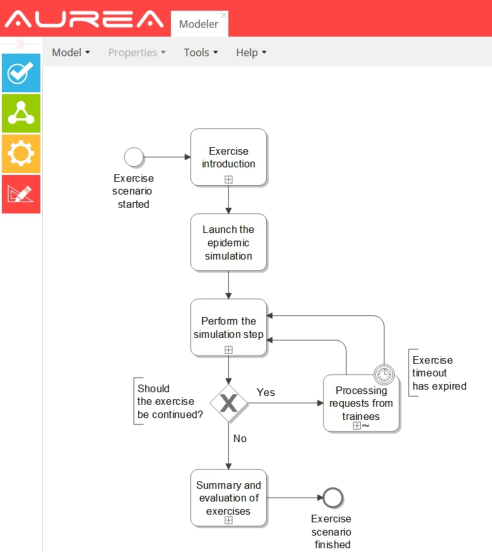
Integrated Enterprise Process Management All business processes are designed (Figure 1), operated and controlled in one central, integrated repository. All target user groups: sanitary inspectors, organization and management departments, operational and IT departments and financial controllers work in an integrated environment. Thanks to this, integrated management of processes in the entire organization is possible (Waszkowski et al., 2018).
Figure 1: Aurea BPM process modeler and one of the outbreak investigation processes (source: own elaboration).
Low-Code Development Platform for Modeling and Implementation 297
In order to perform tasks related to the detection of epidemic threats and cutting the paths of epidemic spread, the LCDP platform must meet cer- tain functional characteristics. These features are listed and described in the following sections.
Remote Control The technology used provides system users with access to repository resources from any place, using a web browser. The system works on most of the available operating systems and hardware platforms and can be operated by many different web browsers (Internet Explorer, Firefox, Mozilla, Safari and Opera).
Security The applied security subsystem protects data against unauthorized access. Access to the system is controlled on several levels, starting from database objects, through the application server, and ending with the application itself. The system can operate both in the open Internet and in a secured internal corporate network.
Reliability The use of proven IT technologies ensures adequate reliability of the system. In addition, the solution has a built-in exceptional situation logging sub- system. Thanks to this, any noticed problem in the system’s operation can be diagnosed and removed very quickly (Nowicki et al., 2018)(Waszkowski et al., 2018).
Flexibility, Openness and Integration The applied system architecture, built-in API and interfaces allow for a very simple way to develop both the functionality of the system and integrate the solution with other systems used in the company.
The system uses a unique approach that allows you to “build”the function- ality of handling business processes into existing systems in the organization. It is even possible to use the user interface of one of the existing systems and embed the Aurea business process management system there.
The implementation of a business process very often requires the use of different IT systems at different stages of processing. The Aurea BPM system works in a service-oriented architecture (SOA). Thanks to this, it can be easily integrated with other company systems.
Reporting The Aurea BPM system is based on the Oracle, MS SQL or Postgres rela- tional database. At the same time, all events related to process handling are recorded, such as process start and end times, performers of individual steps, delegation, opinion and escalation paths, etc. Thanks to this, in addition to standard reports available in the system, ad-hoc reports can be built using tools using the SQL language or specialized OLAP class tools (Kiedrowicz et al., 2017).
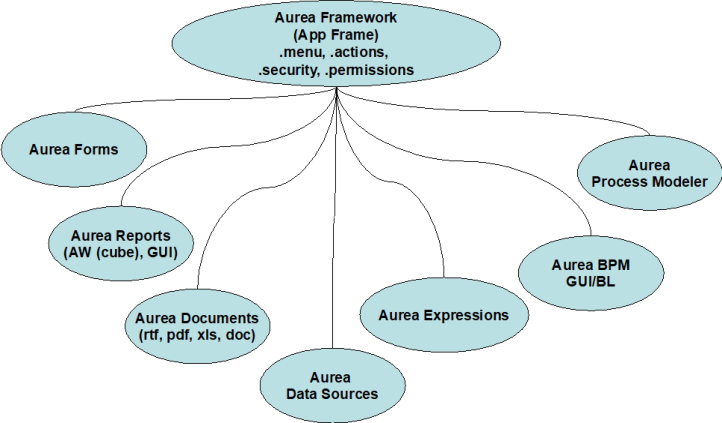
SYSTEM FUNCTIONALITY The overall functional architecture of the system is shown in Figure 2. The system components are described below.
Figure 2: Overall functional architecture of the Aurea BPM system implementing outbreak investigation processes (source: own elaboration).
Aurea Framework The Aurea Framework is the base on which the entire functionality of the system is based. It includes both frontend and backend elements. He is responsible for organizing work with the system by defining menus and actions functionality. In addition, it contains a layer of system security and defines and manages permissions for individual users and groups.
Modeling of Business Processes Using the Aurea Process Modeler module, authorized users of the system define new and modify existing business processes. A process is defined as a set of activities carried out in a specific sequence, in parallel or iteratively. This component allows you to define new business processes, create new versions of existing processes, create users and grant them appropriate permissions, track the implementation of current processes, complete processes or hand them over to other people for execution.
User Interface System users performing tasks as part of business processes use the Aurea BPM GUI module. This module, in addition to the list of tasks for a given user, also presents information about the status of currently processed processes and the history of processing processes that have already been completed.
Low-Code Development Platform for Modeling and Implementation 299
Enumerating Data Using Expressions Using the Expressions module, it is possible to define arithmetic expres- sions based on business process data. In this way, calculable data is created, thanks to which system users have a better overview of the situation when making decisions in the implementation of business pro- cess tasks (Patalas-Maliszewska and Krebs, 2015)(Patalas-Maliszewska and Łosyk, 2020).
Use of Data From External Systems Performing a business process very often involves the use of data from exter- nal sources. Access to these sources and data acquisition rules are defined in the Data Sources module. Thanks to this, there is no need to synchro- nize data and the system has direct access to external data. This ensures data consistency and gives system users real and quick information about the actual status of cases, also in external systems. LCDPs can be also used for data collecting from external sensors and other IoT devices (Witczak et al., 2020)(Pazera et al., 2020).
Creation of Documents and Workflow Most often, a business process is related to document handling. The Aurea BPM system, using the Documents module, streamlines the generation and circulation of documents by filling in appropriately prepared letter templates with process data (Waszkowski et al., 2017b)(Kiedrowicz et al., 2016). The generated letters can be further edited by popular office software, such as MS Office.
Collecting Statistics and Reporting The Aurea Reports component is a set of predefined reports on the status of processes. The tool is intended for process owners, managers and other users. Reports are powered by data collected by the Aurea Process Execution Engine module. Thanks to the use of a transparent relational data structure, it is also possible to create ad-hoc reports using other available tools that support the SQL language. Collecting all the data produced during the process execution enables the use of the group method of data handling (GMDH) and may be used in deep learning networks (Mrugalski and Korbicz, 2007)(Mrugalski et al., 2003).
Data Processing by the User Each business process processes data associated with a specific instance of that process. If the data is processed by users, a user interface in the form of screen forms is needed. With their help, the user enters and modifies data. Forms ensure the correctness and consistency of data by using validation rules and data dictionaries (Worwa et al., 2017). In the Aurea BPM sys- tem, the Forms module is responsible for user data processing. All the data and their subsequent versions are stored in the database. It helps to orga- nize the knowledge transfer from one part of the organization to another (Patalas-Maliszewska and Krebs, 2015)(Dudek and Patalas-Maliszewska,
2016) improving overall organizational experience and reducing errors in the performance of business processes.
CONCLUSION
Using a low-code development platform for outbreak investigations can offer several significant benefits. These benefits are based on the application of technology to manage, analyze, and respond to outbreaks of diseases or other related incidents. The main benefits of utilizing LCDP in outbreak investigations are:
1. Faster response time, 2. Data centralization for various sources with duplication reduction, 3. Improved data analysis which leads to more accurate and insightful assessments of outbreak dynamics, 4. Early detection of unusual patterns allowing for identification of poten- tial outbreaks at an early stage and taking proactive measures, 5. Optimal resource allocation based on real-time data and predictive modeling, 6. Enhanced communication and coordination among different organiza- tions and agencies involved in outbreak investigations, 7. Data privacy and security allowing sensitive health information to be managed safely, 8. Scenario simulations allowing understanding of potential outcomes of different intervention strategies, 9. Evidence-based decision making thank to providing accurate and up-to- date information and reducing reliance on assumptions or incomplete data, 10. Historical data analysis that can be invaluable for understanding trends, recurrence patterns, and the effectiveness of past interventions, 11. Remote access to outbreak data and analysis, facilitating collaboration among experts even when physically distant.
In addition, the regular use of LCDPs in outbreak investigations enhances the skills of health professionals in data management, analysis, and response strategies.
ACKNOWLEDGMENT
This work was financed by Military University of Technology under research project UGB 810/2023.
REFERENCES
Adrian, B., Hinrichsen, S., Nikolenko, A., 2020. App Development via Low-Code Programming as Part of Modern Industrial Engineering Education. Adv. Intell. Syst. Comput. 1207 AISC, 45–51. https://doi.org/10.1007/978-3-030-51369-6_ 7/COVER
Low-Code Development Platform for Modeling and Implementation 301
Dudek, A., Patalas-Maliszewska, J., 2016. A Model of a Tacit Knowledge Transformation for the Service Department in a Manufacturing Company: A Case Study. Found. Manag. 8, 175–188. https://doi.org/10.1515/FMAN-2016-0014 Jasiulewicz-Kaczmarek, M., Waszkowski, R., Piechowski, M., Wyczółkowski, R.,
2017. Implementing BPMN in Maintenance Process Modeling. Inf. Syst. Archit. Technol. Proc. 38th Int. Conf. Inf. Syst. Archit. Technol. – ISAT 2017 300–309. https://doi.org/10.1007/978-3-319-67229-8_27 Kiedrowicz, M., Nowicki, T., Waszkowski, R., 2017. Business Process Data Flow between Automated and Human Tasks. DEStech Trans. Soc. Sci. Educ. Hum. Sci. https://doi.org/10.12783/dtssehs/icss2016/9000 Kiedrowicz, M., Nowicki, T., Waszkowski, R., Wesołowski, Z., Worwa, K., 2016.
Optimization of the Document Placement in the RFID Cabinet. MATEC Web Conf. 76, 02001. https://doi.org/10.1051/matecconf/20167602001 Martinez, E., Pfister, L., 2023. Benefits and limitations of using low-code development to support digitalization in the construction industry. Autom. Constr. 152, 104909. https://doi.org/10.1016/J. AUTCON.2023.104909 Mrugalski, M., Arinton, E., Korbicz, J., 2003. Dynamic GMDH Type Neural
Networks. Neural Netw. Soft Comput. 698–703. https://doi.org/10.1007/978-3- 7908-1902-1_108 Mrugalski, M., Korbicz, J., 2007. Least mean square vs. outer bounding ellipsoid algorithm in confidence estimation of the GMDH neural networks. Lect. Notes Comput. Sci. Subser. Lect. Notes Artif. Intell. Lect. Notes Bioinforma. 4432 LNCS, 19–26. https://doi.org/10.1007/978-3-540-71629-7_3/COVER Nowicki, T., Saniuk, A., Waszkowski, R., 2018. Clothing Distribution Optimization
for Rental Company Warehouse. Adv. Intell. Syst. Comput. 386–397. https://doi. org/10.1007/978-3-319-94000-7_39 Overeem, M., 2022. Evolution of Low-Code Platforms. Utrecht University. https://doi.org/10.33540/1197 Patalas-Maliszewska, J., Krebs, I., 2015. Decision model for the use of the application for knowledge transfer support in manufacturing enterprises. Lect. Notes Bus. Inf. Process. 228, 48–55. https://doi.org/10.1007/978-3-319-26762-3_5/COVER Patalas-Maliszewska, J., Łosyk, H., 2020. An Approach to Assessing Sustainability
in the Development of a Manufacturing Company. Sustain. 2020 Vol. 12 Page 8787 12, 8787. https://doi.org/10.3390/SU12218787 Pazera, M., Buciakowski, M., Witczak, M., Mrugalski, M., 2020. A quadratic boundedness approach to a neural network-based simultaneous estimation of actuator and sensor faults. Neural Comput. Appl. 32, 379–389. https://doi.or g/10.1007/S00521-018-3706-8/FIGURES/9 Rokis, K., Kirikova, M., 2022. Challenges of Low-Code/No-Code Software Devel-
opment: A Literature Review. Lect. Notes Bus. Inf. Process. 462 LNBIP, 3–17. https://doi.org/10.1007/978-3-031-16947-2_1 Sanchis, R., García-Perales, Ó., Fraile, F., Poler, R., 2019. Low-Code as Enabler of Digital Transformation in Manufacturing Industry. Appl. Sci. 10, 12. https://doi.org/10.3390/app10010012 Waszkowski, R., 2022. Low-code Development Platform for Business Process
Automation: Aurea BPM. Presented at the Production Management and Process Control, AHFE International. https://doi.org/10.54941/ahfe1001633 Waszkowski, R., 2019. Low-code platform for automating business processes in manufacturing. IFAC-Pap. 52, 376–381. https://doi.org/10.1016/j.ifacol.2019.10. 060
Waszkowski, R., Bocewicz, G., 2022. Visibility Matrix: Efficient User Interface Modelling for Low-Code Development Platforms. Sustainability 14, 8103. https://doi.org/10.3390/su14138103 Waszkowski, R., Kiedrowicz, M., Nowicki, T., Worwa, K., 2017a. Customer Service
Processes Automation in Administrative Office with RFID Tagged Documents. Presented at the 2017 Fourth International Conference on Mathematics and Com- puters in Sciences and in Industry (MCSI), IEEE. https://doi.org/10.1109/mcsi .2017.47 Waszkowski, R., Kiedrowicz, M., Nowicki, T., Worwa, K., 2017b. Access Control Management in Administrative Office with RFID Tagged Documents. Presented at the 2017 Fourth International Conference on Mathematics and Computers in Sciences and in Industry (MCSI), IEEE. https://doi.org/10.1109/mcsi.2017.48 Waszkowski, R., Nowicki, T., 2020. Efficiency investigation and optimization of
contract management business processes in a workwear rental and laundry service company. Procedia Manuf. 44, 551–558. https://doi.org/10.1016/j.promfg.2020. 02.256 Waszkowski, R., Nowicki, T., Worwa, K., 2018. Corporate efficiency improvement with business process automation. MATEC Web Conf. 210, 02012. https://doi.or g/10.1051/matecconf/201821002012 Witczak, M., Mrugalski, M., Pazera, M., Kukurowski, N., 2020. Fault diagnosis of
an automated guided vehicle with torque and motion forces estimation: A case study. ISA Trans. 104, 370–381. https://doi.org/10.1016/J. ISATRA.2020.05.012 Worwa, K., Kiedrowicz, M., Nowicki, T., Waszkowski, R., 2017. Evaluating the Impact of Testing Document Management System with RFID Tags Software on the Level of its Reliability. Presented at the 2017 Fourth International Confer- ence on Mathematics and Computers in Sciences and in Industry (MCSI), IEEE. https://doi.org/10.1109/mcsi.2017.49
LISTED IN THE AHFE DIGITAL BOOKSTORE CATALOGUE
Explore the complete digital volume
Application of Emerging Technologies
Read this individual research paper free through the original publisher, or explore the full digital proceedings book.
ISBN 978-1-958651-91-9
Explore this ISBN in the AHFE Bookstore ↗Listed in the July 2026 bookstore catalogue; search by ISBN to confirm current availability · Digital book purchase optional