Robert Waszkowski, Tadeusz Nowicki (2024). Optimizing Contract Flow: A Simulation-Based Approach to Efficiency Improvement. In: Human Factors, Business Management and Society. AHFE Open Access, vol. 135, pp. 237–246. https://doi.org/10.54941/ahfe1004950
This paper explores the efficiency and performance of business processes involved in contract flow. We leverage simulation techniques to analyze various parameters that impact contract flow, extending beyond just efficiency. The simulation model encompasses the entire contract lifecycle, allowing us to identify bottlenecks and assess the impact of different process configurations. Our investigation examines a range of performance indicators, including efficiency, cost, and cycle time. The results provide valuable insights for organizations seeking to optimize their contract flow processes and achieve improved performance.
Optimizing contract flow processes is crucial for organizational efficiency and performance. Traditional approaches often focus solely on improving efficiency, neglecting other critical factors such as cost and cycle time. This paper presents a novel approach for analyzing contract flow by leverag- ing simulation techniques. Our research goes beyond traditional methods by examining a range of performance indicators.
The contract flow process under investigation involves several key steps. Initially, an employee drafts a contract based on a request. This contract then undergoes a multi-level approval process, involving various stakeholders like task managers, plan managers, legal counsel, and potentially public procure- ment departments. Additionally, the deputy director, chief accountant, and ultimately the director need to sign off. Revisions might be necessary based on feedback received during the approval stages.
Following the approval process, relevant departments like finance and payroll verify the contract’s data accuracy. The delivery method, either phys- ical or electronic, is then chosen by the employee. Depending on the chosen method, the contract is either printed and delivered or generated and sent electronically. Upon receiving the signed contract from the contractor, it is attached and scanned for record-keeping purposes. Finally, the system auto- matically generates a metric signifying the completion of the contract process. It is important to note that the contract can be rejected at any point during the approval stages.
This paper utilizes a simulation model encompassing the entire contract lifecycle implemented with the help of the Aurea Low-code Development Platform (Adrian, 2020; Martinez, 2023; Overeem, 2022; Rokis and Kirikova, 2022; Sanchis et al., 2019; Waszkowski, 2019; Waszkowski, 2022; Waszkowski and Bocewicz, 2022). This allows us to identify bottlenecks within the process and assess the impact of different configurations on over- all performance. By analyzing a broader range of performance indicators, including efficiency, cost, and cycle time, we aim to provide valuable insights for organizations seeking to optimize their contract flow processes (Worwa et al., 2017; Waszkowski et al., 2018; Waszkowski and Nowicki, 2020, Waszkowski et al., 2017, Waszkowski et al., 2020).
CONTRACT FLOW BUSINESS PROCESS The business process starts with an employee creating a new contract based on a request. This contract then undergoes a multi-step approval process involving the task manager, plan manager, lawyer, and potentially public procurement, the deputy director, chief accountant, and finally the director. If revisions are needed, the employee amends the contract based on feed- back (Waszkowski et al., 2018; Waszkowski et al., 2017a; Waszkowski et al., 2017b). Following this, the Economic and Financial Department and Payroll Department verify the contract’s data accuracy within their respective areas. The employee then chooses between delivering the contract electronically or physically to the contractor. Depending on the chosen method, the employee either prints and delivers the physical copy or generates and sends the electronic version.
Upon receiving the signed contract from the contractor, the employee attaches it for record-keeping. The signed document is then scanned. Finally, the system automatically generates a metric, likely a record or confirma- tion, signifying the completion of the contract process. It’s important to note that the contract can be rejected at any point during the approval stage (Dudek and Patalas-Maliszewska, 2026; Jasiulewicz-Kaczmarek et al., 2017; Kiedrowicz et al., 2016; Kiedrowicz et al., 2017; Antosz et al., 2022).
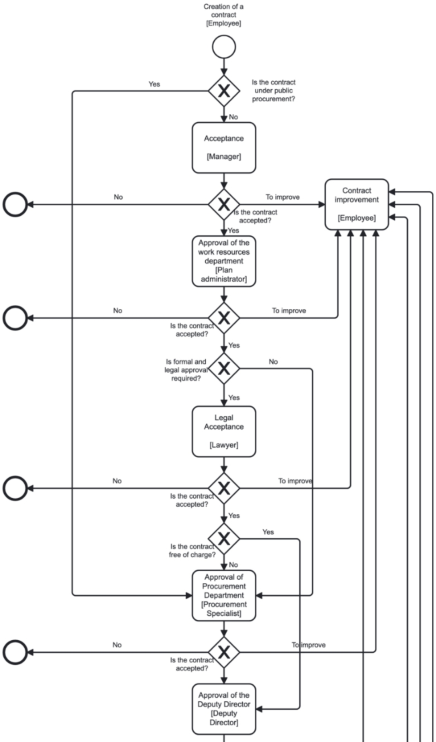
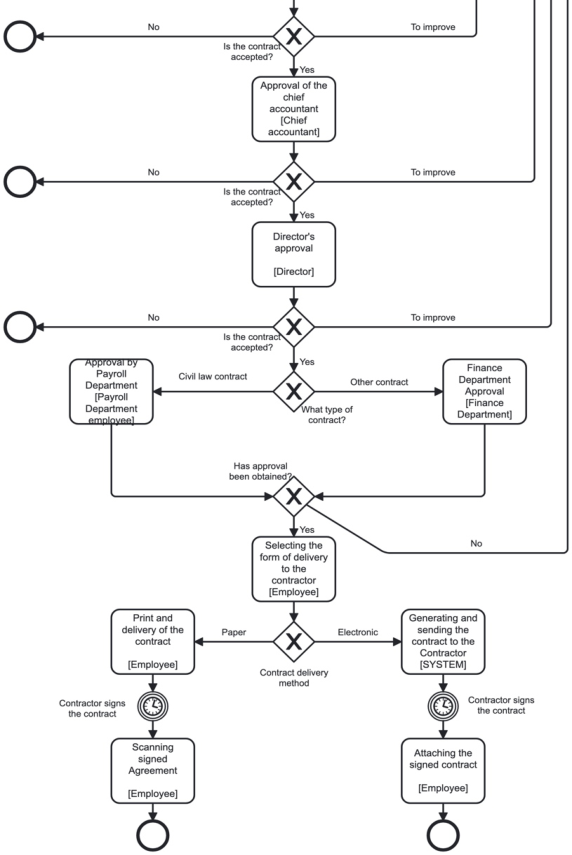
In details the business process of contract flow works as follows (Fig. 1 and Fig. 2):
1. Creation of a Contract - Creation of a new contract based on demand. 2. Executor: Employee 3. Acceptance by the Task Manager. Executor: Task Manager 4. Acceptance by the Plan Manager. Executor: Plan Manager 5. Acceptance by the Lawyer. Executor: Lawyer 6. Acceptance by Public Procurement. Executor: Public Procurement 7. Acceptance by the Deputy Director. Executor: Deputy Director 8. Acceptance by the Chief Accountant. Executor: Chief Accountant 9. Acceptance by the Director. Executor: Director 10. Contract Amendment - Amendment of the contract documentation. Executor: Employee 11. Approval by the Economic and Financial Department - Verification of the correctness of the entered data of the Contract. Executor: Employee - Economic and Financial Department
Optimizing Contract Flow: A Simulation-Based Approach to Efficiency Improvement 239
12. Approval by the Payroll Department - Verification of the correctness of the entered data concerning the civil law contract. Executor: Employee - Payroll Department 13. Selection of the Delivery Method to the Contractor - Selection of whether the contract will be delivered digitally or physically to the Contractor. Executor: Employee 14. Printing and Delivering the Contract to the Contractor. Executor: Employee 15. Generating the Contract and Sending it to the Contractor - Generating the contract and sending it electronically to the Contractor. Executor: Employee 16. Attaching the Contract Signed by the Contractor. Executor: Employee 17. Scanning the Contract Signed by the Contractor. Executor: Employee 18. Generating a Metric. Executor: System 19. Optionally – Rejected - The contract was rejected at the acceptance stage. Executor: System
Figure 1: Contract management business process – part 1 (own evaluation).
240 Waszkowski and Nowicki
Figure 2: Contract management business process – part 2 (own evaluation).
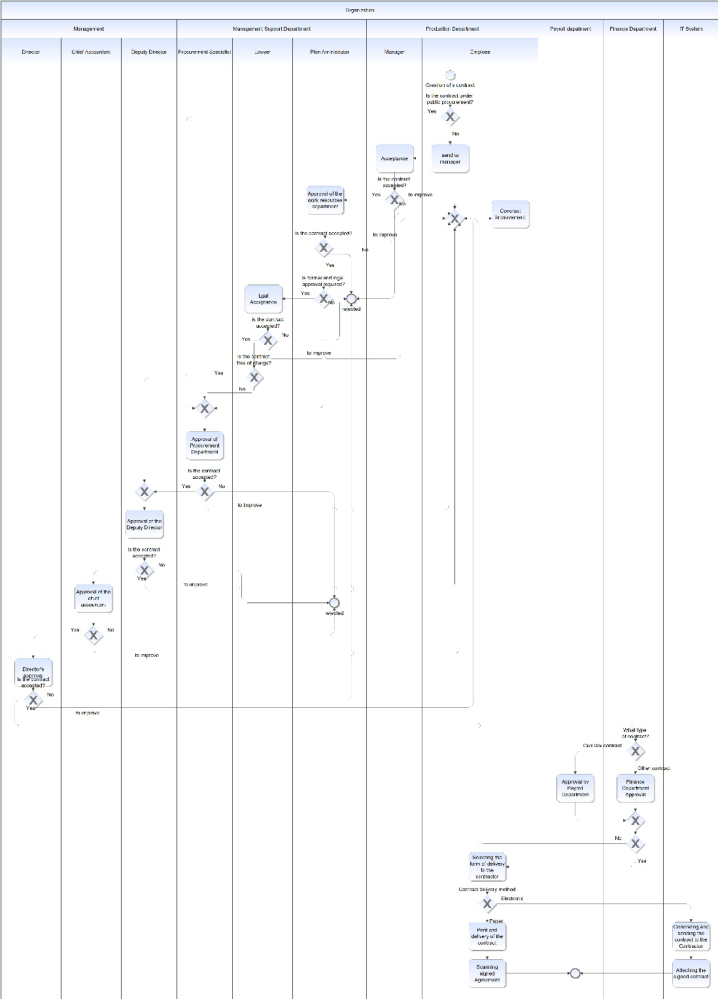
RESULTS OF SIMULATION EXPERIMENTS In the iGrafx business process modeling and simulation support environment, a simulation model of contract flow will be presented. Simulation experi- ments will be designed to study the properties of the process of contract flow. The characteristics of both the process itself and the execution environment implementing the contract flow will be examined. To simulate the function- ing of the business process relating to contract flow in given organization, this process was implemented in the iGrafx environment, which is the equivalent of the Low-code systems class. This process is shown in Figure 3.
Optimizing Contract Flow: A Simulation-Based Approach to Efficiency Improvement 241
Figure 3: Contract flow business process made in iGrafx environment (own evalua- tion).
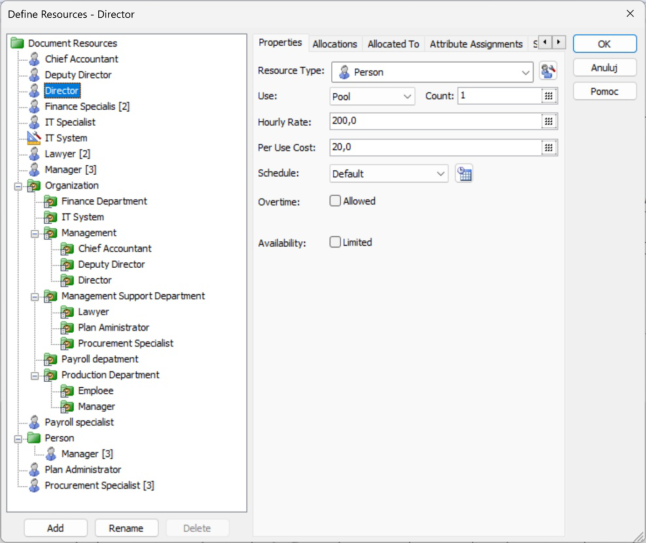
For the process implemented in the iGrafx environment, a number of data necessary to run a computer simulation of the process functioning were intro- duced. The structure of a part of the organization corresponding to the flow of documents in the organization was established. This structure is shown in Figure 4.
242 Waszkowski and Nowicki
Figure 4: Organization structure corresponding to the contract flow business process made in iGrafx environment (own evaluation).
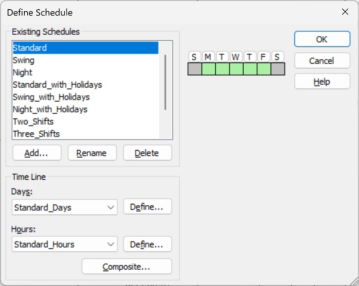
Each of the people shown in the organization structure has a fixed work schedule in the organization. It is shown in Figure 5.
Figure 5: Fixed work schedule for people in the organization in the iGrafx environment (own evaluation).
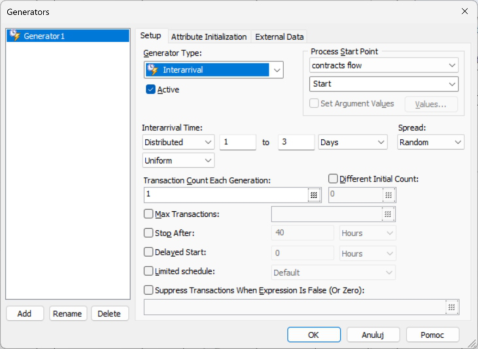
The characteristics of document inflow streams to be handled in the contract flow process must also be determined (Waszkowski and Nowicki, 2023). The parameters of the document inflow generator for the contract flow are shown in Figure 6.
Optimizing Contract Flow: A Simulation-Based Approach to Efficiency Improvement 243
Figure 6: Parameters of generator for contract flow in the iGrafx environment (own evaluation).
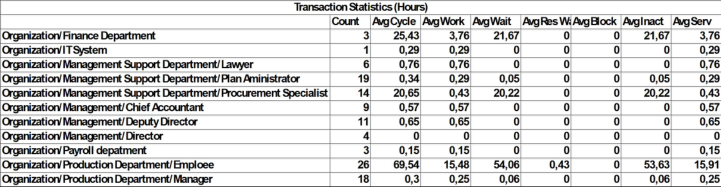
As a result of a number of simulation experiments, a number of interesting combinations relating to the process of contract flow were obtained. You can show statistics relating to the execution times of various types of activities (Figure 7).
Figure 7: Aggregate characteristics for various activities in the iGrafx environment (own evaluation).
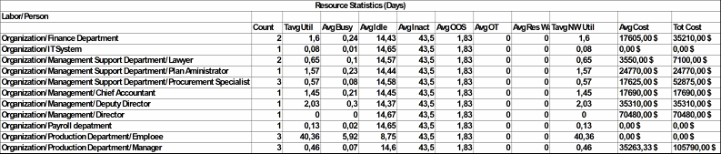
It is also important to show the characteristics related to individual resources in the model. A number of properties of the processes of using these resources in the process of electronic circulation of documents can be shown (Figure 8).
Figure 8: The degree of resource utilization in the process in the iGrafx environment (own evaluation).
244 Waszkowski and Nowicki
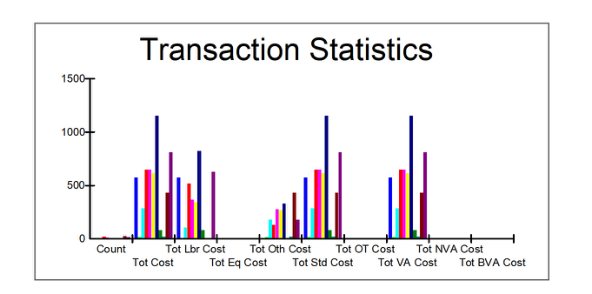
We can also show a number of aggregate statistics relating to the activi- ties carried out in the process of electronic correspondence circulation in the organization (Nowicki et al., 2017; Nowicki et al., 2013, Nowicki et al., 2018). Such a summary in the form of a bar chart is shown in Figure 9.
Figure 9: Aggregate statistics relating to the activities performed in the process in the iGrafx environment (own evaluation).
Many other interesting characteristics can be demonstrated by performing numerous simulation experiments (Patalas-Maliszewska and Krebs, 2015; Patalas_Maliszewska and Łosyk, 2020; Pazera et al., 2020). Analysis of the dynamics of functioning of a certain part of the organization is extremely interesting and necessary to assess the quality of this organization’s operation.
CONCLUSION
This paper demonstrates a method for modeling and simulating a business process representing contract flow within an organization. The process was translated into a low-code equivalent, enabling efficient simulation of its functionality and analysis of various model parameters. This approach facil- itates the examination of inherent properties of the electronic contract flow process, allowing for identification of bottlenecks, resource deficiencies, and other improvement opportunities.
Furthermore, the application of business process modeling and computer simulation in a low-code environment presents a valuable tool for under- standing and optimizing real-world processes. This methodology encourages continuous model development and iterative process modifications to achieve optimal efficiency within the organization.
ACKNOWLEDGMENT
This work was financed by Military University of Technology under research project UGB 701/2024.
Optimizing Contract Flow: A Simulation-Based Approach to Efficiency Improvement 245
REFERENCES
Adrian, B., Hinrichsen, S., Nikolenko, A., 2020. App Development via Low-Code Programming as Part of Modern Industrial Engineering Education. Adv. Intell. Syst. Comput. 1207 AISC, 45–51. https://doi.org/10.1007/978-3-030-51369-6_ 7/COVER Antosz, K., Jasiulewicz-Kaczmarek, M., Waszkowski, R., & Machado, J. (2022).
Application of Lean Six Sigma for sustainable maintenance: case study. IFAC- PapersOnLine, 55(19), 181–186. https://doi.org/10.1016/j.ifacol.2022.09.204 Dudek, A., Patalas-Maliszewska, J., 2016. A Model of a Tacit Knowledge Transformation for the Service Department in a Manufacturing Company: A Case Study. Found. Manag. 8, 175–188. https://doi.org/10.1515/FMAN-2016-0014 Jasiulewicz-Kaczmarek, M., Waszkowski, R., Piechowski, M., Wyczółkowski, R.,
2017. Implementing BPMN in Maintenance Process Modeling. Inf. Syst. Archit. Technol. Proc. 38th Int. Conf. Inf. Syst. Archit. Technol. – ISAT 2017 300–309. https://doi.org/10.1007/978-3-319-67229-8_27 Kiedrowicz, M., Nowicki, T., Waszkowski, R., 2017. Business Process Data Flow between Automated and Human Tasks. DEStech Trans. Soc. Sci. Educ. Hum. Sci. https://doi.org/10.12783/dtssehs/icss2016/9000 Kiedrowicz, M., Nowicki, T., Waszkowski, R., Wesołowski, Z., Worwa, K., 2016.
Optimization of the Document Placement in the RFID Cabinet. MATEC Web Conf. 76, 02001. https://doi.org/10.1051/matecconf/20167602001 Martinez, E., Pfister, L., 2023. Benefits and limitations of using low-code development to support digitalization in the construction industry. Autom. Constr. 152, 104909. https://doi.org/10.1016/J. AUTCON.2023.104909. Nowicki, T., Kiedrowicz, M., Waszkowski, R., Chodowska, A., & Lach, A. (2017).
Access control system for RFID-tagged documents in supply chain management. LogForum, 13(1), 91–101. DOI: https://doi.org/10.17270/J. LOG.2017.1.8. Nowicki, T., Pytlak, R., Waszkowski, R., & Bertrandt, J. (2013). The method for finding optimal sanitary inspectors schedules. ANNALS OF NUTRITION AND METABOLISM, 63, 1027. Nowicki, T., Saniuk, A., Waszkowski, R., 2018. Clothing Distribution Optimization
for Rental Company Warehouse. Adv. Intell. Syst. Comput. 386–397. https://doi. org/10.1007/978-3-319-94000-7_39 Overeem, M., 2022. Evolution of Low-Code Platforms. Utrecht University. https: //doi.org/10.33540/1197 Patalas-Maliszewska, J., Krebs, I., 2015. Decision model for the use of the application
for knowledge transfer support in manufacturing enterprises. Lect. Notes Bus. Inf. Process. 228, 48–55. https://doi.org/10.1007/978-3-319-26762-3_5/COVER Patalas-Maliszewska, J., Łosyk, H., 2020. An Approach to Assessing Sustainability in the Development of a Manufacturing Company. Sustain. 2020 Vol. 12, Page 8787 12, 8787. https://doi.org/10.3390/SU12218787 Pazera, M., Buciakowski, M., Witczak, M., Mrugalski, M., 2020. A quadratic
boundedness approach to a neural network-based simultaneous estimation of actuator and sensor faults. Neural Comput. Appl. 32, 379–389. https://doi.or g/10.1007/S00521-018-3706-8/FIGURES/9 Rokis, K., Kirikova, M., 2022. Challenges of Low-Code/No-Code Software Development: A Literature Review. Lect. Notes Bus. Inf. Process. 462 LNBIP, 3–17. https://doi.org/10.1007/978-3-031-16947-2_1 Sanchis, R., García-Perales, Ó., Fraile, F., Poler, R., 2019. Low-Code as Enabler
of Digital Transformation in Manufacturing Industry. Appl. Sci. 10, 12. https: //doi.org/10.3390/app10010012
246 Waszkowski and Nowicki
Waszkowski, R., 2019. Low-code platform for automating business processes in manufacturing. IFAC-Pap. 52, 376–381. https://doi.org/10.1016/j.ifacol.2019.10. 060 Waszkowski, R., 2022. Low-code Development Platform for Business Process
Automation: Aurea BPM. Presented at the Production Management and Process Control, AHFE International. https://doi.org/10.54941/ahfe1001633 Waszkowski, R., Bocewicz, G., 2022. Visibility Matrix: Efficient User Interface Modelling for Low-Code Development Platforms. Sustainability 14, 8103. https: //doi.org/10.3390/su14138103 Waszkowski, R., Kiedrowicz, M., Nowicki, T., Worwa, K., 2017a. Customer Service
Processes Automation in Administrative Office with RFID Tagged Documents. Presented at the 2017 Fourth International Conference on Mathematics and Com- puters in Sciences and in Industry (MCSI), IEEE. https://doi.org/10.1109/mcsi .2017.47 Waszkowski, R., Kiedrowicz, M., Nowicki, T., Worwa, K., 2017b. Access Control Management in Administrative Office with RFID Tagged Documents. Presented at the 2017 Fourth International Conference on Mathematics and Computers in Sciences and in Industry (MCSI), IEEE. https://doi.org/10.1109/mcsi.2017.48 Waszkowski, R., Nowicki, T. W., & Worwa, K. A. (2018). Corporate efficiency
improvement with business process automation. MATEC Web of Conferences, 210. https://doi.org/10.1051/matecconf/201821002012 Waszkowski, R., Nowicki, T., & Ole´s, M. (2020). Human-computer interaction in business process external tasks. In Advances in Intelligent Systems and Computing (Vol. 972). https://doi.org/10.1007/978-3-030-19135-1_5 Waszkowski, R., Nowicki, T., & Saniuk, A. (2017). Human-computer interaction in
sanitary inspection simulation exercises. In Advances in Intelligent Systems and Computing (Vol. 486). https://doi.org/10.1007/978-3-319-41685-4_22 Waszkowski, R., Nowicki, T., 2020. Efficiency investigation and optimization of contract management business processes in a workwear rental and laundry service company. Procedia Manuf. 44, 551–558. https://doi.org/10.1016/j.promfg.2020. 02.256 Waszkowski, R., Nowicki, T., Worwa, K., 2018. Corporate efficiency improvement
with business process automation. MATEC Web Conf. 210, 02012. https://doi.or g/10.1051/matecconf/201821002012 Waszkowski R., Nowicki T., 2023, Simulation Studies of the Properties of Electronic Correspondence Processes Implemented in a Low-code Development Plat- form. Proceedings of the 41st International Business Information Management Association Conference, 41st IBIMA Conference on Software Engineering 2023. Worwa, K., Kiedrowicz, M., Nowicki, T., Waszkowski, R., 2017. Evaluating the
Impact of Testing Document Management System with RFID Tags Software on the Level of its Reliability. Presented at the 2017 Fourth International Conference on Mathematics and Computers in Sciences and in Industry (MCSI), IEEE. https: //doi.org/10.1109/mcsi.2017.49
LISTED IN THE AHFE DIGITAL BOOKSTORE CATALOGUE
Explore the complete digital volume
Human Factors, Business Management and Society
Read this individual research paper free through the original publisher, or explore the full digital proceedings book.
ISBN 978-1-964867-11-3
Explore this ISBN in the AHFE Bookstore ↗Listed in the July 2026 bookstore catalogue; search by ISBN to confirm current availability · Digital book purchase optional