Robert Waszkowski, Tadeusz Nowicki, Agata Chodowska Wasilewska (2022). Designing and Implementing Simulation Exercises for State Sanitary and Epidemiological Service. In: Production Management and Process Control. AHFE Open Access, vol. 36, pp. 171–177. https://doi.org/10.54941/ahfe1001632
The paper presents business processes related to the work of sanitary services in cases of an epidemic of foodborne diseases. On their basis, simulation exercises according to given scenarios were developed. The work is related to the implementation of a project financed by the National Center for Research and Development. The activities of the staff of the county-level State Sanitary Inspectorate were analyzed in terms of actions taken in crisis situations related to the emergence of a large food poisoning outbreak or an epidemic of food-borne infectious disease. The same analysis was carried out in the scope of actions performed by individual teams participating in the simulation exercises. The result of the analysis was presented in the form of business process diagrams made in BPMN notation. The architecture of the simulation exercise support system assumes the use of a number of components responsible for the preparation of data and exercise scenarios, the implementation of exercises in training teams, supervision by exercise management, monitoring of the current course of the exercise, and review after activities.Business processes perfectly illustrate what activities are performed by individual groups of people during exercises and allow for monitoring and measuring indicators of the team’s work effectiveness. Business processes have been divided into two groups of processes. The first group of processes concerns activities performed only by persons exercising. These are processes that describe the activities performed during an epidemiological inquiry. In this case, describing the activities in the form of a process allows the practitioners to increase the speed of reaction in making decisions that directly affect the course of the investigation because they have at their disposal the entire range of data processed by the process along with the full picture of the situation.The second group of business processes describes the activities of the teams for preparing exercises, play-offs, and evaluating the results in the form of a simulation exercise scenario. The activities listed in this group of processes allow the participants of the above-mentioned teams for the efficient management of the tasks of the training team, for monitoring their activities, and for full control of the simulation. The training preparation team receives tasks related to the preparation of the environment and data for a given exercise scenario and the commissioning of individual system components at the start of the simulation exercises. The play-off team receives tasks related to the preparation of answers to the questions of the practitioners, reactions to decisions made by the practitioner team, and the control of the simulation time. The results analysis team receives tasks related to the analysis of the history of processes, the analysis of decisions and actions, the assessment of the course of exercises, and the skills of the training team. Each team receives a full range of data processed by individual processes in this group.The processes of both groups are interconnected. Activities undertaken by the training team within the processes of the first group directly affect the appearance of activities in the processes of the second group. Mutual communication within the performed tasks allows for simulation exercises in accordance with the modeled exercise scenario. The simulation exercise support system records each action and decision of the participants in the history of the processes along with the exact timestamp and a record of who performed the action. The concept of the AAR subsystem (after action review) is based on historical data of tasks performed within the framework of the processes, enabling the reconstruction of the course of the exercise with the possibility of starting the exercise from a selected moment. The paper will also present the methodology of designing interfaces for a system of computer-aided simulation exercises.
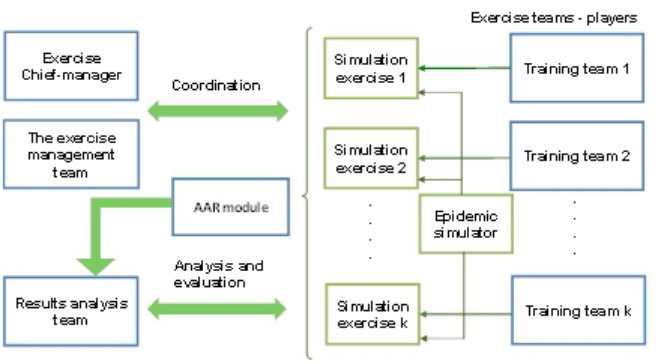
Nowadays, simulation exercises are more and more common and are orga- nized for various applications (Lateef, 2008), (Cayirci, Marincic, 2009) and (Schirlitzki, 2007). Controlled training based on computer simulation has already achieved some standardization (IEEE Std 1516 TM,2010). In the case of an epidemic of food-borne diseases, sanitary inspectors are participants in training teams. Organized simulation exercises make it possible to practice the procedures and roles used by them during the epidemic. Simulation exe- rcises should be organized to increase in complexity. Learning in a safe and managed environment provides essential hands-on experience that integra- tes key theoretical concepts with interactive, computer simulated situations. Controlled simulation-based training reduces risk as the learning environ- ments are safe, while sanitary inspectors can master the skills needed in a real-life situation. Simulation exercises organized today have a complex stru- cture. There are not only exercise teams - players, but also other groups of participants necessary to carry out this type of exercise. It is worth remembe- ring that each of the possible teams participating in the simulation exercise, including exercise preparation team, exercise management team, team for analyzing the results of exercises and system administrator (see Figure 1).
Figure 1: Structure of computer-based simulation exercises.
The paper presents business processes related to the work of sanitary servi- ces in cases of an epidemic of foodborne diseases. On their basis, simulation exercises according to given scenarios were developed. The activities of the staff of the county-level State Sanitary Inspectorate were analyzed in terms of actions taken in crisis situations related to the emergence of a large food poi- soning outbreak or an epidemic of food-borne infectious disease. The same analysis was carried out in the scope of actions performed by individual teams participating in the simulation exercises.
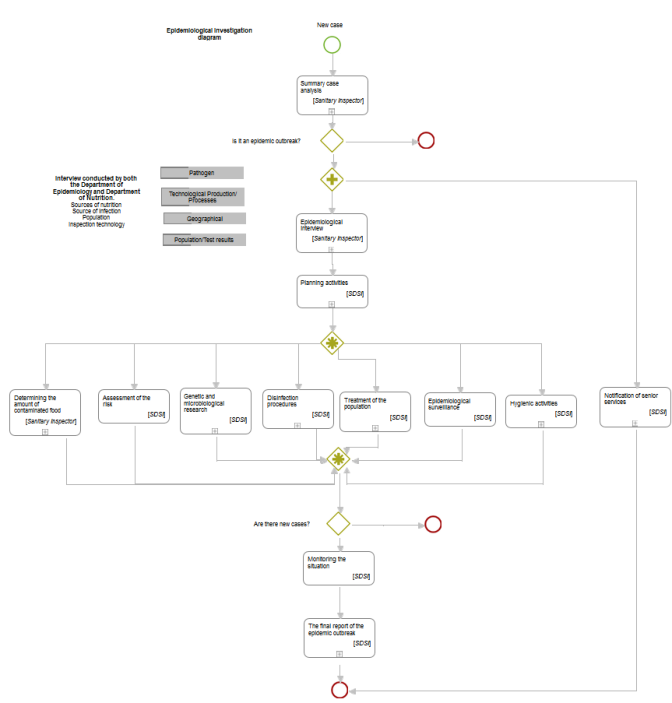
BUSINESS PROCESSES OF EPIDEMIOLOGICAL INVESTIGATION Simulation exercises for sanitary services are similar to the anti-epidemic pro- cesses carried out during an epidemic of foodborne diseases. Business process for the operation of sanitary inspectors during an epidemic of foodborne diseases specified at the highest level of detail is shown below (see Figure 2).
The epidemiological investigation in the event of an food–borne epidemic is part of the simulation exercise and improving procedures in the activities of the health supervision departments in cases of poisoning and infectious food–borne diseases support system. The process supports the planning and executing activities aimed at detecting the cause, sources, and mechanisms of the spread of food-borne diseases among people in a given area, for a fixed population and assumptions related to the occurrence of various types, essen- tial for the development of disease conditions. All cases of disease or deaths related to food-borne communicable diseases are recorded in the system and the information is based on the relevant paper forms supplied by the system. Each new case registered in the system results in verification of the number of cases - if it exceeds a critical number of cases or deaths defined for the disease. If the check is found to exceed the number of applications which is critical for the disease a new epidemiological investigation is launched. The basic activity of health services in the event of a food–borne epide- mic, is an epidemiological investigation. The diagram of an epidemiological
Designing and Implementing Simulation Exercises 173
Figure 2: Epidemiological investigation business process diagram.
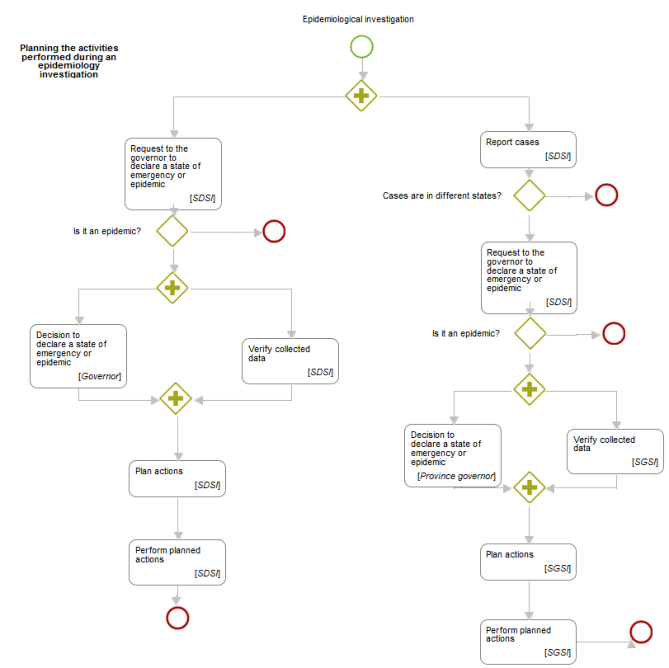
investigation business process realized in simulation exercise is shown below (see Figure 3).
SIMULATION EXERCISES The design and implementation of the simulation exercise system was cre- ated to improve the procedures of sanitary inspectors during epidemics of foodborne diseases. In other words, the exercises are designed to better pre- pare inspectors to deal with potential outbreaks of foodborne poisoning or disease.
The Method of Carrying Out Simulation Exercises Important element used in the organization of simulation exercises is constru- cted earlier simulator functioning of the organization. It is usually a discrete event-driven simulator allows for adequate reflection of the environment in which they work every day exercising teams. For activities sanitation servi- ces in the conditions of emergence and development of disease outbreaks of foodborne simulator is two-fold role by implementing:
Figure 3: Business process diagram - planning the activities performed during an epidemiology investigation.
epidemic simulation for training purposes - simulator is used as a system that simulates the rise and the spread of the epidemic (in the relevant processes can be adequately controlled through the transmission and reception of the parameters of the processes of the organization)
simulation epidemic for decision support - simulator acts as a type system DSS (decision support) during the epidemic (in the relevant processes simulator provides information on past, present and future anticipated course of the epidemic.
In the first stage of preparations, the exercise management team develops a training exercise scenario that defines the course of the simulation exerci- ses. Based on the prepared scenario of exercises, an exercise is carried out to check the professionalism of the team. During the exercise, the exercise management team coordinates and monitors its course. The exercise mana- gement team can simultaneously coordinate many simulation exercises that are performed by people exercising. After completing the exercise, the results analysis team presents the results of the exercises for all training teams and evaluates them by showing all the good and bad elements of the recorded
Designing and Implementing Simulation Exercises 175
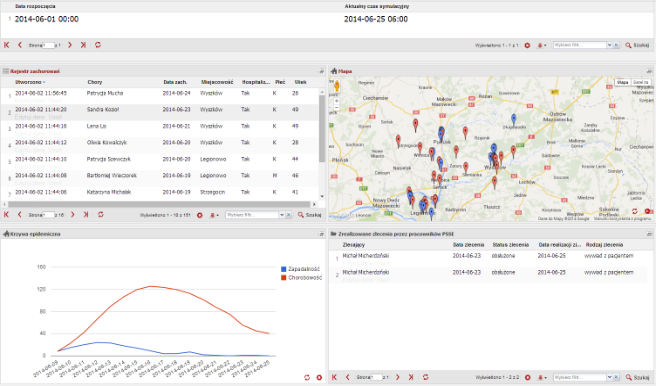
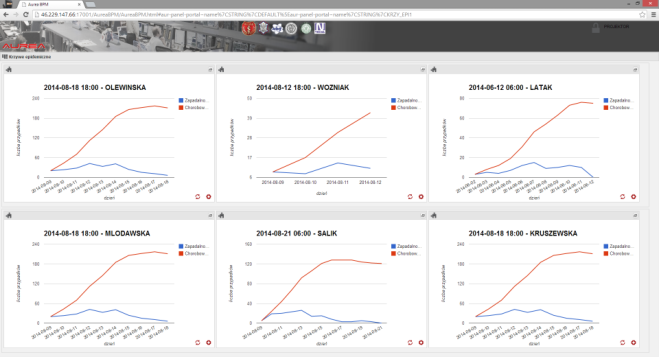
Figure 4: Key performance indicators presented in the form of various tabular reports, charts or graphs.
activities. It uses the AAR module Each practicing sanitary inspector can evaluate his own participation in the simulation exercise.
The AAR Subsystem Concept During the simulation exercises, the system supporting these exercises allows you to perform ad-hoc actions, which are also recorded in the history of the actions performed. The task of the AAR subsystem is to analyze the history of all actions, regardless of their type - whether they are actions performed as part of investigative processes or ad-hoc actions, however, performed in the context of a given epidemiological investigation, and to create a uniform, complete history of a given epidemiological investigation conducted as part of the exercises. The AAR subsystem also has the ability to add KPIs (Key Performance Indicator), which, by analyzing the status of processes, task exe- cution times, and data entered by users, report the current state of the system, allowing for a more accurate evaluation of the exercise. KPIs can be presented in the form of various tabular reports, charts or graphs (see Figure 4).
Cumulative summaries of many exercises performed by different training teams according to a set scenario are also available, allowing you to compare them and evaluate the progress of the participants (see Figure 5).
Experiences After Conducting the Simulation Exercises During each simulation step, the time shift of the corresponding interval is also simulated. By using computer simulation in the spread of the epidemic, it is possible to simulate the entire course of the epidemic in a short time. In mature simulation exercises, the AAR mechanism allows us to view and analyze the course of exercises by teams performing exercises. The analysis module with AAR at its disposal will be able to track the history of activities during the simulation step by step. The conclusions of this analysis will be
Figure 5: Cumulative summaries of many exercises performed by different training teams according to a given scenario.
used to evaluate and improve procedures and actions to combat epidemics of food poisoning and diseases. The technology used to visualize the results of the simulation exercises performed in the After Action Review module pro- vides an overview of the process simulation history also during the exercise. Individual results of simulation experiments are stored in a database constru- cted and at the user’s request simulation process is restored to any moment of an outbreak of the disease. Depending on the needs of the simulation process is repeated and simulation exercises is participants demonstrated the epide- mic and examines their actions in preventing the development of epidemics. You can also, on request, conducting exercises come back at any moment of the epidemic, and after changing some parameters of the epidemic, sani- tary service activities and decisions of the authority of these services may be carried out simulation experiment for the revised terms of development and the prevention of epidemics. Any obtained in this way results are stored in a database and can be used to illustrate the course of the epidemic of food- borne illness. At the same time these results become the basis for assessing the members of the teams participating in simulation exercises. The simulation exercise system was positively assessed by the sanitary services participating in the exercises.
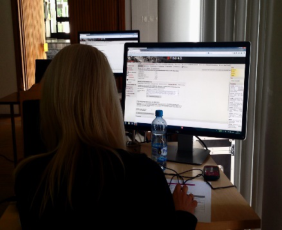
A large series of simulation exercises were conducted for sanitary inspe- ctors (see Figure 6). Various exercise scenarios were used. Each simulation exercise lasted approximately 3-4 hours.
CONCLUSIONS
A programming environment was launched and tested on the food borne dis- ease epidemic development model and the work of sanitary inspectors during the development and duration of the epidemic. The results of solved research problems that appeared in connection with the creation of a simulation envi- ronment for the organization of simulation experiments have been published
Designing and Implementing Simulation Exercises 177
Figure 6: Photo of the person taking part in simulation exercises and post-simulation analysis.
(Nowicki, 2012) and (Nowicki et al., 2014). Simulation exercises are one of the most important elements of consolidating good practices for sanitary inspectors. The organization of simulation exercises for sanitary inspecti- ons requires many years of preparation of both training teams and the team preparing the exercises. User interfaces will be characteristic of the natural working environment of sanitary inspectors. Internal interfaces between the components of the simulation exercise support system ensure good commu- nication, archiving, situational visualization and multi-variant analysis of the course of exercises.
This work was created as a part of the project PBS1/A7/6/2012 financed by Polish National Centre for Research and Development.
REFERENCES
Cayirci, E., Marincic, D., (2009). Computer Assisted Exercises and Training: A Reference Guide, John Wiley and Sons. IEEE Std 1516 TM (2010): IEEE Standard for Modeling and Simulation (M&S)
High Level Architecture (HLA) - Framework and Rules. Lateef, F. (2010). Simulation-based learning: Just like the real thing. Journal of Emergencies, Trauma, and Shock, 3(4), pp. 348–352. Nowicki T, Pytlak R., Waszkowski R., Bertrandt J., Kłos A., (2014). Formal
Models of Sanitary Inspections Teams Activities, International Conference on Food Security and Nutrition, Johannesburg, South Africa, February 10 - 11, 2014. Nowicki T. (2012), “The method for solving sanitary inspector’s logistic problem”. in: Production Management – Contemporary Approaches – Selected Aspects, Publishing House of Poznan University of Technology, Pozna´n, ISBN: 978-83-7775-189-3, pp. 23–34. Nowicki T. et al. (2016) Data flow between RFID devices in a modern restricted
access administrative office, MATEC Web of Conferences, Volume 76, DOI: DOI10.1051/matecconf/20167604004. Schirlitzki H. J. ed. (2007). Exercises – Planning and Execution in Integration of Modelling and Simulation, NATO Research and Technology Organization 2007, ISBN 978-92-837-0046-3. Waszkowski R. (2018) Multidimensional modeling and analysis of business proces-
Read this individual research paper free through the original publisher, or explore the full digital proceedings book.
ISBN 978-1-958651-12-4
Explore this ISBN in the AHFE Bookstore ↗Listed in the July 2026 bookstore catalogue; search by ISBN to confirm current availability · Digital book purchase optional