Kim-Phuong L. Vu, Panadda Marayong, Elyzza Aparicio, Chi-ah Chun, Simon Kim (2023). Use of Online Tools to Introduce Students to Research. In: Application of Emerging Technologies. AHFE Open Access, vol. 115, pp. 499–506. https://doi.org/10.54941/ahfe1004349
Engaging students in research is a high-impact practice shown to increase graduation outcomes and sustain their pursuit of careers in science, technology, engineering, and mathematics (STEM). However, research opportunities for students early in their undergraduate studies are not widely available at most colleges or for most students. To overcome this barrier, we developed three online resources designed to introduce students to what research is and direct them on how to get started with the search for research opportunities. These resources consist of (a) two introductory videos to inspire students to learn more about research, (b) online modules on a variety of topics, including getting started with research, transferable research skills, and publications and presentations, and (c) a searchable research faculty directory. We found these online resources to be an effective way to reach and engage a large number of undergraduate students who are accustomed to obtaining information on the web. These online resources can also serve as useful supplemental resources for advising staff and faculty who wish to introduce students to research.
Early exposure to research is a high-impact practice shown to increase the retention of undergraduates in STEM majors and help them attain their degrees and enter research careers (Hurtado et al., 2008; Jones et al., 2010; Kingsford et al., 2022). However, research opportunities for students early in their undergraduate studies are not widely available at most colleges or to most students. A National Survey on Student Engagement (NSSE) showed that only 5% of undergraduate students participate in research during their first year, which is much less than the 25-40% of undergraduate students that participated in research in their senior year (Buffalari et al., 2020). Some known barriers to early participation in research for undergraduates include first-year students not knowing what research is or where to begin. For exam- ple, many first-year students take introductory courses that are scheduled in large classrooms or lecture halls. This type of environment is not con- ducive for students to get to know their faculty and learn about their faculty’s research interests.
To address these barriers, the California State University Long Beach (CSULB) Building Infrastructure Leading to Diversity (BUILD) Program part- nered with the Office of Undergraduate Research Services (OURS) on campus to develop three online resources designed to help students learn about research and show them how to get started with research on campus. First, two short videos were developed that introduce students to what research is, describe how it is done across a wide range of disciplines, and provide an overview of a variety of student-centered research programs and eligibility requirements. Second, we developed three online professional development modules on topics geared toward early-career students, including (a) how to engage in research on campus, (b) benefits of participating in research via scholarly presentations and publications, and (c) transferability of research skills to non-research careers. Third, a searchable faculty research mentor directory was created as an online tool that connects students seeking fac- ulty research mentor directory who are recruiting student research assistants. Using the faculty research directory, students can find a potential mentor by searching for faculty in a particular department, program, or area using key- words that capture the students’ research interests. Students can also view the directory to explore the broad types of research being conducted by fac- ulty. Students interested in applying to specific research programs can use the directory to determine which faculty are associated with specific student programs.
In the following sections, we describe the process in which we used to develop:
Highly engaging online videos to introduce students to research and inspire them to find out more about research.
Professional development modules that provide more in-depth coverage of how to get started with research, highlight the importance of research and the opportunities research can provide, and the transferability of research skills to non-research careers.
A searchable faculty research mentor directory to highlight available faculty mentors and their research areas.
We also provide preliminary evaluation data to demonstrate the helpful- ness of the modules to all participants, especially students who are new to research. Finally, we end the paper with recommendations for other organizations interested in adopting online tools to introduce students to research.
INTRODUCTION TO RESEARCH VIDEOS As noted in the Introduction, many students are not introduced to research early in their undergraduate studies or do not know how to get started. Thus, we proposed to develop student-centered online videos to intro- duce students to research and research opportunities on campus. To ensure adoption of these online tools within our university, we engaged the key stakeholders (e.g., University Administrators, OURS Director, Direc- tors/Coordinators of various student research programs, and undergrad- uate students) in the development of content. Feedback from meetings
Use of Online Tools to Introduce Students to Research 501
with these stakeholders resulted in the following design criteria for the videos:
1) Avoid research jargon: The videos should be inviting to students who may not know what research is, apart from what they see in the media (e.g., a person in a lab coat leaning over a microscope). To encourage stu- dents to explore research and research careers, content should be written in a manner that is inviting and consistent with community/public messaging rather than with scientific jargon. 2) Represent a broad range of research disciplines: Typical characterization of research is in the traditional Science, Technology, Engineering, and Mathematics (STEM) disciplines. However, research occurs in all areas. The videos should have a broad coverage of research areas, spanning from the STEM disciplines to the Arts, Humanities, and Business. The range of research possibilities presented should invite more students to explore their own interests. 3) Be engaging: Students indicated that videos on research typically consist of a professor talking about their research projects. This type of presen- tation is neither inviting nor engaging for students new to research. The video should take advantage of the appeal of multimedia and animation to a broader audience of students to engage them in the viewing of the content. 4) Be representative of diversity: Students should be able to “see” them- selves as researchers and see other researchers that resemble their multi- faceted identities. Thus, the people or characters in the videos should be representative of different cultural, ethnic, gender, and able-bodied identities. 5) Be specific to the university: Students need to “see” themselves as part of the research community. The videos should reflect images/locations that are representative of campus and campus life. 6) Flexible usage: The videos should be in a form that can be used for various types of outreach activities (i.e., have a shorter video to play at a variety of university events and a longer one for more targeted recruitment events).
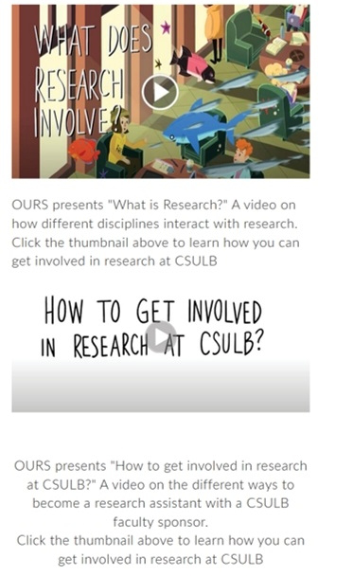
Based on the feedback received, we partnered with the students and a fac- ulty member in the Animation Program in the School of Art at CSULB to develop animated videos that introduce students to research. Specifically, a set of introductory videos were produced: What is research? and How to get involved in research at CSULB? (see Figure 1 for screen shots). These videos were developed with best instructional design practices (Brame, 2016) and animation practices: Short length to retain attention, use of visual ele- ments to highlight important information, and use of animation to maintain engagement. The following process was used to develop and refine the videos:
1) Content generation from subject-matter experts: The Director of OURS and two BUILD Principal Investigators, all of whom were experienced with directing student research programs generated the initial content for the videos by providing key points in a PowerPoint slide deck.
2) Storyboarding: The animation team took the key points from the slides and generated a narrative for the videos and mock-ups of potential visual imagery to accompany the narrative. This part was led by animation students. 3) Iterative feedback and design: The storyboards were reviewed by subject matter experts for content accuracy. Feedback on the revised content was obtained from representative undergraduate students as well as faculty and staff from campus student research programs. 4) Initial production: After multiple feedback sessions, the animation team produced the videos and revised them based on additional feedback from various stakeholders consisting of students, staff, faculty, and administrators. 5) Final production: The final What is research? video was almost 7 min- utes in length, which was deemed to be too long for use as a general recruitment tool. As a result, a shortened, 4-minute version was also pro- duced by the animation team with input from the subject matter experts. The How to get involved in research at CSULB? was 6 minutes in length.
Figure 1: Screenshot of the what is research (top) and how to get involved in research at CSULB (bottom) videos posted on the OURS website: Office of Undergraduate Research Services (OURS) | California State University, Long Beach (csulb.edu); https: //www.csulb.edu/office-of-undergraduate-research-services-ours.
Use of Online Tools to Introduce Students to Research 503
Feedback on the final version of the two videos was obtained from focus groups with undergraduate students, OURS peer advisors, and research pro- gram directors. In general, the feedback was positive, indicating that the videos were engaging to watch, covered a broad range of research disci- plines, were inclusive of diverse student identities, and served as a good online resource for introducing students to research and directing them on how to get started with research.
Both videos can be found on the main page of the OURS website. Addition- ally, when students are invited to apply to OURS programs (OURS Connects or the Undergraduate Research Opportunity program, UROP), the video link is included in their invitation letter so they can learn more about the research process at CSULB.
PROFESSIONAL DEVELOPMENT MODULES In support of student research training and professional development, the CSULB BUILD Program worked with the university’s Academic Technology Services to produce 8 online modules on the topic of applying to summer research experiences (SREs) and graduate schools. The modules were for- mally evaluated by BUILD trainees enrolled in Spring 2021 to assess trainees’ general experiences with the online modules. The BUILD trainees indicated that the modules were useful, informative, easy to access/use, good use of their time, and a good supplemental activity to their learning community activities (see Vu et al., 2021). Moreover, the trainees indicated that they preferred the online modules over in-person or synchronous lecture presen- tations because the videos can be viewed at their convenience, class meeting times can be used more for discussion of issues rather than lecture on the topics, and the videos (or parts of the videos) can be viewed as often as needed.
While the “Applying for Summer Research Experiences and Graduate Schools” modules were found to be helpful, they are intended for advanced undergraduates who are already committed to research. As such, we devel- oped three new modules that would be tailored to undergraduates exploring research. These modules are 30–60 minutes in length and include quizzes and references to resources. The topics were selected based on feedback from fac- ulty research mentors obtained from BUILD focus groups and OURS advising staff. The first module, Getting Started with Research, introduced students to research and research opportunities on campus and provided a more in- depth coverage than the 6-minute How to Get Involved in Research video described earlier. The second module, Transferable Research Skills to Other Careers, was designed to illustrate to students that research skills can be applied to many daily tasks and, as a result, provide preparation for a broad range of career paths. The goal of this module is to let students know that research skills are an important part of critical thinking and that these skills can be applied to non-research careers if students decide to go on a different career path. The third module on Publication and Presentation Opportunities introduces students to the different types of publications and presentations. It also highlights some of the benefits of conducting research and encourages students to seek opportunities to disseminate their scholarly work.
To develop these three introductory modules, subject matter experts worked with instructional designers to develop the content and media for the videos. An iterative design process was used that composed of:
1. A “kick-off” meeting: This meeting allowed the various individuals working on the video to determine what would be involved in the creation of the content and video. 2. Content development: The subject matter expert provided the con- tent for the module, which included a script (narrative for the videos), PowerPoint slides with key points. 3. Storyboards and mock-ups: The instructional designer provided a sto- ryboard that mapped the narrative to visual concepts (key points dis- played and relevant graphics). Mock-up displays were also provided that included choices for graphical assets (some of which had to be purchased) to be used in the final video. 4. Video recording: The modules contained video-recorded introductions by the subject-matter experts and voice-over visuals. 5. Completion of video production: The designers provided full draft videos that were edited over 2–3 iterations.
These three new modules, along with the original ones developed for applying to summer research experiences and graduate schools, were made available in Fall 2022 to students who enrolled in the Research Certificate Program offered by OURS. Based on the pilot survey conducted in Spring 2023, students in the OURS Research Certificate Program (n = 21) reported agreement in their satisfaction of the quality of the professional development modules (M = 3.86, sd = 0.96) and found the modules beneficial (M = 3.90, sd = 1.00). A 5-point Likert scale was used where 1 = Strongly disagree, 3 = Neutral, and 5 = Strongly agree. Students indicated in their qualitative responses that they had mixed feelings about the modules. Some students indicated that the modules were very helpful, but others indicated that the number of modules available to be intimidating and time-consuming to work through.
RESEARCH MENTOR DIRECTORY To make faculty research mentors more accessible to students, we initially created a mentor database with a selected number of faculty who were research mentors for the BUILD program. The database was created as a searchable table hosted on the BUILD program website. Each BUILD faculty profile included their name, picture, affiliation, contact information (email address and research website), research keywords, and availability of research assistant positions for prospective students. Prospective students could search for potential faculty research mentors through various filters (implemented as selection boxes), such as department, research keywords, and types of research (e.g., applied, qualitative). The database was maintained by a BUILD staff. Faculty mentors could update their personal profile by submitting a request to the program staff.
Use of Online Tools to Introduce Students to Research 505
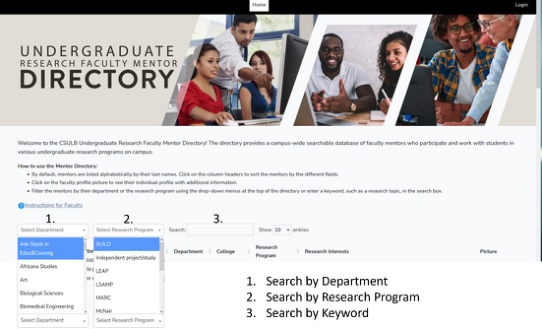
As part of our institutionalization efforts with OURS, we transferred this database and worked with our campus Information Technology Services to create a campus-wide faculty mentor directory that provides students with information about faculty research opportunities across a broader range of disciplines and undergraduate research programs in addition to BUILD. The new directory (see Figure 2 for a screenshot) is hosted on the OURS website for use by any CSULB student and faculty. The searchable items are more simplified than the BUILD mentor directory to keep the directory more user- friendly for campus-wide users across all academic disciplines and easier to maintain by OURS staff. The directory is linked to the university employee database from which the faculty member’s affiliation (department and col- lege) and contact information (name and email) are imported and updated automatically. Each faculty profile includes additional information, such as picture, research keywords, research website, research program participation, and completion status of relevant faculty mentor training (e.g., Advancing Inclusive Mentoring or Beach Mentor Program, see Young et al., 2022). For our campus, having the Beach Mentor Program completion status in the fac- ulty profile signals to students that the faculty member has engaged in about 10 hours of mentor training. An improved feature of this directory is that the faculty mentors can directly update their research descriptions in their profiles by logging on to the site using their university credentials. The new directory allows students to connect with prospective research mentors across all disciplines to begin their research journey and was streamlined to minimize maintenance effort.
Figure 2: Mentor directory home page where students can search for a faculty mentor by (1) department, (2) research program (3) keyword (i.e., research area). https://cws. csulb.edu/mentor/.
CONCLUSION
Overall, we found that the use of online videos and resources to introduce students to research to be effective tools. These tools allow students to access the materials at their convenience (any time, any place and with any device). Students can also view the material at their own pace and as often as needed.
However, simply employing these tools without providing human resources, such as peer mentors or staff/faculty advisors, can be overwhelming to stu- dents new to the research endeavour. Thus, we recommend that for maximum benefit, online resources are scaffolded with appropriate levels of peer or professional support.
ACKNOWLEDGMENT
We thank Beom Sik Shim, Benjamin Lin, and Justine Prebich from the CSULB Animation Program for their work on the introduction to research videos. We also thank Mark Lim, Francisco Romero, Preston Wingrove, and the CSULB Academic Technology Services (ATS) team for their work on the professional development modules. This research was supported in part by the National Institute of General Medical Sciences of the National Institutes of Health under Award Numbers; UL1GM118979; TL4GM118980; RL5GM118978. The content is solely the responsibility of the authors and does not necessarily represent the official views of the National Institutes of Health.
REFERENCES
Buffalari, D., Fernandes, J. J., Chase, L., Lom, B., McMurray, M. S., Morrison, M. E., & Stavnezer, A. J. (2020). Integrating research into the undergraduate cur- riculum: 1. Early research experiences and training. Journal of Undergraduate Neuroscience Education, 19(1), A52. Hurtado, S., Eagan, M. K., Cabrera, N. L., Lin, M. H., Park, J., & Lopez, M. (2008).
Training future scientists: Predicting first-year minority student participation in health science research. Research in Higher Education, 49(2), 126–152. Jones, M. T., Barlow, Amy E. L., & Villarejo, M. (2010). Importance of undergraduate research for minority persistence and achievement in biology. The Journal of Higher Education, 81(1), 82–115. Kingsford, L., Mendoza, R., Dillon, J., Chun, C.-A., & Vu, K.-P. L. (2022). Broaden-
ing and diversifying the behavioral and biomedical research workforce through early access to an undergraduate research training program. Understanding Interventions, 13(2), 1–24. Vu, K.-P. L., Chun, C.-A., Chin Goosby, K., Cho, Y-H., Dillon, J., & Marayong P.
(2021). Preparing undergraduate students for summer research experiences and graduate school applications in a pandemic environment: development and imple- mentation of online modules. In: Yamamoto S., Mori H. (eds) human interface and the management of information. information-rich and intelligent environments. HCII 2021. Lecture notes in computer science, vol. 12766, 156–176. Springer, Cham. Young, K. A., Marayong, P., & Vu, K.-P. L. (2022). Advancing inclusive mentoring: Faculty mentor training at a diverse R2 university changes mentoring practices and increases mentoring skill confidence. Journal on Excellence in College Teaching, 33(4), 105–132.
LISTED IN THE AHFE DIGITAL BOOKSTORE CATALOGUE
Explore the complete digital volume
Application of Emerging Technologies
Read this individual research paper free through the original publisher, or explore the full digital proceedings book.
ISBN 978-1-958651-91-9
Explore this ISBN in the AHFE Bookstore ↗Listed in the July 2026 bookstore catalogue; search by ISBN to confirm current availability · Digital book purchase optional