Taiki Matsunaga, Ryunosuke Fukada, Kimi Ueda, Hirotake Ishii, Hiroshi Shimoda (2024). Proposal of Color Queue Creation Task for Automatic Divergent Thinking Evaluation. In: Creativity, Innovation and Entrepreneurship. AHFE Open Access, vol. 125, pp. 43–50. https://doi.org/10.54941/ahfe1004719
In recent years, with the advent of the information society, creativity is becoming more and more important, and divergent thinking is becoming more and more important. The Alternative Uses Test (AUT) is the most used test for evaluating divergent thinking. However, its result is affected by difference in native languages, since the evaluation is dependent on a person who evaluates. Therefore, the purpose of this study is to devise a new task to evaluate divergent thinking that solves on the problems of the AUT. This task focuses on the evaluation of flexibility which is evaluated by how much varieties of color sequence are in a color queue consisting of 100 color sequence. This is devised as a non-verbal task and expected to avoid the influence of language differences. An experiment was conducted to see if flexibility was affected by cognitive load as assessed by the created task. The results suggested the possibility that the effect of cognitive load on flexibility can be evaluated.
With the advent of the advanced information society, the value of intellec- tual output has increased, and creative thinking has become more important. Guilford roughly classified creative thinking into two broad categories: diver- gent thinking, which generates a wide variety of ideas from a single concept or idea, and convergent thinking, which narrows down a wide variety of ideas into a single idea (Guilford, 1967). The divergent thinking test, which is based on theories of association and the SOI model by Guilford, is the most used test to measure creative thinking (Mark and Steven, 2011). The Alter- native Uses Test (AUT) is an example of a divergent thinking test in which examinees respond with ideas for different uses of a familiar object and are evaluated based on the number of responses and the content of those ideas (Guilford, 1967). However, there are several problems with the AUT. Since the evaluation of responses is manual, it may be biased depending on the evaluator, leading to higher costs in personnel and time. In addition, its result is affected by difference in their native languages. It is supposed that diver- gent thinking could be automatically measured from a color queue consisting
of color sequence generated by a user. Therefore, the purpose of this study is to devise a task to evaluate divergent thinking and to propose an evaluation index based on the solving of the problems of AUT and task ideas described above. We also aim to demonstrate the validity of the developed task by using the results of a previous study in which divergent thinking was affected when cognitive load was applied. There are three typical indicators of divergent thinking: fluency, flexibility and originality (John, 2016). In this research, we propose a task that focuses on flexibility (Torrance, 1988) to measure the quality of ideas.
DIVERGENT THINKING EVALUATION TASK The basic idea, flexibility index and interface used in devising a divergent thinking evaluation task will be described here.
Basic Idea of New Task In developing the task, the policy is to use a computer to answer the questions, to allow automatic evaluation to improve human subjective evaluation, and to be non-verbal so as not to be affected by differences in language. Users are asked to create a color queue consisting of 100 color sequence, and the flex- ibility of divergent thinking is evaluated based on the color queue. Young suggested that ideation is thinking of a new combination or generating it by combining existing ideas (Young, 2003). It has also been suggested that randomness within humans is important for generating novel ideas (Sonia, 2001). Therefore, it is thought that the greater the ability to explore from a variety of existing ideas without repeatedly using the same combinations, the greater the flexibility. In addition, Bains mentioned that the ability to gen- erate strings with more random sequences may be related to creative ability (Bains, 2008). Therefore, a person with high flexibility is expected to show more random color sequences without regularity in color queue, while a per- son with low flexibility is expected to show similar color sequences more frequently. The task is designed based on the above policies and ideas.
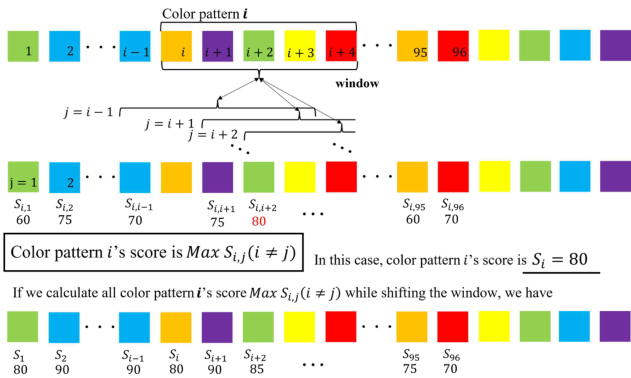
Flexibility Index A color pattern is a sequence of five colors obtained by shifting one window of size 5 from a color queue consisting of 100 color sequence. Since the win- dow size is 5, there are 96 color patterns in a color queue. For a given color pattern i, we calculate the similarity to the remaining 95 color patterns to find if there is a similar color pattern. Therefore, we first explain how to calculate the similarity between two color patterns. The CIEDE2000 color difference formula is used because of the need to express color distance (Luo et al., 2001). This formula can be used to express numerically the distance between colors as perceived by humans. The value range is between 0 and 100, with larger values indicating greater color distance. This formula is applied to two color patterns i and j, each with the same order, to obtain the color differ- ence between them, and the similarity is evaluated by finding the average of the five color differences as shown in Figure 1. The equation for similarity is shown below.
Equation reproduced from the original PDF.
Proposal of Color Queue Creation Task for Automatic Divergent Thinking Evaluation 45
Figure 1: How to calculate similarity between color pattern i and j.
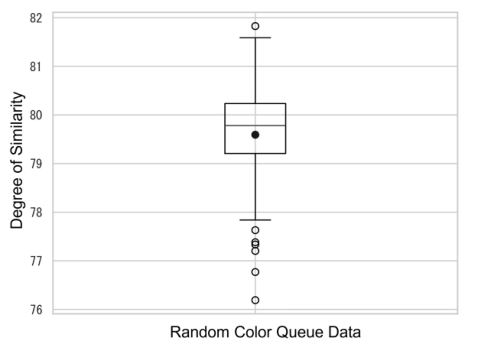
For Eq. (1), Si,j is the similarity between color pattern i and j, µ is the aver- age of the five color differences. The similarity between a color pattern i and the other color patterns in the color queue selected by the respondent is cal- culated, and the highest value of the similarity with the other color patterns is color pattern i’s score, Si. If Si is small, it means that color pattern i is more different from other color patterns in the color queue. Using the above calcu- lation method, we obtain all color pattern’s score Si(1 ≤i ≤96) as shown in Figure 2. The flexibility is evaluated based on the number of color patterns with scores below a predetermined threshold, that is, flexibility is evaluated by the total number of dissimilar color patterns in the created color queue. We describe the setting of the threshold value. For a given color queue con- sisting of 100 random color sequence, all color pattern’s score Si(1 ≤i ≤96) are calculated, and the average value S is calculated. The above opera- tions are performed on 100 color queues consisting of 100 random color sequence. The results are shown as boxplot as shown in Figure 3. S is between 76 and 82, of where the average value, 79.5, is adopted as the threshold value.
Figure 2: How to calculate color pattern i’s score.Figure 3: Similarity results for 100 random color queue data.
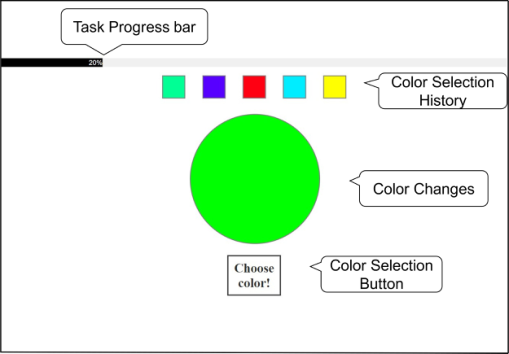
Color Queue Creation Task In the following, this task is referred to as the Color Queue Creation Task (CQCT). CQCT was designed to be performed using a tablet device (iPad) as shown in Figure 4. The color can be changed by swiping the corresponding area with a finger. It is designed to change color according to the direction and distance of fingertip movement. The color can be selected by tapping the color selection button. The color selection history at the top of the screen shows the last color pattern. Flexibility in this test is the ability to create many dissimilar color patterns in the color queue. The respondents are asked to select a color so that a color pattern similar to the one shown in the history does not reappear. They select colors using the user interface while satisfying the above requirements. The task progress bar shows the current progress of the task as a percentage.
Figure 4: User interface for color queue creation task (CQCT).
Proposal of Color Queue Creation Task for Automatic Divergent Thinking Evaluation 47
EXPERIMENT FOR VALIDATION OF CQCT Purpose
Previous studies have reported that the flexibility of divergent thinking was reduced when cognitive load was applied compared to when cognitive load was not applied (Rodet, 2022). Based on these results, the following hypothesis was formulated.
Hypothesis: For the CQCT, flexibility of divergent thinking in the cogni- tive load condition is lower than in the no condition.
If this hypothesis is proven by the experiment using the CQCT, it suggests that the CQCT is useful as a divergent thinking test.
Method
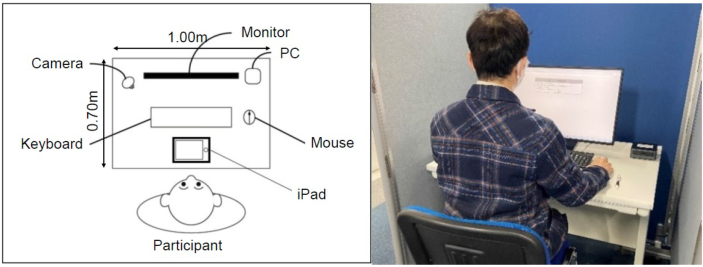
In this experiment, two cognitive load conditions were used: number mem- orization and time pressure. In the number memorization condition, partic- ipants were asked to memorize seven-digit numbers during the task and to answer the seven-digit numbers after the task was completed. In the time pres- sure condition, participants had to select a color within three seconds every time. After the experiment, they were asked in a questionnaire whether they experienced cognitive load in two cognitive load conditions. Eight partici- pants were undergraduate and graduate students enrolled at Kyoto University who were at least 18 years old. Regarding tablet devices, we used Apple 10.2-inch iPad (Wi-Fi, 64GB) Space Gray. We obtained approval from the Institutional Ethics Committee of Graduate School of Energy Sciences, Kyoto University. Figure 5 shows the experimental procedure. In the practice task, they were asked to generate color queue consisting of 30 color sequence. SET1 had no condition. In SET1, they just performed the CQCT (control condition). In SET2 through SET4, CQCT was performed under each condi- tion (number memorization condition, time pressure condition, and control condition). SET2 through SET4 were used for the analysis. A one-minute break was given between SETs. About the experimental environment during the experiment as shown in Figure 6, the camera was placed in front of the participants to observe them, the monitor was used to explain the experiment through zoom, and the mouse and keyboard were used to communicate with the experimenter through zoom.
Figure 5: Experimental protocol.
Figure available in the original PDF paper.
Figure 6: Experimental environment of the participants during the experiment.
Result and Discussion
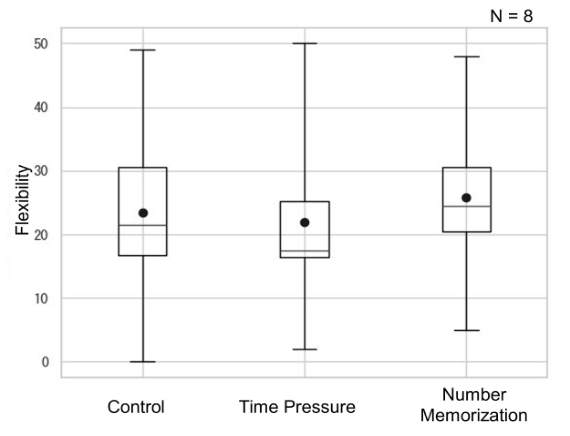
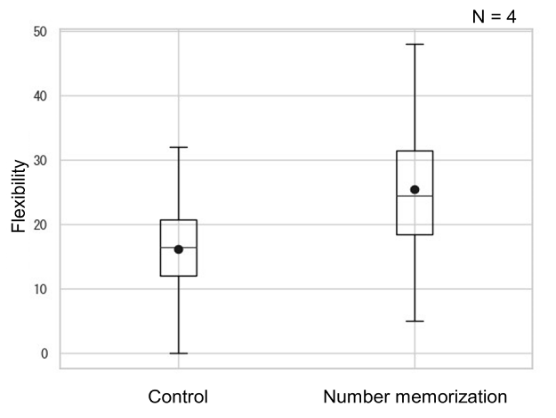
The flexibility results for each experimental condition are represented as a boxplot as shown in Figure 7. Table 1 shows effect size. We used Cohen’s d as the effect size (Cohen, 1988). In the number memorization condition, four out of the eight participants responded that they felt cognitive load. Figure 8 shows the results for those four participants as a boxplot. Flexibility was improved in the number memorization condition compared to the no con- dition, with an effect size of 0.25 as shown in Table 1. On the other hand, flexibility decreased in the time pressure condition compared to the control condition, with an effect size 0.14 as shown in Table 1. Flexibility in num- ber memorization condition was higher compared to control condition. This result is opposite to the hypothesis. However, the reliability of this result is low due to the small sample size. About the mean M and variance S2 of the flexibility of the four respondents who reported that they felt cognitive load in the number memorization condition, M equals 25.5 and S2 equals 2.33 × 10² in the number memorization condition, and M equals 16.25 and S2 equals 1.28 × 10² in the control condition. Regarding mean M, flexibility was about 1.57 times higher in the number memorization condition than in the control condition. Since the sample size was 4, the variance was large, and therefore, it is necessary to increase the sample size for further analysis. Con- trary to the hypothesis, these results indicate that flexibility decreased. There- fore, it is suggested that flexibility in the AUT and flexibility in the CQCT are different indices. As a consideration, since the AUT is a verbal test and is evaluated based on the ideas that are answered, the cognitive load inhibits the generation of ideas and reduces flexibility, while the CQCT is evaluated based on color sequences generated without any regularity, so the cognitive load may not inhibit color selection. However, for CQCT, since we evalu- ate color queue created without regularity, it is possible that cognitive load does not inhibit creating color queue. Alternatively, the cognitive load may have allowed the creation of color queue without regularity by eliminating extraneous thoughts.
Proposal of Color Queue Creation Task for Automatic Divergent Thinking Evaluation 49
Figure 7: Flexibility results for each condition.Figure 8: Flexibility results for those who answered there was cognitive load in number memorization condition.Table 1. Difference in mean values of flexibility in each condition and effect size (Cohen’s d) with and without cognitive load conditions.
Table available in the original PDF paper.
Control Number Memorization
Time Pressure Means of flexibility 23.38 25.75 22.00 Effect size (Cohen’s d) with control -- 0.25 0.14
CONCLUSION
The divergent thinking test proposed in this study, which can be automati- cally evaluated, was not validated in this experiment. However, since it was confirmed that cognitive load affected the proposed flexibility index. In the future studies, we need to conduct an experiment to see how cognitive load affects flexibility by increasing the data size and conducting experiments on CQCT with experimental conditions that do not involve cognitive load and investigate the relationship between CQCT we proposed and the existing test, AUT.
REFERENCES
Cohen, J. (1988). Statistical Power Analysis for the Behavioral Sciences (2nd ed.).
Routledge. Cortney S. Rodet. (2022). Does cognitive load affect creativity? An experiment using a divergent thinking task. Economics Letters, Volume 220. Guilford J. P. (1967). The nature of human intelligence. New York, McGraw-Hill. John Baer (2016). Domain Specificity of Creativity. Academic Press. M. R. Luo, G. Cui, B. Rigg. (2001). The Development of the CIE 2000 Colour-
Difference Formula: CIEDE2000. COLOR research and application, volume 26, pp. 340–350. Mark A. Runco., Steven R. Pritzker. (2011). Encyclopedia of Creativity. Academic Press. Sonia Sequeira. (2001). Randomness and creativity. Trends in Neurosciences, Volume
24, p. 694. Torrance E. P. (1988). The nature of creativity as manifest in its testing. The Nature of Creativity. William Bains. (2008). Random number generation and creativity. Medical Hypothe-
ses, Volume 70, Issue 1, pp. 186–190. Young, James Webb. (2003). A technique for producing ideas. McGraw-Hill.
LISTED IN THE AHFE DIGITAL BOOKSTORE CATALOGUE
Explore the complete digital volume
Creativity, Innovation and Entrepreneurship
Read this individual research paper free through the original publisher, or explore the full digital proceedings book.
ISBN 978-1-964867-01-4
Explore this ISBN in the AHFE Bookstore ↗Listed in the July 2026 bookstore catalogue; search by ISBN to confirm current availability · Digital book purchase optional