Yuan-cheng Liu, Nikol Figalová, Jürgen Pichen, Philipp Hock, Martin Baumann, Klaus Bengler (2023). Workload Assessment of Human-Machine Interface: A Simulator Study with Psychophysiological Measures. In: Human Systems Engineering and Design (IHSED 2023): Future Trends and Applications. AHFE Open Access, vol. 112, pp. 546–555. https://doi.org/10.54941/ahfe1004172
Human-machine Interface (HMI) is critical for safety during automated driving, as it serves as the only media between the automated system and human users. To guarantee an understandable and transparent HMI, an evaluation method is urgently needed. However, there hasn't been a standardized and objective assessment method for HMI transparency. The methods used to evaluate HMI nowadays are primarily subjective and not efficient. To bridge the gap, an objective and standardized HMI assessment method was proposed in a previous study, but the adaptation to a simulator environment was not validated. Hence, the objective of this study is to first identify suitable objective workload measures in a driving context before incorporating them into the proposed transparency assessment method. In this study, two psychophysiological measures, electrocardiography (ECG) and electrodermal activity (EDA) were evaluated for their effectiveness in finding differences in mental workload among different HMI designs in a driving simulator. Three HMI designs with different transparency were developed and used as independent variables. Besides the root mean square of successive differences (RMSSD) between normal heartbeats from the ECG and the skin conductance response (SCR) from the EDA, self-reported NASA-TLX scores were also evaluated and considered as dependent variables. The study was conducted in a static driving simulator with a field of view of 120 degrees. A total of 24 participants were recruited, and each experienced 12 trials counterbalanced for HMI designs and driving scenarios. Participants were asked to monitor the HMI constantly and activate SAE Level 2 automated driving system whenever they felt comfortable. During the interaction, the eye tracker was applied to identify the time points when participants were gazing at the HMI designs. These time points were later used as references to calculate the corresponding RMSSD and SCR. Results showed that the RMSSD from ECG and the SCR from EDA were able to identify significant differences in objective mental workload when interacting with in-vehicle HMIs. Plus, the same correlations among HMI designs for two psychophysiological measures and the NASA-TLX were also identified. To the best of our knowledge, this study is the first to use psychophysiological measures to estimate the mental workload when interacting with HMI during automated driving. The results of this study could be used as a firm ground for future research. The findings not only help identify suitable objective workload measures for the interaction with HMI during simulator driving but also serve as the first step toward a standardized transparency assessment method.
Human-machine Interface (HMI) of Automated Driving Systems (ADS) is a critical component that aims to facilitate an intuitive way for humans to interact with automation (Bengler et al. 2020). However, depending on the level of automation, the roles and responsibilities of human users may be constantly changing. Thus, the design of the HMI plays a crucial part in enabling a safe and efficient transition between the roles by providing critical and understandable information and making the automated system transparent.
When evaluating HMIs, existing methods are mostly based on subjective questionnaires (Richardson et al. 2018; Voinescu et al. 2020), making them prone to biases and difficult to standardize. To resolve the problem, we proposed the Transparency Assessment Method (TRASS) in a previous study (Liu, Figalová, and Bengler 2022), where the transparency toward the HMI is estimated by evaluating the actual understanding and the workload of the user during the interaction. To further apply the TRASS in a dynamic environment (e.g., in simulator or test track studies), the workload estimation method must be adapted.
Workload Assessment of Human-Machine Interface: A Simulator Study with Psychophysiological Measures 547
Multidisciplinary approaches have been used to measure workload in driving scenarios (Stapel, Mullakkal-Babu, and Happee 2019; Kim et al. 2018; Lim, Sourina, and Wang 2018; Matthews et al. 2019). Subjective mental workload measures like NASA-TLX are easy to assess and come directly from participants. However, these subjective mental workload assessment methods alone are usually inaccurate and unable to operate in real-time. On the other hand, psychophysiological measures enable a more objective and continuous assessment of the mental workload. With the non-intrusive sensors, the experimental process becomes more efficient, and the resulting measurements are also more reliable.
In this paper, we present a simulator study where electrocardiography (ECG) and electrodermal activity (EDA) are used to estimate the objective workload of participants when interacting with AV HMIs. The aim of this paper is to evaluate the effectiveness of these psychophysiological measures in finding differences in mental workload when interacting with different HMI designs in simulated driving. To the best of our knowledge, this is the first study that applies these two psychophysiological measures to estimate the mental workload of different AV HMIs. The main novel contribution of this paper is that the results of these real- time and objective workload measures could be further applied for researches in high-fidelity AV environments and HMI design and evaluation processes.
RELATED WORKS Psychophysiological measures have been widely adopted in the driving context to assess many psychological constructs, such as workload and stress, owing to their sensitivity and accuracy in detecting mental workload (Meng, Zheng, and Huang 2022; Lohani, Payne, and Strayer 2019). Besides, they can also capture dynamic changes in workload that might be difficult to detect with subjective or behavior measures (Charles and Nixon 2019). In this study, we use ECG and EDA for their reliability in short task duration and sensitivity in continuous mental workload detection (Baek et al. 2015; Yoshida et al. 2014).
Electrocardiography Electrocardiography (ECG) is a method commonly used to capture the electrical activity of the heart. From a series of heart beat waves, heart rate (HR) and heart rate variability (HRV) could be calculated, analyzed, and used to estimate mental workload (Heine et al. 2017; Shakouri et al. 2018). HR was found to increase with the increase in the mental workload, while the HRV decreased.
Heart period (R-R interval) could be derived from the time intervals between heart beats (R peaks). By converting the heart period (usually in milliseconds), we could obtain the heart rate (usually in beats per minute). On the other hand, HRV metrics are more versatile and could be categorized into frequency domain and time domain. In the frequency domain, methods such as low-frequency (LF) power, high-frequency (HF) power, or LF/HF ratio are often used (Alaimo et al. 2020). While in the time domain, the standard deviation of R-R intervals (SDRR) and root mean square of successive differences between normal heartbeats (RMSSD) are widely adopted. However, literature shows that the RMSSD is one of the most robust workload measurements, which is also reliable in ultra-short-
term analysis (measurement duration less than 5 mins) (Shaffer and Ginsberg 2017; Baek et al. 2015).
Electrodermal Activity Electrodermal activity (EDA) reflects changes in the electrical potential of the skin. It has been commonly used as an objective workload indicator in simulators and real driving studies (Yoshida et al. 2014; Daviaux et al. 2020). Two components are usually derived from the EDA signals, which are tonic and phasic. The tonic component is the slowly changing in the electrical conductivity level, also known as skin conductance level (SCL). In comparison, the phasic component describes the event-related change that increases the magnitude of electrical conductance, also called skin conductance response (SCR). Both SCL and SCR are found sensitive to changes in mental workload. SCL was found to increase with the higher workload during real-driving scenarios (Mehler and Reimer 2019), while higher SCR values were found with higher mental demands (Foy and Chapman 2018).
METHODOLOGY
Participants Twenty-four participants were recruited for this study, where eight were male, 15 were female, and one was diverse. The ages ranged from 22 to 30, with mean age = 27.92, 𝑆𝐷= 4.34. All of the participants came with valid driving licenses, and they had held them for at least three years (𝑀= 8.03, 𝑆𝐷= 3.78)
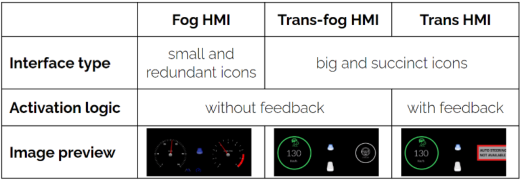
Human-machine Interface Designs Three different SAE Level 2 HMI designs were developed and applied in the driving simulator, as shown in Figure 1. Following the design principles for human-computer interface and results from the previous study (Liu, Figalová, and Bengler 2022), we developed these three in-vehicle HMIs that are distinct in transparency and workload required to understand. The Fog HMI design should require the highest amount of mental workload during the interaction, owing to its small icons, low contrast color, and the fact that there would be no feedback when the system fails to activate. In contrast, the Trans HMI provide clear graphical designs, with big and high contrast icon and feedback information when necessary, hence should provide participants with the highest transparency and relatively low mental workload during the automated driving. The last HMI design is the Trans- fog HMI, which shares the same visual clarity as the Trans HMI but has no feedback information, similar to the Fog HMI.
Figure 1: Illustration of HMI designs used in the driving simulator.
Workload Assessment of Human-Machine Interface: A Simulator Study with Psychophysiological Measures 549
In the previous study, these three HMI designs show significant differences in subjective workload measured (NASA-TLX). The same approach would also be included in this study as a reference to the previous one and others in the literature.
Psychophysiological Measures The ECG electrodes were placed in the common Lead II Configuration, while the EDA electrodes were mounted on the left foot to minimize the noise from the hand and right foot movement during driving. Usually, the EDA electrodes are placed on palmar sites or fingers, but foot placement is recommended when palmar sites or fingers are not available or suitable for placing EDA electrodes (Hossain et al. 2022). All electrodes are connected to a wireless trigger for LiveAmp, and the continuous signals were recorded and saved on a remote device throughout the experiment. The data were recorded with a 500 Hz sampling frequency and preprocessed in the Matlab version R2022a.
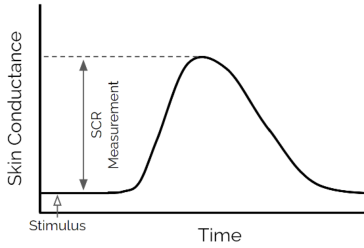
Figure 2: Illustration of the raw ECG signal and processed R-R interval (left) and skin conductance response (right).
Heart Rate Variability (HRV) In this study, we use the root mean square of successive differences between normal heartbeats (RMSSD) as the metric among the time domain heart rate variability (HRV) for its robustness and sensitivity in ultra-short-term workload measurement. To obtain the RMSSD, we first need to calculate the time differences between consecutive heart beats (or between R peaks). Then, average the squared values of those time differences. Finally, we take the square root of the average obtained and have the RMSSD over the designated duration. Before the RMSSD calculation, the raw ECG signal was filtered and differentiated for clearer R-R intervals, as shown in Figure 2. Ten seconds before and after the activation of the Level 2 ADS were used as an epoch representing the interaction period between the participant and the HMI design. During this time, participants were required to monitor the HMI closely to answer the following question when the driving simulator was paused or stopped.
Skin Conductance Response (SCR) In this study, we intend to capture the rise of skin conductance with the EDA signal. As the cognitive load rises, so does the skin conductance value, and this change in EDA is the skin conductance response (SCR). After the initial stimulus, there is usually a 2-5 seconds delay before the skin conductance begins to rise (see Figure
2). After the rising phase, the skin conductance value reaches the peak and begins to descend. This difference in skin conductance value between the initial stimulus and the peak after the delay is the SCR magnitude. We collected a 10 seconds epoch after the activation of the Level 2 ADS (stimulus) and calculated the corresponding SCR values.
Self-reported Workload Measures Two subjective workload measurements were included in this study. The first one is the National Aeronautics and Space Administration-Task Load Index (NASA- TLX) (Hart and Staveland 1988), which is a six-item questionnaire. The average across the six workload related factors was calculated without the weighted parameter. The second subjective workload measurement was derived from the previous study (Liu, Figalová, and Bengler 2022), where participants were asked to evaluate whether they agreed they could understand and obtain critical information from the HMI design. They were asked if they agreed that the HMI design was easy to understand. All three questions were scaled from 0 to 100.
Procedure
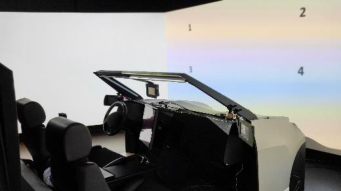
Figure 3: Illustration of the driving simulator setup and experimental procedure.
The study was conducted in a static driving simulator with a field of view of 120∘, as illustrated in Figure 3. The front panel consists of three screens with the scenes projected from three projectors respectively. It also has rear, left, and right mirrors, which are small LCD displays. The software SILAB was used to create the 4-lanes highway scenario. A touch screen was fixed on the right-hand side of the driver’s seat, where automated cruise control (ACC) and L2 automation activation buttons were shown.
When participants arrived, we welcomed them and provided a brief study overview. A pre-recorded video containing detailed instructions was played to ensure all participants received the same information. Afterward, participants were asked to fill in a demographic questionnaire. In the meantime, experimenters set up the ECG and EDA electrodes and ensured signals from the amplifier were normal. Participants were then brought to the driving simulator and started a familiarization test drive. During the test drive, the baseline ECG and EDA data were also collected. After the familiarization, the formal test would begin if no symptoms of simulator sickness were shown.
The experimental procedure of this study is shown in Figure 3. In each trial, one of the three HMI designs was applied randomly, and two surveys were presented to the participants at different stages. Both surveys consisted of a NASA-TLX questionnaire and a subjective transparency test and would later be used to
Workload Assessment of Human-Machine Interface: A Simulator Study with Psychophysiological Measures 551
compare to the psychophysiological measures. The first and second surveys were used to estimate the subjective workload the HMI design required when the ACC was activated, and when the Level 2 (L2) ADS was activated. respectively. In each trial, participants were asked to start the vehicle and drive from the shoulder to the right lane on the highway. Meanwhile, they could activate the ACC function on the panel right to the steering wheel whenever they felt comfortable. At the moment the ACC button was pressed, the ADS began the longitudinal control, followed by a five seconds countdown before the simulator went into a pause. When the simulator was paused, all the screens dimmed and the sound effects volume lowered in a fade-away pattern to avoid simulator sick. Then, participants were asked to complete the first survey and inform the experimenter when they finished. After the first survey, the simulation resumed, and participants were asked to activate the L2 ADS whenever they felt comfortable. Five deconds after the L2 button was pressed, the simulation stopped (also in a fade-away pattern), and the second survey was presented and asked to complete carefully. Participants had to go through all three HMI designs in a counterbalanced order, where for each HMI design there would be four different traffic layouts, making a total of 12 trials for each participant. The ECG and EDA signal was recorded throughout the study. Finally, participants were compensated at the end of the study after the feedback section about the procedure, questionnaires, and HMI designs.
RESULTS
In this study, we attempted to determine if different HMI designs would significantly affect the mental workload assessed with psychophysiological measures. However, self-reported workload measures were also used as a reference to the previous work and also to future studies. Repeated measure ANOVA was used to test the significance of the differences in ECG, EDA, NASA-TLX, and subjective transparency data. Multiple comparisons with Holm’s correction were made if necessary.
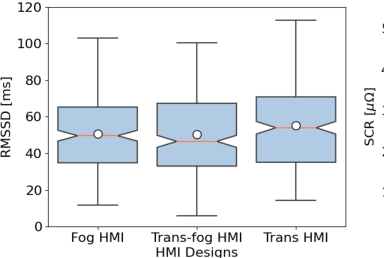
Psychophysiological Measures We can see from Figure 4 that the same correlation in mental workload among HMI designs is shown, where the Trans HMI demanded the lowest workload during the interaction, followed by the Trans-fog HMI, and lastly, the Fog HMI. The time domain HRV, RMSSD, were found to be significantly different among those three HMI designs 𝐹(2,522) = 7.25, 𝑝< 0.001, 𝜂𝑝2 = 0.027, where the Trans HMI had the highest RMSSD, representing that it demanded the lowest cognitive load during the interaction. A similar outcome was found on the SCR values, where the effect of HMI designs was also found to be significant 𝐹(2,522) = 3.372, 𝑝= 0.035, 𝜂𝑝2 = 0.013, and that the Trans HMI had the lowest SCR, which again confirm the finding that the Trans HMI demand the lowest cognitive load when interacting with the ADS.
As detailed in the Table. 1., post hoc comparisons were conducted for both psychophysiological measures. The RMSSD of the Trans HMI was found to be significantly higher than both the Fog and Trans-fog HMI designs, representing a lower workload demand than the rest two. No significant difference in RMSSD was found between the Fog and Trans-fog HMI designs. A similar result was found
that the SCR of the Trans HMI design was significantly lower than that of the Fog HMI design. However, no significant difference was found between the Fog and the Trans-fog HMI designs and the Trans and the Trans-fog HMI designs.
Figure 4: Relationships between psychophysiological measures for workload and HMI designs. (RMSSD: root mean square of successive differences between normal heartbeats. SCR: Skin conductance response)Table 1. Post Hoc Comparisons on HMI Designs for Psychophysiological Measures.
Table available in the original PDF paper.
RMSSD SCR t Pholm t Pholm Fog Trans -3.31 0.003 2.43 0.047 Trans-fog -0.024 0.98 2.09 0.075 Trans Trans-fog 3.29 0.003 -0.33 0.744 Self-reported Workload Measure
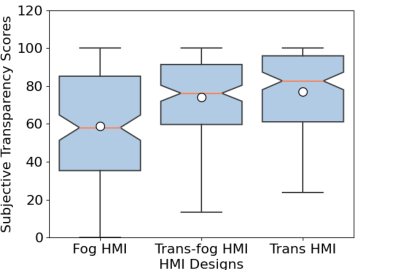
We see the same pattern in self-reported mental workload among the HMI designs from Figure 5, where the Trans HMI had the lowest subjective workload and highest self-reported transparency. The NASA-TLX scores were found to be significantly different among those three HMI designs 𝐹(2,260) = 3.80, 𝑝= 0.028, 𝜂𝑝2 = 0.027, where the Trans HMI got the lowest averaged NASA-TLX score, representing that it required the lowest subjective mental workload. A similar outcome was found on the subjective transparency scores, where the effect of HMI designs was also found to be significant 𝐹(2,260) = 49.88, 𝑝< 0.001, 𝜂𝑝2 = 0.27. Post hoc comparisons were conducted for self-reported workload measures, as shown in Table. 2. The Trans HMI design had significantly lower NASA-TLX and higher subjective transparency scores than the Fog HMI design. But no significant difference was found between the Trans HMI and the Trans-fog HMI designs in NASA-TLX or subjective transparency scores. Between the Fog HMI and the Trans-fog HMI designs, the subjective transparency score of the Trans-fog HMI design was significantly higher than that of the Fog HMI design. But the effect was not found between these two in the NASA-TLX scores.
Workload Assessment of Human-Machine Interface: A Simulator Study with Psychophysiological Measures 553
Figure 5: Relationships between self-reported measures for workload and HMI designs.Table 2. Post Hoc Comparisons on HMI Designs for Psychophysiological Measures.
Table available in the original PDF paper.
NASA-TLX Subjective Transparency t Pholm t Pholm Fog Trans 2.75 0.019 -8.71 < 0.001 Trans-fog 1.25 0.27 -7.15 < 0.001 Trans Trans-fog -1,51 0.27 1.77 0.079
DISCUSSIONS We attempted to evaluate the sensitivity and effectiveness of psychophysiological measures in identifying different mental workloads required when interacting with different in-vehicle HMI designs in this study. We used the three HMI designs developed in the previous study, which were found to result in different self- reported workloads as the workload variable. Results from RMSSD suggested that the ECG measurement and the HRV analysis can be used to find differences in mental workload effectively. The Trans HMI was found to have the highest RMSSD during the interaction with participants, which suggests that it required the lowest workload among the three HMI designs. This was in accordance with the HMI designs and the other psychophysiological measures. The SCR was found to be the lowest on the Trans HMI design, representing that the Trans HMI design demanded the lowest workload since the rise of the SCR corresponded to the increase of the workload. Hence, the EDA, together with the SCR, could also be applied to investigate the differences in workload among HMI designs.
The self-reported workload measures were also confirmed to have the same correlation in workload with the previous study and psychophysiological measures, where the Trans HMI design had higher NASA-TLX scores than the Trans-fog HMI design, and the Trans-fog HMI design than the Fog HMI design. It was also not surprising that the Trans HMI design had the highest score in the subjective transparency test since the lower the workload needed to understand the HMI design, the higher the transparency should be.
Traditionally, the HMI evaluation processes are usually subjective and heuristic, making it difficult to be efficient and standardized. Hence, to develop a standardized HMI evaluation method, the inclusion of objective measures is critical and necessary. In our previous work, we developed a transparency assessment method, which evaluates HMI transparency by combining the true
understanding of the HMI and the workload required during the interaction. Now with the results from this study, the mental workload during the interaction between the users and the HMI designs could be estimated continuously and efficiently. Combining that with the proposed transparency assessment method, the assessment of the HMI designs could be adapted to environments with more dynamic interactions and be more efficient and reliable.
CONCLUSIONS AND FUTURE WORKS In this study, we confirmed the effectiveness of two psychophysiological measures in evaluating the mental workload when interacting with in-vehicle HMI design. This finding could be a strong basis for the HMI evaluation process. The next step is to include the psychophysiological measure in the proposed transparency assessment method, to develop an objective and standardized HMI assessment method, and use it to increase the efficiency of the HMI design process.
ACKNOWLEDGMENT
This project has received funding from the European Union’s Horizon 2020 research and innovation program under the Marie Skłodowska-Curie grant agreement No. 860410.
REFERENCES
Alaimo, Andrea, Antonio Esposito, Calogero Orlando, and Andre Simoncini. 2020.
“Aircraft Pilots Workload Analysis: Heart Rate Variability Objective Measures and NASA-Task Load Index Subjective Evaluation.” Aerospace 7 (9): 137. Baek, Hyun Jae, Chul-Ho Cho, Jaegeol Cho, and Jong-Min Woo. 2015. “Reliability of Ultra-Short-Term Analysis as a Surrogate of Standard 5-Min Analysis of Heart Rate Variability.” Telemedicine and e-Health 21 (5): 404–14. Bengler, Klaus, Michael Rettenmaier, Nicole Fritz, and Alexander Feierle. 2020. “From
HMI to HMIs: Towards an HMI Framework for Automated Driving.” Information 11 (2): 61. Charles, Rebecca L, and Jim Nixon. 2019. “Measuring Mental Workload Using Physiological Measures: A Systematic Review.” Applied Ergonomics 74: 221–32. Daviaux, Yannick, Emilien Bonhomme, Hans Ivers, Étienne de Sevin, Jean-Arthur
Micoulaud-Franchi, Stéphanie Bioulac, Charles M Morin, Pierre Philip, and Ellemarije Altena. 2020. “Event-Related Electrodermal Response to Stress: Results from a Realistic Driving Simulator Scenario.” Human Factors 62 (1): 138–51. Foy, Hannah J, and Peter Chapman. 2018. “Mental Workload Is Reflected in Driver Behaviour, Physiology, Eye Movements and Prefrontal Cortex Activation.” Applied Ergonomics 73: 90–99. Hart, Sandra G, and Lowell E Staveland. 1988. “Development of NASA-TLX (Task Load
Index): Results of Empirical and Theoretical Research.” In Advances in Psychology, 52:139–83. Elsevier. Heine, Tobias, Gustavo Lenis, Patrick Reichensperger, Tobias Beran, Olaf Doessel, and Barbara Deml. 2017. “Electrocardiographic Features for the Measurement of Drivers’ Mental Workload.” Applied Ergonomics 61: 31–43. Hossain, Md-Billal, Youngsun Kong, Hugo F Posada-Quintero, and Ki H Chon. 2022.
“Comparison of Electrodermal Activity from Multiple Body Locations Based on Standard EDA Indices’ Quality and Robustness Against Motion Artifact.” Sensors 22 (9): 3177.
Workload Assessment of Human-Machine Interface: A Simulator Study with Psychophysiological Measures 555
Kim, Jungsook, Woojin Kim, Hyun-suk Kim, and Daesub Yoon. 2018. “Effectiveness of Subjective Measurement of Drivers’ Status in Automated Driving.” In 2018 IEEE 88th Vehicular Technology Conference (VTC-Fall), 1–2. IEEE. Lim, WL, O Sourina, and Lipo P Wang. 2018. “STEW: Simultaneous Task EEG Workload
Data Set.” IEEE Transactions on Neural Systems and Rehabilitation Engineering 26 (11): 2106–14. Liu, Yuan-Cheng, Nikol Figalová, and Klaus Bengler. 2022. “Transparency Assessment on Level 2 Automated Vehicle HMIs.” Information 13 (10): 489. Lohani, Monika, Brennan R Payne, and David L Strayer. 2019. “A Review of
Psychophysiological Measures to Assess Cognitive States in Real-World Driving.” Frontiers in Human Neuroscience 13: 57. Matthews, Gerald, Ryan Wohleber, Jinchao Lin, Gregory Funke, and Catherine Neubauer.
2019. “Monitoring Task Fatigue in Contemporary and Future Vehicles: A Review.” In Advances in Human Factors in Simulation and Modeling: Proceedings of the AHFE 2018 International Conferences on Human Factors and Simulation and Digital Human Modeling and Applied Optimization, Held on July 21–25, 2018, in Loews Sapphire Falls Resort at Universal Studios, Orlando, Florida, USA 9, 101–12. Springer. Mehler, Bruce, and Bryan Reimer. 2019. “How Demanding Is" Just Driving?" a Cognitive Workload-Psychophysiological Reference Evaluation.” In Driving Assesment Conference. Vol. 10. 2019. University of Iowa. Meng, Xiaorong, Wei Zheng, and Kang Huang. 2022. “Cognitive Load Evaluation of
Human-Computer Interface Based on EEG Multi-Dimensional Feature.” In 2022 IEEE 25th International Conference on Intelligent Transportation Systems (ITSC), 1536–41. https://doi.org/10.1109/ITSC55140.2022.9922203. Richardson, Natalie Tara, C Lehmer, Markus Lienkamp, and Britta Michel. 2018.
“Conceptual Design and Evaluation of a Human Machine Interface for Highly Automated Truck Driving.” In 2018 IEEE Intelligent Vehicles Symposium (IV), 2072– 77. IEEE. Shaffer, Fred, and Jay P Ginsberg. 2017. “An Overview of Heart Rate Variability Metrics and Norms.” Frontiers in Public Health, 258. Shakouri, Mahmoud, Laura H Ikuma, Fereydoun Aghazadeh, and Isabelina Nahmens.
2018. “Analysis of the Sensitivity of Heart Rate Variability and Subjective Workload Measures in a Driving Simulator: The Case of Highway Work Zones.” International Journal of Industrial Ergonomics 66: 136–45. Stapel, Jork, Freddy Antony Mullakkal-Babu, and Riender Happee. 2019. “Automated Driving Reduces Perceived Workload, but Monitoring Causes Higher Cognitive Load Than Manual Driving.” Transportation Research Part F: Traffic Psychology and Behaviour 60: 590–605. Voinescu, Alexandra, Phillip L Morgan, Chris Alford, and Praminda Caleb-Solly. 2020.
“The Utility of Psychological Measures in Evaluating Perceived Usability of Automated Vehicle Interfaces–a Study with Older Adults.” Transportation Research Part F: Traffic Psychology and Behaviour 72: 244–63. Yoshida, Ryuichi, Tomohiro Nakayama, Takeki Ogitsu, Hiroshi Takemura, Hiroshi Mizoguchi, Etsuji Yamaguchi, Shigenori Inagaki, et al. 2014. “Feasibility Study on Estimating Visual Attention Using Electrodermal Activity.” International Journal on Smart Sensing and Intelligent Systems 7 (5): 1–4.
LISTED IN THE AHFE DIGITAL BOOKSTORE CATALOGUE
Explore the complete digital volume
Human Systems Engineering and Design (IHSED 2023): Future Trends and Applications
Read this individual research paper free through the original publisher, or explore the full digital proceedings book.
ISBN 978-1-958651-88-9
Explore this ISBN in the AHFE Bookstore ↗Listed in the July 2026 bookstore catalogue; search by ISBN to confirm current availability · Digital book purchase optional