Jürgen Pichen, Nikol Figalová, Martin Baumann (2022). Should I stay or Should I go? Using a Cooperative Sneak Peek Interface in Highly Automated Vehicles. In: Human Factors and Systems Interaction. AHFE Open Access, vol. 52, pp. 262–269. https://doi.org/10.54941/ahfe1002164
In the future, highly automated vehicles (HAVs) will be capable of performing aspects of driving safely and without human assistance. However, even HAVs may occasionally reach a system boundary and not perform efficiently, especially in complex traffic situations. A human driver could outperform the HAV in such situations, given that human eyes and cognitive processes are likely to be more capable in certain tasks than advanced sensors. Therefore, allowing the human driver to cooperate with an automated system may improve driving efficiency and safety. Implementing the driver-vehicle cooperation approach, the HAV could suggest a manoeuvre that can either be accepted or ignored by the driver. To ensure the driver has enough information prior to making the decision, we proposed a “Sneak Peek” function. This cooperative feature allows drivers to adjust the lateral position of the HAV prior to accepting the manoeuvre request. This study aims to explore how drivers use the Sneak Peek in scenarios when an overtake manoeuvre is requested, but the view from the ego vehicle is obstructed by a lead vehicle. Method. We conducted a driving simulator study with 27 participants (15 female, age M = 25.0, SD = 3.2). The ego vehicle drove in a highly automated mode (SAE level 4) with a velocity of 100 km/h. Participants experienced nine scenarios in which they approached a slow-moving lead vehicle (LV) driving at 70 km/h. The position of the LV was either right, the centre, or left of the lane, which changed how obstructed the view from the ego-vehicle was. At a distance of 45 meters from the LV, the HAV suggested an overtaking manoeuvre. Participants could (a) approve the overtake request straight away, (b) adjust their lateral position using the Sneak Peek function prior to deciding whether to accept the requested manoeuvre, (c) continue slowly following the LV. Results. In total, participants accepted 97.7 % of overtake requests. The Sneak Peek function was used in 83.1 % of trials. We found a significant association between the LV lateral position and the Sneak Peek usage (X2 (2, 486) = 65.69, p <.01). Participants used the Sneak Peek significantly less when the LV was positioned on the left of the lane (63.6 %) than when it was in the center (93.8 %) or right (92.0 %) of the lane. Moreover, the duration of the Sneak Peek was longer when the LV was positioned to the left side of the lane (M = 9.6, SD = 10.0) than when on the right of the lane (M = 6.0, SD = 6.4), (F(2, 399) = 5.21, p < .05). Furthermore, higher visual obstruction caused by the LV on the left lane lead to a greater lateral position adjustment (F(2, 444) = 19.044, p <.01), which implies that when the LV was positioned to the left of the lane, participants moved the lateral distance of EV further to the left. All participants confirmed that the Sneak Peek was useful in helping them decide whether to overtake.Conclusion. The Sneak Peek function helps drivers to decide whether to overtake or not and is a feasible cooperative interaction concept.
Human error is responsible for most traffic accidents. Car automation promi- ses to reduce human error and lead to safer and more efficient transportation. However, until cars can operate fully autonomously (level 5 according to SAE International, 2021), the human driver will be required to take over control occasionally. Such situations can occur when the autonomous vehicle (AV) reaches its operational boundary or due to inadequate detection of other road users caused by sensors that are not working correctly. Manual take- overs (TORs) are proposed to be a way to handle these situations on SAE level 3 automation. This approach requires the driver to act as a fallback AV operator and manually take over control when necessary. This approach, however, creates potentially dangerous situations. It expects drivers to be pre- pared to take over control even though they can be involved in non-driving tasks and therefore do not precisely understand the traffic situation.
This issue could be overcome by implementing a driver-vehicle coope- ration approach. In this approach, drivers could only select or approve a maneuver proposed by the AV system. The autonomous system would, after
Should I stay or Should I go? Using a Cooperative Sneak Peek Interface 263
that, perform the desired maneuver. This approach combines the precision of highly advanced sensors with the complexity of human cognition and decision-making. It appears to be a promising way to overcome challenges connected to the transformation from partially automated vehicles to highly automated vehicles. It could further reduce the possibility of human error, increase safety, efficiency, and driving comfort.
RELATED WORK
Manual take-overs show some problems on system boundaries because drivers can become disengaged from the traffic situation during highly auto- mated driving. The disengagement leads to a loss of situational awareness (Endsley, 1995), and drivers may get “out-of-the-loop” with insufficient information to take over the driving task again (e.g., Joost et al., 2014; Merat et al., 2019; Morgan et al., 2016). As a result, manual take-overs may result in drivers exhibiting less safety-critical behavior, such as a minor headway to other cars (Brandenberg, 2014) and shaky lateral control (Merat et al., 2014). Driver-vehicle cooperation is an alternative approach to the manual take- over by the driver. If the automated vehicle reaches a system boundary and cannot execute the driving task on its own, it can provide drivers with a maneuver request. The driver can approve or reject this request based on a set of finite options (Winner & Hakuli, 2006). Such maneuver requests can be authorized by the driver, in which case the HAV will conduct the maneuver, or they can be ignored by the driver, in which case the HAV will continue to drive in its current state (e.g., Pichen et al., 2019; Walch et al. 2019). This approach is non-critical because an action from the driver only leads to higher efficiency.
To avoid potential collisions with passing traffic or other road users, HAVs are typically configured to stay in the center of a lane with a predetermined lateral position to the center of the road. While driving in manual mode, people tend to approach the lane divider to decide whether it is safe to over- take (Deppermann et al., 2018). Another approach would be implementing a ‘Sneak Peek’ function, which allows the human driver to alter the lateral posi- tion of the HAV while deciding about the overtake. The lateral adjustment could help drivers when the LV limits their view of the oncoming traffic or the whole situation.
The cooperative driver-vehicle interaction has shown to be feasible and comfortable in non-critical situations (Pichen et al., 2021; Walch et al., 2016; Walch et al., 2019) and can increase driving efficiency. Furthermore, as the driver is not required to conduct the vehicle manually, it overcomes the hin- dered manual driving skills resulting from long-term exposure to automation (Parasuraman et al., 2000).
METHOD
Study design We conducted an experiment in a fix-based, highly-immersive driving simula- tor with a 190° field of view. Participants operated a level 4 automated vehicle
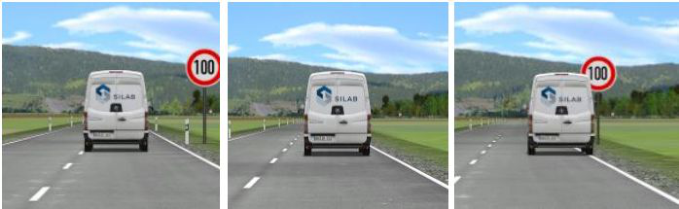
Figure 1: The three positions of the LV.
(SAE International, 2021), traveling on a two-lane rural road with mild onco- ming traffic. The velocity of the ego vehicle was set at 100 km/h. Two different interfaces were implemented to interact with the autonomous system: the natural habituated interface (HI) and a touchscreen interface (TI). Partici- pants experienced nine scenarios per interface in which they approached a slow-moving lead vehicle (LV) driving at 70 km/h. The LV (Mercedes-Benz Sprinter Van) was positioned in front of the ego car and obstructed the view to the road ahead. The position of the lead vehicle was alternated in three different positions (left, center, and right of the lane).
When the ego vehicle reached the slow-moving LV, participants were offe- red an overtaking maneuver. Accepting this proposal led to an overtake. When participants ignored the proposal, the ego vehicle followed the LV, which turned left at the following intersection. Participants could use the Sneak-Peek function to adjust the lateral position of the ego vehicle and obtain better visual information about the traffic situation ahead. Parti- cipants experienced each of the three LV positions three times. We used a within-subject design and counterbalanced the order of the LV position between participants. We also counterbalanced the order in which order participants experienced the interface.
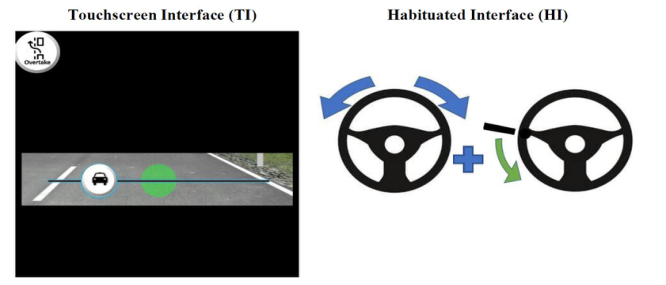
Interfaces The two interfaces used in this study are a touchscreen interface (TI), which is widely used in nowadays cars (Pfleging et al., 2016), and a natural habituated interface (HI) which is based on the interaction that is learned and habituated while conducting a vehicle manually (Pichen et al., 2019). When the vehicle tried to cooperate with the driver, a 17-inch touchscreen in the central console of the car showed the option to use the Sneak Peek function with a slider and a button to initiate the overtake (see Fig. 2) when the driver reassured that it is safe to do so.
The HI was implemented using the steering wheel to change the lateral position of the car to the left and right, as drivers would do it while con- ducting the vehicle manually. The Sneak Peek function was bounded so the vehicle would not cross the dividing lines. These boundaries were commu- nicated by haptic feedback on the steering wheel. To initiate the overtaking maneuver with the HI, participants had to press the indicator to the left.
Should I stay or Should I go? Using a Cooperative Sneak Peek Interface 265
Figure 2: The touchscreen interface (left) and the symbolic representation of the natural habituated interface (right).
Participants We recruited 27 participants (12 men, age M = 25.0 years, SD = 3.2). The inclusion criteria were fluency in the German language, a valid driver’s license in Germany, and prior driving experience in Germany. The experiment took between 60 and 75 minutes to complete. Participants were compensated for their time with 10-12 euros, depending on the time spent in the driving simu- lator. All participants provided written informed consent before participating in the experiment. The experimental procedure was performed in accordance with Helsinki’s Declaration and approved by the local Ethics Committee of Ulm University.
Material To examine the Sneak Peek function usage, all relevant simulator data was logged with a rate of 50Hz. This data included, for example, the lateral and longitudinal position, the distance to the lead vehicle, or the time when participants initiated the overtake. Eye-tracking data was measured using a SmartEye system. Finally, the ratio of fixation on the oncoming road from the moment of a cooperation request to the initiation of the overtaking maneu- ver was calculated to compare the safety assurance behavior between the two interfaces.
Other dependent variables were measured using self-report questionnai- res. These questionnaires included usability, acceptance, and trust towards the system. Usability was measured using a German translated version of the System Usability Scale (SUS; Brooke, 1996). Acceptance was measured using the Car Technology Acceptance Model (CTAM; Osswald et al., 2012). Trust was measured using the Trust in Automation Quesstionaire by Körber (2018). After the experiment, a short semi-structured interview was condu- cted by the researcher. Participants could comment on the interfaces and should tell their preference for the interface to (a) use the Sneak Peek function, (b) approve the maneuver, and (c) their overall preference.
Procedure Participants were asked to fill out an online demographic questionnaire before the experiment. When participants arrived at the laboratory, they were trained to operate the driving simulator. The familiarization took approxima- tely five minutes, and participants were introduced to the driving scenarios, the Sneak Peek function, and the usage of both interfaces.
Participants experienced nine scenarios per interface in which they appro- ached a slow-moving lead vehicle (LV) driving at 70 km/h while they appro- ached the LV with a velocity of 100 km/h. The position of the LV was either right, the center, or left of the lane, which changed how obstructed the view from the ego-vehicle was. At a distance of 45 meters from the LV, the HAV suggested an overtaking maneuver. Participants could (a) approve the over- take request straight away, (b) adjust their lateral position using the Sneak Peek function prior to deciding whether to accept the requested maneuver, (c) continue slowly following the LV. They started with one of the two inter- faces to drive through the approximately 10min long track. After the first track, participants filled in a subjective rating questionnaire about the inter- face. After the questionnaire, the other interface was explained to them, and the participants drove through the same course. Again, the position of the LV was counterbalanced. After the second ride, participants had to fill in the subject questionnaire again and then were asked to do a final comparing eva- luation of both interfaces in the form of a questionnaire and a semi-structured interview.
RESULTS
In total, participants accepted 97.7% of overtake requests. The Sneak Peek function was used in 83.1% of trials. We found a significant association betw- een the LV lateral position and the Sneak Peek usage (X2 (2, 486) = 65.69, p < .01). Participants used the Sneak Peek significantly less when the LV was positioned on the right of the lane (63.6%) than when it was in the center (93.8%) or left (92.0%) of the lane. Moreover, the duration of the Sneak Peek was longer when the LV was positioned to the left side of the lane (M = 9.6, SD = 10.0) than on the right side of the lane (M = 6.0, SD = 6.4), (F(2, 399) = 5.21, p < .05). There was no significant interaction between the Sneak Peek usage and the interfaces (X2 (1, 486) = .809, p = .452). Furthermore, higher visual obstruction caused by the LV on the left side of the lane leads to a greater lateral position adjustment (F(2, 444) = 19.044, p < .01). This implies that when the LV was positioned to the left of the lane, participants moved the lateral distance of the EV further to the left.
Because the data was not normally distributed, the approval times of an overtaking request were compared between the two interfaces using a Wilcoxon signed-rank test. Participants took significantly longer to approve overtake requests in the TI condition (M = 14.31 s, SD = 10.24) than in the HI condition (M = 6.86 s, SD = 4.33), Z = 9.03, p < .001. There were five accidents with the oncoming vehicles (OVs) in total. To compare the safety assurance behavior, a paired samples t-test showed a significant difference
Should I stay or Should I go? Using a Cooperative Sneak Peek Interface 267
between the TI condition (M = 76.83%, SD = 6.81) and the HI condition (M = 97.05%, SD = 3.88), t(21)= 9.943, p < .001.
Both the TI and HI interface received a usability score over 70, which is considered rather high (Bangor et al., 2009). There was a significant diffe- rence found in the scores for HI (M= 87.7, SD = 10.23) and TI condition (M = 80.3, SD = 11.97), t(25) = -2.953, p = .007. No significant differe- nce in acceptance was found between HI (M = 80.04, SD =12.4) and TI (M=78.2, SD = 12.07) condition, t(27)=0.61, p = .546. There was no signi- ficant difference in trust for HI (M = 85.923, SD = 12.294) and TI condition (M = 83.333, SD = 12.982) condition t(27)= 1.12, p = 0.274.
The analysis of the post-experiment semi-structured interviews showed that all participants considered the Sneak Peek function to be a helpful tool to decide whether to accept the proposed maneuver. Participants preferred to execute the Sneak Peek using the HI (n = 19) and approve the maneuver using the button on the TI (n = 15). Overall, participants preferred the HI (n = 19) over the TI (n = 4). Four participants had no preference. We found this difference to be significant using the binomial test for a single proportion (p < 0.001).
When evaluating the interfaces, participants mainly described the HI as less visually demanding. The HI felt more familiar, and they perceived more control over the vehicle than using the TI because they “did not need to look at the wheel to use it”. Contrary, the TI was evaluated as visually demanding. Participants did not like to “take their eyes off the street”. Nevertheless, they preferred the TI to approve the maneouvre, because “it was easier to press a button on the screen than to use the blinker” or because “the blinker already has a different function while driving”.
DISCUSSION
Following recommendations from previous research (Pichen et al. 2021; Walch et al. 2019), as well as observations from naturalistic driving studies (Deppermann, 2018; Mocsári in 2009; Wilson & Best, 1982), we predicted that during SAE level 4 automation, drivers would use a cooperative function which we called the ‘Sneak Peek’. This function allows the driver to adjust the vehicle’s lateral position prior to deciding whether to approve an overtake request. Moreover, we compared the use of the Sneak Peek function when dri- vers interacted with two different interface approaches, the often-used touch screen and the HI the learned while driving a car manually.
The Sneak Peek function was found to be used in 82% of all overta- king situations, regardless of the condition. Participants used the Sneak Peek function more when LVs were positioned to the left of the lane, causing more visual obstruction. They used it less when LVs were positioned to the right of the lane, causing less visual obstruction. This suggests that the Sneak Peek function is helpful, especially when the vision is more obstructed, and drivers don’t need the Sneak Peek function when they have a good visual representa- tion of the road ahead. This assumption is further supported by the fact that the Sneak Peek function was not used in 38 out of 177 trials when the LV
was on the right of the lane, but participants decided to approve the overtake request in all 38 of those trials.
In addition, when the LVs were positioned left on the lane, the lateral dista- nce participants set in the Sneak Peek feature was substantially further to the left, and the duration of time spent in the Sneak Peek function was significan- tly longer. The aforementioned recognized assumptions support statements that the position of LVs has a substantial impact on visual obstruction, which can influence a driver’s conduct before approving an overtaking move and the requirement to alter the vehicle’s lateral position before overtaking.
Participant replies to interview questions provide additional qualitative evidence that the Sneak Peek function aided them in deciding to overtake. For example, when asked “was the Sneak Peek function useful in helping you decide whether to overtake or not?” all participants approved. Additionally, 25 out of the 27 participants answered that there was a visual advantage, asking them, “what was your reasoning for using the Sneak Peek function?”. Such resounding responses imply that the Sneak Peek function was helpful and helped participants decide whether to overtake.
Lastly, the finding that wrong overtakes were so rare, with only five overtake requests approved resulting in an OV having to decelerate or in a collision, backs up previous findings that cooperative interaction with the driver is promising (Walch et al., 2016) because it can be said that drivers acted responsibly by performing the Sneak Peek and checking for OVs when requesting a maneuver that is then executed by the autonomous system. It can also be claimed that because Sneak Peek usage was high across all trials, the Sneak Peek capability can help to lessen the likelihood of a crash.
Even though the Usability of the HI was significantly higher, participants liked the way of initiating the overtake in the TI condition more. This leads to the assumption that the implementation of the habituated interaction should be revised and improved. There were practical implications to refactor the design of both interfaces throughout the interview in the end, which have to be further examined in future studies.
CONCLUSION
The Sneak Peek function is a feasible interaction concept. It helps drivers decide whether to accept overtake requests proposed by a highly automated vehicle. It is especially useful when the driver’s vision is obstructed by a lead vehicle. Moreover, we found that drivers prefer to interact with a habituated interface (steering wheel) over a touchscreen interface. Our findings should be considered in the future design of partially automated vehicle interfaces to make a cooperative driver-vehicle interaction possible and increase drivers safety.
ACKNOWLEDGMENT
This project was funded by the European Union’s Horizon 2020 research and innovation program under the Marie Skłodowska-Curie grant agree- ment 860410. Special thanks goes to Daniel Craven who conducted this study within his master thesis.
Should I stay or Should I go? Using a Cooperative Sneak Peek Interface 269
REFERENCES
Bangor, A., Kortum, P., & Miller, J. (2009). Determining what individual SUS scores mean: Adding an adjective rating scale. Journal of usability studies, 4(3), 114–123. Brooke, J. (1996). SUS-A quick and dirty usability scale. Usability evaluation in
industry, 189(194), 4–7. Deppermann, A., Laurier, E., Mondada, L., Broth, M., Cromdal, J., De Stefani, E., Haddington, P., Levin, L., Nevile, M., & Rauniomaa, M. (2018). Overtaking as an interactional achievement: video analyses of participants’ practices in traffic. 19. 1–131. Körber, M. (2018). Theoretical considerations and development of a questionnaire
to measure trust in automation. In Congress of the International Ergonomics Association. Springer, 13–30. https://doi.org/10.1007/978-3-319-96074-6_2. Merat, N., Seppelt, B., Louw, T., Engström, J., Lee, J.D., Johansson, E., Green, C., Katazaki, S., Monk, C., Itoh, M. (2019). The “out-of-the-loop” concept in automated driving: Proposed definition, measures and implications. Cognition, Technology & Work, 21(1), 87–98. https://doi.org/10.1007/s10111-018-0525-8. Mocsári, T. (2009). Analysis of the Overtaking Behaviour of Motor Vehicle Drivers.
Acta Technica Jaurinensis, 2, 97–106. Osswald, S., Wurhofer, D., Trösterer, S., Beck, E., and Tscheligi, M. (2012).
Predicting Information Technology Usage in the Car : Towards a Car Tech- nology Acceptance Model. Proceedings of the 4th International Conference on Automotive User Interfaces and Interactive Vehicular Applications, 51–58. https://doi.org/http://dx.doi.org/10.1145/2390256.2390264 Parasuraman, R., Sheridan, T.B., and Wickens, C.D. (2000). A model for types and levels of human interaction with automation. in IEEE Transactions on Systems, Man, and Cybernetics - Part A: Systems and Humans, 30(3), 286–297. doi: 10.1109/3468.844354. Pichen, J., Stoll, T., & Baumann, M. (2019). Stuck behind a truck – A cooperative
interaction design approach to efficiently cope with the limitations of automated systems. In Proceedings of the 11th International Conference on Automotive User Interfaces and Interactive Vehicular Applications: Adjunct Proceedings (199–204). https://doi.org/10.1145/3349263.3351519 Pichen, J., Stoll, T. and Baumann, M., 2021, September. From SAE-Levels to Cooperative Task Distribution: An Efficient and Usable Way to Deal with System Limitations?. In 13th International Conference on Automotive User Interfaces and Interactive Vehicular Applications (pp. 109–115). Pfleging, B., Rang, M. and Broy, N. (2016). Investigating User Needs for Non-
driving-related Activities During Automated Driving. In Proceedings of the 15th International Conference on Mobile and Ubiquitous Multimedia (MUM’ 16). ACM, New York, NY, USA, 91–99. https://doi.org/10.1145/3012709.3012735. SAE International (2021), “SAE J3016: Taxonomy and Definitions for Terms Related to Driving Automation Systems for On-Road Motor Vehicles.” Retrieved from https://www.sae.org/standards/content/j3016_202104/ Walch, M., Sieber, T., Hock, P., Baumann, M and Weber, M. (2016). Towards Coope-
rative Driving: Involving the Driver in an Autonomous Vehicle’s Decision Making. In Proceedings of AutomotiveUI 2016. ACM, New York, USA, 261–268. DOI: http://dx.doi.org/10.1145/3003715.3005458 Walch, M., Woide, M., & Muehl, K., Baumann, M & Weber, M. (2019). Cooperative Overtaking: Overcoming Automated Vehicles’ Obstructed Sensor Range via Driver Help. 144–155. DOI: 10.1145/3342197.3344531 Winner, H., & Hakuli, S. (2006). Conduct-by-Wire: following a new paradigm for
driving into the future. In Proceedings of FISITA world automotive congress, 22 (27). DOI: http://tubiblio.ulb.tu-darmstadt.de/29458/
LISTED IN THE AHFE DIGITAL BOOKSTORE CATALOGUE
Explore the complete digital volume
Human Factors and Systems Interaction
Read this individual research paper free through the original publisher, or explore the full digital proceedings book.
ISBN 978-1-958651-28-5
Explore this ISBN in the AHFE Bookstore ↗Listed in the July 2026 bookstore catalogue; search by ISBN to confirm current availability · Digital book purchase optional