Masato Kagiwada (2023). Towards Dementia-Friendly Society: Design and Interactive Technologies for Collaborative Caregiving and Personalised Non-pharmacological Therapy. In: Design for Inclusion. AHFE Open Access, vol. 75, pp. 231–238. https://doi.org/10.54941/ahfe1003344
The speed of aging has been increasing and therefore the demand for products/services which would align to elderly people has been getting higher. With the synchronization of aging, the number of people with dementia has been increasing rapidly and it puts a burden on not only people with dementia but also stakeholders and the entire world. Dementia non-pharmacological therapy is one of the most feasible interventions and it includes cognitive, sensory, and psychosocial therapies.Research Problem: Family caregiver's low accessibility to patient-centred dementia non-pharmacological therapy has caused the low quality of caregiving to people with dementia, the increasing of caregiver's emotional/physical distress, and the low transparency of dementia to medical experts.Research Question: How can design and interactive technologies make dementia therapy more personalised to patients, accessible to caregivers, and transparent to medical experts?Research Aim: Explore the possibility of design and interactive technologies for dementia non-pharmacological therapy.Hypothesis: Giving dementia non-pharmacological therapy more stimulations, playfulness and meaning by design and interactive technology would be beneficial to make it more patient-centred and empower informal caregivers.Methodologies: The research is mainly based on Design Thinking methodology, DICE approach, and Constructive design wheel. The research is preceded with qualitative methods such as questionnaires, interviews, brainstorming, physical and digital prototyping and expert reviews. Conclusions: The research would contribute to the enhancement of dementia therapeutic intervention research and therefore the quality of life in people with dementia.
The world’s population is aging rapidly - the number of elderly people is increasing with the demand for the elderly-friendly products/services such as healthcare, housing, transportation, and education. Globally, there were 703 million persons aged 65 or over in 2019 and over the next three decades, the number of older persons worldwide is projected to more than double, rea- ching more than 1.5 billion persons in 2050. The growth of elderly people who have more risks of cognitive impairments indicates the possible market size in this dementia prevention/treatment would increase as well. Dementia is a brain disease affecting memory, language, thinking that interferes with daily life activities. It is often mistreated as a normal aging because it is simi- lar, for instance, forgetting, falling down, lack of sleep, and so on. Thus it is often too late to be treated properly. And it is a progressive disease. So sooner care to decrease the progression makes better well-being for people with dementia. Alzheimer disease is the most common form of dementia and may contribute to 60-70% of cases. In 2015, dementia affected 47 million people worldwide (or roughly 5% of the world’s elderly population), a figure that is predicted to increase to 75 million in 2030 and 152 million by 2050. For decades, the cause of dementia has been investigated from several fields across the world, however, there is no direct treatment. Besides that, due to the lack of public attention and services, dementia is not visible in the society and therefore there are lots of misconceptions of it and people related to it are left alone and excluded from normal societal activities. On top of that, it could happen to anyone - directly and indirectly. This research has proce- eded with a combination of frameworks from the medical and design field to achieve the aim of exploring the possibility of interactive technologies for dementia non-pharmacological therapy which leverages some actions with people with dementia, caregivers, and their physical and social environment. It has been conducted in Estonia where it is open for technological innovation from individual to country level and a lot of experts are working on activi- ties towards dementia friendly society. Elu Dementsusega and Tartu Health Care College, which founded the Dementia Competence Center, helped this research from the beginning. As a creator aspiring to enhance the well-being of humans and a family member experiencing dementia - one of the biggest threats on public health, it would be a pleasure to make this master’s the- sis a milestone showing the power of design and technology for people with cognitive impairments.
DEMENTIA NON-PHARMACOLOGICAL THERAPY Non-pharmacological therapy refers to several approaches involving some action with the patient and/or their physical and social environment. It can be broadly categorized as generalized and or targeted. Either approach may directly involve the patient (e.g., exercise) and/or work through ano- ther agent – typically the caregiver (e.g., use of communication techniques) or physical environment (e.g., relaxing music). It conceptualizes behavioral symptoms as expressions of unmet needs (e.g., repetitive vocalizations for
Towards Dementia-Friendly Society: Design and Interactive Technologies 233
auditory stimulation); inadvertently reinforced behavior in response to envi- ronmental triggers (e.g., screaming for attention); and/or consequences of a mismatch between the environment and patients’ abilities to process and act upon cues, expectations and demand. It could involve modifying patient and/or caregiver cognitions, behaviors, environments, or precipitating events contributing to behaviors or instructing in compensatory strategy use to reduce the patient’s increased vulnerability to their environment. Several ran- domized trials have found that engagement in physical activity and pleasant events reduced depression in persons with dementia living at home. Based on the existing non-pharmacological therapies for dementia, it utilizes three aspects: (1) Physical contact, (2) Emotional attachment, and (3) Social enga- gement. Sensory-oriented therapy is aiming at providing a positive impact on patients by leveraging physical contacts to enhance emotional attachment, for instance, the multi-sensory room modifies the indoor environment by setting different objects (lights, furniture, plants, etc.). Cognitive-oriented therapy mostly focuses on emotional attachment, for instance, reminiscence therapy invokes a patient’s favorite memories with some objects which trigger the pleasant feeling. Psychosocial therapy is making use of physical contact and social engagement to make a positive emotional effect on patients, for insta- nce, animal-assisted therapy brings pet animals to enhance the non-verbal communication between animals and patients.
PROBLEM SPACE Family caregivers are forced to have mismatched communication and an unbalanced relationship with people with dementia due to the inefficient coping with the main reasons behind these issues. It’s also related to exh- austing and time-consuming collaboration with medical experts and social groups which results from emotional barriers and financial obstacles. Alth- ough occupational therapists are the key collaborator to deal with the disease, there is also an inefficient collaboration with caregivers that comes from insufficient competency and low awareness. Furthermore, care homes and hospitals have a difficulty assessing the caregiving environment for diffe- rent stages of people with dementia, and occupational therapists have more challenges due to the variety of assessing environments.
CONCEPT PRINCIPLES The principle behind the concept is enhancing stimulation and playfulness of non-pharmacological therapy so that it has more meaningfulness for family caregivers and people with dementia. So I determined 3 main factors to formulate the concept: (1) Stimulative, (2) Playful, and (3) Meaning- ful. Since humans get stimulation through their 5 senses and movements around them, making an interaction stimulative would be helpful to enha- nce cognitive capability. For example, aromatherapy uses favorite scents to stimulate people’s sense of olfactory (ability to smell) naturally. Since playful- ness makes daily life more joyful and eventful, making an object customisable and connected to the patient would be beneficial to achieve playfulness. For
234 Kagiwada
example, one design group developed a music memory box in which peo- ple with dementia can customize sound and pictures as they wish. Therefore the combination of stimulation and playfulness would make a meaning for people with dementia (more eventful life), family caregivers (seeing loving person’s happiness), and medical experts (more transparency to people with dementia).
TUNNE Concept Overview
Tunne consists of four modules (1) Therapy module - folklore-storytelling therapy & therapy assistant app, (2) Interaction module - storytelling device, (3) Detection module - speech emotion recognition & data exchange, and (4) Service module - Tunne as a business & as a public service. All modules are interconnecting each other to provide the values which are “stimulative” for people with dementia, “accessible” for caregivers, and “transparent” for medical experts.
Therapy Module The folklore-storytelling therapy is created for people with dementia to get multi-sensorial stimulation and emotional comfort by encountering nostalgic folklore and an interactive storytelling device. The facilitator could be family caregivers, formal caregivers, and social workers. Facilitators could also use ‘Therapy Assistant App’ which allows them to conduct folklore-storytelling therapy, to control the storytelling device, and to get the result of the the- rapy and tips for facilitating therapy. How do they interact with it? After registering an email address and password, they can go to the home screen which shows several folklores. From there, they can select one story and start conducting the therapy with the device turning on. Firstly the introductory narration is played, and then the audio of the story is played. After that the app shows some questions to ask, and then it helps them to conduct a story- telling session. Simultaneously the device records the conversation among participants. And then they can finish the therapy from the app. After the therapy, they can check the result of previous therapies which includes time- /date, speech recordings, and emotion analysis. Also they can get some tips for therapy facilitation, for example, how to use a voice for better comforts, how to encourage verbal communication, and so on.
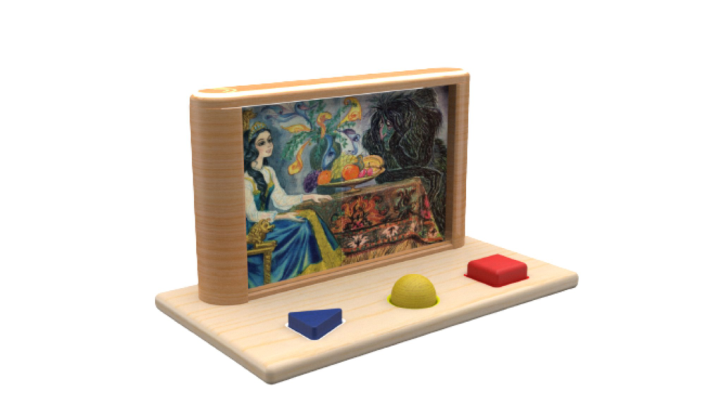
Interaction Module Initiation module consists of a tangible user interface and smart unit so that people with dementia could get emotional comfort and foster their verbal communication with family caregivers. “Storytelling device” is aiming at providing multi-sensorial stimulation with people with dementia by using a tangible user interface with a tactile controller. Since the object itself needs to demonstrate what it is in an intuitive way, the Kamishibai stand was selected to develop further. Kamishibai is a Japanese traditional storytelling theatre
Towards Dementia-Friendly Society: Design and Interactive Technologies 235
Figure 1: Tunne interaction module.
which is interactive in a way that storyteller and audience communicate ver- bally and visually. The concept of Kamishibai has been inspired outside of Japan. The next question is how to make it more interactive and playful by leveraging interactive technologies. To achieve that, I got inspiration from a tambour door cabinet for opening/closing the storytelling device. Three tactile controllers are also added to open/close the tambour door, to play the audio, and to record the speech of people with dementia. It makes interaction more tangible and playful so that people with dementia can get more enjoy- ment and stimulation. It also includes electronics components as a smart unit to make itself smart - showing visuals, playing audios, recording speeches, and achieving tactile controls.
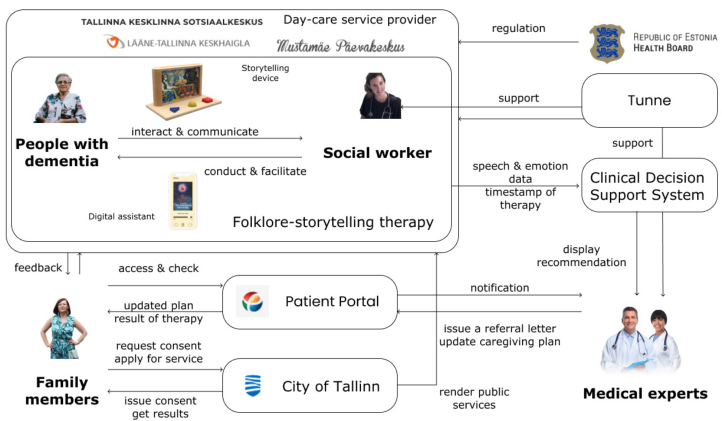
Detection Module Detection module consists of a language model to collect speech and detect emotion, and data exchange via X-road infrastructure. The Detection module is aiming at detecting emotional status of people with dementia by colle- cting and analysing the linguistic pattern from audio inputs coming from the conversation in the storytelling therapy. It is based on human langu- age technologies such as ASR and SER. Given the target user’s language preference and the uniqueness of Estonian language, the module is develo- ped with “Kaldi Offline Transcriber”, “EstBERT”, and “Estonian Emotional Speech Corpus”. The data of therapy, speech and emotion will be stored in the secured database. The database is connected to segmented LAN via X- road gateway so that the data is secured and added to the diagnosis data of the person with dementia registered in the e-Health information system. The updated medical events data will be shown in Patient Portal for authorised people and the Clinical Decision Support System for medical experts.
236 Kagiwada
Figure 2: Tunne service module.
Service Module Service module consists of private and public service models in Estonia so as to increase the accessibility of dementia non-pharmacological therapy and to promote the public awareness of dementia across the society. In the public service model, the provider of the therapy would be social centers of the local government and they get the toolkit which includes storytelling devices and the assistant app. Social workers could get training from the Tunne support team so that they could conduct and facilitate the therapy at the social cen- tre. In Tallinn, there are 3 providers and residents could apply for the social service based on the residential address. In this case, family members would apply for the day-care service with a referral letter from the GP and a con- sent from the City of Tallinn. Upon approval, people with dementia would go to the social centre and get therapy. After that, the data related to the the- rapy will be shared with medical experts so that they can share the updated caregiving plan with family members and give feedback on the quality of the service to the service provider.
Evaluation With the result of expert reviews, two points could be explored further. (1) Balancing familiality and novelty and (2) Opening up more possibilities for different stages of dementia. So far, Tunne connected several aspects - the form of non-pharmacological therapy, the aesthetics of tangible user interfa- ces, the way of aiding caregivers, the integration of interactive and language technologies, and the way of ensuring transparency for medical experts. Now it is essential to look back on the balance of familiality and novelty of Tunne so that it is truly beneficial for main users - people with dementia. And although I have focused on the early and middle stage where people with
Towards Dementia-Friendly Society: Design and Interactive Technologies 237
dementia still have the majority of conversational capability, the possibility that Tunne is used for different stages of dementia could be opened up.
DISCUSSION
The utilisation of interactive technologies such as tangible user interface and human language technologies for dementia non-pharmacological therapy was explored and examined. Broadening the mediums of interaction by leve- raging a tangible object would open up more flexible interaction between human and digital information so that people with different physical and cognitive capabilities could utilize their sensations and perceptions to make their daily life easier and more comfortable. Also secured data exchange with Estonian e-Health Information System was also explored to balance the personal data protection and get dementia care more personalised and transparent. This well-established data exchange infrastructure and digital healthcare system could accelerate the utilisation of health data from seve- ral kinds of touchpoints among patients, doctors, and stakeholders. The feedback from city officials also pointed out this research would enhance the collaboration in both the private and public sector towards the better well-being of people with dementia and caregivers. To implement the design concept as a widely used service, the clinical evaluation should be performed with the approval by the Tallinn Medical Research Ethics Committee. And then the individual and group user testing where people with dementia, care- givers, and social workers interact with a physical and digital assistant, and medical experts review the data through e-Health Information System, would be needed to gain the practical feedback in a real environment. And perso- nal data protection must be followed. Since the clinical evaluation would receive and process significant amounts of personal data, the consent of the data subject must be submitted before that according to the Personal Data Protection Act.
CONCLUSION
Research question is finally answered by reviewing main aspects for three main design targets. Tunne folklore-based storytelling therapy allows pati- ents to gain emotional comforts by encountering nostalgic folklores and feel personalised connections by letting them speak out their personal stories. With the high accessibility of Tunne toolkit and playfulness of the therapy, caregivers could feel empowerment and encouraged to live with people with dementia in a more positive way. And with the capability of the storytelling device - speech emotion recognition - and the connectivity with the digital healthcare system, medical experts could review and analyse the health data for more patient-centred care planning and collaboration with stakeholders. For now Tunne is focusing on the initiation of verbal communication by leve- raging storytelling as a creative medium and targeting early-stage dementia patients whose verbal communication capability is highly remaining. Given the progression of dementia, the patient would reach the point where senso- rial communication replaces verbal communication. One possibility for the
238 Kagiwada
Interaction module is that people with dementia could draw some objects with the input from folklore or make some objects made of clay. It would be the combination of storytelling therapy and art therapy. The other possibility is utilising touchless gesture interaction for the Detection module. For exam- ple, patterns of hand gestures of patients could be used for detecting dementia positive or negative by comparing the gesture motion dataset. Since Tunne consists of customisable modules for dementia non-pharmacological therapy, design and technology interventions could be done for different modules alongside the different stages of dementia.
ACKNOWLEDGMENT
I would like to express my gratitude to ExaWizards Inc. for supporting my work, and to Tallinn University of Technology for providing a supportive research environment during my Masters studies. I would also like to ackno- wledge the guidance and support of my supervisor, Ruth Melioranski, in the completion of my thesis.
REFERENCES
Helen C Kales et al. 2015. Assessment and management of behavioral and psychological symptoms of dementia KreaShibai.de Retrieved 23 May 2021, from https://www.kreashibai.de/ Laura N. Gitlin, PhD, et al. 2012. Managing Behavioral Symptoms in Dementia Using
Nonpharmacologic Approaches: An Overview Prince M, et al. 2015. World Alzheimer Report 2015. The global impact of dementia: an analysis of prevalence, incidence, cost and trends United Nations, Department of Economic and Social Affairs, Population Division.
2020. World Population Ageing 2019
LISTED IN THE AHFE DIGITAL BOOKSTORE CATALOGUE
Explore the complete digital volume
Design for Inclusion
Read this individual research paper free through the original publisher, or explore the full digital proceedings book.
ISBN 978-1-958651-51-3
Explore this ISBN in the AHFE Bookstore ↗Listed in the July 2026 bookstore catalogue; search by ISBN to confirm current availability · Digital book purchase optional