Qiaohan Lu, Zihao Wang (2026). Rider Safety in Outdoor Equestrian Activities: Behavioral and Environmental Approaches. In: Human Factors in Sports, Preventive Medicine and Innovative Agonology. AHFE Open Access, vol. 226, pp. 63–71. https://doi.org/10.54941/ahfe1007824
Equestrian sports have significant physical, emotional, and therapeutic advantages but are also associated with high risks, especially in open environments where visibility and communication are restricted. Past studies have emphasized injuries and safety gear while neglecting the complex relationship between environmental conditions, equine behavior, and system coordination in non-elite sports. This research undertakes a qualitative approach by conducting field studies in a rural center in France and using semi-structured interviews with participants from different backgrounds. The research findings reveal three main problems in the current system: the delay in detecting and localizing incidents, fragmented coordination among stakeholders, and equine-related accidents due to stress behavior. In response to the identified problems, three strategies have been recommended in the research. These strategies include improving the riders’ visibility, stabilizing and interpreting equine behavior, and improving communication in emergencies. This research has positioned the role of behavioral risk mitigation in designing as a mediator between humans and horses and the environment.
“A hero is an ordinary individual who finds the strength to persevere and endure in spite of overwhelming obstacles.”
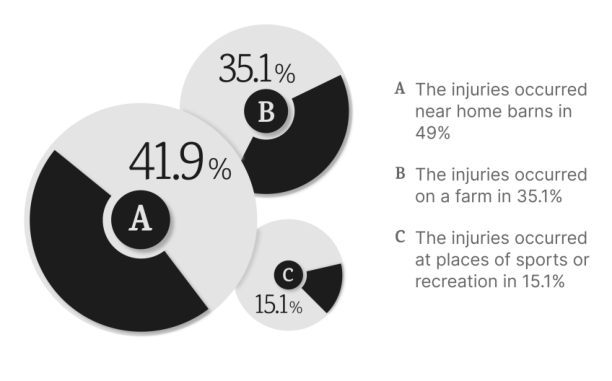
Christopher Reeve — the actor known as Superman — spoke these words after a riding accident in 1995 that caused a cervical spinal fracture and left him permanently quadriplegic. His case is not an exception: equestrian sports remain one of the most dangerous recreational and competitive activities, where a single fall can change a life in seconds (see Figure 1). Statistics show that, for every 1,000 hours of riding, there is approximately one serious injury, and around 12% of these cases lead to PMI (Stigson & Klingegegård, 2024).
This incident reflects a broader issue in rural riding centers in France, where novice riders face significant safety risks. Horses, being sensitive prey animals, may react unpredictably to environmental triggers that riders might not perceive in time. This communication gap often leads to falls and injuries, and emergency response is frequently delayed due to vast terrains and limited Received February 5, 2026; Revised April 3, 2026; Accepted April 21, 2026; Available online July 20, 2026
64 Lu and Wang monitoring. Thus, understanding and addressing these challenges is crucial for improving rider safety.
Figure 1: Horse riding injuries in different situations. (Characteristics of equestrian accidents and injuries leading to permanent medical impairment, 2005).
INJURY PATTERNS AND RISK FACTORS ON EQUESTIAN ACTIVITIES Equestrian activities, particularly outdoor trail riding, are acknowledged to be among those few high-risk recreational and competitive sports. For instance, studies show that 45–86% of the total number of injuries arises from falls, and the rest from kicks, trampling, and collisions.
“In the horse racing industry, jockeys mostly experience bruises and abrasions followed by fractures and dislocations of the upper and lower limbs; however, fracture and concussion incidences were higher in amateur than professional jockeys” (Emily K. Neville, Hicks & Christine C. Neville, 2024, p. 9). Common types of injuries include head trauma, spinal fractures, and fractures of the upper and lower limbs; severe injuries occur more often among amateur riders than professionals.
Key risk factors include: rider experience, horse behavior and use of protective equipment. First, novice riders are more susceptible because of the limited experience with horse behavior and slow reaction time coupled with poor decision-making. Second, riders often become complacent during supposedly safe areas and fail to wear helmets or protective gear. Consequently, helmets and body protectors are not universally adopted, despite the fact they can reduce injury severity, which leaves a large section of riders vulnerable (Gould et al., 2025).
Environmental factors in trail riding outdoors further increase these risks. Dense forests, rough terrain, and poor visibility can delay the detection of falls, increasing the likelihood of severe injury or fatality (Emily K. Neville, Hicks & Christine C. Neville, 2024).
Rider Safety in Outdoor Equestrian Activities: Behavioral and Environmental Approaches 65 EMERGENCY RESPONSE AND TIME-CRITICAL CARE
Rapid intervention is critical in severe equestrian injuries. Multi-center analyses show a significant increase in in-hospital mortality with each 10-minute delay in pre-hospital care (Gauss et al., 2019). Early neurosurgical assessment and expedited transfer for definitive care provide better outcomes for patients with traumatic brain injury or acute subdue hematoma (Leonardo et al., 2021). Specific on-site first aid care immediately after the injury is very important, including the management of airways, hemorrhage, and stabilization of the circulation (Shandong University Emergency Manual, 2023). Poor timing and improper interventions can lead to exacerbated injury severity.
In outdoor trail riding, delays are further manifested by distance from riding centers, dense forest, and limited communication signals that inhibit the prompt detection of falls by instructors or support staff (YouthSafe Outdoors, 2019). Due to the fragmented nature of current coordination systems, reporting and dispatch of resources happen very slowly, marking a critical gap in outdoor equestrian emergency care.
HORSE WELFARE, STRESS, AND BEHAVIOR Horses’ physiological and behavioral responses significantly influence rider safety. Their panic or abrupt movements can be easily triggered by environmental stimuli, for instance, sudden noises, unfamiliar terrain and unfamiliar outdoor settings, so on and so forth, elevating accident risk (Hole et al., 2023). Furthermore, horses can perceive human emotions, and riders’ fear or anxiety can induce physiological and behavioral changes, further increasing accident probability (Jardat et al., 2023). This interplay underscores the need for real-time monitoring of both rider and horse conditions, particularly in outdoor environments where risks are less controlled than in indoor arenas.
Fortunately, acoustic interventions, such as classical music or low-stimulus soundscapes, have been shown to reduce stereotypical behaviors and promote relaxation. However, long-term exposure may result in adaptation, highlighting the need for dynamic and varied sound environments (Fernanda et al., 2024; Gueguen et al., 2023).
COMPARATIVE SYSTEMS IN HIGH-RISK ACTIVITIES Beyond individual protective equipment, many high-risk outdoor industries—such as construction, greyhound racing, and professional equestrian sports—have developed environment-based risk management systems to mitigate accidents in large and unpredictable settings (see Table 1). These systems commonly rely on risk zoning, route management, and real- time environmental monitoring, using digital maps and proximity alerts to identify hazardous areas and warn users before critical situations arise. (Zhou, Goh and Li, 2015) Weather-monitoring tools are often integrated to anticipate sudden changes in visibility, surface conditions, or temperature, particularly when historical incident data reveals recurring risk patterns.
66 Lu and Wang (Burns and Stevens, 2016) Professional horse racing and elite equestrian competitions further demonstrate how system-level safety frameworks can complement individual skills and equipment. Controlled course design, predefined emergency access routes, on-site medical teams, and centralized coordination allow rapid detection and response when accidents occur (Fédération Equestre Internationale, 2022).
Although such infrastructures are designed for regulated and supervised environments, they reveal transferable principles—namely anticipation rather than reaction, spatial awareness, and clear emergency workflows—that remain largely absent in rural and recreational riding contexts, where riders are dispersed, supervision is minimal, and response time is highly variable.
Together, these comparative systems illustrate that safety in high-mobility outdoor activities is not achieved solely through user competence or protective gear, but through the integration of environmental data, spatial planning, and coordinated response mechanisms. This highlights a critical opportunity to rethink how similar principles might inform safety strategies in outdoor equestrian riding.
Table 1: Comparative system analysis.
Table available in the original PDF paper.
Horse Riding Lone Worker Dog Racing Rock Climbing Common Equipment Rental Working Equipment Service, Rescue organization interface Working Equipment Service Accident Detection Algorithm
Difference Horse Renting Risk Zoning Management
On-site emergency medical care
Risk Assessment and Route Management
RESEARCH GAPS AND FINAL RESEARCH QUESTIONS Although existing literature and industry practices provide valuable insights into rider safety, environmental risk management, and horse behavior, several gaps remain insufficiently addressed, especially within the context of everyday equestrian training environments.
For one thing, current visibility-enhancing tools, communication devices, and behavioral management techniques each target isolated aspects of safety but lack a unified framework that accounts for the spatial scale of riding spaces, the dynamic interactions between horses and riders, and the operational constraints of riding centers. For another, environmental risk- zoning and real-time alert systems—commonly adopted in construction, trail sports, and other high-risk outdoor fields—have rarely been examined or adapted for equestrian activities.
What is also worthy of mention is that the unique characteristics of horse– human communication, unpredictable horse responses, and dispersed riding terrains further complicate the applicability of existing approaches.
These gaps reveal the need for deeper investigation into how environmental, behavioral, and operational factors collectively shape risk in equestrian training contexts. To advance current knowledge and inform subsequent design exploration, this research aims to address the following questions:
1. How are risks currently perceived, detected, and communicated within equestrian training environments by riders, instructors, and staff? 2. What limitations exist in the present visibility, communication, and monitoring practices used during riding sessions, especially in large-scale or low-visibility terrains? 3. How do horse behavioral cues interact with environmental conditions to influence safety, and how do different actors interpret these cues? 4. What opportunities emerge for improving situational awareness and early risk detection without disrupting the natural riding experience?
By answering these questions, this research seeks to create a more integrated understanding of equestrian safety needs and to lay the foundation for exploring new strategies in the following chapter.
RESEARCH METHODOLOGY This study adopts a qualitative, user-centered approach to investigate safety challenges and user experience in outdoor equestrian activities.
Field observations were conducted in Haras de Nantes la Vaillantière, a horse riding center, to track the complete riding process: from arrival and preparation to trail riding and return, noting both rider pain points and horse equipment usage. I documented rider behaviors, horse responses, equipment usage, and environmental conditions, identifying common pain points. Meanwhile, I also focus on horses’ behavioral states and contextual factors influencing their sensitivity. These included immediate environmental stimuli (such as noise, terrain, and unfamiliar surroundings) as well as longer-term management conditions observable on site, including feeding routines, rest patterns, and social exposure.
Semi-structured interviews were held with a diverse set of participants: a riding coach, a young learner, an older learner. Semi-structured interviews were held with a diverse set of participants: a riding coach, a young learner, an older learner. The coach reported 2–3 accidents per week, mostly minor but occasionally severe; the young learner struggled with horse unpredictability, while the older learner recounted a three-month recovery after a fall. These accounts collectively illustrate the frequency, variability, and potential severity of equestrian accidents across different rider profiles. These accounts collectively illustrate the frequency, variability, and potential severity of equestrian accidents across different rider profiles.
I carried out some expert interviews as well, with a horse behavior expert and a medical student specializing in traumatic brain injury. The horse expert highlighted horses’ flight responses, lateralized vision, and potential for chaotic reactions in emergencies, noting that better understanding horse behavior improves rider safety and confidence; and the medical student emphasized the severity of head injuries and the importance of timely assessment. These interviews provided both experiential insights and professional knowledge on accidents, horse behavior, injury mechanisms, and emergency response.
Data collection tools: the results field observations and interviews were gathered through photographs, sketches, a stakeholder map, and a
68 Lu and Wang financial & information flow chart which contextualized the interactions and information pathways within equestrian systems, highlighting gaps in communication and coordination.
RESEARCH RESULTS The research findings revealed key problem areas: In outdoor settings, poor visibility and unstable signals often disconnect riders from external systems, making it difficult for rescuers to locate the injured riders, which may delay rescue and lead to even more severe consequences. Worse still, if the rider is injured or unconscious when riding alone, it would be harder for the riders to call out for help.
Rescue involves multiple departments. After reported an emergency, rescue team should know about the condition of the rider and their location and evaluate the situation before carrying put rescue and dispatching resources. Low information, terrain and distance may further extend response time, often exceeding 30 minutes.
Horses are prey animals with highly sensitive physiological and behavioral responses to environmental stimuli, such as sudden noises, unfamiliar terrain, or the rider’s emotional state. These reactions can lead to unpredictable movements—including bolting, rearing, or abrupt stops—which pose significant safety risks to riders.
These insights directly inform the subsequent Design Directions, ensuring that proposed solutions target visibility, horse understanding, and faster emergency response.
DISCUSSION
The findings reveal that safety risks in outdoor equestrian activities are not solely caused by isolated incidents, but by a combination of visibility limitations, fragmented emergency coordination, and horse behavioral unpredictability. This aligns with prior studies emphasizing that equestrian injuries often escalate due to delayed detection and response in large, uncontrolled outdoor environments (Neville et al., 2024; Gauss et al., 2019).
Together, these insights justify the three proposed design strategies: enhancing rider visibility, stabilizing and interpreting horse behavior, and reducing informational friction in emergency response. More broadly, the discussion positions rider safety as a socio-technical challenge involving humans, animals, and environments. This integrated perspective extends current safety research by shifting attention from post-accident response toward early detection, behavioral stabilization, and system-level coordination in everyday equestrian practice.
Strategy 1 - Make Riders Visible, Let Signals be Unmissable: design horse riding related devices–improve riders’ visibility, detect abnormal movement and send alerts to nearby stables and rescue teams.
Research on trauma care emphasizes the importance of early detection and the “golden minutes” following an accident, during which timely intervention can significantly reduce the severity of injuries. However, when a fall occurs
Rider Safety in Outdoor Equestrian Activities: Behavioral and Environmental Approaches 69 in low-visibility outdoor settings, rescue teams often struggle to locate the injured rider, delaying emergency response beyond this critical window.
This strategy emerges from the insight that accidents are not only dangerous because they happen, but because they are not seen in time. Enhancing rider visibility and making distress signals unmistakable in outdoor environments addresses a fundamental gap between the rider and external support systems, forming the first layer of safety intervention.
Strategy 2 - Stabilize the Horse, Amplify Its Voice: make the horses less reactive to sudden stimuli and integrate them as a proactive part of the emergency response system.
Across interviews and expert consultations, a consistent insight emerged: many equestrian accidents originate not from rider error alone, but from the horse’s sudden stress response. As prey animals, horses are biologically predisposed to react quickly and flee when confronted with perceived threats. Sudden noises, unfamiliar objects, environmental changes, or rider anxiety can trigger abrupt movements that place riders at immediate risk.
Beyond immediate stimuli, long-term factors also shape a horse’s emotional stability. Hunger anticipation, caused by rationed feeding schedules, can increase restlessness and reactivity. Social isolation or unstable herd relationships affect emotional regulation, while chronic husbandry stress— such as over-transportation or excessive training—can heighten baseline anxiety levels. Together, these factors increase the likelihood that a horse will react unpredictably in outdoor contexts.
Existing practices already attempt to manage this sensitivity. Calming aids, saddle adjustments, and rider–horse communication training are commonly used to reduce stress and improve mutual understanding. Experienced riders can often interpret subtle behavioral cues, such as ear position, muscle tension, tail movement, or vocalization, allowing early intervention. However, these mechanisms rely heavily on human perception and experience, making them fragile in situations involving novice riders, fatigue, or unfamiliar environments.
Importantly, research and expert interviews reveal that horses already exhibit unintentional “signal behaviors” during emergencies. For example, cases were reported in which a horse returned alone to its stable after the rider had fallen, implicitly indicating distress. These behaviors suggest that the horse is not a passive element in emergencies, but a potential carrier of information.
This strategy therefore re-frames safety not as controlling the horse, but as understanding, stabilizing, and listening to it. By acknowledging both short- term triggers and long-term emotional conditions, the horse is repositioned as an active participant in safety, capable of contributing to early warning and emergency communication rather than being treated solely as a source of risk.
Strategy 3 - Connect Help Faster, Remove Information Friction: create a distributed emergency network where departments receive real-time information about incidents to enable faster dispatch of resources.
Research into emergency response systems reveals that rescue delays are often caused by fragmented information flow. In outdoor equestrian
70 Lu and Wang accidents, response typically involves multiple stakeholders, including riding centers, emergency dispatch, medical teams, and sometimes local authorities. Each step requires manual reporting, confirmation, and coordination.
Comparative studies from construction sites and greyhound racing show that integrated information streams and clear role distribution significantly reduce response time. In contrast, current equestrian contexts lack unified channels, causing delays that are further amplified by distance and terrain.
This strategy responds to the insight that time is lost between actors, not only between locations. Reducing informational friction becomes essential to ensuring that detection leads smoothly into action.
CONCLUSION
“There is something about the outside of a horse that’s good for the inside of a human.” — Winston Churchill Horseback riding offers a unique sense of freedom, trust, and emotional healing, yet this experience is inseparable from risks. This dissertation set out to investigate how rider safety can be improved, focusing on outdoor equestrian contexts where visibility is low, riders are often alone, and emergency response is delayed.
Through literature review and user research, three interrelated safety challenges were identified: reduced visibility and unstable communication in outdoor settings, rider vulnerability when accidents occur without witnesses, and fragmented emergency coordination. While these findings informed three design directions, this project ultimately prioritizes the strategy of stabilizing the horse and amplifying its voice.
Research revealed that many critical incidents originate from equine stress responses and miscommunication, positioning the horse not merely as a source of risk, but as a central actor within safety dynamics. By reframing the horse as an active participant in situational awareness and emergency signaling, this approach addresses risk at its behavioral origin rather than solely at the point of rescue.
Design can mediate between human vulnerability, animal sensitivity, and environmental uncertainty. This project argues for preserving horse riding experience—by making riders visible, horses understandable, and help reachable when it matters most.
REFERENCES
Bocca, Lima, Suriano, Cavalheiro and Rodrigues (2021). Traumatic acute subdue hematoma and coma: retrospective cohort of surgically treated patients. Cindy Meehl (2011). Buck (Documentary film). DailyMotion (2024). How Horses Help Humans Heal Trauma. Available at: https://
www.dailymotion.com/video/x9ei5vu Accessed: 15 December 2025). Emergency Rescue Training at Qilu Hospital of Shandong University, 2023 Available at: www.qiluhospital.com/ (Accessed: 6 December 2025). Emily K. Neville, Hicks and Christine C. Neville (2024). Epidemiology if horse
trauma: A literature review.
Rider Safety in Outdoor Equestrian Activities: Behavioral and Environmental Approaches 71 Essentia Productions (2016). Exploring the Horse–Human Relationship. Available
at: https://www.imdb.com/title/tt5462438/ (Accessed: 8 December 2025). Fédération Equestre Internationale (2022). FEI Eventing Safety Strategy and Risk Management Framework. Gueguen, Henry, Delbos, Lemasson and Hausberger (2023). Selected Acoustic
Frequencies Have a Positive Impact on Behavioral and Physiological Welfare Indicators in Thoroughbred Racehorses. Available at: https://www.mdpi. com/2076-2615/13/18/2970 (Accessed: 2 December 2025). Gould, R. Roy, Gabriel, Lowe, Y. Lin, 2025. Equestrian Sports Safety: An Update on Safety Equipment and Event Medical Coverage. Gauss, Ageron, Devaud, Debaty, Travers, Garrigue, Raux, Harrois and Bouzat
(2019). Association of Prehospital Time to In-Hospital Trauma Mortality in a Physician-Staffed Emergency Medicine System JAMA Surgery. Hole, Murray, Marlin and Freeman (2023). Equine Behavioral and Physiological Responses to Auditory Stimuli in the Presence and Absence of Noise-Damping Ear Covers. Jardat, Liehrmann and colleagues (2023). Horses discriminate between human facial
and vocal expressions of sadness and joy, Animal Cognition. Oliveira, Odakura, Burbarelli, Ouros, Paz, Braz, Garcia and Caldara (2024). Impact of musical rhythm on blood, physiological and welfare parameters in stabled horses. Oliveira, Odakura, Burbarelli, Ouros, Paz, Braz, Garcia and Caldara (2024). Impact
of musical rhythm on blood, physiological and welfare parameters in stabled horses. Pignon (2024). The Horse Whisperer – Human–Horse Communication. Available at: https://pangovet.com/pet-lifestyle/horse-documentaries/ (Accessed: 11 December 2025) Roberts (2012). The Cowboy and the Queen (Documentary film) R. Burns and A. Stevens (2016). The direct costs of fatal and non-fatal falls among
older adults - United States. Stigson and Klingegegård (2024). Characteristics of equestrian accidents and injuries leading to permanent medical impairment. World Horse Welfare (2023). Horses Explained: Emotional Intelligence and Welfare YouthSafe Outdoors (2019). Safety First! Guidelines for Higher Care Off-site
Activities , Level 2 Manual. Zhou, Goh and Li (2015). Overview and analysis of safety management studies in the construction industry.
LISTED IN THE AHFE DIGITAL BOOKSTORE CATALOGUE
Explore the complete digital volume
Human Factors in Sports, Preventive Medicine and Innovative Agonology
Read this individual research paper free through the original publisher, or explore the full digital proceedings book.
ISBN 979-8-950676-02-4
Explore this ISBN in the AHFE Bookstore ↗Listed in the July 2026 bookstore catalogue; search by ISBN to confirm current availability · Digital book purchase optional