Yi Wang, Meiyu Zhou, Zhengyu Wang, Weilin Cai (2025). Emotion-Driven Design of New Energy Vehicle Wheel Hubs: Integrating Kansei Engineering and Generative Adversarial Networks. In: Ergonomics In Design and Kansai Engineering. AHFE Open Access, vol. 170, pp. 175–184. https://doi.org/10.54941/ahfe1006179
Wheel hubs have undergone new form changes as an essential part of New Energy Vehicles (NEV). At the same time, consumers' emotional preferences for the wheel hub design of NEV differ from those of traditional vehicles. However, designers' original knowledge and experience cannot be fully applied, which has limitations. Generative algorithms have been widely used in product design. Therefore, this paper proposes a form design method that combines Kansei Engineering (KE) and Generative Adversarial Networks (GAN) to investigate consumers' emotional preferences for wheel hub form design of NEV and provide designers and manufacturers with design insights. First, a wheel hub dataset is established by collecting and processing images from the website to train GAN and generate various design alternatives. Second, the experts deconstruct the wheel hub form into main features and screen several representative samples. Third, a Kansei questionnaire is distributed to investigate users' emotional preferences and satisfaction with the NEV wheel hub form. Next, the questionnaire data is analyzed and visualized to obtain the relationship between emotional preferences and design features to form a design guide. Finally, Design solutions are selected from the generated wheel hub alternatives according to the design guidelines to realize design automation. This study proposes a systematic method for NEV wheel hub form design, which provides theoretical and practical support for designers to meet user needs more efficiently.
NEV is a significant trend in the current automotive industry, where most exterior design still follows the design of traditional fuel vehicles (Lai et al., 2021). As one of the critical visual focal points on the side of the whole vehicle, the wheel hub’s shape affects the function and aesthetics of the NEV. Especially in recent years, the public’s demand for automobiles is no longer only at the functional level but also pays more attention to aesthetics and emotions than before. As the primary trend of future automobile development, the exterior design of NEV should be different from that of
fuel-powered vehicles (Kang, 2021) to adapt to the increasingly fierce market competition and meet personalized user needs (Wang et al., 2024). Therefore, manufacturers need to understand consumers’ emotional preferences for wheel hub form design of NEV and give design solutions in quick response to the market.
KE is a technology that quantifies perceptual needs through engineering methods to support product design (Nagamachi, 1995). However, the product form design still needs to be completed by designers. NEV wheel hubs are showing new changes in form. The original knowledge and experience of designers have limitations. Moreover, designers spend much time on conceptualization to design the outputs.
Image generation technology utilizes high-quality image datasets to generate various conceptual solutions, assisting designers with design outputs. GAN has been widely used in product form design. However, it is necessary to measure consumers’ emotions to determine whether the generated solutions evoke emotional responses and gain favor with them.
In summary, this paper proposes an emotion-driven design method for NEV wheel hubs integrating KE and GAN to realize product form design that satisfies the user. First, GAN generates massive product images as conceptual alternatives, thus improving design efficiency. Second, KE technology evaluates users’ emotional needs, helping companies identify and grasp consumers’ psychological preferences. Finally, the design guidance is employed to filter the solutions, ensuring that the product form launched by the enterprise aligns with user expectations. The proposed method aims to provide automotive designers and manufacturers with solutions and insights on visually appealing forms.
RELATED WORK
Kansei Engineering KE is a theory that uses engineering techniques to explore the relationship between intangible emotions and tangible product design features (Nagamachi, 1995). KE was first successfully applied to automotive styling in the industry. In academia, Kang et al. (2018) combined KE with fuzzy Quality Function Deployment (QFD) to improve design efficiency and consumer satisfaction with minicars. Sutono et al. (2017) proposed a hybrid method for determining the optimal combination of car form features within KE. Chang and Chen (2016) used KE to evaluate the constituent elements and the overall interrelations in car steering wheel design.
The application of KE to NEVs has also been a research focus in recent years. Lai et al. (2022) identified users’ Kansei needs for NEV exterior design, highlighting the differences from traditional users. Qi and Kim (2024) combined the Analytic Hierarchy Process (AHP) and KE to evaluate the design of NEVs. Chen et al. proposed a design process for NEV front face based on KE, Rough Set Theory (RST), and Back Propagation Neural Network (BPNN) (Zimo et al., 2024).
KE is already a mature design system in automobile design. However, it is mainly used in the design of whole vehicles. There is still a gap in the
Emotion-Driven Design of New Energy Vehicle Wheel Hubs 177
segmentation research about the specific exteriors of NEV. Therefore, this paper selects the wheel hub form design of NEV as a study case to capture the consumers’ emotional preference and promote the green consumption of NEVs.
Generative Adversarial Networks GAN (Goodfellow et al., 2014) was first proposed by Ian Goodfellow et al. in 2014. Its basic principle is to realize data generation by playing two neural networks (generator and discriminator) against each other. This innovative framework opens a new field of generative modeling research. The proposal of GAN has triggered extensive attention and study, leading to significant progress in both the depth of performance improvement and the breadth of application areas.
Subsequently, researchers proposed a variety of improved variants, such as Deep Convolutional GAN (DCGAN) (Radford et al., 2016), which enhanced the quality and stability of the generated images by introducing a Convolutional Neural Network (CNN). StyleGAN (Karras et al., 2019) achieved the control of styles and the capability of generating more complex images through an improved latent space representation. StyleGAN2 (Karras et al., 2020b) was built on the foundation of this optimization, solving some artifacts in the generation process and further improving the model performance. In this context, StyleGAN2-ADA (Karras et al., 2020a) was proposed, which solved the problem of training imbalance through the Adaptive Data Augmentation (ADA) technique and effectively improved the model performance on small sample datasets.
GANs have now been widely used for image generation in product design, gaining substantial application and recognition. Li et al. (2021) used DCGAN to generate many product conceptual images, replacing the designers’ sketching process. Gan et al. (2021) used DCGAN to create pictures of social robots as a basis for detailed design. Alex et al. proposed a model combining a probabilistic variational autoencoder (VAE) with adversarial components from GANs and a supervised learning component to predict automotive aesthetic scores and generate innovative product design (Burnap et al., 2023). These studies show the feasibility of applying GAN and its variants in product design.
Traditional GAN requires large datasets and often struggles to generate fine-grained designs for specific product categories, producing outputs that lack details and interpretability. This study integrates KE and StyleGAN2- ADA for NEV wheel hub design. KE captures consumers’ preferences and transforms abstract emotional conceptions into concrete design elements. At the same time, StyleGAN2-ADA exhibits strong performance even with a small dataset, making it suitable for generating high-quality wheel hub alternatives. The proposed method is intended to increase design efficiency while improving the design process and outcomes.
CASE STUDY This research selects the wheel hubs of NEV as the research object, focusing on five aspects: image generation, form deconstruction, emotional demands extraction, Kansei evaluation, and generated image selection.
Wheel Hub Image Generation A high-quality image dataset is essential to generate wheel hub images. There are few open-source wheel hub datasets suitable for training image generation models. Images obtained from websites often contain significant noise and exhibit inconsistent quality (Jin et al., 2017). Therefore, we must construct our dataset through a systematic two-stage approach: image acquisition and processing. In the first stage, images are obtained from the website using a web crawler. In the second stage, the collected images undergo processing, which includes filtering out unqualified, resizing, removing backgrounds, and standardizing formats.
First, we chose Dongchedi as the source of our dataset due to its status as a comprehensive Chinese internet platform providing numerous high- definition wheel hub images. The orthogonal close-up view of the wheel hub, which can best reflect the design features, was selected as the angle of sample collection. Secondly, the images were manually inspected to remove unclear, wrong angle, and non-wheel images. Adobe Photoshop was used to remove the background of the pictures and adjust them to white. The size of the photographs was adjusted to 1024×1024 resolution in jpg format. Finally, a product image dataset of 4355 wheel hub images was successfully constructed for GANs training.
The StyleGAN2-ADA was trained using the original NVIDIA implementation on a computer with an Ubuntu operating system with
Emotion-Driven Design of New Energy Vehicle Wheel Hubs 179
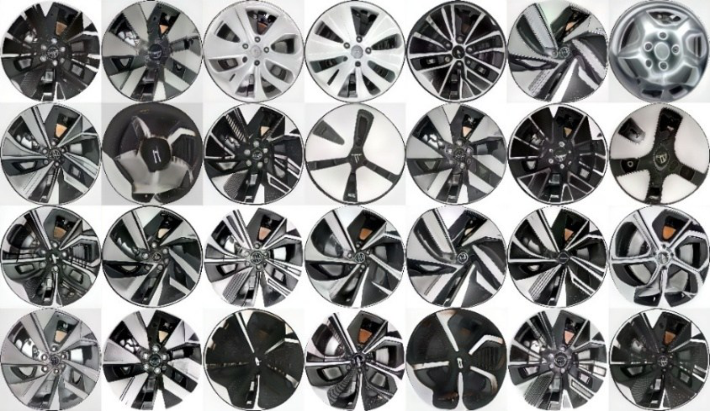
two NVIDIA GeForce RTX 3090. We used the official StyleGAN2-ADA PyTorch implementation and enabled all available augmentations for ADA. The pre-training network used the FFHQ1024 obtained by training with the original StyleGAN2 due to its high-definition resolution and rich detailed features. Other network parameters and loss function settings have not been modified and follow the original StyleGAN2-ADA implementation. After the training, the trained network is utilized to generate images. Figure 1 shows some of the generated NEV wheel hub images.
Wheel Hub Form Deconstruction First, representative samples were selected using the focus group research method. The focus group comprised 15 graduate students with more than 5 years of design experience. The images were decolorized to reduce the interference of irrelevant factors. Meanwhile, all brand logos in the sample were erased to prevent branding effects. Next, the KJ method was used to classify the 4355 images for form comparison.
Then, the focus group performed feature deconstruction on the samples. We extracted and summarized the feature parameters of the NEV wheel hub form by combining previous literature studies and the new features, as shown in Table 1. This method considers human intuitive perceptual cognition and incorporates quantitative parametric methods. While retaining as many styling features as possible, the design features are abstracted and simplified to reduce the burden of screening while improving representativeness.
Table 1: Parameters of wheel hub form features.
Table available in the original PDF paper.
Features Encoding
Product Features Feature Parameters 1 2 3 X1 Wheel hub style Mesh Spoke Mesh X2 Number of Spokes <5 5 >5 X3 Spoke Shape Straight Curved Geometric X4 Spoke Width Thin Medium Wide X5 Composition Radial Rotational Forked X6 Hollow Area Small Medium Large X7 Decorations Few Medium Many
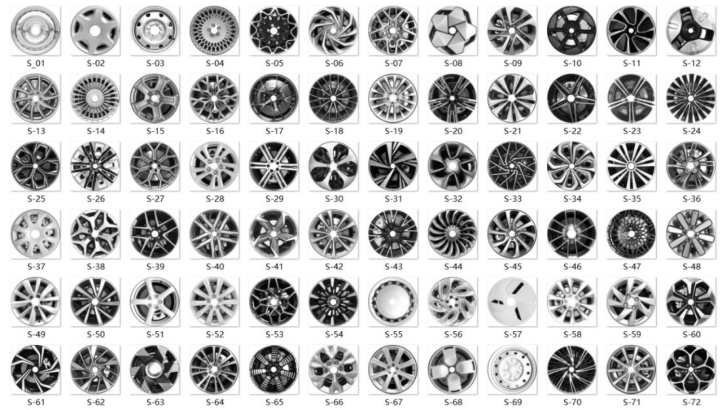
Ultimately, 72 NEV wheel hubs were screened as the final evaluation samples (see Figure 2).
Wheel Hub Emotional Demands Extraction We collected 320 adjectives describing automobiles and wheel hubs from professional publications, magazines, and research papers to construct a Kansei corpus. To reduce the cognitive load of the subjects in the subsequent evaluation, the researchers de-duplicated and clustered the Kansei words in the corpus according to their meaning and frequency. At the same time, the pair of Kansei words “Polluted - Eco-friendly” was added to consider the role of NEVs in arousing the public’s interest in cleaner production and
environmental protection. After the focus group discussion, eight pairs of Kansei words with opposite meanings were summarized for the subsequent semantic difference evaluation, as shown in Table 2.
Code Kansei Words Code Kansei Words A1- Conservative A1+ Fashion A2- Wild A2+ Elegant A3- Tough A3+ Soft A4- Mature A4+ Young A5- Affordable A5+ Luxurious A6- Fragile A6+ Solid A7- Traditional A7+ Technological A8- Polluted A8+ Eco-friendly
Wheel Hub Kansei Evaluation We aimed to investigate users’ emotional preferences and their satisfaction with the NEV wheel hubs. A total of 72 samples of wheel hubs were selected on a 7-point Likert scale for the evaluation. Each evaluation sample included nine ratings: eight Kansie word pairs and one overall satisfaction. 50 subjects were invited to participate in the Kansei evaluation experiment, aged between 18 and 30, including product designers, product managers, and graduate students in product design.
The Kansei scores (A1-A8) and satisfaction values (A) of the 72 NEV wheel hub samples were integrated into an evaluation matrix. Part of the content is shown in Table 3.
Emotion-Driven Design of New Energy Vehicle Wheel Hubs 181
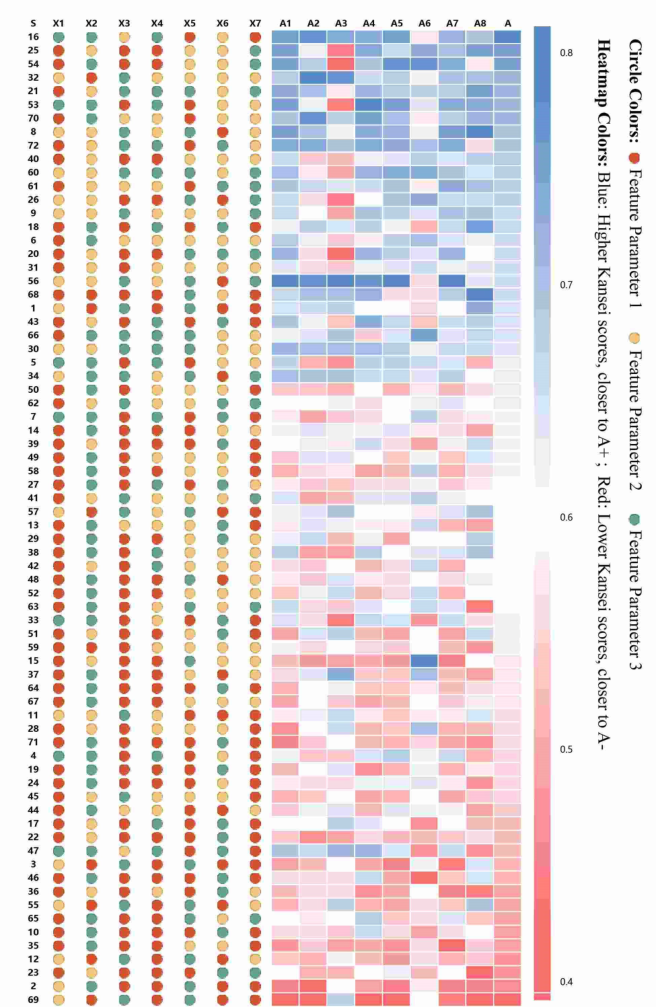
According to the Kansei evaluation matrix and parameters of wheel hub form features, we created a graphic that illustrates the relationship between form features and emotional preferences of the NEV wheel hubs by the level of satisfaction scores (Figure 3). This visualization will offer valuable insights into users’ satisfaction levels with NEV wheel hubs and how these preferences are connected to emotional needs and form features.
In Figure 3, 72 samples are reordered according to the user’s satisfaction score (A). Blue indicates a higher score, while pink indicates a lower score. By observing the color gradient, one can quickly identify which samples are favored by users and which are less well received. This visualization also reflects the corresponding segmented emotional preferences(A1-A8) and design form features(X1-X7).
In terms of emotional preferences, most of the high-score samples were characterized as fashion (A1+), elegant (A2+), young (A4+), luxurious (A5+), and technological (A7+). Secondly, the emotional preferences of “tough-soft” (A3) and “fragile-solid” (A6) did not lead to differences in high scores of satisfaction. In addition, the sense of Eco-friendliness (A8+) conveyed by the samples enhanced user satisfaction to a great extent.
Regarding morphological characteristics, the higher-scoring samples showed the form feature parameters of a moderate hollowing area (X62) with moderate decoration (X72). No significant differences were shown in other form features. The results suggest that appropriate combinations of different form features can arouse consumers’ favor.
We must be wary of the emotions aroused by the lower-scoring samples and the design features. Conservative (A1−), wild (A2−), affordable (A5−), fragile (A6−) and polluted (A8−) were associated with high levels of low satisfaction. While young (A4+) was appealing to consumers, it also ran the risk of being disliked. Besides, thin spokes (X41) as a design feature must be cautiously adopted as it may result in lower satisfaction scores.
Figure 3: Visualization of the relationship between NEV wheel hub form features and emotional preferences. In this figure, “S” represents the sample number, ranging from 1 to 72. “X1-X7” denote different design features, while the colored circles represent feature parameters (see Table 1 for details). Additionally, “A1-A8” and “A” represent Kansei scores and the satisfaction score, with Kansei classifications provided in Table 2.
Emotion-Driven Design of New Energy Vehicle Wheel Hubs 183
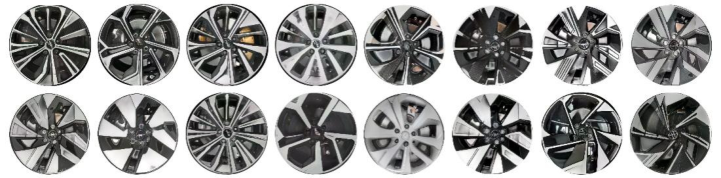
Generated Wheel Hub Selection In the previous section, we visualized the relationship between emotional preferences and form design features, which can be used to guide the selection of appropriate wheel hubs of NEV from the generated design alternatives. The following are the filtered wheel hubs (Figure 4). From this, we can observe that GANs can generate wheel hubs with a moderate hollow area and a moderate amount of decoration, which aligns with the wheel features favored by users. At the same time, the thin spoke feature is not generated, thus reducing the sense of fragility and negative user emotions.
Figure 4: Selected NEV wheel hub form design.
CONCLUSION
This study proposes a method that integrates KE and GAN. The technique employs GAN to generate images of wheel hubs, subsequently investigates the relationship between the form features of wheel hubs and user emotions through KE techniques to select design solutions that meet user emotional demands from the generated images. The contributions of this study are as follows: (1) GAN is utilized in product design to generate massive high-quality product images in short. This algorithm can be applied to design conceptualization and avoid the quality problems of design schemes caused by the subjectivity of designers. (2) KE technology can help enterprises mine user emotional demands and key form features, obtaining visualization design guidance. The selection process informed by this guidance ensures that the final design aligns with user expectations. (3) This paper proposes an emotion-driven automated design framework that combines KE and GAN, which can provide manufacturers with insights and solutions on user emotional preferences and thus maintain an edge in a competitive market.
However, the study has limitations, including a small sample size and participant numbers, potential bias in representing complex emotions with simple adjectives, and reliance on structured design deconstruction. Future work should explore larger datasets, integrate physiological measures, and utilize more detailed feature characterizations to improve the proposed framework.
REFERENCES
Burnap, A., Hauser, J. R., Timoshenko, A. (2023). Product Aesthetic Design: A Machine Learning Augmentation. Mark. Sci. Chang, Y.-M., Chen, C.-W. (2016). Kansei assessment of the constituent elements
and the overall interrelations in car steering wheel design. Int. J. Ind. Ergon. 56, 97–105. Gan, Y., Ji, Y., Jiang, S., Liu, X., Feng, Z., Li, Y., Liu, Y. (2021). Integrating aesthetic and emotional preferences in social robot design: An affective design approach with Kansei Engineering and Deep Convolutional Generative Adversarial Network. Int. J. Ind. Ergon. 83, 103128. Goodfellow, I. J., Pouget-Abadie, J., Mirza, M., Xu, B., Warde-Farley, D., Ozair, S., Courville, A., Bengio, Y. (2014). Generative Adversarial Networks. Jin, Y., Zhang, J., Li, M., Tian, Y., Zhu, H., Fang, Z. (2017). Towards the Automatic
Anime Characters Creation with Generative Adversarial Networks. Kang, X. (2021). Combining rough set theory and support vector regression to the sustainable form design of hybrid electric vehicle. J. Clean. Prod. 304, 127137. Kang, X., Yang, M., Wu, Y., Ni, B. (2018). Integrating Evaluation Grid Method and
Fuzzy Quality Function Deployment to New Product Development. Math. Probl. Eng. 2018, 2451470. Karras, T., Aittala, M., Hellsten, J., Laine, S., Lehtinen, J., Aila, T. (2020a). Training Generative Adversarial Networks with Limited Data [WWW Document]. arXiv.org. Karras, T., Laine, S., Aila, T. (2019). A Style-Based Generator Architecture for
Generative Adversarial Networks. Karras, T., Laine, S., Aittala, M., Hellsten, J., Lehtinen, J., Aila, T. (2020b). Analyzing and Improving the Image Quality of StyleGAN. Lai, X., Zhang, S., Mao, N., Liu, J., Chen, Q. (2022). Kansei engineering for new
energy vehicle exterior design: An internet big data mining approach. Comput. Ind. Eng. 165, 107913. Li, X., Su, J., Zhang, Z., Bai, R. (2021). Product innovation concept generation based on deep learning and Kansei engineering. J. Eng. Des. 32, 559–589. Nagamachi, M. (1995). Kansei Engineering: A new ergonomic consumer-oriented
technology for product development. Int. J. Ind. Ergon., Kansei Engineering: An Ergonomic Technology for product development 15, 3–11. Qi, Y., Kim, K., (2024). Evaluation of electric car styling based on analytic hierarchy process and Kansei engineering: A study on mainstream Chinese electric car brands. Heliyon 10, e26999. Radford, A., Metz, L., Chintala, S. (2016). Unsupervised Representation Learning
with Deep Convolutional Generative Adversarial Networks. Sutono, S. B., Abdul-Rashid, S. H., Taha, Z., Subagyo, Aoyama, H. (2017).
Integration of grey-based Taguchi method and principal component analysis for multi-response decision-making in Kansei engineering. Eur. J. Ind. Eng. 11, 205–227. Wang, Z., Niu, S., Fu, C., Hu, S., Huang, L. (2024). Advancing data-driven sustainable design: A novel NEV form design approach in China’s market. J. Clean. Prod. 461, 142626. Zimo, C., Hailong, F., Yajun, L., (2024). A Front Face Design of New Energy Vehicles
Based on Rough Set Theory and Backpropagation Neural Network, in: Kansei Engineering. Presented at the AHFE (2024) International Conference, AHFE Open Access.
LISTED IN THE AHFE DIGITAL BOOKSTORE CATALOGUE
Explore the complete digital volume
Ergonomics In Design and Kansai Engineering
Read this individual research paper free through the original publisher, or explore the full digital proceedings book.
ISBN 978-1-964867-46-5
Explore this ISBN in the AHFE Bookstore ↗Listed in the July 2026 bookstore catalogue; search by ISBN to confirm current availability · Digital book purchase optional