Menghan Xia, Meiyu Zhou (2025). Handheld gimbal camera design based on Kansei Engineering and TRIZ. In: Ergonomics In Design and Kansai Engineering. AHFE Open Access, vol. 170, pp. 185–194. https://doi.org/10.54941/ahfe1006180
In order to solve the problems of common appearance, lack of personalization, and unclear function description in the design of handheld gimbal cameras, and to help designers optimize their design solutions through users' emotional needs and technological innovations, this study proposes a handheld gimbal camera design method based on Conformal Engineering (KE) and TRIZ theory. Through literature research and a questionnaire survey, we screened 10 pairs of semantic words that match the appearance imagery of handheld sports cameras and designed a questionnaire under the guidance of the semantic difference method to be distributed to young designers and the main user groups of handheld sports cameras. After recovering the questionnaires, through factor analysis, we extracted the core perceptual factors influencing users' preferences. Based on this, the key challenge of the design, i.e., the gap between ideal and reality, was analyzed and summarized. According to the principle of multiple inventions of TRIZ, we solved three pairs of technical contradictions and proposed a modular design and interaction optimization scheme. Finally, a portable handheld gimbal camera prototype for the young group was designed and validated. The approach synthesizes cross-domain methods, considers user emotions and technical feasibility, and provides a new way of thinking for the design of handheld sports cameras.
In the context of the proliferation of internet technology and the concomitant growth of the Internet economy, there has been a notable increase in individuals electing to share their personal lives on social platforms. According to data from the China Market Research Group (CMRC), the handheld gimbal market in China is undergoing substantial growth. Projections indicate that this market will reach a valuation of 2.73 billion yuan by 2025, with an anticipated annual growth rate of 16.6% (ChinaIRN, 2024). This trend has catalyzed a surge in innovation within the domain of handheld gimbal technology, giving rise to novel forms such as the integration of a gimbal with a camera, a subject that will be explored in this article. This innovative device integrates the functions of a gimbal, offering stabilization, along with those of a camera, thereby combining the professional capabilities of the former with the portability of the latter. Consequently, it has garnered
significant popularity among fashion-conscious young adults, particularly those in their 20s and 30s, becoming a prevalent tool for daily video recording.
Presently, the handheld gimbal camera market is undergoing rapid expansion, accompanied by both opportunities and challenges. From a styling design perspective, the products exhibit a high degree of homogeneity and a paucity of aesthetic innovation, failing to stimulate the emotional resonance of users and meet their diversified and personalized needs in terms of product performance and experience. While numerous studies have been conducted on handheld gimbals, there remains a dearth of research on handheld gimbal cameras, a refined product field. This study draws upon the principles of perceptual engineering, employing a multifaceted approach that encompasses the analysis and quantification of users’ perceptual needs, the capture and evaluation of their subtle sentiments and design preferences, and the integration of advanced TRIZ theory concepts and tools to address the technical challenges and conflicts inherent in the design process of handheld gimbal cameras. The overarching objective of this study is to achieve a dual enhancement of product functionality and emotional value.
RELEVANT CONCEPTS AND RESEARCH METHODOLOGY Handheld Gimbal Camera
A handheld gimbal camera is a device that integrates camera and gimbal technologies, primarily utilized to capture stabilized images in diverse shooting scenarios. A handheld gimbal camera is composed of two modules: a handle module and a camera module. Typically, gyroscopes, motors, and other components are integrated into the camera, enabling it to detect and compensate for camera shake. In comparison to a cell phone, a handheld gimbal camera provides smoother and more fluid footage, while offering greater flexibility and portability than a traditional external handheld gimbal. The contemporary handheld gimbal camera is primarily classified into two categories: consumer-grade and professional-grade. Consumer-grade products are predominantly associated with daily life application scenarios, such as vlog shooting, outdoor sports records, selfies, and similar activities. In contrast, professional-grade products are primarily utilized in the film and television industry. A survey of prominent domestic e-commerce platforms reveals a preponderance of consumer-grade handheld gimbal cameras.
A Research Framework for Combining KE and TRIZ Kansei Engineering, which originated in Japan, is a design methodology that combines human emotional needs with engineering technology. The core idea of KE is to transform consumers’ perceptual needs into design elements and to realize the emotional design of products through engineering technology (Li Yanzu, 2003). This method is used in the product design stage to help designers create products that meet users’ expectations.
TRIZ theory, or “Theory of Inventive Problem Solving”, is a systematic approach to innovative problem solving proposed by Soviet expert
Handheld Gimbal Camera Design Based on Kansei Engineering and TRIZ 187
G. S. Altshuller and others in 1946 (Li et al., 2021). The theory’s methods and tools, such as the Contradiction Matrix, Substance Field Analysis, and Invention Problem Solving Algorithm, can help innovators standardize and abstract complex problems and find effective solutions. Therefore, the application of TRIZ theory is of great significance in promoting technological innovation and product development.
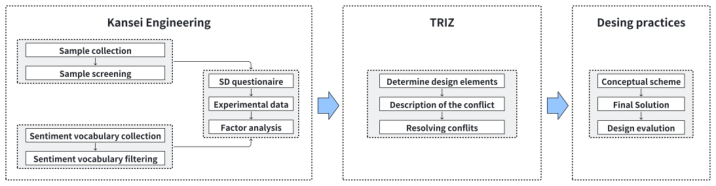
In the field of handheld gimbal cameras, previous research has mainly focused on gimbal technology and neglected product design. Starting from the perspective of user experience, Ouyang Haifugui et al. used Python to analyze user requirement data to design the handheld gimbal camera and its accompanying APP, which enhanced its playability (Ouyang Haifu, 2021). Zhao Junjing et al. took three typical samples of sports cameras with different styling styles as research objects and conducted perceptual evaluation tests based on the semantic differential method and eye-tracking experiments on sports camera consumers (Zhao et al., 2024). Others used the Kano model to locate users’ needs for handheld gimbals at the level of function and form from a functional perspective (Meng, 2022). These studies selected a small research sample and combined handheld gimbal and handheld gimbal cameras, which lacked specificity. Based on the previous research experience, the research framework adopted in this study is shown in Figure 1. This research focuses on a handheld gimbal camera with an integrated camera and gimbal, and a complete research path is designed by combining KE and TRIZ.
Figure 1: Technology roadmap for handheld gimbal camera research integrating KE and TRIZ.
RESEARCH PROCESS OF HANDHELD MOTION CAMERA BASED ON KE AND TRIZ Sample Selection for Handheld Sports Camera Design Study
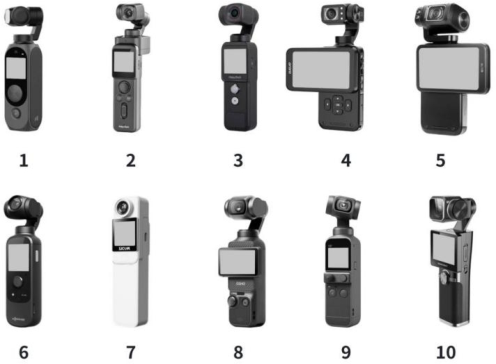
This study utilizes a variety of information collection channels, including but not limited to well-known domestic and international shopping platforms, professional magazines, advertising media, and in-depth perceptual engineering research results and product review feedback. These channels are used to comprehensively collect handheld gimbal camera samples. Following a thorough analysis and comparison process, 10 samples were identified as the most representative, encompassing seven distinct brands. Subsequently, the images of the ten samples were decolorized, and the contents of the
188 Xia and Zhou
camera display were uniformly masked. The results are shown in Figure 2, which was created to reduce perceptual errors caused by angles and colors.
Figure 2: Sample picture and ID.
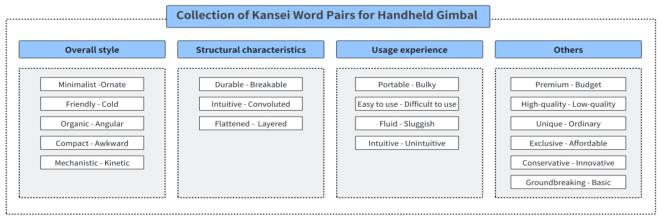
Sentiment Vocabulary Collection of Appearance Intentions for Handheld Sports Cameras A comprehensive review of pertinent materials, encompassing but not limited to meticulous product descriptions of handheld sports cameras, promotional content, feedback sections on e-commerce platforms, and industry updates, was undertaken to ascertain prevailing linguistic tendencies and expressions reflecting user sentiment. To ensure the relevance and practicality of the vocabulary, the collected adjectives were preliminarily sorted, eliminating those that were infrequently used or highly repetitive in meaning. At the same time, adjectives with opposite meanings were merged to reflect contrast and balance in the subsequent design evaluation. The card sorting method was employed to systematically categorize and preliminarily screen the perceptual vocabulary database. A total of 17 pairs of perceptual vocabulary words in four categories were ultimately selected (see Figure 3).
Figure 3: Sensory vocabulary collection.
Handheld Gimbal Camera Design Based on Kansei Engineering and TRIZ 189
SD Questionnaire Production and Distribution The SD questionnaire was created through discussions with professional designers, who extracted six pairs of words that best reflected the perceptual imagery of the camera. These pairs included “budget - premium,” “cold - friendly,” “breakablee - durable,” “difficult to use - easy to use,” “bulky - portable” and “conservative - innovative”. The semantic difference scale for word pairs was constructed by forming a questionnaire with 10 representative samples and 6 pairs of representative perceptual words and asking 78 respondents to score each representative sample for each of the 6 pairs of adjectives. This questionnaire employed a five-point scale ranging from 1 to 5, with labels reading “trongly disagree,” “disagree,” “neutral,” “agree,” and “strongly agree”, to accurately gauge the extent to which respondents concurred with the descriptions of the preset terms.
ANALYSIS OF RESULTS Principal Component Analysis (PCA) was utilized as the primary analytical instrument, demonstrating efficacy in identifying and extracting the key components, or principal components, of users’ perceptual needs for handheld gimbal cameras. This approach facilitated the simplification and revelation of the predominant trends and patterns underlying the data. The KMO (Kaiser-Meyer-Olkin) sphericity test was conducted on the collected data, and the KMO coefficient was 0.678, which is higher than the threshold of 0.6. The significance level of the P-value was 0.02, indicating that the data is suitable for factor analysis, i.e., the data of the questionnaire is valid and suitable for further dimensionality reduction by the PCA method.
Table 1: Total variance interpretation.
Table available in the original PDF paper.
Factors Initial Eigenvalues Extract the Sum of Squared
The sum of the initial eigenvalues and the sum of squares of the rotated loadings in the two male factors is greater than one (see Table 1). This finding indicates that the two principal components have a significant impact on the handheld gimbal camera design. The total cumulative variance ratio of the two principal components after rotation through the matrix is 78.519%, indicating that the two factors explain 78.519% of the variation in the data.
The rotated component matrix was employed to further select the perceptual vocabulary. The term “bulky - portable” exhibited the highest loading on component 1, while “budget - premium” demonstrated the highest loading on component 2 (see Table 2). Consequently, the terms “portable” and “premium” emerged as the primary design considerations
190 Xia and Zhou
for the subsequent camera model. Consequently, the subsequent design will prioritize the “portable” and “premium” nature of the camera.
Table 2: Rotated component matrix.
Table available in the original PDF paper.
Pairs Factors
1 2
Bulky – Portable 0.915 Breakable – Durable 0.878 Conservative – Innovative 0.825 Difficult to use - Easy to use 0.688 Budget – Premium 0.873 Cold – Friendly 0.851 The following sample analysis of the word pair “bulky - portable” is provided: Sample 7 has the highest mean score for the word pair bulky- portable (see Table 3). An analysis of the product reveals a simple shape devoid of excessive embellishments, with the camera and handle exhibiting a square design that provides a more consistent aesthetic compared to other hammer-shaped cameras. The absence of camera protrusion during transportation further enhances its portability. Conversely, Samples 4 and 5 received lower average scores for the term. A subsequent analysis of their morphological characteristics revealed that both samples possess a wide, square body and a rotating screen that is more visually appealing and contributes to a heavier overall feel. To enhance the portability of handheld gimbal cameras, it is imperative to prioritize the reduction of their lateral dimensions during the design process.
The following analysis examines the word pair “budget - premium”: The highest average score for the word pair “budget - premium” was received by sample 8, which is DJI’s Pocket3. As illustrated by the images, the Pocket3 boasts a diverse array of design elements, incorporating various shapes and combinations, along with intricate design elements in the handle. These elements leverage differences in size and material to distinguish the functions of the buttons, thereby evoking a sense of “premium”for the user. In contrast, Sample 10 features a handle that differentiates through the material, yet it does not evoke a sense of “premium.” It is imperative to incorporate function-oriented embellishments judiciously during the design process to avoid overwhelming the user with excessive adornments, which can impede the intended functionality.
Table 3: The average scores of each sample across the six word pairs.
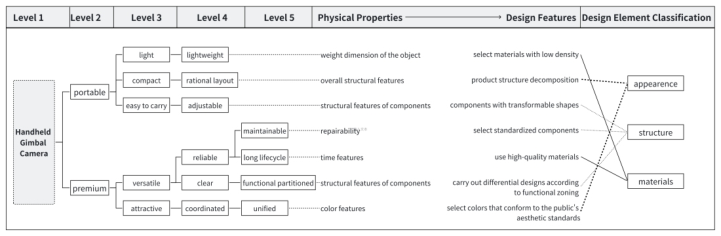
HANDHELD SPORTS CAMERA DESIGN ANALYSIS USING TRIZ METHODOLOGY The determination of design elements is achieved through analysis using the hierarchical category analysis method. The design hierarchy of the camera is illustrated in Figure 4. The various line types depicted in Figure 4 serve to distinguish between different design element classifications.
Figure 4: Design analysis based on two key sentiment words derived from factor analysis.
Description of contradictions: Combined with the class category analysis method, it is learned that the current design elements are mainly divided into three categories: appearance (color, elements), structure (volume, reparability, parts), and materials (density, type). The invention principle and the contradiction matrix composed of 39 technical parameters are applied to solve the technical and physical conflicts in the camera design process. Through the analysis, three groups of conflicts were found to exist, which were transformed into a TRIZ problem model (see Table 4).
Table 4: Conflict problem analysis based on TRIZ theory.
Table available in the original PDF paper.
Conflict No. Conflict Description Types of
Universal Engineering Contradictions Parameter
1 Multifunctional,
Technical
Compact size
Contradiction (TC)
8. Volume of stationary object 35. Adaptability/U- niversality Continued
192 Xia and Zhou
Table 4: Continued Conflict No. Conflict Description Types of
Table available in the original PDF paper.
Universal Engineering Contradictions Parameter
2 Functional partitioning
Technical Contradiction (TC)
33. Operability 36. Complexity of System
for clear operation, Flat surface for easy storage
3 Rounded shape with a
Physical
12. Shape
Contradiction (PC)
friendly feel, Square shape for easy storage For the above 3 contradictions, TRIZ 40 Invention Theory was utilized to solve them (see Table 5).
Table 5: Using TRIZ invention theory to solve conflicts 0.
Table available in the original PDF paper.
Conflict No. Types of Contradictions TRIZ Invention Theory Solutions 1 TC 5. Combination 2 TC 3. Local Quality 3 PC 14. Spheroidality principle
In addressing the technical contradiction between the necessity for functional versatility and the demand for a compact body, a combination solution was implemented, entailing the integration of components that perform analogous operations, thereby reducing spatial requirements. Internally, the integrated circuit board diminishes the size of multiple components, while externally, the integrated design reduces the operational area through the incorporation of buttons for diverse function orientations.
Addressing the necessity for distinct functional zoning for operation and a flat surface for effortless storage, a local quality solution is implemented, even though different components of the object possess varying functions, through the separation of the grip area and the operation area of the hand. The hand-held gimbal camera is designed to modify the product’s status over time through a sliding cover or other mechanisms, including rotation, to alter its operational mode.
The physical contradiction between rounded and square shapes is addressed by adopting the principle of spherical shape. The camera part is designed with partial rounded lines, and the body is designed with partial square lines. These designs are adjusted through suitable transition maneuvers to satisfy the visual aesthetics demand.
DESIGN PRACTICE To resolve the three pairs of conflicting conflicts that were previously identified, the relevant inventive principles were examined to determine the optimal design decision. Users must exercise control over the camera’s lens direction during the utilization of the sports camera. The integration
Handheld Gimbal Camera Design Based on Kansei Engineering and TRIZ 193
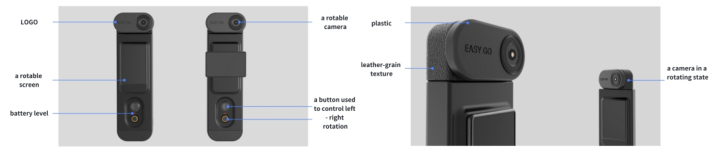
of the four distinct directional buttons into a singular button facilitates the adjustment of the lens direction through left and right shaking, employing remote sensing. This configuration aligns more closely with human cognition, thereby enhancing the operational experience. The product’s design incorporates a one-piece directional structure, inspired by the handling of sample 7, and features a regular shape that conveys a sense of orderliness. The primary function of the sports camera is the “movable camera,” which utilizes different shapes to emphasize the lens part, taking into account the proportion of the structure without compromising the integrity of the product. It also has the characteristics of a clear division of priorities. The culmination of these design principles is illustrated (see Figure 5). The “EASY GO” handheld gimbal camera, as depicted in Figure 6, features a square shape with rounded corners. The device is equipped with functionalities for both shooting and browsing displays. Its ergonomic design enables 360
rotation, achieved by manipulating the device’s orientation with the remote control. This feature enhances the user’s ability to compose images with optimal framing. The screen supports manual rotation, and the user can easily select horizontal or vertical preview.
Figure 5: Design analysis based on two key sentiment words derived from factor analysis.
In this study, design evaluation was conducted in the form of radar charts, and Sample 8 (DJI POCKET3), which was rated high in terms of overall qualities, was selected as the comparative product to be scored. “EASY GO” exceeds Sample 8 in terms of portability, friendliness, durability, and ease of use. In comparison, Sample 8 is more upscale and innovative, and it has more advantages in material, craftsmanship, and camera shape. Taken together, EASY GO’s radar map is larger, resulting in a positive design outcome for this practice.
CONCLUSION
This study analyzes the design of a handheld gimbal camera by integrating perceptual engineering and TRIZ methods. In comparison with previous studies, the scope of the present study has been refined to elucidate the distinction between a handheld gimbal camera and a handheld gimbal. Secondly, an extensive collection of research samples has been undertaken to ensure the generalizability of the research results. The integrated utilization of TRIZ innovation has yielded solutions for the design of a handheld sports camera. Lastly, a new handheld sports camera has been designed through
194 Xia and Zhou
design practice. This study contributes to the theoretical framework and practical methods in the field of handheld gimbal camera design, while also providing valuable references and inspirations for the future development and innovation of this industry. The objective is to promote the design of handheld gimbal cameras to move forward in the direction of being more humanized, intelligent, and emotional.
However, the study is not without its limitations. In the design practice section, the optimization of the internal structure of handheld sports cameras can be studied in depth in the future. The survey instrument of this study primarily focuses on young designers and users aged 20–30 years, with the potential for expansion to encompass a more diverse sample for future research.
REFERENCES
ChinaIRN. (2024). Research Report on In-depth Market Analysis and Investment Strategy of China’s Handheld Gimbal Industry from 2024 to 2029. The ChinaIRN Website: https://www.chinairn.com/report/20240531/ 092114418.html?id=1907489&name=HuangWenYu (in Chinese). Li Xiong, Su Jianning, Zhang Zhipeng, and Bai Ruisheng. (2021) Product Innovation Concept Generation Based on Deep Learning and Kansei Engineering. Journal of Engineering Design, 32(10), pp. 559–589. Li Yanzu. (2003). New Design Concept: Kansei Engineering. New Arts, (04),
pp. 20–25. (in Chinese). Meng, Y. (2022). Research on the Design of Handheld Gimbals Based on KANO Model. In: Soares, M. M., Rosenzweig, E., Marcus, A. (eds) Design, User Experience, and Usability: Design Thinking and Practice in Contemporary and Emerging Technologies. HCII 2022. Lecture Notes in Computer Science, vol. 13323, pp. 200–212. Ouyang Haifu. (2021). Research on the Design of Handheld Gimbals and Supporting
App Based on User Experience. Harbin University of Science and Technology. (in Chinese). Zhao Junjing, Wang Xuelin. (2024). Research on the Shape Design of Action Cameras Based on Eye - tracking Experiments. Design, 37(07), pp. 112–115. (in Chinese).
LISTED IN THE AHFE DIGITAL BOOKSTORE CATALOGUE
Explore the complete digital volume
Ergonomics In Design and Kansai Engineering
Read this individual research paper free through the original publisher, or explore the full digital proceedings book.
ISBN 978-1-964867-46-5
Explore this ISBN in the AHFE Bookstore ↗Listed in the July 2026 bookstore catalogue; search by ISBN to confirm current availability · Digital book purchase optional