This research investigates innovative methodologies in product design, focusing on enhancing usability and customer satisfaction through the integration of the Theory of Inventive Problem Solving (TRIZ) and Human-Centered Design (HCD).Product design is a continual process aimed at meeting and improving both product functionality and user needs. The innovative aspect of this research lies in the organic integration of TRIZ with HCD, initiating the design process from a human-centric perspective.TRIZ theory, renowned for its effectiveness in innovation and invention, is employed to tackle these challenges.It does so by utilizing its set of 40 inventive principles to craft design solutions that not only address these challenges but also advance product innovation. And the HCD principles, user needs are effectively transformed into design challenges, facilitating clearer problem definition. Consequently, the integration of TRIZ and HCD emerges as a potent tool in the realm of product design, effectively harmonizing technical problem-solving with user-centric design considerations.Accurate identification and fulfillment of user needs are crucial for successful product design. While TRIZ offers a structured approach focused on technical and engineering problem-solving, facilitating systemic innovation, it may fall short in addressing the nuances of user needs and experiences. Conversely, HCD focuses on analyzing user requirements and experiences but may lack strategies for complex technical challenges.Addressing these gaps, the paper proposes a novel product design methodology that synergizes TRIZ’s logical and systemic problem-solving framework with the insights into user needs afforded by HCD.This fusion is designed to surmount the inherent limitations of each approach, aiming for holistic optimization in product design.A detailed case study of a capsule heater design showcases how TRIZ’s methodical problem-solving capabilities can be seamlessly integrated with the user-centric philosophy of HCD, adeptly balancing technical and user-based design challenges.The study highlights the importance of this integrated methodological approach in industrial design, especially in addressing complex user requirements and navigating market challenges.Acknowledging its limitations, this study recognizes the need for contextual adaptation when applying the TRIZ-HCD integration across different product types and market conditions.In future research, we aim to expand the scope by integrating additional design theories and methods to construct a more comprehensive design model, capable of addressing a broader spectrum of design challenges. Furthermore, while the current case study primarily focuses on the improvement of existing market products, subsequent in-depth studies will explore the application of this refined methodology to the innovative design of new products, assessing its adaptability across diverse cultural and economic landscapes.In conclusion, this research contributes to enhancing product usability and customer satisfaction, providing valuable theoretical and practical insights for ongoing and future applications in industrial design.
Product Innovation Design Through Integrated TRIZ-HCD Methodological Approach 209
INTRODUCTION
The innovation and application of design methods play a pivotal role in providing effective guidance for product design, ultimately leading to height- ened usability and increased user satisfaction. Central to successful product design is the careful consideration of user requirements, and the precise identification of these needs stands as a critical factor for success. Among various innovative methodologies, the Theory of Inventive Problem Solving (TRIZ) finds extensive application in engineering and design fields. Concur- rently, the Human-Centered Design (HCD) approach has been a longstanding methodology applied across diverse domains within product design.
This paper delves into the innovative redesign of a heater. Initially, prod- uct improvement design is undertaken, taking into account the functional requirements and adhering to specified constraints. Subsequently, a compre- hensive user needs analysis is conducted based on the HCD design philos- ophy. This is complemented by the integration of relevant design principles derived from the TRIZ theory. The fusion of TRIZ and HCD theories results in the development of a rational, integrated approach and process tailored for solving practical design problems. This comprehensive methodology aims to refine existing user practices, enhance product usability, and elevate overall user satisfaction.
INNOVATIVE DESIGN INTEGRATION OF TRIZ AND HCD TRIZ Theory
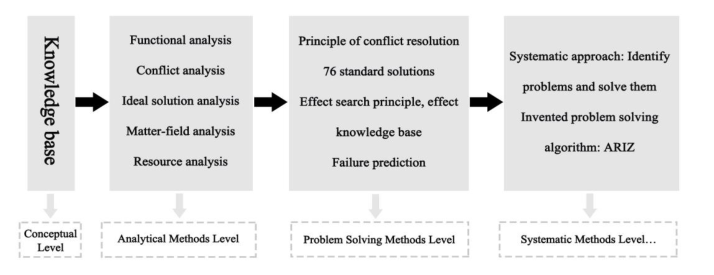
In 1964, the Soviet inventor Genrich Altshuller summarized extensive research on inventions and proposed the Theory of Inventive Problem Solving (TRIZ). This theory involves the application of tools such as the contradic- tion matrix, 76 standard solutions, ARIZ (Algorithm for Inventive Problem Solving), Anticipate Fault Determination (AFD), substance-field analysis, Innovative Situation Questionnaire (ISQ), Directed Evolution (DE), eight evolution trends, and scientific effects. These tools collectively serve to address inventive problems. The TRIZ theoretical framework is illustrated in Figure 1.
Figure 1: TRIZ theory system.
The core tenet of TRIZ theory is to furnish innovative solutions to con- tradictions and conflicts inherent in the realm of design, thereby catalyzing design innovation in products. The evolutionary trajectory of a product is marked by the continual resolution of conflicts intrinsic to the product itself. In the TRIZ framework, conflicts manifest primarily as physical, technical, and managerial in nature. Technical conflicts are systematically addressed through the Technical Contradictions Matrix, which endeavors to pinpoint optimal solutions for these conflicts. This matrix encompasses 39 major tech- nical parameters and 40 inventive principles, unveiling overarching patterns that govern innovation optimization in products. This methodology finds pri- mary application in the domain of technological innovation, offering insights into the systematic principles governing innovative design.
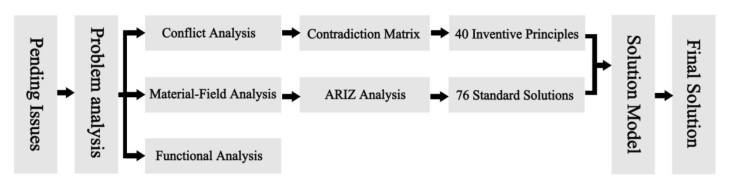
A pivotal facet of addressing inventive challenges within the TRIZ frame- work is the adept handling of conflicts. The approach to problem resolution is contingent upon the clarity of its description or formalization. The more lucid the depiction, the more straightforward it becomes to discern the ulti- mate solution. Throughout this iterative process, the system incrementally converges towards an ideal solution, while the underlying nature of the problem progressively comes to the fore, leading to finer subdivisions until conflicts in technical, physical, and other dimensions are distinctly identi- fied. When a specific problem metamorphoses into a TRIZ problem, the application of the table of 39 major technical parameters aids in delineat- ing corresponding approaches, deriving a solution for the problem at hand, and subsequently formulating a specific resolution for addressing the initial predicament.
Figure 2: Problem solving model of TRIZ theory.
HCD Theory HCD (Human-Centered Design) is a design theory that places humans at the forefront, advocating the prioritization of human considerations throughout the design process, catering to both basic physiological and psychological needs. The theory places humans at the core of research objectives through- out the entire product lifecycle, maintaining close connections with different individuals at different stages, readily incorporating user feedback, and utiliz- ing research findings to guide the enhancement of product user experiences, ultimately serving people better. Humans are not only the discoverers of product issues but also the problem solvers and primary beneficiaries of prod- uct optimization within the HCD framework. The standards of HCD draw
Product Innovation Design Through Integrated TRIZ-HCD Methodological Approach 211
from various fields such as human-computer interaction, computer science, and artificial intelligence, internationally recognized as ISO 9241-210, titled “Ergonomics of Human-System Interaction – Part 210: Human-Centered Design for Interactive Systems.” Under this standard, HCD is defined as a sys- tematic research and design method aimed at improving efficiency, enhancing human well-being, user satisfaction, accessibility, and sustainability. It also seeks to counteract adverse effects on human health that may result from use, ensuring safety and high performance.
The design methods and theories based on HCD necessitate comprehensive observation of user behavior from the outset of the design process, focus- ing on natural user behaviors, product usage goals, psychological changes during product usage, etc. This approach uncovers genuine user needs, prior- itizes those needs, and subsequently refines product functionality accordingly. HCD theory initiates product innovation at its source, elevates product qual- ity, enhances user awareness of the product, and improves the commercial viability of the product.
It is noteworthy that people often easily equate HCD with UCD. HCD the- ory is proposed based on User-Centered Design (UCD), with the distinction lying in the different scopes of their target populations. The term “User” in UCD primarily refers to users in the traditional sense, with a clear focus on individuals carrying out operational tasks. On the other hand, “Human” in HCD stems from humanity itself, centered on human needs and emphasizing a broader consideration of human requirements and values. Compared to UCD, HCD adds a layer of philosophical significance. In this sense, the cate- gory of Human is more extensive, encompassing not only users of a product but also various stakeholders in a product or system. Additionally, factors such as culture, tradition, regional environment, values, and dignity are also considered within the scope of HCD theory.
The primary research methodology of HCD is ethnography. There are five other research methods: scenario design, empathy design, participa- tory design, lead user approach, and collaborative design. Ethnography is an anthropological method that underscores understanding human perspec- tives and experiences, prioritizing people in research. It requires researchers to engage in users’ lives for an extended period, observe user behavior in nat- ural settings, conduct interviews with users, play the role of users to gather necessary information, and collect user requirements and usable data. This approach aims to comprehend existing issues, user preferences, and stake- holders’ concerns about the product, aligning with the core principle of human-centered design.
The design methodology of Human-Centered Design (HCD) involves several key stages: User Research and Interviews: In the early stages of design, it is crucial to identify various user groups within the system, as different user segments have distinct needs and expectations from the product’s features and services. Conducting in-depth investigations into users’ environments and contexts, employing evaluation methods such as interviews, diary studies, etc., aids in understanding users’ backgrounds and establishing resonance.
User Requirement Acquisition: User requirements stem from the interac- tions between users and the product or system. Understanding users’ actions and behaviors is essential in determining their needs.
Design Based on User Requirements: Designing solutions that meet users’ usage requirements, resulting in tangible product innovations or intangible service innovations.
User Evaluation: Evaluation is conducted by expert groups or target audi- ence users simulating real usage scenarios and authentic usage contexts. The conclusions drawn from these evaluations serve as feedback to further optimize the product.
Ideas of TRIZ-HCD Integrated Innovation Method The core of design innovation based on TRIZ theory lies in abstracting the problems to be addressed, namely constructing relevant contradiction matrices representing the primary contradictions faced in product design. However, TRIZ theory itself does not identify contradictory issues in product design; instead, TRIZ tools are needed to discover design contradictions.
On the other hand, Human-Centered Design (HCD) starts with human needs. In the early analysis and planning stages, it determines the primary contradictions in product design through user research, needs analysis, and design positioning. HCD considers specific users and their contextual rela- tionships as its main principles. While HCD regards people as the focal point of development, TRIZ theory prioritizes physical and technical con- tradictions. Both approaches follow a similar framework, progressing from research and analysis to solution generation and evaluation.
If we divide the innovation process of a product system into four steps: problem discovery, tool selection, solution generation, and evaluation, then in the first stage, HCD primarily emphasizes problem discovery. Although TRIZ tools can also be used in the problem definition stage, TRIZ typically defines the problem space based on managerial needs, marketing perspectives, or insufficient information derived from experience, rather than through user research. Therefore, by organically combining TRIZ and HCD, HCD’s user needs analysis is used to determine design contradictions in the initial design phase, and the identified design contradictions are then introduced into TRIZ theory. Subsequently, TRIZ tools are employed to construct a contradic- tion matrix, followed by the application of inventive principles to solve contradictory problems, thereby achieving innovation in product design.
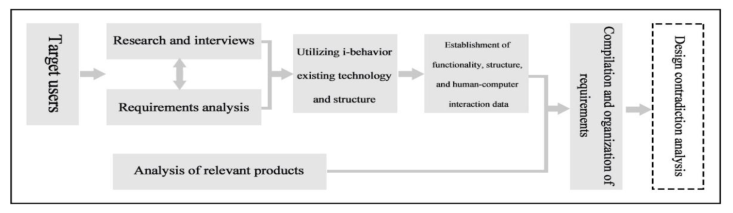
Product Innovation Design Model of TRIZ-HCD Integrated Method Constructing the TRIZ-HCD integrated method’s product innovation design model based on the approach of the TRIZ-HCD integrated innovation method. As illustrated in the diagram below, this model primarily involves combining TRIZ and HCD to identify the main contradictions in product design. Initially, a user survey and related needs analysis are conducted for the target users of the product. Based on this, the positioning of the relevant product is determined, and an analysis of the problems existing in the prod- uct design is performed to identify and analyze contradictions. Subsequently,
Product Innovation Design Through Integrated TRIZ-HCD Methodological Approach 213
considering factors related to human-computer functionality based on user needs, an analysis and synthesis of technical issues related to the product’s functions, structure, materials, and design are conducted to derive the design contradictions of the product.
In the process of resolving the contradictory issues, the TRIZ theory and its tools are employed to construct a contradiction matrix for solving the identified contradictions, resulting in new design solutions. Finally, a user satisfaction survey is conducted to validate the proposed solution, guiding subsequent iterative designs to ultimately establish the product’s design plan.
Figure 3: Product innovation design model based on TRIZ-HCD integration method.
DESIGN OF CAPSULE HEATER BASED ON TRIZ-HCD INTEGRATED METHOD User Demand Analysis
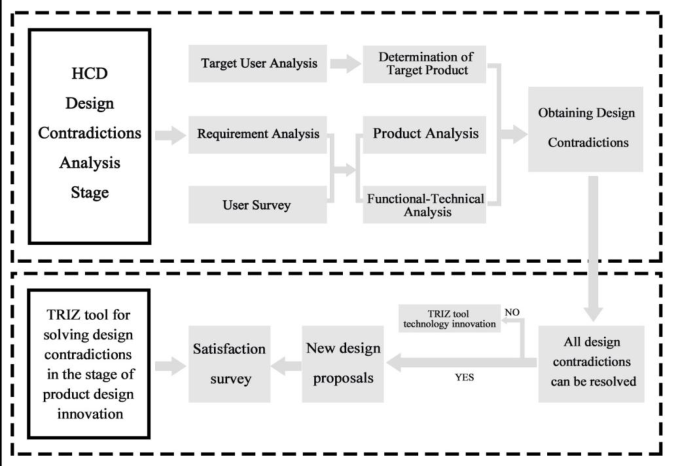
Analysis of user requirements using the HCD theory is the foundation for identifying and determining contradictions in the design of the capsule heater. Initially, an analysis of user requirements and satisfaction is conducted, con- sidering aspects such as user usage patterns, methods of use, human-machine interaction processes during product use, and the product’s usage environ- ment. Through the analysis of these design elements, the goal is to ensure the capsule heater’s effective performance and a positive user experience. Inte- grated with the TRIZ-HCD integrated method’s product innovation design model, an analysis of user requirements for the capsule heater design is conducted. The TRIZ contradiction matrix is then employed to address issues related to the heater’s functionality, structure, usage methods, and
human-machine interaction. The process of obtaining contradictory anal- ysis in design is finalized, as illustrated in Figure 4. The identification of design contradictions primarily stems from user group requirement surveys, obtaining innovative points in product design through analysis. This involves determining the product’s fundamental functions, interaction levels based on user needs and behavior, and acquiring technical data and information related to the product’s manufacturing, styling, and functional construc- tion. Simultaneously, existing problems and design contradictions in current products are summarized, and by analyzing these aspects along with the gath- ered requirements, the design contradictions for the product are ultimately determined.
Figure 4: Design conflict analysis flow.
Based on the above method, user analysis of the capsule heater is con- ducted through HCD requirement analysis. The obtained user requirement information is organized and summarized. Employing TRIZ to construct a contradiction matrix for analysis, the design requirement data shown in Table 1 is derived, utilizing it as a basis for further analysis.
Table 1. User demand data of capsule heaters.
Table available in the original PDF paper.
Problem sorting Structural analysis Functional analysis Demand analysis security Easy to operate property Aesthetic sense of modeling Cost analysis Independent heating element Thermal insulation structure Double-sided inlet and outlet Air purification Lifting device
Heating element Temperature control system Air filter element Thermal insulation structure, waterproof structure, outer shell.
Two heating modes, clean air, portable Handling safety, heat insulation and flame retardant material, Power off protection, lift lock Handling comfort Easy to use Form, color, material beauty
Product Innovation Design Through Integrated TRIZ-HCD Methodological Approach 215
Capsule Heater Design Contradiction Problem Solving From Table 1, the user requirements for the design of the capsule heater were obtained. Combined with the analysis based on the TRIZ theory, it was identified that design contradictions exist among these user requirements. These include the contradiction between high heat conversion rate (energy of stationary objects) and dimensional constraints (shape), the contradic- tion between convenience and reliability, and the contradiction between the operability of the lifting device and structural stability.
By comparing the identified design requirements with the 39 technical parameters in the TRIZ theory (Table 2), the technical parameters that require improvement and those that may lead to deterioration were selected to construct a contradiction matrix (Table 3). Subsequently, relevant TRIZ inventive principles (primarily principles 1, 3, 5, 6, 7, 11, 14, 15, 31, 32, 40) were chosen based on the intersections in the matrix to address the identified design contradictions. This approach was employed for the innovative design of the capsule heater.
Table 2. TRIZ 39 technical parameters.
Table available in the original PDF paper.
1.Weight of a moving object
7.Volume of a moving object
13.Stability 19.Energy of a moving object
37.Controlled measurement complexity
25.Time loss 31.Generation of harmful factors by an object 26.Quantity of matter
32. Manufac- turability
38.Automation Level
2.Weight of a stationary object
8.Volume of a stationary object
14.Strength 20.Potential energy of a stationary object 21.Power 27.Reliability 33.Operability 39.Productivity
3.Length of a moving object
9.Velocity 15.Action time of the moving object
34.Maintainability 22.Energy loss 28.Testing accuracy
4.Length of a stationary object
10.Force 16.Action time of the stationary object 5.Area of a moving object 11.Stress or Pressure 17.Temperature 23.Material Loss
33.Operability 15, 17 11, 15, 32 21, 28, 32 35.Adaptability and versatility 6 3, 6, 14, 15 38.Degree of automation
5, 7, 15, 17 1, 15, 32 3, 6, 11, 21 28 23
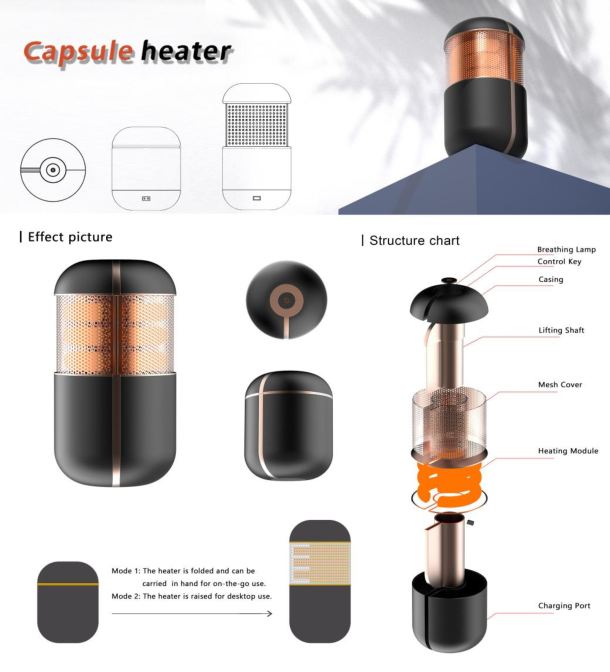
Innovative Design of Capsule Heater Applying the integrated TRIZ-HCD method, we conducted an analysis of the design contradiction matrix, extracted design elements, and developed a portable and minimalist Capsule Heater.
In response to user requirements, an in-depth investigation and needs analysis were carried out using HCD to identify design contradictions. Sub- sequently, rational inventive principles were selected, leading to the adoption of a lifting structure with a top locking key (child lock). The device can also be operated through a mobile app. Two modes are available: desktop heater and portable hand warmer. In Mode 1, the internal high-temperature resis- tance wire rises with a red indicator light, suitable for use as a “little sun” on the desktop. In Mode 2, the high-temperature resistance wire descends with a green indicator light. The external components utilize insulating ceramic materials to significantly reduce the heat generated by the high-temperature resistance wire, achieving a comfortable temperature for human touch. The device is portable and functions as a hand warmer for on-the-go use.
Figure 5: Design scheme of capsule heater.
Product Innovation Design Through Integrated TRIZ-HCD Methodological Approach 217
CONCLUSION
The process of product design is an iterative refinement to meet the functional requirements and user usage needs. The organic integration of TRIZ theory and HCD truly considers human perspectives. Utilizing the HCD method to translate user needs into design contradictions helps clarify design problems. The TRIZ theory efficiently facilitates inventive creation by selecting corre- sponding among the 40 inventive principles, combined to implement design solutions, promoting innovative product design. Therefore, the integrated TRIZ-HCD approach is an effective tool for product design innovation.
Shortcomings and Improvements: This paper constructs a design model based solely on TRIZ and HCD theories and methods. In future research, the incorporation of more design theories and methods will be considered to build a more comprehensive design model for addressing additional design challenges. Additionally, the focus of this case study is on the improvement design of existing products in the market. Subsequent in-depth research will explore applying more advanced methods to innovate the design of new products.
REFERENCES
Jiang Fan, WANG Yijun, HU Yidan. Case study of institutional innovation design based on TRIZ Theory [J]. Journal of Guangzhou University (Natural Science Edition), 2013, 12 (1) : 75–80. Liu Xiaomin, Huang Pinghui, Chen Zhiqin et al. Conceptual Innovation design and
reliability Research of seagrass gripper manipulator based on TRIZ and AD [J]. Chinese Journal of Mechanical Engineering, 2016, 52(5): 40–46. Pu Juan, Chen Yong, Xiong Yan, et al. Product conceptual design and evaluation based on TRIZ Theory and fuzzy Analytic Hierarchy Process [J]. Manufacturing Automation, 2014, 36 (1) : 14–17. Shi Yuanwu, Zheng Hyo-cheng. Research on Application of GQFD-TRIZ integrated
Method in Police UAV design [J]. Journal of Graphics, 2019, 40(2) : 296–302. Tan Runhua, WANG Yu, YUAN Caiyun et al. Theory of invention problem solving: TRIZ-TRIZ process, tools and development trend [J]. Journal of Mechanical Design, 200118(7): 7–12. Wang Nianping, Zhou Jun. Research on Product Concept Innovation design Method
based on AD and TRIZ [J]. Light Industry Machinery, 2014, 3(2) : 82–86+94. Wang Xiuhong, Tang Shuzhen, Li Shufang et al. Innovative design of toys for visually impaired children based on TRIZ and QFD theory [J]. Packaging Engineering, 2019, 40 (4) : 168–172. Zhang Jian-Hui, Liang Rui, Han Bo, et al. Problem Flow Network Construction and
Solving Process Model for Complex Products [J]. Chinese Journal of Mechanical Engineering, 2018, 54(23) : 160–173.
LISTED IN THE AHFE DIGITAL BOOKSTORE CATALOGUE
Explore the complete digital volume
Usability and User Experience
Read this individual research paper free through the original publisher, or explore the full digital proceedings book.
ISBN 978-1-964867-32-8
Explore this ISBN in the AHFE Bookstore ↗Listed in the July 2026 bookstore catalogue; search by ISBN to confirm current availability · Digital book purchase optional