Tianlu Zhu, Yajun Li, Ceng-Juan Wu, Zhizheng Zhang, Yu-Hui Ge (2023). A method for product form design based on user perceptual imagination and product modeling constraints. In: Kansei Engineering. AHFE Open Access, vol. 101, pp. 66–72. https://doi.org/10.54941/ahfe1002993
To solve the difficulties in obtaining user requirements and establishing objective and effective product modeling constraints in product design , A research model of design method based on user perceptual imagination and product modeling constraints was constructed. Firstly, based on the collection of user information, the KJ method is used to obtain the accurate perceptual cognition of users about the product. To address the problem of strong subjectivity of data acquisition in the process of user imagery cognition research, on the basis of user perceptual cognition, the product perceptual imagery semantics is targeted to obtain user perceptual demand information.Then, the user data and the user perceptions obtained from the interviews are combined, and the user perceptual needs are derived through filtering. Next, the complex constraint theory is used as a guide to summarize the design constraint problem and establish the product modeling constraints. Finally, by integrating product perceptual imagination and morphological constraints, product design positioning is derived. The method model of this study can accurately derive a product design orientation based on user needs and objective constraints of the product, and improve design effectiveness and accuracy.
Product form refers to the state of the product that is designed and manu- factured to meet users’ needs and finally presented in front of them. As the first element to convey product information, it can make the inner quality, organization, structure, connotation and other essential factors of the pro- duct rise to the external appearance factors, and through the visual display and make people produce a physiological and psychological perception pro- cess. The design and expression of product form is directly related to and affects the sales volume and market share of products, and is an important means to enhance the competitiveness of enterprises. Product form inclu- des the consciousness form, visual form and application form of product
communication. Consciousness form refers to the spiritual attributes of pro- duct communication, visual form refers to the visual attributes of product communication, and application form refers to the use attributes of product communication. Form is the expression of the intrinsic nature of things under certain conditions, and is the carrier for the embodiment of the designer’s concept and the channel of communication between the designer and the user, who often perceives the intrinsic meaning of the design through the product form and makes the corresponding value judgment. Only with the help of all its external morphological characteristics can a product become the object of use and cognition and play its own function.
Product form design is based on user needs, and user needs are mainly derived from the user’s perceptual imagery of the product. The formation and development of the concept of perceptual imagery first originated from perceptual engineering. In the 1970s, the long-established concept of desi- gning and producing products based on the producers’ own understanding began to waver, shifting to a market-oriented concept, i.e., a market-oriented marketing strategy based on users’ needs. Based on this background, in 1970, the Department of Engineering at Hiroshima University in Japan formally proposed the method of emotional engineering. Perceptual engineering is the concretization of non-deterministic factors such as users’ emotions or ima- gery into product design, and perceptual imagery is an important step for perceptual engineering to obtain users’ needs. Perceptual imagery is used to describe, measure and statistically analyze the relationship between factors such as users’ emotional preferences and product form. Perceptual imagery focuses on the interrelationship between the user and the product, converting the imagery or concepts generated in the user’s mind into quantifiable design parameters. In product design research, obtaining perceptual imagery can express people’s implicit perceptual factors in a quantified or semi-quantified form, and can establish a correlation with the design elements of the pro- duct, which can then be used to achieve a target product that meets the user’s perceptual needs.
This study takes user perception and imagination and product modeling constraints as the entry point to carry out a systematic study of product form design methods, and through obtaining user perceptual imagery, and then obtaining comprehensive and accurate user needs for product form design, objectively determining the positioning of product form design through form constraints, scientifically obtaining product form design that meets user needs and multiple constraints, and guiding designers in the We guide designers in the R&D process to obtain iterative and innovative product design soluti- ons with high satisfaction. At the same time, through the study of product form design method, it can effectively inspire and guide the relevant product design research, improve the market competitiveness of products, and has an important realistic guiding role in assisting designers to innovate and develop product design.
METHODS OF ACQUIRING USER PERCEPTUAL IMAGINATION By acquiring user perception imagery, designers can obtain objective data of consumers’ perceptual cognition of products, so as to comprehensively
understand consumers’ preferences and perceptions, and thus design pro- ducts that meet consumers’ needs. Therefore, the reasonable extraction of imagery is of great significance to effectively design products that meet con- sumers’ needs. The extraction of imagery can not only obtain the semantic meaning of the imagery expressed by the product, but also reflect the con- sumers’ preferences for the product, and provide the demand source and imagery design direction for the optimal design of the product shape. In the product form design, the imagery extraction analysis is mainly focused on the perceptual information triggered by the external design features of the product.
As the key information, the user’s perceptual imagery can directly translate the customer’s feelings and imagery into user needs, which in turn translates into product design elements and determines the subsequent product design work. In order to ensure the accuracy of the test results in the subsequent stage, it is necessary to ensure the validity and accuracy of the data as much as possible in the imagery acquisition stage. Therefore, researchers usually col- lect product samples and perceptual vocabulary that can accurately describe the product from as many sources as possible, and after pre-processing, make a product case study and a perceptual vocabulary respectively, and invite subjects to evaluate the perceptual vocabulary of the product samples in the case study to obtain the subjects’ perceptual imagery. The research- ers applied interviews, questionnaires and semantic differences to obtain the users’ perceptual imagery indirectly through their subjective expressions such as language, actions and expressions.
Commonly used methods of perceptual imagery acquisition include survey interview method, KJ method, semantic differential method, focus group, Kano model and joint analysis method, among which KJ method is ado- pted by a wide range of designers and target users because of its ease of use and operability.The KJ method is a method of collecting verbal and writ- ten information such as facts, opinions or ideas about unknown problems and problems in unexplored areas, and using their intrinsic interrelationsh- ips to make a categorized and combined diagram in order to organize ideas from complex phenomena, grasp the essence, and find a way to solve the pro- blem. method. The product data, design elements and pictures obtained from the survey are grouped and organized according to their degree of relevance. Through the KJ method of information collection, discussion, summariza- tion, sorting, analysis and processing, we can combine the brainstorming method to organize the product perceptual imagery.
The SD method, often used in conjunction with the KJ method, is one of the most commonly used methods for measuring psychological indicators, and is implemented mainly by the “subject” being tested, the “evaluation scale” adjective, and the “subject The SD method is composed of the “subject”, the “evaluation scale” adjectives, and the “subject”. Using the semantics of speech as a scale for psychological experiments, a Likert scale is created to quantitatively describe the perceptual imagery of the product by analyzing the semantic scale of the product and constructing a database of product imagery. The number of quantitative equivalence points chosen for the evaluation scale should be an odd number, and a 5th or 7th order scale is commonly used. The
A Method for Product Form Design 69
meaning of the scores varies somewhat depending on the level of the scale chosen.
ESTABLISHING THE PRODUCT MODELING CONSTRAINT SYSTEM In addition to the need to obtain the user’s practical needs around the user’s perceptual imagery, product form design should also meet the constraints of the product’s own modeling process, to perfectly achieve manufacturing and processing, it must meet the constraints of morphological factors and other conditions. As the conception stage in the product design process, pro- duct concept design needs to coordinate the material function structure of the product and consider the spiritual aesthetic function of the product, and also needs to deal with the complex relationship between the product and the user, the enterprise, the society and the environment. Therefore, product concept design needs to cross the user domain, market domain, functional domain, structural domain, manufacturing domain, and also needs to deal with the human-machine, interface, aesthetic, emotional, cultural, family identification and other aspects, these factors constitute the constraints of product concept design. Product concept design is essentially the process of solving all kinds of design constraints and conflicts, and a good design solu- tion should be a clever compromise of all design constraints, or the maximum satisfaction.
Due to the complexity of product morphological properties, there are multiple ways to classify morphological constraints and they may cross and overlap with each other. Therefore, how to cognize morphological constraints and make scientific and objective classification and representation of mor- phological constraints is the basis for the establishment of morphological constraint system. The classification of product morphology definition inclu- des visual morphology, application morphology and ideology. Based on this classification, this study intends to classify morphological constraints from three dimensions and six levels. The first dimension is the visual form of the product, meaning the objective properties and functional characteristics of the product form itself, including product form aesthetic constraints and product color constraints, the specific indicators of product form aesthetic constraints include balance, proportion, rhythm, coordination, continuity, repetition, symmetry, unity, regularity, similarity, etc., and the specific indi- cators of product color constraints include hue, saturation and brightness, etc., for the product The constraints of objective properties should be sele- cted according to the characteristics of the design object in the specific design application; the second dimension is the application form of the product, meaning the interactive properties between human-machine and environment that exist during the use of the product, including ergonomic constraints and use of environmental constraints; the third dimension is the ideology of the product, ideology is in The third dimension is the ideology of the product, which is the form derived from the product with certain functions and rules, and the development rules and style attributes that need to be followed in the design or iteration process, including product style constraints and brand style constraints. The classification of the morphological constraint system is shown in Table 1.
Table 1. Classification of the morphological constraint.
Table available in the original PDF paper.
Morphological constraint Constraint levels visual morphology product form aesthetic constraints product color constraints applied morphology ergonomic constraints use of environmental constraints ideology product style constraints brand style constraints
Product morphological constraint networks are based on complex netw- ork theory and consist of a finite set of constraint variables in a design constraint library, each associated with a discrete theoretical domain and a set of constraint sets. The design constraint subsets are regarded as network nodes, and each node forms a constraint network through the interaction of constraint relations, which in turn constructs a morphological constraint network. The network pairwise graph is used to determine the constraints and proceed to obtain the network key nodes, and the importance of the design constraint network nodes is also influenced by the neighboring nodes because there is usually a certain correlation between each single con- straint.There are two representations of constraint network graphs, which are the original constraint graph and the pairwise constraint graph. Primal constraint graphs represent constraint variables by nodes and associate edges with any two nodes located in the same constraint; dyadic constraint graphs, on the other hand, represent each constraint subset by a node and associ- ate edges labeled by shared variables with any two constraint subset nodes. Since there is often some correlation between each single design constraint, the importance of the design constraint network nodes is influenced to some extent by the neighboring nodes. Therefore, compared with the original con- straint graph, the pairwise constraint graph can be used to show the structure of the design constraint network in more depth and analyze the importance of each node in the whole constraint network. In this case, a single related constraint variable can be combined into a constraint subset, and the analysis of the constraint network can be carried out through the pairwise constraint diagram.
The products are divided into constraint categories according to the models, and the constraints derived from the solution of the morphologi- cal constraint problem are used as constraint indicators, and the regulations and contents of each constraint indicator are clarified to prevent the exi- stence of mutual inclusion or coupling between indicators. The specific product morphological constraint indicators and contents are shown in Table 2.
CONSTRUCTING PRODUCT FORM DESIGN METHOD MODEL In order to effectively sort out the logical relationship between user perce- ption imagery and product modeling constraints to product form design, and to better expand the application scope of processes and methods in this study, a design method research model based on user perception imagery and
A Method for Product Form Design 71
Table 2. Product morphological constraint index and contents.
Table available in the original PDF paper.
Product type Ai Constraint category Di Constraint index Vi Constraint content Ei A1 D1 V1 E1 V2 E2 V3 E3 ... ... D2 V10 E10 ... ... ... ... ... ... An Dn Vn En
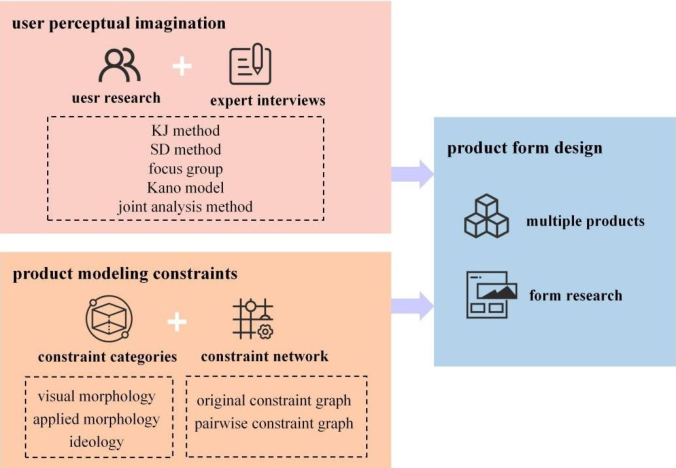
product modeling constraints is proposed and constructed, which contains three dimensions: application level, step level and method level. The model clearly shows the logical relationship and hierarchical structure between the elements of user perception imagery and product modeling constraints, which can better obtain the real needs of users and sort out and list the matching research methods and functional elements, more comprehensive and obje- ctive, and provide a basis for designing with product form. The research model of design method based on user perception imagination and product modeling constraints is shown in Figure 1.
Figure 1: The research model of design method based on user perception imagination and product modeling constraints.
CONCLUSION
Based on the two dimensions of user perceptual imagery and product form constraint, this paper aims to obtain a product form design that satisfies mul- tiple perceptual demands scientifically through comprehensive and accurate
user perceptual imagery and objective determination of product form design positioning through form constraint. The research is carried out for the pro- duct form design method, and the design model is proposed by the discussion and analysis. The classification of product form-driven design constraint system is a new attempt to study the constraint problem. The method system constructed in this study is a product objective form-driven design theory and method system, which can effectively solve the problem of excessive subjecti- vity in industrial design, better cooperate with the subjective user perceptual demand, and ensure the accuracy of the final guided product form design process.
At present, the research on product form design methods based on user perceptual imagery and product form constraints is still in its initial stage, and subsequent research needs to classify and express the form constraints in terms of the nature and semantics of form and explore various product form constraint systems, so as to improve the efficiency of product form design and eventually establish a clearer and more explicit form constraint library to ensure the feasibility of research methods and theoretical systems. The final morphological constraint library is clearer and more explicit to ensure the feasibility of the research method and theoretical system.
ACKNOWLEDGMENT
The authors would like to acknowledge.
REFERENCES
Lin L, Chen L C. (2002) “Constraints modelling in product design”, in: Journal of Engineering Design. Volume 13 No. 3. Mayer S, J. R. Landwehr. (2018) “Objective measures of design typicality”, in: Design
Studies. pp. 146–161. Park J, Gunn F, Lee Y, et al. (2015) “Consumer acceptance of are volutionary technology-driven product: The role of adoption in the industrial design deve- lopment”, in: Journal of Retailing and Consumer Services. pp. 115–124. S. Krish. (2011) “A practical generative design method”, in: Computer-Aided Design,
Volume 43 No. 1, pp. 88–100. Sutono S B. (2016) “Selection of Representative Kansei Adjectives using Cluster Analysis: A Case Study on Car Design”, in: International Journal of Advanced engineering, Management and Science. Volume 2 No. 11. T. L. Zhu, Y. J. Li, C. J. Wu, et al. (2022) “Research on the design of surgical auxiliary
equipment based on AHP, QFD and PUGH Decision Matrix”, in: Mathematical Problems in Engineering. Van Kuijk, J. J. Daalhuizen, H. Christiaans. (2019) “Drivers of usability in product design practice: Induction of a framework through a casestudy of three product development projects”, in: Design Studies. pp. 139–179. Yvars P A. (2009) “CSP approach for the net work of product life-cycle constraints
consistency in a collaborative design context”, in: Engineering Applications of Artificial Intelligence. Volume 22 No. 6. pp. 961–970. Z. Z. Zhang, W. T. Wei, T. L. Zhu, et al. (2022) “New Dimension on Quality of Life Differences among Older Adults: A Comparative Analysis of Digital Consumption in Urban and Rural Areas of China”, in: International Journal of Enviromental Research and Public Health. Volume 19 No. 22.
LISTED IN THE AHFE DIGITAL BOOKSTORE CATALOGUE
Explore the complete digital volume
Kansei Engineering
Read this individual research paper free through the original publisher, or explore the full digital proceedings book.
ISBN 978-1-958651-77-3
Explore this ISBN in the AHFE Bookstore ↗Listed in the July 2026 bookstore catalogue; search by ISBN to confirm current availability · Digital book purchase optional