Qing Xue, Yilin Yang, Wang Haining, Jing Ou (2024). VR Controller Design for Autistic Children and Therapists. In: Ergonomics In Design. AHFE Open Access, vol. 129, pp. 41–49. https://doi.org/10.54941/ahfe1004809
Intervention training will be beneficial to autistic children when they are entering regular primary schools. The interaction between autistic children and regular children will help autistic children to develop their social skills, motor skills, and learning abilities. VR-based therapeutic games have been proven to have good intervention effects. However, there is currently no VR controllers on the market for children nor therapists. Therefore, this study aims to develop a set of VR controllers that will provide a better experience for children while offering more efficient assistance to therapists. The development of the VR controller adopted many ergonomic methods, such as children’s pain points and their needs. This VR controller development collected user experience experiments results, which improves the overall user experience, increase intervention effectiveness, and provides reference for the future VR controller designs for the autistic children treatments.
VR-based therapeutic games not only utilize significantly effective peer inter- vention methods, but also offer greater controllability and more realistic sensory characters, which provides better intervention effects. Existing thera- peutic games mainly involve children playing the games with online guidance from rehabilitation therapists. The absence of suitable controllers for the games may lead to children’s rejection, and also increase the difficulty for therapists to accurately capture and assess autistic children’s behavior. The therapists also face the problem of complex and uncomfortable operations. This study will be based on the ergonomic method research, experimental quantitative analysis of the user experience of the controller, to develop a set of VR controllers for autistic children and rehabilitation therapists.
USER ANALYSIS According to the research, motor impairment are prevalent in children with autism, which means that there is a potential safety hazard during the game- play. Children with autism often experience sensory abnormalities, such as hypoesthesia, which may lead to self-injurious behaviours, or hypersensitiv- ity in touching and hearing, which may result in emotional dysregulation and avoidance behaviours. In summary, there are significant individual
differences in autistic children, including perceptual sensitivity, movement disorders, etc. Even at similar levels of the autism spectrum; there are notice- able variations in sensitivity, motor skills, and other aspects. Therefore, it is very important for the therapists to participate in games to ensure the safety of children and enhance the effectiveness of gameplay. In this study, we focus on designing controllers that not only enables comfortable and safe for chil- dren but also allows therapists to efficiently adjust variables in the virtual environment.
EXISTING PRODUCT ANALYSIS In the research process, we have observed common issues with mainstream handheld controllers, such as hand weakness and the tendency to slip dur- ing actions like throwing. Therefore, the controller design should follow the curvature of the hand as much as possible to enhance comfort, and the chil- dren’s controllers are designed to be wearable to avoid taking off the hand. In terms of interaction, most products have problems such as unrelated interac- tive actions, and limited button controls. Children with autism generally have delayed intellectual development and low comprehension abilities, children’s controller design should simplify operations and adopt natural interaction methods. Additionally, optimizing the button design of therapist controllers can enhance control efficiency.
ANALYSIS OF GAME INTERACTION This article analyzes Floreo, a social and communication skills training game that can be used by children with autism. Children use the controller to complete movement and gripping actions, the variables include the direc- tion of movement, grip strength, balance, and etc. Therefore, the controller is designed to be round and easy to grip. Variables are evaluated using technolo- gies such as piezoelectric films and accelerometers. For therapists, variables that need to be controlled include speech speed, volume, and giving positive or negative feedback. Due to the complexity of the interaction, the design will focus on comfort and ease of use, improving the efficiency of interaction through the combination of touch dials and buttons. The layout of the but- tons comprehensively considered the frequency of use, the convenience of the left and right hands and the user’s habits, and the rationality test was carried out in the follow-up experiments.
EXPERIMENT 1: ADULT ERGONOMICS EXPERIMENT Participants and Equipment
Data from the Autism Institute shows that the ratio of female to male autism therapists is 9:1. In this study, a sample of five female participants between the ages of 19 and 21 with prior experience using VR controller devices were randomly selected. Two pairs of adult controller models were created using lightweight clay to minimize the influence of differences in weight of the device and to facilitate evaluation of the size of the devices.
VR Controller Design for Autistic Children and Therapists 43
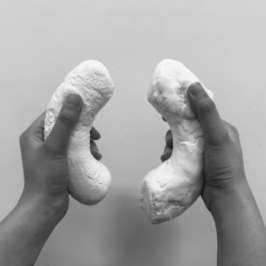
Experimental Methods The main differences between the two sizes (large/small) of models lie in the length and thickness of the products. The large size model measures 160mm in length and 50mm in width, while the small size model measures 155mm in length and 45mm in width. These two pairs of models were used to eval- uate the experience of holding and using the devices, as well as their design appeal. Each participant grasped the controller models in the most comfort- able manner, with the right hand simulating button operations and the left hand simulating touchpad operations, to experience the operational feel of different-sized controller models.
Figure 1: Participants held adult controller models, with the small size in their left hand and the large size in their right hand.
Data Collection and Analysis Participants answered three questions, with a maximum score of 5 points each, where 0 points represented the lowest score and 5 points represented the highest score. Integer values were used for scoring. The questions included (1) evaluation of the comfort of holding the adult controller, (2) evaluation of the usability of holding the adult controller, and (3) evaluation of the aes- thetics of holding the adult controller. The participants’ hand data (thumb length, index finger length, and distance from the tip of the index finger to the palm base, measured at the main gripping area) are provided for data analysis reference.
The experimental data was categorized into Group A: independent vari- able data indicators (large size, small size) and Group B: user experience data indicators (comfort, usability, aesthetics). Independent sample t-tests were used to compare whether there are significant differences in user experience data indicators between the two groups of models with different sizes, and to identify the factors that significantly impact user experience. Due to the small sample size, the Shapiro-Wilk test was first used to check the normality of the data. The test results indicate that the comfort, usability, and aesthetics score data for different-sized samples all follow a normal distribution, meeting the criteria for independent sample t-tests (Tables 1, 2, and 3).
From the analysis of the independent sample t-tests, it can be observed that there is no significant difference (p > 0. 05) in usability scores and aesthetics
scores between different-sized samples. However, there is a significant differ- ence (p < 0.05) in comfort scores, indicating that different-sized samples have differences in comfort scores with a 95% confidence level (Table 4). Analysis of the data from Experiment 1 shows that:
Size samples show a significant difference (p < 0.05) in comfort scores, suggesting differences in comfort scores and usability scores between different-sized samples. Additionally, according to Cohen’s d value, the difference effect of comfort scores between different-sized samples is quite significant, with a large effect size (Table 5).
Moreover, the size demonstrates a significant difference in comfort scores at the 0.01 level (t = 3.780, p = 0.005). Specifically, the mean of the large size (3. 80) is significantly higher than the mean of the small size (1.80) (Table 4).
Table 1. Normality test results of comfort score data.
Table available in the original PDF paper.
Comfort Score Skewness Kurtosis Shapiro-Wilk Test
Items Sample Size
Mean Standard Deviation
Statistic W p-Value Large size 5 4.200 0.837 −40.512 −0.612 0.881 0.314 Small size 5 2.400 1.140 0.405 −0.718 0.961 0.814
Table 2. Normality test results of usability score data.
Table available in the original PDF paper.
Usability Score Skewness Kurtosis Shapiro-Wilk Test
Items Sample Size
Mean Standard Deviation
Statistic W p-Value Large size 5 4.000 0.707 0.000 2.000 0.883 0.325 Small size 5 3.000 1.000 0.000 −3.000 0.821 0.119
Table 3. Normality test results of aesthetic scores data.
Table available in the original PDF paper.
Aesthetic Score Skewness Kurtosis Shapiro-Wilk Test
Small Size 5 4.00 0.71 1.00 −0.263 ∼2.263 1.826 8.000 0.105 Total 10 3.30 1.34 Usability Score Large Size
5 3.00 1.00
Small Size 5 3.00 0.71 0.60 −0.784 ∼1.984 1.000 8.000 0.347 Total 10 3.50 0.97 Aesthetic Score Large Size
5 2.40 1.14
Small Size Total 10 2.70 0.95
*p<0.05, **p<0.01
Table 5. In-depth analysis of t-test: effect size indices.
Table available in the original PDF paper.
In-Depth Analysis - Effect Size Index
Analytical Variable S2pooled Cohen’s d Value Comfort Score 1.000 1.800 Usability Score 0.750 1.155 Aesthetic Score 0.900 0.632
EXPERIMENT 2: CHILDREN’S ERGONOMICS EXPERIMENT Participants and Equipment
In this study, five children aged between 5 and 8 years old were randomly selected. To minimize the influence of quality differences and facilitate the evaluation of the size and shape of the equipment, we created four models of children’s handles using lightweight clay.
Experimental Method The main difference between the two modeling semantics (round/flat) lies in the thickness of the product at its thickest point. The thickest part of the round semantic children’s handle is 20mm, with a fuller center to fit the hand, while the thickest part of the flat semantic children’s handle is 15mm, with an overall flatter shape. The main difference between the two sizes (large/small) lies in the diameter of the product. The diameter of the large size is 55mm, and the diameter of the small size is 50mm. The arrangement of “large round,” “large flat,” “small round,” and “small flat” is 2*2. These four models were used to evaluate the experience of holding and using the equipment as well as the design attractiveness. Each participant held the handle model with their right hand in the most comfortable way and simulated actions in VR games (such as moving the handle and grasping actions) under guidance.
Data Collection and Analysis Participants answered 3 questions, with a maximum score of 10 points, where 0 points represent the lowest score and 10 points represent the highest score. Integers were used for scoring. The questions include (1) evaluation of the comfort of children’s controller, (2) evaluation of the usability of children’s controller, and (3) evaluation of the aesthetics of children’s controller. Partic- ipant hand data (thumb length and distance from fingertip to palm bottom, measured at the main gripping area) are provided for data analysis reference.
The experimental data were divided into Group A: independent variable data indicators (large size, small size, round shape, flat shape) and Group B: user experience data indicators (comfort, usability, aesthetics), analyzed using canonical correlation analysis. Comfort, usability, and aesthetics were used to examine whether there is a correlation between the two groups and to identify factors that have a greater impact on user experience.
From the results of canonical correlation analysis (Table 6), the evidence shows that only the first pair of canonical variables has a significant corre- lation (P < 0. 05). The number of canonical correlation coefficients can be determined as 1, indicating a correlation coefficient, and from the correlation coefficient (ρ(A1, B1) = 0. 805), it can be seen that Sets A and B are positively correlated. The standardized first pair of canonical variables obtained are: A1 = −0. 042*size + 0. 445*shape. B1 = 0. 095*comfort score - 0. 045*usability score - 0. 049*aesthetics score.
Results
Analysis of the Experiment 2 data shows:
In the independent variable data indicators, the canonical variables responding to the independent variable data indicators are mainly deter- mined by shape, as its absolute value is the largest (Table 7).
In the user experience data indicators, the canonical variables respond- ing to the independent variable data indicators are mainly determined by holding comfort, as its absolute value is the largest (Table 8).
At the same time, the coefficients of the canonical variables exhibit heteroscedasticity, reflecting a positive correlation between shape and holding comfort, indicating that the more round the model, the better the user’s gripping experience.
Table 6. Canonical correlations of independent variable data and user experience data.
Table available in the original PDF paper.
Canonical Correlation Coefficient and Significance Wilks’ Lambda df 1 df 2 F p Canonical Correlation Pair Canonical Correlation Coefficient
EXPERIMENT 3: EXPERIMENT ON BUTTON POSITION AND SURFACE CURVATURE OF ADULT HANDLES Improving the surface curvature of the handle can alter the comfort of tool-to-human contact, and appropriately mimicking the curvature of the human body can enhance the overall comfort of handheld tools. To find out the relationship between adult handle button placement and handle surface curvature, we conducted a powder experiment.
Participants and Equipment In this study, five females with experience using VR controller devices, aged between 19 and 21 years old, were randomly selected. To assess the button position and surface curvature of the handle more realistically, we created adult handle models using lightweight clay.
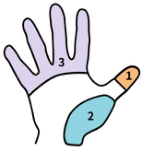
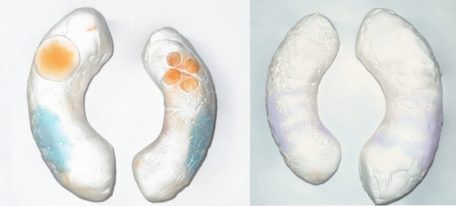
Experimental Method The dimensions of the adult handle models were based on the larger size model with a higher average comfort score from Experiment 1 (length 160mm, width 50mm). Each participant dipped the tips of their thumbs in orange powder, while the remaining four fingers, excluding the thumbs, were dipped in purple powder. After applying blue powder to the thenar emi- nence, they held the handle model in the most comfortable manner. The right thumb simulated button operations, and the left thumb simulated touchpad operations, leaving behind powder imprints.
Figure 2: Diagram of hand coloring experiment with powder.Figure 3: Presentation of powder experiment results.
Data Collection and Conclusion Analysis The portions of the handle surface corresponding to the positions of the hands are in contact with each other. Deeper orange powder areas represent the more comfortable range of motion for the participant’s thumbs during operation. Deeper blue and purple powder areas indicate stronger contact between the handle and the hands during operation. It is necessary to adjust the surface curvature of the handle to better conform to the curves of the human hand in areas of stronger interaction. Additionally, the placement of buttons and touchpads should be within the comfortable range of motion for the thumbs.
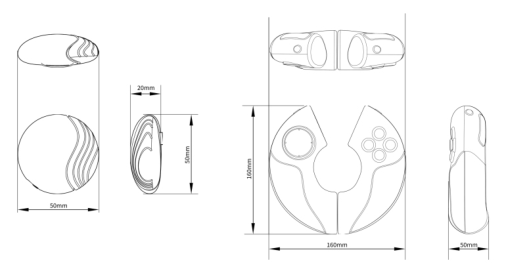
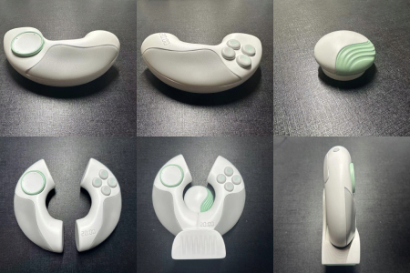
DESIGN AND CONCLUSION Referring to the results of the experiment, that is, children prefer the round design of the handle, and considering the comfort of adults holding a larger model and the overall experience related to the curved surface shape of the product and the position of the buttons, we collected the product-specific data. A product size diagram was created to demonstrate these design con- siderations (Figure 4). Based on those autistic children’s preference, the team further refined the color, material, and details of the product, created a model of the product and 3D printed the model (Figure 5).
We provided product models that created in this study and regular grip-on VR controllers, invited therapists and children to experience and simulate the game process. We observed the behaviour of the users. The children showed an attitude of active experimentation and cooperation, and there was no rejection or avoidance. Therapists agree that this product is more comfort- able and easier to use than traditional controllers. This VR controller design is more autistic children friendly, and this design increased the effectiveness and efficiency of the therapists while treating the autistic children.
In this paper, A set of VR controllers which are used for autism treat- ment games was studied, and the operating experiments between children and therapists were conducted. The comfort, ease of use, and effectiveness of the product were confirmed through multiple experiments, which pro- vided a reference for the future design of VR controller products and autism treatment products.
VR Controller Design for Autistic Children and Therapists 49
Figure 4: The length width height size of VR controllers.Figure 5: Photograph of the 3D printed model of VR controllers.
REFERENCES
Cao Yingying, Chen Jianjun & Liu Dianzhen. (2022). A Review of Research on the Application of Virtual Reality Technology to the Intervention of Children with Autism, China Special Education (09). pp. 39–46. Dan Yujin. (2021). Autistic Children’s Visual Movement Perception Life Dilemma
and Virtual Reality (VR) Intervention Prospects, Physical Education and Science (02). pp. 106–113. Liu Xinchen, Huang Keyue. (2022). Research on Color Usability Design of Educational Space for Autistic Children. Architecture and Culture (12). pp. 259–261. Qi Wang, Tao Liu, Xuehua Tang & Minyan Xia. (2009). Converse Seeking under
Pressure test used for Improving Man-machine Effects of Hand-holding Tools, Mechanical Design (01). pp. 76–78.
LISTED IN THE AHFE DIGITAL BOOKSTORE CATALOGUE
Explore the complete digital volume
Ergonomics In Design
Read this individual research paper free through the original publisher, or explore the full digital proceedings book.
ISBN 978-1-964867-05-2
Explore this ISBN in the AHFE Bookstore ↗Listed in the July 2026 bookstore catalogue; search by ISBN to confirm current availability · Digital book purchase optional