Ademario Santos Tavares, Luiz Wilson Nunes de Albuquerque, André Francisco da Silva Sousa, Marcelo Márcio Soares (2022). Ergonomics in Industry: Various Sectors Contributing to the Development of a New Product. In: Advances in Ergonomics In Design, Usability & Special Populations: Part II. AHFE Open Access, vol. 19. https://doi.org/10.54941/ahfe1001221
The process of product development is one of the most important and complex stages for the industry. For a new product to get into the hands of the consumer, a lot of research and testing is performed. Although the intention is to generate a product that makes the difference the market, catches the attention of the consumer and can increase sales of the company, another issue is considered important: the production process. The integration between various areas of knowledge can provide solutions that meet diverse industrial needs that go beyond usability needs of users. This article will deal with a multidisciplinary team during the development of a new medical product. How can segments of knowledge apparently distant from each other work together and provide improvements to the employees of a company? This article shows how teamwork between professionals of Ergonomics, Industrial Design, Engineering, Medical, Production and Sales allowed the optimization of the production process, employee satisfaction and sales success.
The competition between companies is one of the main responsible reasons for innovation in industries. Fueled by investments and technological advances, the complexity in generating new products is a key factor for the company to stand out in the competitive market, be it local, national or international. However, the manufacture of new products involves several complex aspects, not only related to the product to be developed, but also to the productive system, the quality of life of industrial workers and future users.
Product design is a multidisciplinary and systematic activity that involves a series of tasks that includes everything from the first market research that may point to the need for a new product to the market launch. Depending on the complexity of the product, it involves not only the industrial workers, but external professionals and the users themselves as well. A product design poorly developed and executed can cause many losses and many risks for the industry. As an example, it can be said: the acquisition of machinery and equipment, hiring professionals, accumulation of raw materials, increase in direct costs (electricity, water, gas), accidents, lawsuits, etc.
To lesser these risks, it is important to know the productive possibilities and needs of the company as a whole, including its departments and sectors, and not just be focused on profits that sales can provide. Develop a product taking into account the sectors and departments responsible for turning a conceived idea in a final product is an important decision and may represent a change in the mindset of the company. In these optimization processes and changes, the production sector is considered a very important and crucial area, which can be a great differential. Thus, the company will not benefit only through the end result of the product, but also with the operational benefits, optimization of the production process and improvement in the quality of life of employees.
This article will show through a case study how the development of a new product can mobilize various sectors and departments, with external cooperation of professionals outside the company. Working closely with a multidisciplinary team allowed several changes in the production process, resulting in greater employee satisfaction, reduced direct cost expenditures and raw materials, among other benefits that will be shown at the end of this article. The Brazilian company that allowed the preparation of this article demanded discretion in displaying the images of the manufacturing process for reasons of copyright, patent process and privacy and confidentiality. Therefore, the company is called “industry IPMH” and developed product will be called “product NBD”.
THEORETICAL REFERENCE The relationship between ergonomics and industrial design
Since the dawn of the Industrial Revolution in the eighteenth century, competition between companies has become a major factor for innovation in the industry. In order to gain consumer preference and sales increase, companies began to develop increasingly differentiated products, whether in the aesthetic or the functional product aspects. In virtually all areas and activities, while the manufacturing process was optimized with the advancement in technology, the products have reached the consumers in a more effective and usable fashion with more friendlier formal elements and facilitating people's lives on a daily basis.
This race to achieve a prominent position in the market meant that industries also invested in its production sectors, in the set of productive activities, in studies of materials, in investments in technology, in acquisition and optimization of machines, etc. However, this time the workers were not taken into consideration in the improvement of enterprises. In this context, the accidents began to occur in a more common manner and regarded indifferently by the administrative and management of companies sectors. This caused many labor movements in Europe, in order to achieve improvements in working conditions, hygiene, food. It was necessary for the worker to be respected as a human being, not just as part of a production system. These revolts have taken effect and several changes occurred.
In this context, in the last century, Ergonomics takes up the stage. Initially used only for military purposes, its interdisciplinarity started to be applied in the general industry. Concentrated in the binomial man-machine, ergonomics brought new scientific knowledge about the nature of working, which began to influence the management sectors of industries to review their positions (Iida, 2005). As Ergonomics was inserted in industries, improvements for workers were deployed, such as the organization of work, training and quality of life in the industrial environment.
As its principles and techniques are not applied only in the workplace, ergonomics has become too important to the daily lives of people. According to Zapata (2011), the focus of ergonomics in humans spawned the development of a theoretical and practical framework that enabled the optimization of human welfare in various fields. Ergonomics (or human factors) is a systematic process that applies its principles and methods in projects for human use, which can be a device or tool that the individual uses or an environment where this individual works or attends, the tasks the individual performs and systems this individual manages (Attwood et al., 2004).
There are several benefits of applying ergonomics in a company. A study of its use in projects suggests that if ergonomics is considered in the conceptualization stage, the cost to industry will add only 0.5% to the total project cost (Guimarães, 2013). Adding to this thought, Phillips (2009) draws attention to the emergency approach to problems in ergonomic interventions for problem correction, or in other words, it is not recommended to adopt ergonomics in the later stages of the project, as it may increase costs and cause the delay of deadlines. Reinforcing this thought, ergonomics acting as an element of prevention may be an "adequate output to safeguard the health and safety of users" (Soares and Correia, 2002).
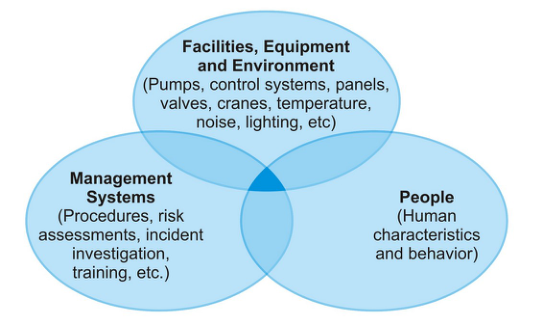
In the case of an industry, the production department can function correctly through integration and maintenance of some essential elements, as shown in Figure 1. If these elements are not functioning in an integrated manner, failures may occur in the system and probably the goals will not be achieved. The figure 1 is a simple way to show how the integration between elements highlights the multidisciplirity of ergonomics, making its application very relevant.
Figure 1. Representation of the process of Ergonomics (Adapted from Attwood, 2004)
Bringing this discussion to the industrial context, there is another activity that is also multidisciplinary, which is directly linked to product development: the profession of industrial design. In a similar manner to Ergonomics, the industrial design is a systemic activity and goes beyond the stages of development of creative alternatives and the use of drawings. Although there are still some people who think that way.
Its performance is directly linked to the majority of systematic steps of the process of producing a product. The diversity of activities present in the set of responsibilities of an industrial designer aims to generate a product that can cover and meet the diverse needs, abilities and possibilities of various sectors of industry, particularly those sectors responsible for the production. In this case, designers seek to meet the simplicity and ease of production desired by engineers, the differences and advantages that provide more business to vendors, the possibility of low investment and quick return on capital coveted by businessmen, and of course, meet the needs of usability of future consumers (Baxter, 2011).
Zapata (2011) emphasizes the relationship between ergonomics and design stating that this union provides a clear conceptualization of the relationship between product-user-context. Their multidisciplinary bases allow forming an investigation process that may include documentation, analysis, summaries and conclusions that will have great impact on the design of a new product. The author also stresses that this process builds on the requirements and characteristics of its future users and the environment where new products will be used. It is perceivable the emphasis given to human beings in both activities.
According to the Brazilian Ergonomics Society (ABERGO, 2013) the application of theories, principles and methods of ergonomics allow the optimization of human well-being and overall system performance. In this article, the system in question is the production sector of an industry. Improving the production system requires not only give emphasis to the relationship between man and his work, but also understand his equipment and environments, noting that these are inherent to the human being (IIDA, 2005). This multidisciplinary approach to ergonomics allows a relevant, constructive and complementary approach to industrial design activity.
In this context it is possible to observe that the generation of a new device requires a variety of analyzes and activities. As already mentioned, the design arises not only to improve the aesthetic and functional features, but also to consider how this new product will impact the operational activities of the industry. Therefore, some questions arise: What will its production process be like? Is the industry prepared to develop a new product? Will there be the need for modifications, adjustments, improvements in the production system? Regarding ergonomics in industry, improvements and modifications may occur at various stages of the project (Iida, 2005). Some examples of possible changes: the design of machinery, equipment and working stations, changes in plant layout; allocation of new raw materials, modifications to existing systems etc.
The research on the evaluations and reflections caused in the industry by the developing a new product is fundamental. Considering this necessity, industrial design plays a relevant role in this issue. Preliminary research can make relations with the industrial context and the product, examining its relevance in addressing project issues and several questions, ranging from product usability limitations to the problems faced by the industry. In this case, there may appear essential and critical information to the implementation process of a new product design and for the initial progress of that process.
Reinforcing this view, the Portuguese Design Center (1997) reports that the results of the project are connected together in a much broader process of product creation. Activities related to product development become the object of study of various areas of knowledge, in addition to industrial design itself. It is observed that beyond the project itself, there are other objectives to be implemented in the previous production steps, such as the analyzes to simplify manufacturing, studies for reduction of building elements and improvements in visual appearance (Lobach, 2001).
Following the same line of thought and once again starting on the phase prior to the productions of a new product, it is important to highlight that these studies occur in the conceptual phase of the project. Evaluations can have the greatest impact in the conceptual stage of product design, it is at this stage that industrial designers have greater project freedom and flexibility, or in other words, accepting the changes without further restrictions (Jacko et al., 2012). Both the industrial designer and the ergonomist can work together and find a way to benefit as much as possible all sectors involved in the manufacture of the new product before the beginning of the process. But for this to occur, it is important to also rely on the experience and information from other areas of knowledge involved, not only in the production process but also in the context of product usability.
The project: internal experience vs. external contribution Because of their multidisciplinary nature, both industrial design as ergonomics rely on multiple sources of information to assist and guide their respective performances in the complex activity that is developing a new product. These sources are not only represented by the professionals who are part of the staff of a certain industry, but also by other professionals that fit the context in which the new product will be used. It is important to recall that, in a simple and hypothetical way, it is understood that a product is manufactured to be used by a human being seeking to perform a given task in an environment.
From the ergonomics point of view, products can be regarded as means for men to perform certain functions (Iida, 2005). In this case study, the product in question falls under the category of medical products of an invasive nature, or in other words, it is a product in which some components are inserted into the body of human beings and any design error can cause serious damage to health, including the death of the patient. This piece of information only highlights the importance of doing very detailed analyzes from various points of view, among professionals from different fields, in order to develop a product that is as safe and comfortable as it can be. The industry IPMH produces this type of product.
Some of these products are generally used during and after surgical procedures, during which the patient is weakened or on recovery. Therefore, it is critical to the health of the patient that the medical product that will be used meets the minimum requirements for safety, comfort and hygiene, being as effective as possible and allowing the patient to respond positively to treatment and move on to a faster recovery.
The case study will address the development of a medical product called NBD. Because it is directly related to human health, it is necessary to rely on the experience and information from professionals of this field. As stated by Iida (2005), each type of professional involved (doctors, engineers, psychologists, designers) tend to see the problem in accordance with their professional bias, highlighting their experiences and aspects that other professionals do not see on the system. Recalling that health professionals live, know and understand the diverse needs and situations of patients (users), so their point of view related to the product and its usability is different, for example, compared with the professionals in charge of project development. Therefore, the participation of a multidisciplinary team becomes essential because the information and contributions that can be discussed and added on.
As experiences may be considered phenomena of many facets, they may involve various manifestations such as subjective feelings, behavioral reactions, expressive reactions and physiological reactions (Desmet & Hekkert, 2007). The exchange of experiences of professionals from different fields of knowledge can make a difference to the company and the products it produces, especially when developing products with enhanced complexity and that can endanger the lives of users if poorly designed.
This teamwork is one of the bases for what ergonomists call participatory ergonomics (macroergonomics), as the success of the project depends on the participation of the entire company (Guimarães, 2013). This branch of ergonomics can be considered as the discipline that studies the how the different parts must be involved in a design process (Vink et al., 2006). Its practice encompasses different approaches to solving a certain problem or optimizing a process towards a faster, coherent, viable and economical solution. Attention is given to operators (employees), to the members of the company management, the ergonomists and others involved, therefore, the responsibilities are not falling only to industrial designers.
It is important to note that each case is an unique ergonomic intervention, with features, quirks and unique situations that may require the adaptation of methodologies. Although there are principles of participatory ergonomics in this case study, much of its methodology was not applied, so this study can not be considered a complete example. However, the procedure was as expected and the results achieved their goals, surpassing expectations.
CASE STUDY The industry IPMH is located in the state of Pernambuco, Brazil. It’s been on the business for a few decades and it develops and manufactures portable hospital equipment. The company has a countrywide influence and is considered a benchmark company and delivers high quality products. Its staff consists of professionals from different categories spread across various sectors and departments related to industrial production. The diverse sectors respond to: the manufacture of metal and polymer assembly process, packaging, quality control, sterilization, marketing, sales and administrative sector. There are services provided by external companies (outsourcing services), but about 90% of the necessary activities for their products to reach the market is developed by the industry IPMH itself.
After conducting some market research, the industry IPMH proved that their profit margin suffered some falls mainly related to a particular product, which is an earlier version of the product NBD. Responsible for a significant percentage of sales, this product has been superseded by its competitor and the number of sales is shrinking. Given this situation, the direction of the industry IPMH opted to develop a new product with the positive features of the previous version of the product NBD, however, this product not only should bring improvements in product performance, but also in the production process.
Initiation of the process: meetings and assignments The decision to develop a new product was taken after a meeting between management and those responsible for the various company departments. During the meeting a market research and a summary containing information exchanges with customers were presented. At the meeting some of the first strategies and objectives were drawn to initiate the development of a new product process. Basically, the real reasons to opt for the creation of a new product were discussed. The most addressed topics were:
There are similar products on the international market smaller in size;
Similar products are more efficient and accurate;
Aesthetically, similar products were more attractive;
There was a need to reformulate some systems on product usability.
These requirements and other information were incorporated into the briefing that would be given to the product development department, but the head coach said each industry sector will contribute with data about the current version of the product NBD and its production process, allowing everyone to participate and cooperate with their knowledge and experience for a better product creation. And that moment of the meeting would be crucial to establish the first idea exchanges among professionals.
The initial phase in a process of product development, including the design as a systematic activity, distinguishes itself from others due to the accumulation of information that will serve to give support to ideas. This step will contribute to the generation of parameters and requirements that will help the designer become more acquainted with the information necessary to create (Oliveira & Scaletsky 2012). That way he will find means to simplify the whole process, both by the materials used and by the production processes.
This is necessary for an industrial production that prioritizes the economic outcome (Lobach, 2001). It is worth noting here that the term mentioned "economic outcome" refers to improvements in the production process, translated in the reduction of material costs, or decrease the constraints of their operators, or improvements in the flow of raw materials, etc. Thus, a meeting with the operators is necessary, who are directly linked to the process of producing the first version of the product NBD so that they could participate in the design and development of solutions for the new product release.
After the first meeting, attended only by employees and operators from industry IPMH, another meeting was scheduled, but now with the presence of external professionals who are not part of its staff, including health professionals and ergonomics professionals. This feedback from professionals that are placed in the context of product use is critical to better understand the interaction between the product, the user and the environment. This combination of knowledge, skills and exchange of information were needed for the enrichment of the briefing, in particular by establishing connections with the industrial designer and the ergonomist.
It is important to mention that health professionals were considered the main users because they are using and applying the product in patients. In this case, the information provided by doctors and nurses have great relevance due to the experience and practical knowledge in the use of similar products and the old product NBD, which will be the basis for the new version to be developed. Although part of the product is introduced into the patient's body, usually the patient does not handle the product himself, and this step aimed at healthcare professionals only.
Definition of improvements The first meetings have enabled the development of a briefing which embraced the multifaceted characteristics of the product and which would help to guide the development process. The relevant data to be considered in the new product were collected from the point of view of a multidisciplinary team. The briefing can be understood as an instrument of information, monitoring and evaluation, consisting of requirements, parameters and other initial information that will guide the development of the product. After their preparation, the briefing should be given to all those responsible for the project, after all, they are all responsible for it (Phillips, 2009). Although ergonomics is a key factor is to contribute to a design solution in our broader lives and helps us work more effectively (Stanton, 2003), this exchange of ideas involving user, designer, medical, client, operator, engineer , direction, stockist and seller, was necessary done at a right time.
After several discussions, many adjustments to the briefing were made, especially when there were incompatibilities between certain ideas or requests among the meeting participants. It is important to mention that developing a project that will meet all your needs, desires and specific opinions is an impossible task. Remembering that, activities that are done in a teamwork must have mutual trust and flexibility towards a solution that meets the collective needs and not just a few individuals.
Before the start of the development of the project, it was established that the product should meet the maximum needs and specifications of both the production system and the users. The search for match such different and sometimes divergent requests was the responsibility of the designer, Ergonomist and the directors of the industry. Thus, it was determined that two optimization processes were to be implemented:
Optimization "Level A" - improvements designed to the production process, with particular focus on the operator. There will be the participation of professionals in the following areas: Industrial Design, Ergonomics, Production (productive sector = machine operators, manufacturing, quality control), Packaging, Assembly-line, Materials (Engineering), Inventory, Purchasing department, Sales, Marketing, Engineering sectors;
Optimization "Level B" - improvements for the final product, with a focus on primary user (doctor and
nurse) and also patient. There will be the participation of professionals in the following areas: Medicine, Industrial Design, Ergonomics, Marketing, Sales sector, Production (productive sector = machine operators, manufacturing, quality control), Materials, Engineering.
Optimization Level A takes into account both the human being and quality of life at work and the possibilities and limitations of the production sector. The application of the principles and techniques of ergonomics in the company enabled the generation of projective requirements by the needs of workers, becoming a facilitator in regards to issues relating to the safety, comfort and usability of these professionals (Soares and Correia, 2002). At this level some improvements to the sectors linked to production are addressed resistance of the material of the product, optimization of certain machinery and tools, reducing direct operating costs, studies and pressure tests, repositioning elements in the body of the product, logistics and transportation of raw materials, maintenance of machinery etc.
On its turn, optimization Level B is directly targeted to product users. There are already data and research about usability in the product NBD, which is related to its previous existent version. Health professionals who participated in the meetings already knew the old version of the product. Their experience and practice in the use of it was key to the gathering of information, so they could pass on this feedback to technical professionals. Some of the items covered in this level: problems and ways of handling, grip types used, accuracy of the product, each element of performance, maximum volume for disposal, hygiene in use, instructions, safe use and disposal of the product, comfort during grip, comfort for the patient, visualization of the organic material collected.
Because of the complexity inherent in any product development, it was necessary to order the procedures to be implemented in stages, with fixed dates, following a clear and logical sequence of events. These steps follow a detailed schedule and were led by industrial designer, the product engineer and ergonomist using pre-defined parameters of time, cost, resources, and quality. To facilitate the approach of the factors which affect the project, the division model proposed by Gomes Filho (2003) was used. He summarized the steps of applying ergonomics in the product in three blocks of analysis and called them Ergonomic Factors and Basic - EFB. Figure 1 shows a summarized way the EFB adopted for the project.
Table 1: Identification of Ergonomic Factors and Basic (Adapted from Gomes Filho, 2003)
Table available in the original PDF paper.
The Ergonomic Factors and Basic helped and guided procedures and the management team of product development in a qualitative manner, where many professionals were surveyed to get feedback about the product at all times of their life cycle: design, experiments, prototyping early testing, assembly, production, packaging, storage, distribution, sale, transportation, use, maintenance, disposal. Decision-making have always been based on respect, professionalism, dedication, discipline, optimizations of production and product use.
All this effort was required so that the product NBD could meet the needs of its customers and users with safety, comfort and efficiency. It’s important to remember that customers are hospitals, clinics and other institutions connected with the maintenance of human health. On the other hand, users can be divided into two types: indirect - health professionals, responsible for the product insertion in the patient; direct - humans who remain with some components of the product inserted into their bodies.
Product NBD: new design based on the previous version To facilitate the production process, the current version of the product NBD was used as the basis for the new project. Thus, all the knowledge gained, the machinery used and other procedures were utilized, reducing production costs and optimization. The product NBD has a cylindrical body, two valves and two extensions with flexible plastic tube format. One of these two extensions is inserted into the patient's body, but none of them will change, as well as the valves will not be changed. The improvements will occur only in the cylindrical body components, which are divided into seven parts:
Component 1: (TT) - Top tab (contains instructions and the main components of the product); Component 2: (OIV) - Output and input valves (inserted int the Top tab-TT and in the structural top piece - STP; Component 3: (STP) - Structural top piece (upper structural element); Component 4: (TSP) - Transparent Side part (allows to observe the expelled material and its volume); Component 5: (SS) - Spring System (responsible for product performance); Component 6: (LSP) – Lower structural part (lower structural element); Component 7: (BT) - bottom tab (contains cord for ambulation of the patient).
Focusing the analysis on the production process, several meetings and technical tests in each part of the product were carried out to verify that the requested changes were feasible from the standpoint of strength, safety, hygiene, comfort, economy of materials, etc criteria. For reasons of protection of industrial property and copyright, the industry IPMH did not allow to specify in more detail the tests or publish their results, but released some information. Some of the tests performed to meet optimizations Level A, linked to the production process were as Ergonomics In Design, Usability & Special Populations II follows:
Configuration and positioning Testing of the spring system;
Tests of strength and vacuum provided by the spring system;
Resistance of the material used in the components of the product Testing (metal and polymer);
Density of polymers testing;
Testing and area calculations of volume that the product can receive;
Testing of new welding molds and possible changes in the machinery;
Studies of new molds and tools for polymers cutting;
Testing in the workplace to increase the comfort and efficiency of the workers;
Study the layout of the production sector to facilitate the flow of materials and components;
Tests in radio frequency and sterilization of the product NBD.
Aiming at the optimizations of Level B, directly linked the relationship between the product, its interface, its users and its usability, several tests were also conducted. This step involved the participation of external professionals to the company, particularly those linked to medicine. The following are some of the tests:
Test of resistance and deformation of each component of the product;
Drop test and deformations of the assembled product (empty and full);
Simulation of opening and closing of valves tests;
Tests of stress and pressure exerted by the user;
Tests of gripping;
Visual acuity of the graphics contained in the Top Tab (TT);
Redesign of the formal setting (symmetry combined to resistance);
Tests of transport;
Development of new packaging (instructions and new graphic design);
Stacking and packaging of the packaging tests.
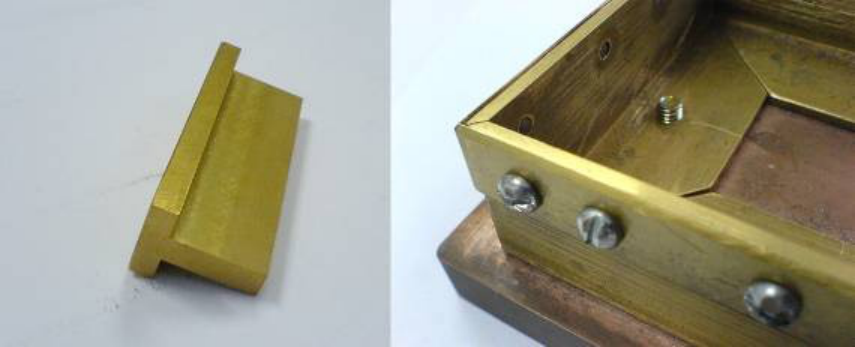
These were some of the tests that were part of the optimization processes of Levels A and B. The industry is not allowed to display images of the tests, but Figure 2 displays two tools developed during this process. The industry also has not authorized the disclosure of the results or the sequence of tests and also did not disclose the name of raw materials and machinery used in the production. However, what was shown allows us to understand some of the complexity of the process.
Figure 2. Images of the tools developed (Source: author)
FINAL RESULTS The final results exceeded expectations. With the participation of several professionals in the development of the product, there were some improvements in virtually all sectors of industry. Following are the results obtained after the completion of all technical tests, after changes in machinery and molds, after the analysis of usability with users, among other procedures are listed. Table 2 presents a list with all the advantages and benefits, indicating the parts of the product that obtained improvements and sectors of the company that were also benefited. That way it will be easier to understand the importance of the participation of a multidisciplinary team in the process and where each professional (and their respective sector) contributed.
For ease of understanding, each piece of the product will be represented by their numbering in the first column of the table. This number has been indicated in this article. In the second column is the aforementioned benefits earned. The third column indicates the sectors or professional participants of the proceedings. Each is represented by a code consisting of two letters to facilitate understanding of the table 2. Attention to the coding of sectors: Medicine = ME (represents the direct and indirect users, and consumers); Assembly = AS; Inventory (Stock) = IN; Packaging = PA; Materials = MA; Sales = SA; Purchases = PU; Production = PR; Marketing = MK; Industrial Design = ID; Ergonomics = EG; Engineering = EE.
.
Table 2. Optimizations Level A: production centered (Source: author)
Table available in the original PDF paper.
Optimization results of “Level A” (Table 2) had a higher contribution from professionals related to Industrial Design, Engineering, Production and Ergonomics. To facilitate this understanding, the percentage of participation of each of the sectors and departments involved in the process will be presented: Industrial Design (18.75%), Engineering (17.19%), Production (17.19%), Ergonomics (12.5%), Assembly (9.38%), Medicine / clients (4.69%), Sales (4.69%), Purchases (3.9%), Packaging (3.13%), Inventory (3.13%), Marketing (3.12%), Materials (2.34%).
The result of optimization of “Level B” (Table 3), on the other hand, had the Industrial Design, Medicine (customers), Ergonomics and Marketing as major its main contributors. The percentage supporting this conclusion is as follows: Industrial Design (17.04%), Medical / Customers (17.04%), Ergonomics (15.9%), Marketing (14.78%), Engineering (14.78%), Sales (14.78%), Materials (2.27%) Production (2.27%), Purchases (1.14%). Professionals related to Inventory, Assembly and Packaging sectors did not contribute at this level.
Table 3. Optimizations Level B: user centered (Source: author)
Table available in the original PDF paper.
CONCLUSIONS
The last two tables show clearly the benefits and advantages that the industry IPMH reached with the process of developing its new product through the participation of many professional sectors and departments. This satisfactory result was possible because, in the early stages of the process, the profits from sales were not the main concern, rather, the improvements to the various industry sectors that would result from the project.
Teamwork enables such positive results, due to the multidisciplinary nature involving this type of approach in the industry. This teamwork enables resolving problems more quickly, easily and efficiently because there is a mutual commitment, an exchange of knowledge, delegations, opinions, views and experiences that add up and complement each other, to meet the proposed objectives and mission that the group intended.
The end result of this process was broader than the information contained in this article, but this exhibition allows us to highlight the importance of ergonomics and industrial design activities alongside with an effective and concerned management. An organizational effectiveness was attempted, better and more efficient productivity, higher quality of life for employees, greater exchange of information and experiences with the workers, customer satisfaction and of course the safety and comfort of patients, who are the direct users of this product.
This case study is another example of an industry that, if an industry (or any company), adopt preventive rather than corrective ergonomics, focusing on the process before it even starts, there will be higher chances of a satisfactory outcome.
REFERENCES
Abergo (2013). O que é Ergonomia?; Ergonomia. Abergo (Brazilian Ergonomics Society) website: http://www.abergo.org.br/ . Attwood, D.A.; Deeb, J.M.; Danz-Reece, A.E. (2004) “Ergonomic Solutions for the Process Industries”. Gulf Professional Publishing, Elsevier. Baxter, M. (2011) “Projeto de produto – Guia prático para o desenvolvimento de novos produtos“. Edgard Blücher. Centro Português de Design (1997). “Manual de Gestão do Design”. Porto Editora. Ergonomics In Design, Usability & Special Populations II
Desmet, P., Hekkert, P. (2007). Framework of Product Experience. International Journal of Design. v.1, n.1, p.57-66. Website: http://www.ijdesign.org/ojs/index.php/IJDesign/ article/ viewFile/66/7 Gomes Filho, J. (2003) “Ergonomia do Objeto – sistema técnico de leitura ergonômica”. Escrituras Editora. Guimarães, L. B. M. (2013) “Abordagem Ergonômica: o método ‘macro’ (AMT)”. Apostila do. 8° Curso de Especialização em Ergonomia. UFPE. Iida, I. (2005), “Ergonomia: projeto e produção”. Edgard Blücher. Jacko, J.A., Yi, J.S., Sainfort, F., Mcclellan, M. (2012) “Human factors and ergonomics methods”, in: Handbook of human
factors and ergonomics. John Wiley & Sons, Inc. Salvendry, Gavriel (Ed.). pp. 298-329. Karwowski, W. (2012) “The discipline of human factors and ergonomics”, in: Handbook of human factors and ergonomics. John Wiley & Sons, Inc. Salvendry, Gavriel (Ed.). pp. 3-37. Löbach, B. (2001) “Design Industrial – bases para a configuração dos produtos industriais”. Edgard Blücher. Oliveira, F. S. K. A.; Scaletsky, C. C. (2012) “Briefing e Contrabriefing: construção, representação e reflexão do problema de
design”. In: Anais do X Congresso Brasileiro de pesquisa e Desenvolvimento em Design – P&D. Philips, P. L. (2009) “Briefing: a gestão do projeto de design”. Edgard Blücher. Soares, M. M.; Correia, W. F. M. (2002) “Usabilidade e Segurança nos Produtos de Consumo: um diferencial na qualidade do design”. In: Anais do V Congresso Brasileiro de pesquisa e Desenvolvimento em Design – P&D. Stanton, N. (2003) “Human factors in consumer products”. Taylor & Francis Inc. Vink, P., Koningsveld, E.A.P., Molenbroek, J.F. (2006) “Positive Outcomes of Participatory Ergonomics in Terms of Higher
Comfort and Productivity”. Applied Ergonomics, 37, 537-546, Website: <http://www.academia.edu/322480/ Positive_Outcomes_of_Participatory_Ergonomics_In_Terms_of_Higher_Comfort_and_Productivity>. Zapata, L.M.S. (2011). “Integration of ergonomics in the design Process: conceptual, methodological, and practical foundations”, in: Human factors and ergonomics in consumer product design – methods and techniques. CRC Press, Taylor & Francis Group, Karwowski, Waldemar; Soares, Marcelo M.; Stanton, Neville A. (Ed.). pp. 155-176.
LISTED IN THE AHFE DIGITAL BOOKSTORE CATALOGUE
Explore the complete digital volume
Advances in Ergonomics In Design, Usability & Special Populations: Part II
Read this individual research paper free through the original publisher, or explore the full digital proceedings book.
ISBN 978-1-4951-2107-4
Explore this ISBN in the AHFE Bookstore ↗Listed in the July 2026 bookstore catalogue; search by ISBN to confirm current availability · Digital book purchase optional