Stephen Baoa, Han Kima, Barbara Silversteina, Ninica Howarda (2018). Effectiveness of Evidence Based Ergonomic Interventions in a Manufacturing Facility. In: Advances in Physical Ergonomics and Human Factors: Part II. AHFE Open Access, vol. 2. https://doi.org/10.54941/ahfe100066
A large US northwest aluminum mill has been committed to combating the work-related musculoskeletal disorders (WMSDs) that the metals manufacturing industry faces by improving their working conditions and protecting the health of their workers. The mill formed an ergonomics team a few years ago, which received 2.5 days of applied production ergonomics training from researchers of the SHARP program. Several changes have been made since then by the ergonomics team. A few changes were made in conjunction with some of the lean process activities, which focused on reducing waste and improving productivity. The goals of the present study were to qualitatively and quantitatively evaluate the improvement changes, with regards to their impact on biomechanical loading that may cause WMSDs. While several production processes and jobs were evaluated, only the following improvements will be reported in the present paper: (1) loading and unloading treated aluminum plates in the vertical heat treat area, (2) changing paper rolls on the Striene machine, (3) some changes associated with lean manufacturing activities. Significant improvements in terms of biomechanical loading reduction were observed in these intervention projects.
Work-related musculoskeletal disorders (WMSDs) represent a huge problem in Washington State; with metals manufacturing ranking 4th based on the Prevention Index for Workers’ Compensation State Fund companies, and 7th among Self-Insured companies. WMSDs are serious conditions accounting for an average of 188 lost days per compensable WMSD claim (Silverstein and Adams 2006). The total cost was $3.9 billion over a 9-year period in the State Fund alone. The losses due to the high cost and skilled workers in the northwest aluminum industry make sustainability a question and affect the overall economy. These manufacturing jobs require skilled workers. These workers are getting older, making them more vulnerable to disabling WMSDs.
A large US northwest aluminum mill has committed itself to improving working conditions and protecting the health of their workers. The mill formed a new ergonomics team in 2007. The team included management, union members, engineers, and production and maintenance workers. The ergonomics team received a 2.5 day applied production ergonomics training from SHARP researchers, which included some basic ergonomics concepts, simple job risk identification and evaluation, development of control measures in risk reduction/elimination, evaluation of improvement, participatory ergonomics approaches, elements of ergonomics programs, etc. After receiving the ergonomics training, the mill ergonomics team assessed several jobs throughout the facility and made changes to reduce the musculoskeletal risk in some of these jobs. While some of the interventions were made in conjunction with the introduction of lean process activities, other interventions involved the redesign of tools. The lean process activities were primarily aimed at reducing waste (non-value added activities) and improving productivity.
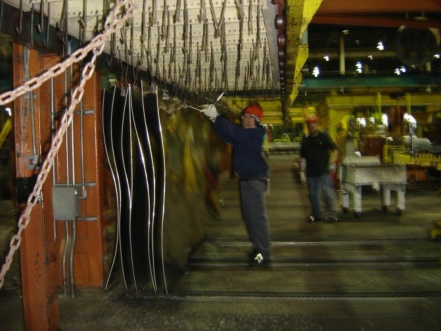
Vertical Heat Treat At the vertical heat treat area, aluminum plates are heat treated in a tempering process. A worker operates a vac-u- lift machine to load/unload plates between stacks of metal plates and the hanger. Metal gravity clamps are used to secure the plates on the hanger. Manually handling the clamps was required (figure 1). The height to the hooks on the hanger is about 80” from the ground. Before the improvement, the clamps were difficult to release. Multiple hits on the clamps with a hammer were often necessary. This caused high hand force use, repetitive movements, and elevated shoulder loadings on the operators. After a few design iterations, newly designed clamps were used. This clamp should be easier to release and require only one relatively light hit using a hammer according to the design.
Figure 1. Detaching clamp at the vertical heat treat area
Paper Roll Change The installation of the paper roll onto the Striene machine was originally performed manually. Heavy lifting/moving and awkward/forceful hand gripping of the paper rolls was required. A handle bar was developed to solve the awkward/forceful hand gripping problem by the ergonomics team in the mill, and a modified pallet jack was introduced to transport and install paper rolls onto the machine in order to reduce the heavy lifting/moving activity.
Lean Process Activities In order to improve productivity, lean activities (e.g., reducing wasted motion, storage, waiting, transporting, etc.) have been conducted in several production areas. Implemented lean improvements included:
(1) Installing a positioning frame at the Sonic machine. In this area, a crane operator was previously required to operate a crane to lift large aluminum plates after they came out from the Sonic machine and load them onto a flatbed truck. This task required the operator to manually guide the plates into position so that the plates could be properly stacked in alignment with each other. (2) Changing aluminum plate loading process. In one production area of the mill, a crane lifted large aluminum
plates one by one (or in small batches) and loaded them onto flatbed trucks to be transported (there were still about 10% of the plates transported out this way). This process was time consuming and required manual guiding and alignments by the crane operator during the loading process. (3) Installing an unscrambling system to properly align and space aluminum plates.
The goals of the present study were to qualitatively and quantitatively evaluate the changes that were implemented in the aluminum mill in terms of the reduction of biomechanical loading that may cause work-related musculoskeletal disorders. The specific aims were:
(1) To qualitativelyassessthe implemented lean process activities on biomechanical loading reduction and productivity improvement, (2) To quantitatively assess and compare muscle loading using an old and a new design of a clamping system
used in the vertical heat treat area, and (3) To compare biomechanical loading on Striene machine operators using an old and a new method of handling paper rolls.
SUBJECTS AND METHODS This study was approved by the Washington State Institutional Review Board. All available workers in jobs where interventions were implemented were invited to participate in this study. The purpose and procedures of the study were explained to potential participants by the researchers and written information was available. Workers were informed that the participation in this study was voluntary. Signed consent of participation was obtained from study participants before the start of measurements.
Workers from the following areas participated in this study. In some cases, other workers who were familiar with the operations volunteered to simulate the task performances for the evaluation purposes.
Two of the three workers available operators at the vertical heat treat area,
Two workers simulated the paper roll change process at the Striene machine,
One operator demonstrated the task performance at the new Sonic machine, and also simulated the condition before the change,
One operator demonstrated the task performance at the loading area, and also explained the condition before the change,
Mill representatives explained the functions of spacer placer equipment. This is a process evaluation, and no evaluation analysis was performed on operators at this production area.
Vertical Heat Treat Area The physical workload of the operators was evaluated using the two types of clamps. In addition, the use of two types of hammers (the conventional 32 oz Estwing hammer vs. a smaller 12 oz Ball Peen hammer) was compared.
Electromyography (EMG), electrogoniometry, video filming and workers’ self-reporting were used in this evaluation. The EMG provided quantitative muscle activity measurements of the shoulders and the dominant forearm muscles during task performance. The electrogoniometry technique provided quantitative wrist posture measurement. The EMG used surface electrodes, which were placed on the skin over the left and right upper trapezius muscles of the shoulder region, and the extensor digitorum and flexor digitorum of the forearm of the dominant. The electrical signals of the muscles were recorded through wireless transmitters and recorded on a laptop. The analyzed EMG was expressed in terms of percent maximal voluntary contraction (% MVC), which is the muscle workload relative to the muscle’s maximal capacity. The electrogoniometry technique placed two small wire-type transducers on the back of the dominant hand/forearm using double-sided tapes. Again the electrical signals were transmitted wirelessly and recorded on the laptop to quantify wrist angles. Video filming was used to document the task activities simultaneously with the EMG and electrogoniometric recordings.
The video-recorded task activities were later time-studied using the MVTA software (Yen and Radwin 1995) in the laboratory. EMG and electrogoniometric data were analyzed for each task activity of the operators. An analysis program, MUFDAP (Mathiassen and Gloria 1994) was used to analyze the signals.
Paper Roll Change The goal of this evaluation was to verify whether the risks due to the manual material handling and the high hand force gripping had been reduced when the new paper roll change technique was used, whether the new technique was user-friendly, and assess the impact on productivity.
The evaluations were performed as workers used the improved and the original paper roll change method. Motion analyses were conducted using video cameras while workers performed this task to document the postures of lifting/moving. The NIOSH Lifting Equations (Garg 1995) and the Michigan 3-D Static Strength Prediction Physical Ergonomics II (2018)
(3DSSP) program (University of Michigan 2008) were used to evaluate the manual handling activities under the two test conditions.
The hand force used to grip the paper rolls with and without the use of the newly developed handle bars was estimated using a hand force matching method (Bao and Silverstein 2005). This was accomplished by asking the workers to mimic the perceived hand force on a force dynamometer. The video recordings were also used to evaluate the usability of the handle bar and the modified loading pallet jack. The usability evaluation results would identify further improvements if needed. Work productivity, in terms of task completion time, was measured from the video recordings as well.
Ergonomic Improvements in relation to lean activities Ergonomic impacts of these lean improvements were assessed by considering the types of physical risk factors before the implementation of the lean measures and using appropriate measurement methods to quantify the risk reductions. For the improvements at the Sonic machine and loading area, biomechanical analyses on simulated task performance before and after the lean improvements were performed through taking force measurements (push/pull and lifting) and motion analysis from recorded videos. A qualitative analysis (observations and discussions with operators) was performed for the improvements for the task activity of placing spacers.
RESULTS
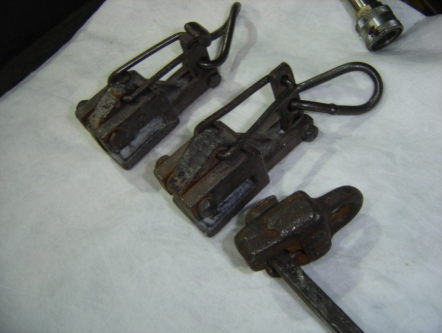
Vertical Heat Treat Area Tasks of the vertical heat treat operators included loading aluminum plates by attaching clamps on hangers (attaching), cleaning the edges of aluminum plates with a hand tool (wiping edges), unloading aluminum plates and detaching clamps from hangers (detaching), simply holding the hammer between the clamp detaching activities (holding hammer), and other miscellaneous activities (other activities). Multiple task cycles were measured of the two volunteers. The newly designed clamps (left in figure 2) and an older clamp (middle in figure 2) were used in the evaluation.
Figure 2. New (left) and old (middle) clamps used in the study
Figure 3 shows the average durations of performing the different task activities and muscle loadings when performing these activities. On average, detaching each of the clamps took about 4.9 seconds compared to only 2.0 seconds when attaching it to the hanger. Muscle loadings for all the four muscles were significantly different when performing the different task activities. Significantly higher median left trapezius load (left shoulder, 21.1% MVC) occurred when attaching the clamps onto the hangers. Compared to other activities, the right trapezius muscle (right shoulder) had the highest median load when performing the wiping edge activities (14.0% MVC) followed by the detaching activity (12.3% MVC). The wiping edge activity also required significantly higher right forearm muscle loadings (right forearm flexor median load: 33.5% MVC and right forearm extensor median load: 20.0% MVC) compared to other task activities.
The newly designed and old clamps were tested in both the “detaching” and “attaching” activities. Figure 4 shows that it took about 5.4 seconds to detach an old clamp from the hanger and toss it into a bin compared to only 4.6 seconds with the new clamp, though this difference was not statistically significant. Detaching the old clamps created significantly higher left shoulder loadings (left trapezius median and peak load, p<0.05) compared to the new clamps.
In the activity of attaching clamps, the use of the “new” clamps resulted in significantly lower left trapezius peak load (p<0.05), and right trapezius static and median loads (p<0.05) compared to the “old” clamps. At the same time, it took longer to attaching the “old” clamps (2.8 seconds) compared to the “new” ones (1.9 seconds, p<0.05).
Higher muscle loadings were also found in the “other” task activities and in the “wiping” activity when the old clamps were used compared to the new clamps (p<0.05).
It should be noted that the physical effort of detaching and attaching clamps was dependent on the workers’ positions at the aluminum plates (the middle vs. end of the plate). Compared to the end position, the middle position induced a longer time to detach (p<0.05) but shorter time to attach (p<0.05) clamps. Significant muscle loadings were also found at the two different positions in both detaching and attaching activities.
Equation reproduced from the original PDF.
Time* (s) left trapezius median load* (%MVC)
right trapezius median load* (%MVC)
right forearm flexor median load* (%MVC)
right forearm extensor median load* (%MVC)
Figure 3. . Average task activity times (seconds) and median muscle loading (% MVC) when performing different task activities;
Figure available in the original PDF paper.
* statistically significant differences between comparisons, N – number of measurements (cycles)
Detaching "new" vs "old" clamps: Task completion time and muscle load
Time (s) left trapezius median load* (%MVC)
left trapezius peak load* (%MVC)
right trapezius peak load* (%MVC)
Figure 4. Detaching clamps: Task performance time (seconds) and muscle loading (% MVC) comparisons between using the “new” vs. “old” clamps in the “detaching clamps” task activity. * indicates a statistically significant difference at p<0.05, N – number of measurements (cycles), % MVC – percent of maximal voluntary contraction.
Figure available in the original PDF paper.
In comparisons between using the large and small hammers, no advantages were found from using the small hammer in the detaching task activity, although holding the large hammer required higher right forearm muscle effort (right forearm flexor peak load, p<0.05.
With regard to wrist and forearm postures, no significant differences were found between using the new vs. old clamps in any of the tasks. In general, the wrist moved within a range of 1- 20˚ flexion, and 8˚ ulnar deviation to 18˚ radial deviation for about 80% of the time in the detaching clamps activity of the unloading task. The range of forearm supination and pronation was quite small in the detaching activity. It ranged only from 2˚ pronation to 24˚ supination during 80% of the time at this task activity.
In the comparisons between the large and small hammers, there was a significant difference between the wrist flexion and extension postures although these were not biologically significant differences. The small hammer required slightly more wrist flexion and ulnar-radial movement than the large hammer.
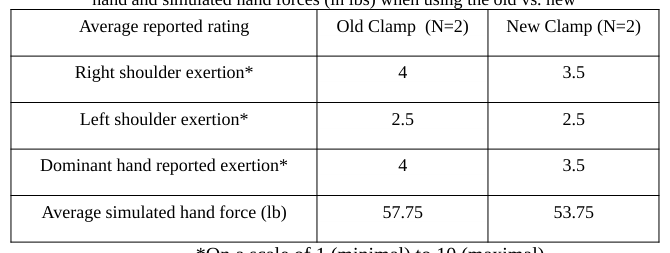
Table 1 shows the self-reported exertion levels on the shoulders and dominant hand, as well as the simulated hand forces when using the new clamps compared to the old clamps. In general, the exertion levels were moderate on the shoulders and dominant hand in both conditions. Workers perceived that the old clamps required slightly higher hand force and also experienced slightly higher exertions on the shoulders and the dominant hand.
Table 1. Workers’ self-reported exertion levels clamps on the shoulders and dominant hand and simulated hand forces (in lbs) when using the old vs. new Average reported rating Old Clamp (N=2) New Clamp (N=2)
*On a scale of 1 (minimal) to 10 (maximal)
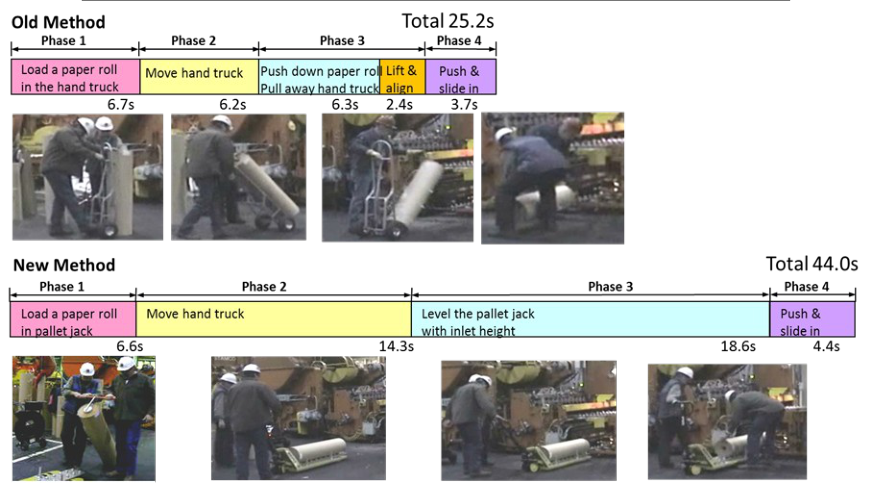
Paper Roll Change The previous method of changing a paper roll on the Striene machine involved the following phases: 1) load a paper roll onto a hand truck, 2) move the hand truck to the Striene machine, 3) dump the roll onto ground, which is then lifted by two workers, and 4) manually push the roll into the machine (Figure 5 panels A-D). The new method is composed of these phases: 1) load a paper roll onto the pallet jack using a grip tool; 2) move the pallet jack; 3) adjust the pallet jack platform height; and 4) manually push the paper roll into the machine (Figure 5 panels E-H).
For each method and task phase, a representative posture was selected and analyzed for the associated low back stress measured by the L5/S1 disc compression force (Chaffin and Andersson 1991). The paper roll weight is 154 lbs with a length of 50 inches. The low back stresses were marginally higher for the first three phases of the old method (figure 5, panels A, B, C) than the corresponding phases of the new method (figure 5, panels E, F, G) However, the third phase of the old method (panel C) shows a low back stress (1,064 lbs of spinal disc compression force) well above the design limit of 770 lbs recommended by the National Institute of Occupational Safety and Health (NIOSH). This compression force is due to the heavy lifting required in this phase. Manually pushing the roll onto the machine (last phase performed in the old method; figure 5, panel D) resulted in the second highest low back stress (697 lbs of spinal disc compression force). In the new method, however, the lifting component was eliminated and a pallet jack was used to raise the paper roll which resulted in significant reductions in low back stresses (294 lbs and 685 lbs in the 3rd and 4th phases, respectively (figure 5. Panels G, H).
Phases A) Load paper on
B) Move hand truck C) Dump & lift paper
D) Push paper roll
hand truck to machine
roll onto machine on machine
OLD
1400
NIOSH Maximum Permissible Limit (1430 lbs)
Old
1200
New
1000
800
600
NIOSH Design Limit (770 lbs)
Low Back
400
200
0
Compression Force (lbs) NEW
Phases E) Load paper roll
F) Move pallet jack G) Adjust pallet jack H) Push paper roll on pallet jack onto machine inlet height to machine inlet height
Figure 5. The sequential phases of changing the paper roll on the Striene machine, using the old method (panels A-D) and new method (panels E-H) method and the associated L5/S1 spinal disc compression forces.
Figure available in the original PDF paper.
The changes in joint stresses can be quantified by the percentage of the general population who possess the joint strength required to perform a specified job (Chaffin and Anderson 1991). For the most strenuous job components, namely the lifting (phase 3) and pushing (phase 4) in the old and new method, the analysis indicated significant improvements in the new method (table 2). Most notably, the population strength capability for the elbow increased from 29 to 99% (70% increment). However, less than 60% of the general population possesses the required hip strength capacity to perform either method.
The task time analysis results are displayed in figure 6. It was observed that the new method takes 74% longer time (44.0 seconds) than the old method (25.2seconds). This is largely due to the component of Phase 3 (figure 5, panel G) in which the worker raises the pallet jack platform to align with the elevation of the Striene machine inlet. This component takes the longest time (18.6s) of all components in the new method. Consequently, presetting and fixing the pallet jack platform to the inlet elevation would eliminate this component. This would potentially result in a completion time of 25.4s, which is effectively comparable to that for the old method.
Table 2. Percent of the General Population having required joint strength capacity to perform the paper roll change methods at the Striene Machine
Table available in the original PDF paper.
Old
New % Improvement
Method
Method
Elbow 29% 99% (+70%) Shoulder 98% 96% (-2%)
Torso 80% 96% (+16%) Hip 52% 54% (+ 2%)
Knee 99% 99% (0%)
Figure 6. Completion times for task components comprising each job method. The width of each box represents the relative duration of each component, whose average length was indicated below in seconds.
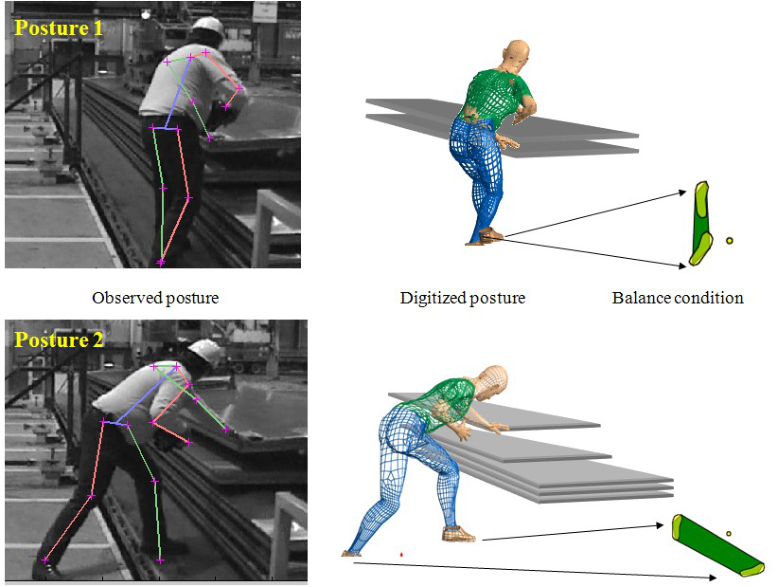
Ergonomic Improvements in relation to lean activities In the Sonic machine area, the previous process of lifting large aluminum plates from the Sonic machine on flatbed trucks was slow and not very accurate. In the simulated task performance, the pushing force used in guiding a plate onto a flatbed truck was measured as 27 lbs in the horizontal direction. Using the same procedure as for the Striene machine, representative postures of workers as they manually guided plates were selected and digitized in order to calculate the associated low back compression forces and population joint strength capabilities (figure 7).
Figure 7. Postures analyzed in Sonic machine jobs Using 3-D biomechanical analysis and balance analysis (indicated by the center of gravity projected onto the ground (small circle) and the base of support (the area bounded by the feet in contact with the ground))
In Posture 1 the worker pushes an aluminum plate with both feet close to the stack. The posture analysis determined at the low back compression force of approximately 413 lbs. The population having the joint strength capacity to perform in this posture ranged between 54% (shoulder) and 99% (torso and knee). Additionally, the estimated balance condition is not acceptable. The balance analysis showed that the center of gravity projected onto the ground (figure 7, small circles on the right panels) was outside of the base of support (the area bounded by the feet in contact with the ground). This specific posture, which is partially supported by the left arm and hand pushing and leaning against the plate, puts the worker at the risk of falling should the left hand contact become unstable or lost. Similar results were found for Posture 2, in which the worker’s upper body and left leg are stretched forward. Specifically, the estimated low back compression force of 693 lbs is near the NIOSH recommended design limit of 770 lbs. The knee joint strength capacity is only present in 68% of population, and the balance condition is not acceptable.
After the lean process activities, this job was improved by installing an alignment frame fixture at the station to guide the positioning of the aluminum plates. Now, the worker only needs to lower the aluminum plates along the guiding frame fixture when loading the truck. The manual hand guidance maneuver has been completely removed, eliminating the potential risks of the manual pushing effort and associated risks of fall. This fixture greatly improves the loading accuracy and has made the process faster. Specifically, a task time analysis indicates that the new method typically takes 41.6 seconds to complete in contrast to 56.2 seconds in the old method, which is a 26% time reduction. The new method greatly improved the efficiency of this job as the lengthy and iterative cycles of lowering plates and manual alignment were eliminated.
In the evaluation of the flatbed truck loading process of large aluminum plates, a manual push force in the horizontal direction was measured to be about 30 lbs. Using the same procedure as for the Striene machine and Sonic machine jobs, analysis of a digitized representation of the posture adopted during the load process indicated that manually aligning plates resulted in a high low back stress, with a L5/S1 disc compression force of 657 lbs, a magnitude near the NIOSH design limit (770 lbs). Although the corresponding balance analysis determined this posture to be acceptable, the position of the center of gravity on the boundaries of the base of support indicates that a potential risk of fall may be still present. The percentage of population having the necessary joint strength was 99% Physical Ergonomics II (2018)
(elbow), 94% (shoulder), 97% (torso), hip (90%), and 97% (knee).
The mill identified this process as one of the production wastes and decided to make changes according to lean manufacturing principles. They modified a crane attachment so that it would be able to grab multiple plates at one time. They further changed the production process by using the newly designed crane attachment to load multiple plates onto a wagon which would transport larger loads to their destination. These changes not only improved the productivity, but also eliminated the extra physical efforts that the operators would otherwise need.
In another production area of the mill, a multi-million dollar piece of equipment was installed to automate the stacking and packing process. No manual manipulations were needed in this production area except in one activity – placing aluminum spacers between plates. Each aluminum spacer weighed 4 lbs. A worker usually carried 6 of them (24 lbs total) 14 feet from a bin to the workspace where they were placed between finished aluminum plates. According to the Liberty Mutual’s manual material handling guidelines (Snook 1978, Liberty Mutual 2004), this carrying activity reached the maximal carrying weight limit of 90% male workers, under the assumption that the spacers were carried at the chest level for a distance of 14 feet with a work pace of one carry every 16 seconds. Additional physical load was placed on the workers shoulders when he repetitively reached to place the spacers.
To improve this process, the mill introduced a commonly used sawmill technology – a lugs system that unscrambles the boards, and modified it to fit the aluminum spacer placing application. The new spacer placing system is able to automatically place the aluminum spacers onto the plates. This change not only improved the productivity dramatically, but also eliminated the physical effort of carrying and placing the spacers.
CONCLUSIONS
Lean improvement activities can sometimes go hand-in-hand with ergonomic improvement activities. Through worker involvement in assessing the lean process activities, both productivity and work conditions have been improved.
The newly modified clamps significantly reduced the operators’ physical workload and improved the work conditions for the vertical heat treat operators. Further improvement is needed to reduce work postures with the upper arm above shoulder level during attaching and detaching the clamps.
The newly modified paper roll change procedure at the Striene machine greatly reduced the low back loading as well as loadings on the elbow and torso regions. Improvement in usability of this new procedure is needed in order to encourage the operators to use the new method.
REFERENCES
Bao, S. and B. Silverstein (2005). Estimation of hand force in ergonomic job evaluations. Ergonomics 48(3): 288-301. Chaffin, D. B. and G. B. J. Anderson, Eds. (1991). Occupational Biomechanics. New York, John Wiley & Sons. Garg, A., Revised NIOSH Equation for Manual Lifting: A Method for Job Evaluation, American Association of Occupational Health Nurses Journal, 43(4): 211-218, 1995 Jonsson, B. (1982). Measurement and evaluation of local muscular strain on the shoulder during constrained work. Journal of
Human Ergology 11: 73-88. Liberty Mutual Group. (2004). Liberty Mutual Materials Handling tables. Boston, Massachusetts, Liberty Mutual Group. Mathiassen, S. E. and R. Gloria (1994). A comprehensive program package - MUFDAP - for analyzing data from ergonomic studies. Toronto, Canada. Silverstein, B. and D. Admas (2006). Olympia, WA, USA, SHARP program, Washington State Department of Labor and
Industries. Snook, S. H. (1978). The design of manual handling tasks. Ergonomics 21(12): 963-985. University of Michigan. (2008). 3D static strength prediction program (Version 6.0.0). Ann Arbor, Michigan, The University of Michigan, Center for Ergonomics. Yen, T. and R. Radwin (1995). A Video-Based System for Acquiring Biomechanical Data Synchronized with Arbitrary Events
and Activities. IEEE-Transactions-on-Biomedical-Engineering 42(9): 944-948.
LISTED IN THE AHFE DIGITAL BOOKSTORE CATALOGUE
Explore the complete digital volume
Advances in Physical Ergonomics and Human Factors: Part II
Read this individual research paper free through the original publisher, or explore the full digital proceedings book.
ISBN 978-1-4951-2105-0
Explore this ISBN in the AHFE Bookstore ↗Listed in the July 2026 bookstore catalogue; search by ISBN to confirm current availability · Digital book purchase optional