Olga Veilande, Henrijs Kalkis, Zenija Roja (2024). Human Factors and Ergonomics in Patient Safety Within the Framework of Environmental, Social and Governance. In: Social and Occupational Ergonomics. AHFE Open Access, vol. 152, pp. 59–69. https://doi.org/10.54941/ahfe1005321
The healthcare system is one of the keys to sustainable development and has historically embraced the social pillar of environmental, social and governance (ESG) efforts, caring for patients and medical employees. Since the human factor and ergonomics (HFE) is part of the social efforts, integration of the HFE into the process and quality management system might create a new discourse also for management of patient safety system. Hence the integration of HFE in patient safety with the ESG framework is a current and evolving field of study. Aim of the research is to investigate scientific literature on the field of HFE in Patient Safety and ESG framework in order to develop systematic literature review on how to develop sustainable patient safety with HFE integration with ESG framework. Systematic literature review was performed during the study, using monographic and PRISMA method guidelines. Research results show that sustainable development is one of the key issues in the healthcare industry. Human Factors and Ergonomics (HFE) scientific researches in patient safety have addressed various contemporary factors, including technology use, human errors and its role in patient safety, work efficiency and work abilities in patient safety a.o. Integrating HFE in patient safety with the ESG framework can lead to a holistic approach towards improving patient safety and healthcare outcomes and most importantly – provide sustainable patient safety. This integration can help healthcare organizations manage risks and opportunities related to environmental, social, and governance criteria, hence improving the overall wellbeing of patients and at the same time also for healthcare workers.
Patient safety corresponds with several United Nations’ Sustainable Devel- opment Goal 3 (SDG 3) – to ensure healthy lives and promote well-being for all at all ages. In particular, SDG 3 highlights the goal for safe and qual- ity healthcare. The Institute of Medicine (IOM) considers patient safety as “indistinguishable from the delivery of quality health care” (Aspden et al.,
2004). However, on average, an estimated one in 10 patients (Domer et al., 2021) is subject to an adverse event while receiving hospital care in high- income countries. Low and middle-income countries fare far worse as one in four patients is estimated to be harmed (Slawomirski et al., 2017). According to the Organisation for Economic Co-operation and Development (OECD), patient harm is estimated to be the 14th leading cause of the global disease burden (ibid.) that involves a high financial cost that could be used for the direct healthcare needs. In particular, up to 15% of hospital expenditure and activity can be attributed to treating safety failures in OECD countries (WHO, 2019). Furthermore, the psychological cost to the patient and fami- lies associated with a loved one’s death or disability, and loss of trust in the healthcare system are immeasurable (WHO, 2017).
It must be emphasised that above 5% of harm (1 in every 20 patients) is preventable (Panagioti et al., 2019), and medical errors can be attributed to both system and human factors. Human factors often lead to human errors. For instance, researchers emphasise that as a human-based and human- oriented enterprise, healthcare is ideally suited to benefit from the domain of human factors and ergonomics (Perry et al., 2021). Recent studies have proven the importance of integration of HFE in health care. For example, the checklist (called a ‘cognitive artifact’ by HFE specialists) made central line insertion unambiguous and behaviourally specific (Gurses, 2008). Patient safety practices focus on a specific area of the work system and should be planned and implemented in accordance with HFE principles in order to promote various patient safety advantages (Haynes et al., 2009). As stated in several leading ergonomist research findings, the value of HFE to health care quality and safety is increasingly recognized (Hignett et al., 2013). Good examples have been experienced in response to the COVID-19 pandemic. For instance, in the United Kingdom (UK), the Chartered Institute of Ergonomics and Human Factors (CIEHF, 2022) rapidly produced documents with advi- sory HFE guidance for a variety of topics during the pandemic, including the physical, mental and social health of children studying and learning from home, the safe and effective rollout of time-critical vaccination programs, sustainable organizational changes of health care systems, and the design and use of ventilators (CIEHF, n.d.). ESG reporting may be a helpful tool for healthcare organisations to measure, evaluate, and follow-up their sustain- able performance, in patient safety. With comprehensive analysis, healthcare organisations can identify the areas for improvement, develop corrective actions for issues to-be-improved, measure the performance, and ensure con- tinuous improvement in the safety management. Additionally, healthcare providers may benefit from application of ESG approaches.
METHODS
Systematic literature review was performed to gain the latest research results from scientific studies on human factor ergonomics in relation to the patient safety within the Framework of Environmental, Social and Governance. A survey of the literature was conducted to identify the interdependence of the human factors and patient safety and the benefits of their integration with the
Human Factors and Ergonomics in Patient Safety 61
ESG framework, social and governance factors in particular. Research papers were selected using Mendeley Catalog from Science Direct data base and Open Source. The review was conducted in accordance with PRISMA guide- lines 2020 for systematic reviews. For the selection of scientific articles and publications, authors chose the following keywords - Ergonomics, Human Factors, Patient Safety, sustainability, quality, ESG, healthcare, resilience, embedded human factors. Keyword searches in the selected databases led to selection of 156 papers. After deleting duplicates, the authors selected 98 documents. Of the 98 publications that were selected by title, several were excluded because they did not satisfy all the selection criteria in that the texts were not available in total and free of charge. 32 full-text papers that sat- isfied all the criteria were analysed and used to create a systematic review of the literature. The literature review covers published information for the period from 2000 till 2023 and it is limited to the studies on assessment of the impact of HFE on sustainable patient safety management and integration of both factors with the ESG framework.
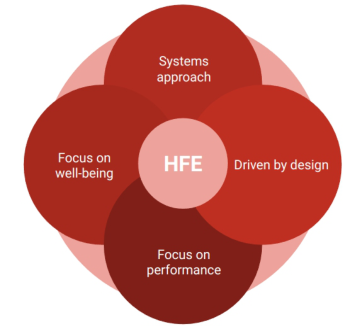
LATEST FINDINGS IN HFE SCIENTIFIC DISCIPLINE REGARDING PATIENT SAFETY HFE as an interdisciplinary science has evolved significantly during the past three decades (Dempsey et al., 2000). The studies in the field of patient safety in the context of HFE have revealed that during the past 30 years the cul- ture of healthcare has adopted a new - ‘system failure’ - approach (Institute of Medicine, 2005) as a more significant contributor to risk and harm and introduced “systems thinking”(Perry et al., 2021), as a solution. As proposed by Dul et al. (2012), key elements of the HFE can be summarised as seen in the Figure 1.
Figure 1: HFE elements (created by the authors based on Dul et al., 2012).
In the healthcare field, ergonomics refers to adoption of a variety of sci- entific measures to enhance the compatibility between the workplace and
employees (Chen et al., 2020). These measures are the potential and limita- tions of the working environment, which are formulated by considering the actual situation of workers (ibid.). Ergonomics allows the design of appro- priate workplaces to promote a healthy work culture, that is, by solving workload management problems, to make up for human errors of medical health workers (Chen et al., 2021). The studies show that HFE is critical for patient safety across all healthcare domains (Alper, 2012) and focuses on holistic aproach (Sharples and Buckle, 2015) and work system (Xie and Carayon, 2015).
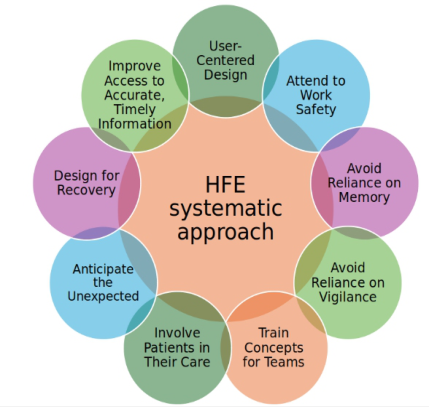
HFE as critical field for patient safety across all healthcare domains in the discourse of a systems approach was proposed by several researchers (Kohn and Coorigan, 1999). Preventing death and injury from medical errors requires dramatic, system-wide changes (Donaldson, 2008). IOM recom- mends applying a systematic approach (Reid et al., 2005) as shown in the Figure 2.
Figure 2: HFE systematic approach (created by the authors based on Reid et al., 2005).
Later (2005), the IOM and the National Academy of Engineering con- cluded that HFE could be viewed as one tool needed to design better healthcare systems (Institute of Medicine, 2005). For instance, consideration of HFE principles during the design of health IT, such as clinical decision support, can improve the usability of the technology (Salwei et al., 2022). HFE experts focus on designing user-friendly interfaces that can improve the user’s performance and reduce human error (Gurses et al., 2012). As defined by the International Ergonomics Association, HFE is based on three domains: physical, cognitive and organisational ergonomics (IEA, 2000). Each of the domains can help in solving certain patient safety related applications (Table 1).
Human Factors and Ergonomics in Patient Safety 63
Table 1. Domains of specialisation within the human factors and ergonomics discipline (Gurses, 2012) (created by the authors).
Table available in the original PDF paper.
From an organisational HFE viewpoint, work systems should be designed so that tasks are reasonably demanding physically and cognitively and within the organisational context, in which these technologies will be used (Carayon et al., 2014). Therefore, an HFE systems approach to healthcare quality and patient safety should include organizational HFE or macro-ergonomic considerations (Donaldson, 2008).
HFE as an Innovation in Patient Safety To facilitate and support the application of HFE in healthcare organizations, several researchers propose to consider HFE as an innovation in patient safety that needs to be adopted and implemented in healthcare organiza- tions (Carayon, 2010). Table 2 provides some examples for each of three types of HFE domains and innovations for patient safety which were initially proposed by Carayon (2010).
Additionally, as noted by Rivera, the presence of clinically embedded HFE provides an opportunity for more robust, appropriate and likely more sus- tainable interventions at the frontlines of care, clarity on trade-offs within and across their healthcare work system, as well as planning for potential consequences associated with any changes that are made (Rivera, 2014).
There has been increasing effort at various levels of healthcare policy, accreditation, reimbursement, operations and associations to improve patient safety (Carayon, 2010); the effects of these interventions and programs on patient safety is unclear however (Vincent et al., 2008). Some of the most frequently mentioned challenges in the studies can be summarised as follows:
1) Medical staff are afraid to register and report on adverse events. It should be emphasised that collecting and analyzing data are central to the function of quality improvement at all levels therefore the adverse events
need to be registered. However, contrary to the Theory of human factors, which manifests that punishment is not necessary means and does not help solve problems (Stewart, 2002) and although in most countries there is a legal requirement to register and investigate adverse events, medical staff are afraid to do so. Studies in the patient safety have found that fear around the report- ing of errors is manifested within health care cultures impeding progress and learning for improvement and error prevention (American College of Medical Quality, 2005, 2009, 2021).
Table 2. Domains of human factors and ergonomics (HFE) and their relationships to HFE innovations and patient safety (created by the authors based on Carayon, 2010).
Table available in the original PDF paper.
2) Healthcare organisations need to improve data collection techniques and have appropriate tools for data collection because to get quality, unbi- ased data, one must use sound data collection techniques, appropriate tools, correct sampling techniques, ensure data validity, and confirm it is secured (Domer, 2021).
3) Education of health care professionals has given little attention to patient safety (Leotsakos et al., 2014), resulting in limited understanding of the nature of risk in health care and the importance of strengthening systems therefore World Health Organisation (WHO) has recognized the need for an international leader in patient safety education and in 2013 published a Multi-professional Patient Safety Curriculum Guide for standardization of patient safety education, an update to its earlier Curriculum Guide for Medical Schools published in 2009 (Farley, 2015).
ESG Framework Explained The 2023 report of the Lancet Countdown on health and climate change con- firms climate change as the biggest global health threat of the 21st century
Human Factors and Ergonomics in Patient Safety 65
(Romanello et al., 2023; Karliner et al., 2020). Every health dimension tracked by the Lancet Countdown is worsening as the climate changes. Exten- sive social and health inequities will occur as a result (Friel, 2022). In order to ensure global development, including mitigation of climate change, in 2015 the United Nations (UN) General Assembly adopted the so-called 17 Sus- tainable Development Goals (SDGs) (United Nations, 2015). As addressed in SDGs 11 (Sustainable Cities and Communities), 12 (Responsible Consump- tion and Production), and 13 (Climate Action), environmental factors have a direct impact on health. For example, clean air, safe drinking water, nutritious food, noise, infection control, waste management, energy efficiency, sewage treatment and disposal are essential for good health. Therefore, efforts to minimise negative impact of climate change directly contribute to better health outcomes. On 12 December 2019, European Green Deal (EGD) - a major socio-economic restructuring plan to confront climate change (Kyriazi and Miró, 2022) – was endorsed with subsequent adoption of the Corporate Sustainability Reporting Directive (CSRD) and the European Sustainability Reporting Standards (ESRS) in 2023. CSRD requires European Union (EU) companies and organisations to disclose sustainability information on envi- ronmental, social, and governance (ESG) impacts (European Parliament and the Council, 2022). ESG can be defined as a framework that helps stakehold- ers assess and manage risks related to environmental, social, and governance criteria.
As of 2024, hospital is subject to the CSRD if they meet two of the following three criteria (European Parliament and the Council, 2022):
more than 250 employees and/or
net sales of more than EUR 40M and/or
balance sheet total of more than EUR 20M.
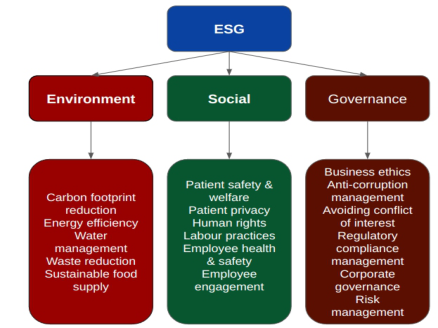
Reports for hospitals that fall under the above scope, are supposed to pre- pare their first reports in 2026, covering the financial years 2025. Some ESG factors relevant to the healthcare sector can be found in the Figure 3.
Figure 3: ESG factors (created by the authors).
ESG takes the holistic view that sustainability extends beyond just envi- ronmental issues. Governance factor encompasses all three factors that would ensure sustainable operation of healthcare organisations. The World Health Organisation has defined seven elements of a climate-friendly hos- pital (WHO, 2019) that includes energy efficiency, green building design, alternative energy generation, transportation, food, waste and water.
Sustainable Patient Safety With HFE Integration With ESG Framework Already in 1972, the United Nations declared that sustainable development would be one of the greatest, if not the greatest, global challenges of the 21st
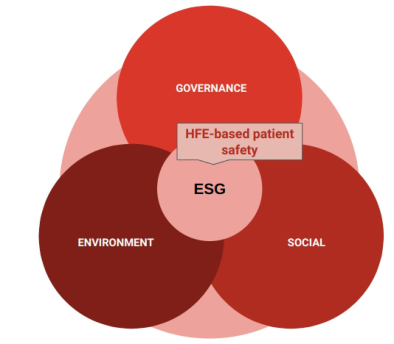
century. Studies claim that the implementation of sustainability in health- care operations would result in both financial and quality improvement for healthcare (Tudor, 2007). Hence authors provide visualization based on the research of sustainable patient safety with HFE integration with ESG framework (see Figure 4).
Figure 4: Sustainable patient safety with HFE integration with ESG framework (created by the authors).
Sustainability can be defined as the capability of being maintained at a certain rate or level (Gruen, 2008), encouraging healthcare managers to frame social and governance issues ensuring resilience and long-term value creation. As service excellence in healthcare context is the ability of the provider to consistently meet and manage patient expectations (Marimuthua and Paulose, 2016), sustainability in social and governance factors within the ESG framework should be viewed as the key drivers for effective integration of HFE-based patient safety with the ESG framework.
As noted in research findings one of the future suggestions, which authors could immediately identify, is about expanding the scope of sustainability in healthcare beyond environmental sustainability into human based sustain- ability (e.g. patient, employee and community) for enhancing organizational excellence and high quality of service (Marimuthua & Paulose, 2016).
Human Factors and Ergonomics in Patient Safety 67
CONCLUSION
The present study has demonstrated that HFE methods are becoming a cru- cial part of the patient safety improvement tools. Application of HFE requires a systematic approach to minimise potential human errors of human involve- ment. The study showed that although HFE can be viewed as an investment in operation of healthcare organisations and could result in reduction of patient harm and lead to financial savings, there are also challenges in inte- gration of HFE in healthcare system. Most common challenges are related to the culture changes in healthcare, education of health care professionals and data collection about patient safety related adverse events. Sustainability in patient safety management could be reached through an integrated approach that is based on social and governance factors. Sustainability has become the key driver for innovation, therefore healthcare organisations have the opportunity to improve patient safety through incorporation of ESG-driven changes into the patient safety management. Organisations could benefit from integrating ESG-driven changes into the human factor-based patient safety governance.
Future research will be directed to expand and compare other issues related to sustainability formation in healthcare in a more integrative and holistic perspective.
REFERENCES
Alper S. J., Holden R. J., et al. (2012). Self-reported violations during medication administration in two paediatric hospitals. British Medical Journal Quality & Safety. 2012;21:408–415. Aspden P, Corrigan J, Wolcott J, et al., editors. Patient safety: achieving a new
standard for care. Washington, DC: National Academies Press; 2004. Carayon P. (2010). Human factors in patient safety as an innovation. Appl Ergon.
41(5): 657–65. Carayon, P., Xie, A., & Kianfar, S. (2014). Human factors and ergonomics as a patient safety practice. BMJ Quality & Safety, 23, 196–205. CIEHF, (2022). Covid-19 – Human factors where it’s needed most (n.d.), Available:
https://covid19.ergonomics.org.uk/. CIEHF. (2022). Chartered Institute of Ergonomics and Human Factors. Covid-19 – Human factors where it’s needed most. Available: https://covid19.ergonomics.org .uk/. Chen, X., Wang, X. & CQ Ai (2020). Application of Ergonomics in Health Care.
International Conference on Advances in Biological Science and Technology. Chen, X., et al. (2021). Application of Ergonomics in Health Care. IOP Conference Series: Earth and Environmental Science, Volume 707, 2020 International Conference on Advances in Biological Science and Technology. Dempsey, P., Wogalter, M., & Hancock, P. (2000). What’s in a name? Using terms
from definitions to examine the fundamental foundation of human factors and ergonomics science. Theoretical Issues in Ergonomics Science, 1, 10–3. Domer, G., Gallagher, T. M., Shahabzada, S., Sotherland, J., Paul, E. N., Kumar, K.-N., Wilson, B., Salpekar, S., & Kaur, P., editors. (2021). Contemporary Topics in Patient Safety. Volume 1, Chapter Patient Safety: Preventing Patient Harm and Building Capacity for Patient Safety.
Donaldson, M. S. (2008). An Overview of To Err is Human: Re-emphasizing the Message of Patient Safety. In R. G. Hughes (Ed.), Patient Safety and Quality: An Evidence-Based Handbook for Nurses. Agency for Healthcare Research and Quality (US). Dul, J., Bruder, R., Buckle, P., Carayon, P., Falzon, P., Marras, W. S., Wilson, J. R., &
van der Doelen, B. (2012). A strategy for human factors/ergonomics: Developing the discipline and profession. Ergonomics, 55(4), 377–395. European Parliament and the Council. (2022). Directive (EU) 2022/2464 of the European parliament and of the council, Available: https://eur-lex.europa.eu/legal-co ntent/EN/TXT/?uri=CELEX:32022L2464. Farley, D., Zheng, H., Rousi, E., & Leotsakos, A. (2015). Field Test of the World
Health Organization Multi-Professional Patient Safety Curriculum Guide. PLoS One, 10(9). Friel, S., Climate change, society, and health inequities. (2022). Med J Aust. 2022; 217: 466–468. American College of Medical Quality, editors (2005, 2009, 2021). Medical Quality
Management, Theory and Practice, Third Edition. 302–310. Gruen, R., Elliott, J., Nolan, M., Lawton, P., Parkhill, A., McLaren, C., et al. (2008).
Sustainability science: An integrated approach for health-programme planning. Lancet, 372(9649), 1579–89. Gurses, A. P., Seidl, K. L., Vaidya, V., et al. (2008). Systems ambiguity and guideline compliance: A qualitative study of how intensive care units follow evidence-based guidelines to reduce healthcare-associated infections. Quality and Safety in Health Care, 17, 351–359. Gurses, A. P., Ozok, A. A., & Pronovost, P. J. (2012). Time to accelerate integration
of human factors and ergonomics in patient safety. BMJ Quality & Safety, 21, 347–351. Haynes, A. B., Weiser, T. G., Berry, W. R., et al. (2009). A surgical safety checklist to reduce morbidity and mortality in a global population. Health Care Without Harm, produced in collaboration with Arup. (2019). Health
Care’s climate footprint, How the health sector contributes for action, pp. 20–22. Hignett, S., Carayon, P., Buckle, P., & Catchpole, K. (2013). State of science: Human factors and ergonomics in healthcare. Ergonomics, 56(10), 1491–1503. IEA. (2000). International Ergonomics Association. The Discipline of Ergonomics.
Available: https://iea.cc/about/what-is-ergonomics/. Institute of Medicine. Building a Better Delivery System: A New Engineering/Health Care Partnership. Washington, DC: National Academies Press, 2005. Karliner, J., Slotterback, S., Royd, R., Ashby, B., Steele, K., Wang, J. (2020). Health
care’s climate footprint: The health sector contribution and opportunities for action. European Journal of Public Health, 30 (5). DOI: https://doi.org/10.1093/ eurpub/ckaa165.843. Kyriazi, A. and Miró, J. (2022). Towards a socially fair green transition in the EU?
Ananalysis of the Just Transition Fund using the Multiple Streams Framework. Comparative European Politics (2023) 21:112–132. Kohn, L. T., Corrigan, J. M., & Donaldson, M. S. (Eds.). (1999). To Err is Human: Building a Safer Health System. National Academy Press. Washington, DC. Leotsakos, A., Ardolino, A., Cheung R., et. al. (2014). Educating future leaders in
patient safety. Journal of Multidisciplinary Healthcare 2014:7 381–388. Marimuthua, M., & Paulose, H. (2016). Emergence of Sustainability Based Approaches in Healthcare: Expanding Research and Practice. Procedia - Social and Behavioral Sciences, 224, 554–561.
Human Factors and Ergonomics in Patient Safety 69
Panagioti, M., Khan, K., Keers, R. N., Abuzour, A., Phipps, D., Kontopantelis, E., et al. (2019). Prevalence, severity, and nature of preventable patient harm across medical care settings: Systematic review and meta-analysis. BMJ, 366, l4185. Perry, S. J., Catchpole, K., Rivera, A. J., Henrickson Parker, S., & Gosbee, J. (2021).
Strangers in a strange land’: Understanding professional challenges for human factors/ergonomics and healthcare. Applied Ergonomics, 94, 103040. Reid, P. R., Compton, W. D., Grossman, J. H., & Fanjiang, G. (2005). Building a Better Delivery System. A New Engineering/Health Care Partnership. The National Academies Press. Rivera, A. J. (2014). A socio-technical systems approach to studying interruptions:
Understanding the interrupter’s perspective. Applied Ergonomics, 45(3), 747–756. Romanello, M., di Napoli, C., Green, C., et al. (2023). The 2023 report of the LancetCountdown on health and climate change: The imperative for a health- centred response in a world facing irreversible harms. Lancet. 2023; (published online Nov 14). https://doi.org/10.1016/S0140-6736(23)01859-7. Salwei, M. E., Carayon, P., Wiegmann, D., Pulia, M. S., Patterson, B. W., &
Hoonakker, P. L. T. (2022). Usability barriers and facilitators of a human factors engineering-based clinical decision support technology for diagnosing pulmonary embolism. International Journal of Medical Informatics, 158. Sharples S. and Buckle P. (2015). Ergonomics and Human Factors as reflective practice. In: Wilson JR, Sharples, S, eds. Evaluation of human work (Fourth Edition). Boca Raton: CRC Press 2015: 975–82. Slawomirski, L., Auraaen, A., & Klazinga, N. (2017). The Economics of Patient
Safety: Strengthening a value-based approach to reducing patient harm at national level. OECD Health Division. Available: https://doi.org/10.1787/5a9858cd-en. Slawomirski, L., Auraaen, A., & Klazinga, N. (2021). The economics of patient safety in primary and ambulatory care: Flying blind (OECD Health Working Papers No. 106). Organisation for Economic Co-operation and Development. Available: https://doi.org/10.1787/baf425ad-en. Stewart, J. M. (2002). Occupational Health & Safety, 4., 80–84. United Nations. (2015). Transforming our world: The 2030 Agenda for Sustainable
Development. Available: https://sdgs.un.org/2030agenda. Tudor, T. L. (2007). Towards the development of a standardised measurement unit for healthcare waste generation. Resources, Conservation and Recycling, 50, 319–333. Vincent, C., Aylin, P., Franklin, B. D., Holmes, A., Iskander, S., Jacklin, A.,
et al. (2008). Is health care getting safer? British Medical Journal, 337(7680), 1205–1207. WHO. (2017). World Health Organization. Patient Safety: Making health care safer. Geneva. Available: https://www.who.int/publications/i/item/WHO-HIS-SD S-2017.11. WHO. (2019). World Health Organisation. Available: https://www.who.int/. Xie, A., & Carayon, P. (2015). A systematic review of Human Factors and
Ergonomics (HFE)-based healthcare system redesign for quality of care and patient safety. Ergonomics. 2015;58(1):33–49.
LISTED IN THE AHFE DIGITAL BOOKSTORE CATALOGUE
Explore the complete digital volume
Social and Occupational Ergonomics
Read this individual research paper free through the original publisher, or explore the full digital proceedings book.
ISBN 978-1-964867-28-1
Explore this ISBN in the AHFE Bookstore ↗Listed in the July 2026 bookstore catalogue; search by ISBN to confirm current availability · Digital book purchase optional