Svetlana Kocerova, Henrijs Kalkis, Zenija Roja (2024). Process improvement with AI in service industry: case studies. In: Social and Occupational Ergonomics. AHFE Open Access, vol. 152, pp. 80–86. https://doi.org/10.54941/ahfe1005323
To be competitive in the market and deliver results in the long-term perspective, service industry companies are using different techniques for process improvement and optimization. One of the most used business efficiency improvement techniques is Lean methodology. With a development of technologies and referring to industrial revolution 5.0, implementation of Lean approach and process improvement provide most effects by adding artificial intelligence (AI) and other related technologies to classic Lean instruments. The aim of the research is to study real case studies in the service industry and evaluate pre-requirements of possibility to implement process improvement using AI technologies in service delivery and evaluate the degree of human support that is required during and after implementation of measures. Research is focusing also on factors that support or limit use of technology for full automation of processes, discovering both short-term and long-term perspectives in different level manual processes. Systematic literature review, content analysis, empirical refinement and validation are used as research methods for this paper. Empirical study and validation involve both IT and Lean practitioners. Main results show that process improvement with AI provides higher efficiency and quality increase for service industry companies. The level of automation depends on many factors and in particular on the initial process embracing and introducing Lean instruments.
Following industrial revolution 4.0 and 5.0, AI is becoming a natural part of daily lives in society and business operations. Both manufacturing and service industries are actively implementing AI technologies and successfully harvesting results from this innovation and process improvement (Prikshat et al., 2021; Zhang et al., 2022).
As an important pre-requisite for successful implementation of AI in organ- isations, is not only technical improvements, but also accepting the fact that AI will be a part of everyday work and part of the work will be automated. It takes time to accept AI by different units inside the organisation and mit- igate resistance for both implementation and maintenance in organisations. It is proven that process improvement has a positive indirect effect on the capacity of the company to absorb AI technology (Bogodistov et al., 2022).
Initial assumption in the service industry is that AI and robotics solutions supplementing Lean instruments could deliver a huge saving, improve process
Process Improvement With AI in Service Industry: Case Studies 81
and can be an independent solution with no need of human support. To increase productivity and ensure savings in the long-term perspective, ser- vice companies in combination with Lean implement AI into different parts of the process or the whole process (Kocerova et al., 2022; Grossu-Leibovica & Kalkis, 2022).
If an organisation is actively working with Lean and process improvement techniques, including defining key performance indicators (KPI) and overall objectives, it will be willing to take a more active role in adoption of AI technology and possibilities to deliver results. Practical experience from the case studies shows that AI is supporting processes, positively influencing the efficiency and quality goals.
As a starting point it is always good to “start small”, following the same logic as when implementing Lean methodology. Good starting point is simple process automation with robotic process automation (RPA), in order to auto- mate rule-based business processes across the company at a low cost and with fast delivery (Aldoseri et al., 2023). Benefit of such a starting point is of course rather low-cost levels, possibility to address “quick wins” and onboarding of employees in the world of AI (Aldoseri et al., 2023). Simple automation provides faster handling time, cost reduction, increased process quality and control. Referring to use cases described below, robots work faster than a human – only limited by the slowness of applications, if volume increases – several robots can work on the same process and robots do only what they are programmed to, e.g., no human mistakes like typos, mixing customers and forgetting steps. Chosen case studies in this publication cover one part of an organization with manual tasks to define dependencies and efficiency results implementing AI during process improvement.
Implementing the first RPA, a company is preparing also in terms of techni- cal perspective, working on best solutions for infrastructure and maintenance processes for automation solutions.
The next logical step is introducing AI, often called smart robots or machine learning. Its main advantage is the possibility not only to automate rule-based processes, but also to automate decisions and evaluations that are providing a wider range of possible benefits (Sarker, 2021).
AI is described in many ways, but one of the definitions involves the explanation that AI is a technology or branch of computer science that is developing a human-like intelligence and is aimed to solve complex problems in situations of uncertainty (Akshay, 2021). AI requires understanding of how and where it could be implemented. In order to solve this problem, various special supporting workshop kits for learning are created. This is comparable to Lean process improvement, which must be seen and understood to decide on an automation process. If the analysis is correct and people working with processes are not showing resistance for implementation, business cases and results are good and some of the examples supporting this are provided in the case study section.
The aim of the research is to study real case studies in the service industry and evaluate pre-requirements of possibility to implement process improve- ment using AI technologies in service delivery and evaluate the degree of human support that is required during and after implementation of measures.
Cases also cover evaluation of human interaction needed to implement IT and run it, there is not much evidence on actual effort needed, especially after implementation. Cases are chosen from finance-based service sector organisa- tions and are related to benefit realisation, examples have quite large savings in the number of full-time equivalent (FTE) compared to other projects in organisation.
IMPLEMENTING AI IN SERVICE INDUSTRY PROCESSES Case studies are provided from a company that is representing the service sector and working in finance. When starting the automation journey with RPA and AI,the company had an ambition to fully automate a lot of processes and free up resources for other tasks. Below you will find a description of this company journey during implementation of AI, lessons learned and main takeaway - fact that there are no fully automated processes per today and all AI solutions need either “human touch” or maintenance of processes that are automated by AI. Two examples that granted most savings per today show that due to limitations of technologies and complexity of processes, there is a need for support by people.
Implementation of AI related technologies requires pre-work in order to result in automation. Such frameworks as ISO, Total quality management and Lean philosophy can be utilized in order to get control over processes and ensure good documentation of processes and all related elements (systems, roles, etc.). AI is getting highly integrated into the quality and improvement framework (Makridakis, 2020); new standards and methodologies start to appear combining quality for process and quality in work with AI (Kocerova et al., 2022; Grossu-Leibovica & Kalkis, 2022).
The company that is chosen for case studies is using ISO framework as a best practice to develop and integrate AI into service processes. One of the commonly known frameworks provided is SO / IEC 23053 (Heyn et al., 2023). A very important element during evaluation and implementation is to consider all possible risks and considerations that need to be taken into account when implementing AI. Some of them are AI and automation goal alignment with company goals, balance between personalization and standardization, ethical concerns, data security, AI literacy, evaluation of AI-generated content, AI trainer and employee training and support, accessi- bility and inclusiveness, cost and resource allocation, and trust building and acceptance process. ISO AI framework that addresses these risks and chal- lenges could be adopted in any company. Every company needs to evaluate alignment to this framework. Same as with the Lean, quality and process improvement work, where it is extremely important to adopt all the methods and frameworks to a company culture, resources, to ensure that employees who will be working and are committed to it. The AI framework shall be adopted to certain company culture.
The organisation that the Authors have used for case studies, adopted a simplified framework in order to ensure better communication with employ- ees in the organisation; the adopted framework for development of AI in
Process Improvement With AI in Service Industry: Case Studies 83
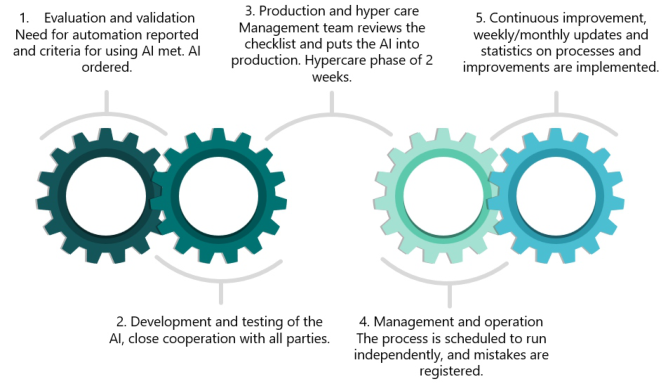
this particular company is described in Figure 1. Clear guidelines and people developing AI are covering the risk and data part.
Figure 1: AI development process for communication with organisation, based on ISO framework (developed by authors, 2023).
Practically there are 5 main stages in the AI development process:
1. Process evaluation: any business unit in the organisation can come up with ideas for automation. Use cases are reviewed, initial evaluation is performed (process, risks, cost, timeline). Technologies are evaluated for implementation. 2. Process design: IT developers are split into teams and agree on resources. Tests data for business processes is analysed in detail. 3. Development: development of solution and all documentation is updated if required based on this activity. 4. Tests: UAT, validation with business, testing solution with responsible employees, report. 5. Production & hyper care: the business accepts solution, monitoring dur- ing 3 months and later on if required, improvements are registered and made.
All steps are crucial and required to ensure quality on the development of AI. During the first year, the framework was improved and adjusted to meet organisational needs and ensure ownership for the development and maintenance process.
Below are explained some of the documented results and benefits that can be measured. During this time the company implemented more than 180 process automation solutions, calculated savings of 363 FTE for 12 months, and more than 34 million EUR saved from the start of the implementation. All benefits are recorded and measured to prove to the organisation that use of AI and AI-related technologies actually does deliver results, calculation
is based on case recording performed by robots and dashboard for all the solutions working on the cases.
During five years of work with AI and related technologies, the company identifies several clear benefits, such as:
Improved processing time: in some examples the processing time of pro- cesses is reduced from around 3 days to less than 1 minute that has resulted in higher conversion rates for customers applying for Car Loan; this is indicating that our customers are more satisfied with our products.
Improved customer experience: reduced customers manual work time to get approval by making the robot get information required for the process (with the customers consent) instead of asking them to send doc- umentation to the company; this makes the process more streamlined for customers and thus the customers are more satisfied.
Improved employee process: company removed manual errors like typos, mixing up info and forgetting steps when automating the process; this leads to less complaints to employees, more time for customer service and thus more satisfied customers.
According to practical case experience, it is crucial when starting the imple- mentation journey for AI to ensure a good monitoring tool for quality, cases and efficiency.
Each organisation needs to define principles of building up a pipeline and accepting a project where simple automation threshold could be a process that requires at least 0.5 FTE and has a digital input for the process, for exam- ple, it could be from chatbots, web schemes, emails, excel sheets etc. And for machine learning this shall be much higher to ensure a positive business case.
AI is a commonly used technology and many companies are increasingly trying to use AI also as a driver to digital transformation and offload routine and repetitive tasks from human workers, moving it to AI solutions (Aldoseri et al., 2023).
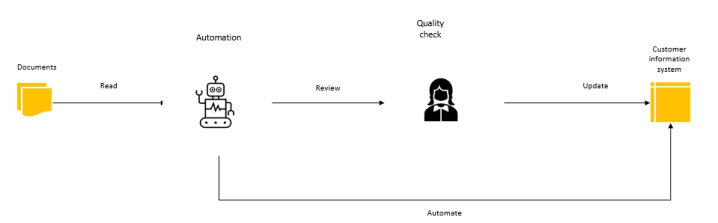
Document Processing Services Process for registration and checking certain elements in the credit agree- ments, was chosen for case analysis as a good candidate for automation with AI. Automation included OCR services, object detection using deep learning models, cloud services and AI models to read handwritten dates. Business case was excellent and in addition a new regulation stated that around 120k cases needed to be processed in a very short time. Some parts of the docu- ments contained handwritten information. Originally measurements of the processes were 7 min per case on average.
A custom-built solution was using AI to automate extraction of required information, but during the design and test AI did not deliver the required quality level, and it was decided to add a human quality check into the process, in the middle of the process. Solution including human steps, ensured required speed and delivery on time based on the requirement of new requirements for this process. The new process is visualised in the Figure 2.
Process Improvement With AI in Service Industry: Case Studies 85
Figure 2: Process automation of the credit agreements (developed by authors, 2023).
As a result, the solution is collaboration between AI and a human and this hybrid automation delivered a reduction in processing time with 50% and delivery of total volume on time.
Process Automation: Claim Processing Claim processing process in the payment value chain was a high-quality case example for automation. The business case was evaluated with the possibility to save 8.4 FTE out of 10.5 FTE and deliver better quality to customers due to automation of claims that are repetitive. The only issue in the process was related to free text in some of the requests if customers could not use only standard form for claim registration.
During the design process it was decided to mix robotics process automa- tion and machine learning. Timeline for implementation was 8 months. Benefits were calculated for the process and are:
Processing of work 24/7
Several robots will process work of saved FTE
Faster execution of tasks
Eliminated mistakes and all the unidentified cases will be processed by 20% humans Positive business case and successful implementation require risk assess- ment and continuity planning for AI solutions, as the number of FTEs replaced by AI solutions is rather high and such assessment is needed. The company did perform required analysis and the conclusion was that there is a need to keep this automated process under supervision to ensure compliance and competence and after launching the automation, continue with machine learning and develop solutions to higher automation grade in the future. It aligns with other researches that study AI in education that discussing and analyzing the processes there is always a room for continuous improvements and AI has many great benefits for the improvement of research, development and practice (Bhimdiwala et al., 2021). As a result, in the authors discussed business case there was a requirement of at least 0.5 FTE for maintenance and learning of AI solutions.
CONCLUSION
Conclusion is based on the case studies is that even after the process improve- ment with AI, the improved processes need to be supported by humans to ensure continuity and support of the new processes both in terms of change, adjustments, support, and continuity. Process improvement with AI requires resources, costs, time, and risk assessment to deliver real results for a service industry company. There are several criteria when AI and robotics could be implemented not only in terms of what is possible, but also each company needs to consider a business case in order to receive efficiency gains. Level of automation is dependent on several factors in the process. AI provides a wide range of process improvement solutions, but according to many case studies in the service industry, not always AI is the best solution from a long-term perspective.
REFERENCES
Akshay, M. (2021). Emerging artificial intelligence methods in Structural Engineering, VIVA-IJRI Volume 1, Issue 4, Article 62, pp. 1–2. Aldoseri, A., & Al-Khalifa, K., Hamouda, A.. (2023). A Roadmap for Integrating
Automation with Process Optimization for AI-powered Digital Transformation. 10.20944/preprints202310.1055.v1. Bhimdiwala, A.; Neri, R. C.; Gomez, L. M. (2021). Advancing the Design and Implementation of Artificial Intelligence in Education through Continuous Improvement. Int. J. Artif. Intell. Educ. 32, 756–782. Grossu-Leibovica, D., Kalkis, H. (2022). Total quality management tools and tech-
niques for improving service quality and client satisfaction in the healthcare environment: A qualitative systematic review. SHS Web Conf., 131, 02009. Heyn, H. M., Knauss, E., Pelliccione, P. (2023). A compositional approach to creating architecture frameworks with an application to distributed AI systems. Journal of Systems and Software, Volume 198, 111604. Kocerova, S., Kalkis, H., Roja, Z. (2022). Possibilities of Using Lean and Efficiency
Improvement Methodologies in Service Area. 10.54941/ahfe1002656. Makridakis, S. (2020). The forthcoming Artificial Intelligence (AI) revolution: Its impact on society and firms. Futures, 116, 102511. Prikshat, V., Malik, A., and Budhwar, P. (2021). AI-Augmented HRM: Antecedents,
Assimilation and Multilevel Consequences, Human Resource Management Review, p. 100860. Sarker, I. H. (2021). Machine Learning: Algorithms, Real-World Applications and Research Directions. SN COMPUT. SCI. 2, 160. Zhang, Y., Weng, Y., Lund, J. (2022). Applications of explainable artificial intelli-
gence in diagnosis and surgery. Diagnostics, 12, 237.
LISTED IN THE AHFE DIGITAL BOOKSTORE CATALOGUE
Explore the complete digital volume
Social and Occupational Ergonomics
Read this individual research paper free through the original publisher, or explore the full digital proceedings book.
ISBN 978-1-964867-28-1
Explore this ISBN in the AHFE Bookstore ↗Listed in the July 2026 bookstore catalogue; search by ISBN to confirm current availability · Digital book purchase optional