Svetlana Kocerova, Henrijs Kalkis, Zenija Roja (2022). Possibilities of Using Lean and Efficiency Improvement Methodologies in Service Area. In: Social and Occupational Ergonomics. AHFE Open Access, vol. 65, pp. 32–37. https://doi.org/10.54941/ahfe1002656
According to The Toyota Way (Liker, 2004), Lean is a philosophy that was initiated by Henry Ford and later finalized by Toyota in Japan in the 50s and 60s. years. Lean helps to gain a competitive advantage, reduce production costs, deliver high quality products to the customer, and ensure profitability by implementing Lean thinking and tools. Lean and related efficiency improvement methodologies (Lean) are used most in the industrial manufacturing companies and operations, there is little work that researched use of Lean in the service industry. The main goal of the study is to research use of Lean among service area companies in Latvia, define prerequisites for success and measure relevant key performance indicator for Lean and pre-/non-lean organizations to get insides on how companies in the region could benefit from Lean, what is needed to build up a Lean culture.Methods. The work is benchmarking relevant research in other countries, comparing case studies and empirical analysis to show the starting effort and gains that service industry company could get. Lean allows to use the company's resources efficiently and wisely and to plan the delivery of services. All companies, not just those operating in the industrial manufacturing area, can benefit from the implementation of Lean. Results. Now companies have access to a wide range of methodologies and tools that allow them to improve performance and achieve lower cost levels in the long-term run. Large companies use one or more methods. There are many tutorials and books that describe each methodology and tool, but not always revealing the details of process how company executives perform selection from this large variety of choices. Many companies in the service area are familiar with the methodology, but do not know how to get started and get first “quick wins”, although they could achieve as good results as industry and manufacturing. The topicality and necessity of such study in Latvia is determined by the fact that most of the companies there are the representatives of service area, including state institutions. A lot of effort is applied to “push” Lean into organizations (especially in public sector), but success rate is low. For example, in Scandinavian countries, the Lean and Process Improvement methodology is recognized at the national level and is actively integrated in both education system and business life. This trend is less significant in Latvia. Conclusion. The entry threshold for implementing Lean is lower than many organizations originally think it is. There are many examples showing that the initially wrong choice of the methodology application strategy makescompanies tend to fail and drop the use of Lean. There are several major factors that need to be in place to start Lean transformation in service industry and adopt both culture part and tools in order to succeed. Lean has also high impact on the service industry with rather more complicated visualizations of gain, but it is proven to bring good results both in financial and organizational aspects of the company.
Lean started from manufacturing industry and has proven to be base to drive both financial and qualitative results for the customers and stakehol- ders (Liker, 2003). With time methodology emerged into flexible and reach toolbox and company culture element, that helps to drive not only factories, but also other industries to desired targets. As service industry is also process based to deliver services that did prove the need for Lean, there is a need to investigate impact on service delivery and banking as many companies do not choose to invest time and effort into implementation of Lean culture and lean tools due to the fact that they see it as a complicated and long process that requires resources.
The need of transformation in the traditional banking is high. Digital tran- sformation and importance of fintech industry is highlighted by governments of countries and on the general world initiative level (Arner and Buckley and Zetzsche, 2018). This leads to clear understanding that this is the future and
Possibilities of Using Lean and Efficiency Improvement Methodologies in Service Area 33
old-fashioned ways of banking will evolve into digital customer experience starting from private customer and moving to business customers.
Traditional banks need to have a strong attention to FinTech. FinTech companies started to appear in 2000, when the customers lost trust to tra- ditional banks right after crises. The interesting thing is that founders of the fintech companies are businesspeople and not IT, they know banking and what customers cannot get from traditional banks (Brandl and Hornuf, 2017). Non-fintech companies cannot fully compete with banks as they do not have license to operate, but this might change in the future on a larger scale (Brandl and Hornuf, 2017).
Along with banking, other service industries face same competition chan- ges and customer demand changes. Delivery of services require different approach that producing a product, nevertheless some high-level basic pro- cess management and improvement can be compared. This proves that Lean methodology can be also successfully implemented with some adjustment in any service company, both on large and small scale.
Development and implementation of Lean requires adjustment and clear targets from the company, commitment from management and good follow up in order to keep good balance of efforts and benefits from implementation (Kalkis et al., 2018).
Many service companies basically are running daily operations and doing the fire fighting following ad-hoc priorities that might be short-term and low- focus on development and improvement. This requires a big change to start investing and reallocation time from these activities into improvement and lean to actually free up the time and work more efficient. This kind of decision that should be taken by management is crucial to start Lean transformation.
Also, one of the aspects is to split Targets of the company, define what needs to be prioritized and solved first and choose the right scale for Lean transformation.
Hence, the aim of the research is to understand the possibilities of using Lean and efficiency improvement methodologies in service area, based on theoretical aspects and practical analysis in Latvian business environment.
DEVELOPING AND IMPROVING LEAN IN SERVICE INDUSTRIES According to Womack and Jones (2003) it takes 60 month or 5 years to implement Lean concept fully in any organization. This is standard estimate by implementing the full scope Lean, what is especially exciting about wor- king with service industry that it is different from manufacturing. Here you may choose so called agile approach and “good enough is good enough” way of thinking. As services industry comparing to manufacturing is more flexible to level of what is good process and Targets. In manufacturing you must reach high sigma levels in order to reduce customer unsatisfaction and return (re-work) and ensure safe environment and production. Services are much more flexible. Company could set ambitious or more realistic target and increase it within certain periods like quarters. Also, work safety requi- rements in the office are much more friendly than in production with special equipment.
Not all service organizations have faith in results or knowledge to start lean transformation independently and sometimes in case of hiring consul- tants it becomes rather costly. In order to start or improve way of work many companies train own resources and start the process from inside of the com- pany. This approach may be slower, but less costly and creates higher feeling of ownership in employees, especially those who receive this role as a driver for Lean and continuous improvement. Crucial part is to choose right people to start and delegate / approve / assign the mandate for transformation in organization.
In addition to implementation of Lean, there are many different methodo- logies and tools that are available for companies who want to improve the performance and reach cost excellence in a long-term perspective. Large com- panies chose one or use several methods simultaneously (Andersen, 2007). There are lot of trainings and books describing each method and tool, but how do the managers of the company choose from such variety? This is one more challenge for any company to choose one from many or to create a perfect mix. If service company has no experience with lean, often it is hard to make a decision on how to start and what to choose.
There are many methodologies that come mainly after Lean. Business process management (BPM), Total Quality Management (TQM), DMAIC process, Six Sigma methodology, Model-Based Integrated Process Impro- vement Methodology (MIPI) (Generic Model) Adesola and Baines (2005), Super Methodology (Grossu-Leibovica and Kalkis, 2022; Lee and Chuah, 2001) and others. The fact is that all of them are interrelated or are a part of big consolidated Lean methodology concept.
According to investigation made by Chiarini (2012), all well-known fra- meworks and tools did emerge into some other frameworks and tools over time. Lean framework developed by Toyota needs to be improved with some elements or processes to ensure better visible results for service industry company.
There is a shift from focus only on delivery of services and service catalo- gues in 90-ies to automation and innovation now, the same shift is happening in the frameworks which drive and support that innovation (Dasig, 2018).
Crucial success factors for implementing Lean in service industry in com- parison to factory manufacturing where Lean practices are “must”standards, are the ambassadors and people that show example. Managers have an extremely important role, this is one of the key elements in implementation (Burgelam and Dos, 2001). The decision needs to come from top management to be implemented in organization. Lean role and authority that shall come with this role is different from large company authority. Many organizations failed to implement agile and lean on the large scale due to the middle and general management resistance, ignorance or lack of support and role models (Burgelam and Dos, 2001).
Other factor that pushes service industry companies towards Lean and especially standardization is a huge shift in technology that recently took place. This is relevant to all organizations, but especially to banking sector (Zunzunegui, 2018). Companies are implementing new technologies, such
Possibilities of Using Lean and Efficiency Improvement Methodologies in Service Area 35
as robotics process automation (RPA), Artificial intelligence (AI) and other ways of running the business without or minimum human touch.
Many companies started to work on the digital strategy. Sometimes it is a primary focus of the company. According to research findings of Bharadwaj, El Sawy, Pavlou and Venkatraman (2013) there are four main parts in digi- tal business strategy that company needs to decide: (1) the scope of digital business strategy, (2) the scale of digital business strategy, (3) the speed of digital business strategy, and (4) the sources of business value creation and capture in digital business strategy. Success factor that is pushing compa- nies to start Lean transformation is a need to define processes, describe and remove all “waste” and variation, visualize processes and streamline. Clearly defined and visualized processes are base for faster automation and less costly digitalization.
A common situation in service industry companies is that there are many methodologies which are in use or are in pilot stages in different units of the company. Different units act as a separate island with own priorities – silos. The scale of the improvement was fragmented, number of large projects was low, and it was difficult to ensure visible results of the improvements.
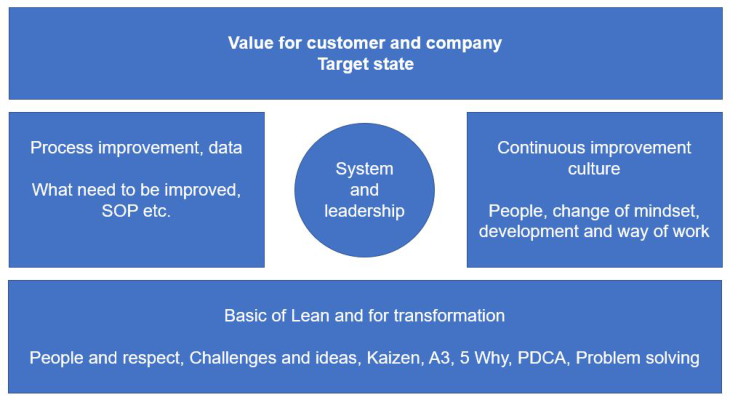
Framework for Implementing Lean On a high-level Lean has two parts: culture and tools. If tools only are used, without building up and maintaining a culture, Lean will not last long. It is important to involve employees, because employee knows best what does not work and needs to be changed as he/she works with the specific processes daily (Liker, 2003). People or employees are the base in the Lean system and need to be involved from the start with a clear and good communication, training and support from management.
Visualization (adopted from Leanuk, 2020) that shows all detentions of the approach, including the importance of leaders and employees.
As it was mentioned previously, it is important to start small and decide on the Target of why company wants to implement Lean and thereafter move to other elements of the visualization of methodology. Regardless of the scale it is important to “touch” several elements that will support each other and test it out in the real life. After adoption of several elements, there might be a need to adjust them or to move forward to next elements to enlarge scale and benefits from Lean.
It is very important to work internationally, considering cultural aspe- cts and nevertheless company culture before implement Lean methodology. Some companies are more mature to take the larger scale of implementation, but some are not. Culture of the country also has an impact on the scale and how the methodology should be addressed first, in order to implement not only tools, but also influence on mind set of the employees. This process needs to be benchmarked and evaluated and sometimes several adjustments are needed to be done during the process. Lean has also high impact on the service industry with rather more complicated visualizations of gain, but it is proven to bring good results both in financial and organizational aspects of the companies.
Figure 1: Domains of lean system implementation and development (Adapted from Leanuk, 2020).
CONCLUSION
The entry threshold for implementing Lean is lower than many organizations originally think it is. There are many examples showing that the initially wrong choice of the methodology application strategy makes companies tend to fail and drop the use of Lean. There are several major factors that need to be in place to start Lean transformation in service industry and adopt both culture part and tools to succeed. As a pre-requisite for implementation is a top management support and good communication about the transformation and expected results and what is expected from each and everyone in the company. Explaining that this will be a new way of work that also needs to be incorporated into other company processes to support the transformation.
ACKNOWLEDGEMENT
This research has been supported by the project “Ergonomic stress indica- tors in contemporary technological work environment and possibilities of its improvement in social-technical system “Human-Machine-Environment”“, Agreement No. Nr.1.1.1.2/VIAA/3/19/546
REFERENCES
Adesola, S., Baines, T. (2005). Developing and evaluating a methodology for business process improvement. Business Process Management Journal, 11(1), 37–46. Andersen, B. (2007). Business process improvement toolbox. ASQ Quality Press. Arner, D. W., Buckley, R. P., Zetzsche, D. A. (2018). Fintech for Financial Inclusion: A
Framework for Digital Financial Transformation. UNSW Law Research Paper No. 18-87; University of Hong Kong Faculty of Law Research Paper No. 2019/001; University of Luxembourg Law Working Paper No. 004–2019. Available at SSRN: https://ssrn.com/abstract=3245287 or http://dx.doi.org/10.2139/ssrn.3245287
Possibilities of Using Lean and Efficiency Improvement Methodologies in Service Area 37
Bharadwaj, A., El Sawy, Omar A., Pavlou, P. A., Venkatraman, N. V. (2013). Digital Business Strategy: Toward a Next Generation of Insights. MIS Quarterly (2013), 37 (2), 471–482. Brandl, B., Hornuf, L. (2017). Where Did Fintechs Come from, and Where Do They
Go? The Transformation of the Financial Industry in Germany after Digitaliza- tion Available at SSRN: https://ssrn.com/abstract=3036555 or http://dx.doi.org /10.2139/ssrn.3036555 Chiarini, A. (2012). Business process reengineering. In From Total Quality Control to Lean Six Sigma, Springer Milan, pp. 25–27). Crowther S., Ford H. (2014). My life and work, CreateSpace Independent Publishing
Platform, 96 p. Dasig, D. Jr. (2018). Six Sigma Methodologies and Kaizen Project Deployment: A Strategic Development for Operational Excellence Through Process Innova- tion. Available at SSRN: https://ssrn.com/abstract=3123593 or http://dx.doi.org /10.2139/ssrn.3123593 Grossu-Leibovica, D., Kalkis, H. (2022). Total quality management tools and tech-
niques for improving service quality and client satisfaction in the healthcare environment: A qualitative systematic review. SHS Web Conf., 131, 02009. Holweg, M., Staats, B. R., Upton, M. (2018). Making Process Improvements Stick. Kenan Institute of Private Enterprise Research Paper No. 18–22. Availa- ble at SSRN: https://ssrn.com/abstract=3240097 or http://dx.doi.org/10.2139/ss rn.3240097 Kalkis, H., Roja Z., Babris, S. (2018). Human Factor and LEAN Analysis at Indu-
strial Manufacturing Plants. Advances in Human Factors, Business Management and Society. J. I. Kantola et al. (Eds.), pp. 274–281. Lee, K. T., Chuah, K. B. (2001). A SUPER Methodology for Business Process Improvement-An industrial case study in Hong Kong/China. International Journal of Operations & Production Management, 21(5/6), 687–706. Liker, J. K. (2003) The Toyota Way: 14 Management Principles from the World’s
Greatest Manufacturer, McGraw-Hill, New York, 330 p. Majchrzak, A., Wang, Q. (1996). Breaking the Functional Mind-Set in Process Organizations. Harvard Business Review, Available at SSRN: https://ssrn.com/abstrac t=2537034 Ndedi, A. A., Ekeme, A. (2017). Implementation of Lean Banking and Continuous
Improvement in an African Global Bank: The United Bank for Africa. Humanistic Management Association, Research Paper Series No. 17-6. Available at SSRN: https://ssrn.com/abstract=2914454 or http://dx.doi.org/10.2139/ssrn.2914454 Womack, J. P., Jones D.T. (2003). Lean Thinking Banish Waste and Create Wealth in Your Corporation, New York, NY: Free Press, Simon & Schuster, Inc., 1996, Second Edition. Zunzunegui, F. (2018). Digitalisation of Payment Services. Ibero-American Institute
for Law and Finance Working Paper No. 5/2018.
LISTED IN THE AHFE DIGITAL BOOKSTORE CATALOGUE
Explore the complete digital volume
Social and Occupational Ergonomics
Read this individual research paper free through the original publisher, or explore the full digital proceedings book.
ISBN 978-1-958651-41-4
Explore this ISBN in the AHFE Bookstore ↗Listed in the July 2026 bookstore catalogue; search by ISBN to confirm current availability · Digital book purchase optional