Zenija Roja, Patricija Freiberga, Henrijs Kalkis (2022). Muscle Fatigue for the Health Staff in Hospital Operating Unit. In: Social and Occupational Ergonomics. AHFE Open Access, vol. 65, pp. 54–64. https://doi.org/10.54941/ahfe1002659
For the research the health sector was selected and it is one of the largest sectors of the economy in Latvia, where more than 6.8% of workers are employed in different professions. Operating block employees from different hospital clinics were selected for the research. The aim of the study was to investigate muscle fatigue and its causes for the operation unit health staff. Such investigation methods were used: survey, determination of the hand muscle strength, muscle fatigue analysis. Survey results prove that operation unit staff indicates discomfort in various body parts after the work shift. That is in accordance with the results of myotonometric measurements that show that during the weekly working cycle, the most loaded muscle groups were in shoulder region and legs, but less loaded were arm muscles. Analysis of the strength of the handgrip muscle shows that the mean handgrip muscle strength of nearly all the employees of the studied professions is in line with the norm before and after a week of performance, for some right-hand grip muscle strength is slightly greater than the strength of the left hand. The research will be continued with motion capture analysis to analyze the awkward movements during operations for surgeons, nurses, and surgeons-residents.
The health sector is one of the largest sectors of the economy in Latvia, where more than 6.8% of workers are employed in different professions (Central Statistical Bureau of Latvia, 2021). Data from the 2019 study shows that the sector has the third highest (12%) number of first-time occupational sufferers, with 66% diagnosed with work-related musculoskeletal disorders (WRMSD) and nervous system diseases. Musculoskeletal and connective tis- sue disorders are the most common causes of occupational diseases, injuries, and disabilities for various professions, including staff in the operating block. A literature analysis shows that the most common health problems for sur- geons in the various sub-specialist sections and nurses in the operating block are associated with muscle, tendon, nerve, and joint overload in certain parts of the body (Centers for Disease Control and Prevention, 2020; Epstein et al. 2018). The most frequently affected parts of the body are the neck, shoulder area, lower back, and often also legs and arms (Janki et al. 2017). The most common diagnoses are carpal tunnel syndrome, lumbar radiculopathy, vari- cose veins, rotator cuff disease, etc. (Forst et al. 2006; Auerbach et al. 2011).
Muscle Fatigue for the Health Staff in Hospital Operation Unit 55
The musculoskeletal system can be influenced by not only the ergonomic risk factors associated with work, but also by a number of psychosocial risks (Devereux et al. 1999) as well as sedentary lifestyles, congenital posture disor- ders and injuries. Several studies have demonstrated that WRMSD reduces hand agility, range of movements, strength of grip, and sometimes even coor- dination, which can directly affect not only the health of surgeons but also successful patient care (Voss et al. 2017). In addition, significant muscle fati- gue (discomfort) is affected by the intensity of the procedures to be performed and their direct effects on staff comfort and surgical accuracy. It is often asso- ciated with a discrepancy of physical load for the worker’s ability to work. It is therefore recommended that, in the same way as for computer opera- tors, temporary rest periods (micro-pauses) are observed, which is an effective means of removing fatigue (Dorion and Darveau, 2013). The same could also be attributed to the daily work of operation nurses, characterised by repea- ted and frequent hand movements, periodic lifting of heavy loads and patient displacement, awkward work postures, attention, and concentration. Such working conditions are associated with increased psycho-emotional stress (Lelis et al. 2012; Magnano et al. 2009).
Despite the fact that between 50 and 85% of practicing surgeons worl- dwide, including young employees, are complaining about these problems, the most frequently mentioned problems are overlooked, which may have an adverse effect not only on the health of the staff in the operating block, but also on productivity (Schlussel and Maykel, 2019). This indicates that there is the need for the training of staff in the operating block, including surgeons and nurses, of ergonomic risks at work and possible WRMSD.
The aim of the study was to investigate muscle fatigue and its causes for the operation unit health staff.
It should be noted that for employees in the operating block, the work is organised in shifts. Work in the operation halls lasts for several hours, depen- ding on the type of operation, in long-lasting standing and awkward posture. Work is very responsible, needs increased attention and concentration. Daily, both scheduled and acute operations are carried out. During operations, personnel handle various medical equipment, such as bronchoscope, echo- cardiograph, microscope, monitors, and hand tools (surgical pliers, tweezers, scalpels, etc.).
Of 39 addressed employees 22 operating block employees from different hospital clinics participated in the research (10 operating surgeons, 9 ope- ration nurses, and 3 surgeons – residents). Their complaints were about pain or discomfort in different parts of the body after work shift. For the study, operating unit employees were selected following these criteria: full- time employees, no acute musculoskeletal symptoms, work experience of at least five years in health care and full consent to participate. All parti- cipants were right-handed. The participants were informed on research aim and research methods. The participants gave written consent to participate in the study. The Ethics Commission of the University of Latvia approved the study on November 17, 2020. Table 1 shows the background factors of the participants.
Table 1. Background factors of the subjects: mean age, mean height, mean weight, mean body mass index (BMI).
Table available in the original PDF paper.
Mean height, Mean weight Profession n Mean age (years) ± SN cm ± SN kg ± SN
Mean BMI, kg/m2 ± SN 10 41.50 ± 7.546 178.10 ± 7.015 82.70 ± 24.176 25.90 ± 7.062
Survey of the Participants The survey covered 33 issues comprised of 3 question blocks: (1) Demo- graphic indicators and general information on the physical activities of the employee, their frequency, harmful habits, weight and height, etc.). (2) Health-related information focusing on the musculoskeletal system pro- blems related to ergonomic risks at work (awkward posture, workload, working environment and organisation of work, including number of ope- rations in shift, duration of operations, etc.). (3) The opinion of study participants on ergonomic risks at work. The questionnaire contained open and closed questions. The questionnaire response bases on the claim “yes” and “no”. Questionnaires were sent electronically to the employees of the operating block to a work email that was filled out on the Internet using the sent link. Questionnaires were analyzed using IBM SPSS 22.0 and Microsoft Excel.
Determination of the Hand Muscle Strength Using a Hand Dynamometer Due to the use of hand tools by the staff of the operating block in their daily work, an electronic hand dynamometer was used to assess the strength of the hand muscles employed - Camry Electronic Hand Dynamometer. In the dynamometer, it is possible to set a number of parameters for the observed person, such as gender and age. The device can be calibrated in kilograms (kg) and pounds (lbs). The maximum possible value is 90 kg and 198 lbs. For the personnel of the operating block, measurements with the dynamometer were performed in the standing position, their hand outstretched at shoulder level maximally compressing the dynamometer equipment. Measurements for the right and left hand were performed 3 times and then averaged. The results obtained were compared with a specially designed dynamometer force table, separately for women and men, depending on age, and the applied force was determined in kilograms (kg). Measurements prior to and after the
Muscle Fatigue for the Health Staff in Hospital Operation Unit 57
workload give an indication of the size of the hand strength when performing a particular work operation. It is also possible to judge the physical fitness of the employee following the acquired hand strength measurements.
Muscle Fatigue Analysis Using Myotonometry Method The myotonometry method was applied to assess the functional status of individual muscle groups during work and after the working week in the working cycle. Measurements were performed with the “MYOTON – 3” device, which records the frequency, speed and acceleration of the sensor rod’s rebound pulse from the surface of the muscle (Vain and Kums, 2002). The operating principles of the facility are described in one of our previous publi- cations (Roja et al. 2006). The myotonometry measurements specify three parameters: (1) a frequency that describes the muscle tonus during natural contractions. The frequency best reflects muscle fatigue. Depending on the type of muscle, the frequency fluctuation ranges from 11 to 16 Hz, but in a contracted state 18 to 40 Hz); (2) decrement value that describes the elasticity of the muscles or the ability to gain initial condition after contraction; (3) a hardness that describes the ability of the muscle to resist changes caused by external forces. Depending on the type of muscle, hardness ranges from 150 to 300 N/m, for contracted muscles, the stiffness value may be higher than 1000 N/m. A computer program determines the changes in the tonus of the measured muscle groups over a specified period of time, which allows the assessment of their fatigue, as well as the adaptability of the muscle groups studied to the corresponding workload.
The trend lines obtained were classified in 3 categories: Category I: the trend line decreases, indicating the muscle relaxation capacity and the complete relief after work.
Category II: the trend line is constant, indicating the ability of the muscle to adapt to the workload and only partially relax.
Category III: the trend line is increasing, indicating that the muscles are not able to relax (the muscle tonus is increasing) and this indicates muscle fatigue.
The myotonometry method evaluated the following muscle groups in a relaxed state: m. extensor digitorum; m. flexor carpi radialis; m.gastrocnemius (caput mediale); m. tibialis anterior and m. trapezius (upper part). Myotonometric testing of muscles was performed at the beginning and at the end of the working week cycle. The procedure of muscle testing was performed in a sitting position, the muscle was of medium length.
Data Processing Methods For data analysis, descriptive statistical methods were used — frequency analysis, cross-column analysis with the Chi-squared test to identify differe- nces between groups if variables are nominal measuring p values that describe the statistical significance p < 0.01 and p < 0.05. In order to determine the clo- seness of the coherence, a Pearson correlation test was applied with a strong
correlation of 0.8-0.9, a mean correlation of 0.4-0.7, a weak or no correla- tion of 0.0 – 0.3. The ANOVA test (p < 0.05) was applied to determine the dispersions of two and more samples. SPSS 22 program was used for data analysis. For regression analysis, to determine the “trend lines” of the muscle tonus, where the R2 or determination coefficient is between 0 and 1, which determines how close the determined parameters are to real data and tables. Microsoft Office Excel was used to arrange tables and graphs.
RESULTS AND DISCUSSION
Survey Results Analysis of the survey participants by age showed that the majority of respon- dents entered the age group from 36 to 50 years (41% of operating surgeons and 18% surgical nurses). On the other hand, in the age group from 51 to 65 and over, there were 10% of operating surgeons and 13% of surgical nurses. In the age group from 26 to 35, there were 8% operating surgeons, 3% of nurses and residents.
Analysis of the length of service by profession shows that for 33% of respondents it is 21-35 years (21% operating surgeons and 12% surgical nurses), the length of service is 11-20 years for 23% of the respondents. Of those surveyed, 18% (10% of nurses and 8% of operating surgeons) have the length of service over 35 years. Length of service from 0 to 5 years has been reported by surgeons-residents and 5% of nurses. Statistical data processing shows that there is a statistically significant difference between the length of service and the age of employees (p = 0.756), i.e. increase in age also incre- ases length of service in the profession. The analysis of the Body Mass Index indicates that all respondents have elevated weight, with the exception of surgeons — residents for whom it is within normal limits.
The surveyed operating surgeons and surgeons - residents (82%) indicated discomfort in the shoulder and neck areas, arms, legs, and lower back, while surgery nurses (90%) - in the arms, legs, and shoulders, but older nurses – also in the lower back. Similar results have been obtained in other authors’ studies on the posture and pain, or feelings of discomfort after work of surgeons and nurses. They indicate that surgeons and nurses mainly work in a standing, awkward posture that causes pain in the back area, arms, legs, neck area, and shoulder girdle. That coincides with the results obtained in our research (Matern and Koneczny, 2007; Tsekoura, 2017).
Of the respondents, 64% indicated that ergonomic working conditions and work equipment were suitable in the working environment, while 31% considered that the working space was unsafe, movements in the room restri- cted, and the staff were not provided with auxiliary aids for lifting and relocating heavy patients. All respondents involved in the study acknowled- ged that hand tools were easy usable at work. These results contradict other studies, which highlight the fact that surgeons complained about uncomfor- table hand and arm postures when working with hand tools (Matern and Koneczny, 2007). Daily, between 5 and 10 operations are performed in a shift lasting between 2 and 10 hours, depending on the type of operation and its complexity.
Muscle Fatigue for the Health Staff in Hospital Operation Unit 59
Of the surveyed operation block staff, 90% denied smoking, but others smoke 11 to 20 cigarettes a day. Alcohol is not consumed at all by 33% of those surveyed, while the others use it in moderate doses. The staff of the ope- ration block (96%) believe that their daily diets are healthy. Unfortunately, from the survey results it should be concluded that the majority of employees are not engaged in or are very rarely engaged in physical activities in spare time, as only 36% of respondents noted that they are engaged 1-2 times and only a few – 5 times a week. The vast majority (82%) of respondents noted that there were no regulated micro-pauses during work. At the end of the survey, nearly 90% recommended additional improvements in working positions, adjusting table height and providing modern auxiliary aids for lif- ting and moving patients. Emphasis was placed on the need for micro-pauses during work and on training on ergonomic working techniques.
Results of Analysis of Hand Grip Muscle Strength The results were compiled for professional groups, calculating the mean values of hand strength, standard deviation (SD), and statistical reliability (p) using the ANOVA test was determined.
Analysis of the strength of the handgrip muscle shows that the mean hand- grip muscle strength of nearly all the employees of the studied professions is in line with the norm before and after a week of performance. For operating sur- geons and surgeons-residents, the right-hand grip muscle strength is slightly greater than the strength of the left hand, while for surgery nurses, the mean muscle strength of the hand is the same for both hands. The strength of hand- grip muscles in the studied groups is higher at the beginning of work than after work in all studied days. Analysis of dispersion showed that there was a statistically significant difference between professional groups and right- hand strength before work (p = 0.037) on the first day of measurement and right-hand strength before work (p = 0.050) on the last day of the weekly working cycle measurement (see Table 2).
Analysing the obtained results by age and sex, it has been found that for almost all operating surgeons, male (22.5%) handgrip muscle strength before and after work, corresponds to normal and strong strength, with the exce- ption of one doctor (38 years old), whose handgrip muscle was weak in the right hand after work (33.9 kg). Of the 22.5% operating surgeons – females, for 13.2% females handgrip muscle strength before and after work corre- sponds to normal hand strength, but only two (29 and 31 years old) - it was weak. Before and after weekly work cycle, only 7.3% of nurses had hand- grip muscle strength corresponding to normal and strong, while some surgery nurses aged 44 to 64 experienced weak handgrip muscle strength. Generally for surgery nurses, the strength of right-hand grip muscles was greater than the strength of the left hand, except for two (ages 37 and 38), for whom the strength of handgrip muscles in the left hand was greater than that in the right hand. Analyzing the handgrip strength of a 28-year-old surgeon - resident – it was found that the strength of the handgrip muscles in the right hand was greater than in the left hand. The strength of the right-hand grip muscles was weak in all measurements for both surgical residents (25 and 27
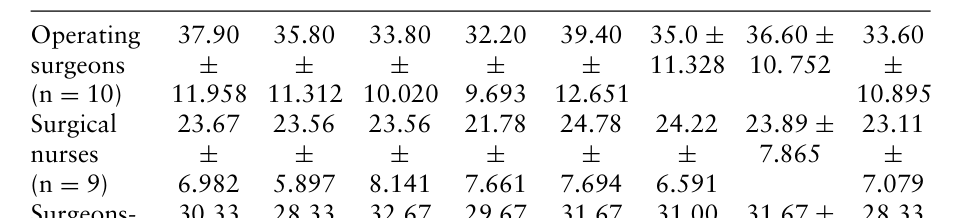
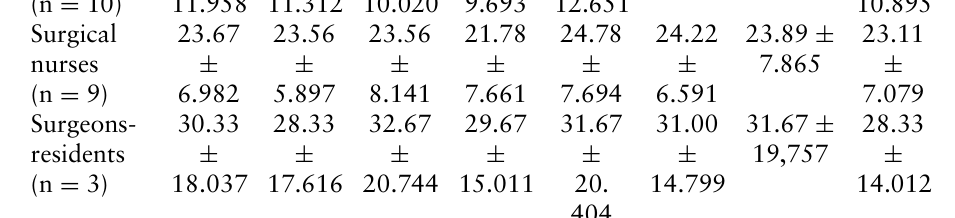
Table 2. Handgrip muscle strength (kg) in weekly working day cycle (kg±SD).
Table available in the original PDF paper.
First working day Fifth working day Before work After work Before work After work
years). The results are consistent with the data from the survey on pain or discomfort in the hands following work in similar studies. A study evaluating handgrip strength for 4 specialist groups - surgeons, dentists, physiotherapi- sts and nurses - found that surgeons had highest grip strength followed by Nursing, Physiotherapy and Dental professionals (Zakariya et al., 2016).
Handgrip strength may also vary depending on the position of the hands during the working hours (Richards et.al. 1996). The above literature descri- bes that changing the position of the forearm between neutral, supinated and pronated altered the grip strength. The supinated position produced the strongest force, whereas the force was weakest in the pronated position. This could be attributed to the nurses and female surgeons-residents involved in our study, since, as observed, the hands of the staff in the operation block often need to be adjusted specifically to perform their work successfully.
Results of Muscle Fatigue Analysis Myotonometric measurements with the MYOTON 3 device were perfor- med to assess muscle fatigue in the operation block staff before and after the weekly working day cycle for the following muscle groups: m. exten- sor digitorum, m. flexor carpi radialis, m. trapezius, m. tibialis anterior, m. gastrocnemius.
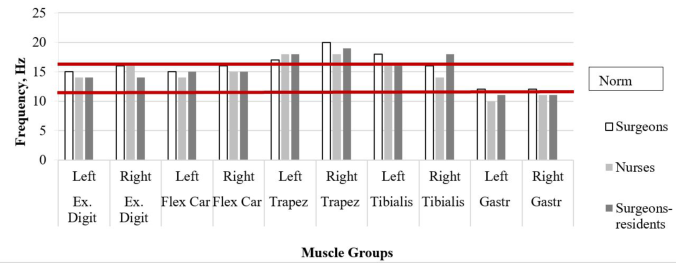
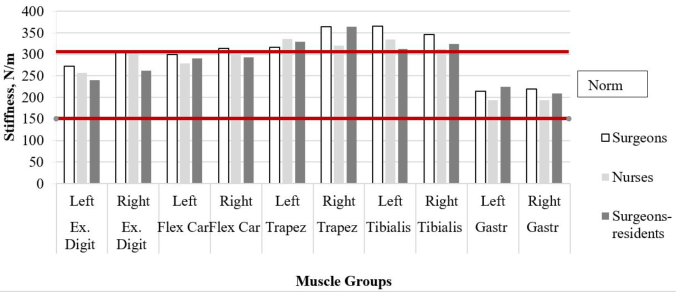
The results of myotonometric measurements show that during the wee- kly working cycle, the most loaded muscle groups were m. trapezius and m. tibialis anterior, but less loaded were m. extensor digitorum, m. flexor carpi radialis, and m. gastrocnemius. This coincides with the results of the survey of the staff of operation block on complaints in these muscle groups (see Figures 1 and 2).
Muscle Fatigue for the Health Staff in Hospital Operation Unit 61
Figure 1: Mean frequency of the right and left side body muscle groups before and after operation.Figure 2: Mean stiffness of the body’s right and left side muscle groups during operations.
Despite the fact that the stiffness and frequency indicators for the right hand m. extensor digitorum and m. flexor carpi radialis do not exceed the permissible levels, the results indicate that the respective muscle groups are loaded during the weekly working cycle.
Analysing the obtained results by professions, it has been found that the operating surgeons have a greater load on the right-side m. trapezius and m. tibialis anterior of the left leg, as well as on the studied arm muscle groups, and also slightly on the right m. gastrocnemius. It should be noted that the body of surgeons is bent during surgery and the head is tilted at more than a 45-degree angle, which often contributes to a variety of health problems, so- called muscle fatigue in the corresponding parts of the body. Studies by other authors have also demonstrated that surgeons’ head positions during surgery increase the pressure on the thoracic part of the spine from 4.5 kg in neutral to 27 kg in bent position, which may negatively affect the musculoskeletal system (Hansraj, 2014).
The analysis of the results of myotonometric measurements for surgery nurses showed that, as with surgeons, more loaded are m. trapezius and m. tibialis anterior. The load is also on m. extensor digitorum and m. flexor
carpi radialis. The results are consistent with survey data on pain or discom- fort in individual parts of the body. The analysis of the integrative literature on WRMSD in nursing profession indicates that nurses most frequently com- plain about pain in the shoulder girdle, lower back, arms and legs (Lelis et al., 2012) and that it is often associated with physical load, psychosocial risks and poor physical fitness (Fonseca and Fernandes, 2010). The load of individual parts of the body of nurses indicates that nurses, like doctors, spend most of the day standing in operation halls, making frequent bending movements, handing tools, regulating monitors, thereby creating a load on both leg and shoulder muscles. Nurses’ duties also include preparation of the operation hall, moving medical equipment, arranging tools between operations, thus creating an increased physical load for all parts of the body, which influences the development of WRMSD.
The increase in the stiffness rate of the left leg m. tibialis during the wee- kly working cycle could be related to the fact that, during surgery, the body weight is often put to the left leg, as the right leg is directed slightly forward. In prolonged time, it could lead to the fatigue of the mentioned leg muscle group.
The results of myotonometry have shown that for operating surgeons and surgeons – residents, m. trapezius is not able to relax after workload. It cor- responds to category III, indicating the fatigue of this muscle. M. tibialis anterior, m. ext. digitorum and m. flex.carpi radialis are able to adapt to the load and partially relax corresponding to category II, but m. gastrocne- mius –to category I, indicating that the muscle is also relaxed after work. Results from myotonometry have shown that for surgery nurses m. trapezius and m.flex. carpi radialis cannot relax after workload thus corresponding to category III, but m. tibialis anterior and m. ext. digitorum are capable of adjusting to the load and partly relax, corresponding to category II. M. gastrocnemius, similarly to that of surgeons, corresponds to category I, which indicates that the muscle is able to relax after workload. The results of the study coincide with our previous research results that health staff (surgeons, anaesthetists, geneticists) are subjected to long and intensive work in compul- sory work positions, which has impact on fatigue of various muscle groups (Roja et al. 2015). The research will be continued with investigation of deep muscles fatigue applying electromyography measurements.
CONCLUSION
It was concluded that in the studied occupational groups during the weekly work cycles muscle fatigue increases mainly in two muscle groups - m. trape- zius and m. tibialis anterior. When analysing the handgrip muscle strength, it was found that generally it is within normal limits for all the groups studied and it indicates that hand muscle groups are not overloaded. In order to cla- rify these results, the authors consider that additional studies will be needed to compare changes in hand positions during operations in relation to length of service, gender, and age. The research will also be continued with motion capture analysis to analyze the awkward movements during operations for surgeons, nurses, and surgeons-residents.
Muscle Fatigue for the Health Staff in Hospital Operation Unit 63
ACKNOWLEDGMENT
This research has been supported by the project “Ergonomic stress indica- tors in contemporary technological work environment and possibilities of its improvement in social-technical system “Human-Machine-Environment”“, Agreement No. Nr.1.1.1.2/VIAA/3/19/546.
REFERENCES
Auerbach, J.D., Weidner, Z.D., Milby, A.H., Diab, M., Lonner, B.S. (2011). Musculoskeletal disorders among spine surgeons: results of a survey of the Scoliosis Research Society membership. Spine 36 (26): E1715-E1721. Centers for Disease Control and Prevention (2020). Work-related musculoskeletal
disorders & ergonomics. Available: https://www.cdc.gov Central Statistical Bureau of Latvia (2021). Available: https://www.csb.gov.lv Devereux, J.J., Buckle, P., Ioannis, W., Vlachonikolis, G. (1999). Interactions between physical and psychosocial risk factors at work increase the risk of back disorders: an epidemiological approach, Occup Environ Med, 56, 343–353. Dorion, D., Darveau, S. (2013). Do micropauses prevent surgeon’s fatigue and loss of
accuracy associated with prolonged surgery? An Experimental Prospective Study. J Vasc Surg 57 (4): 1173. Epstein, S., Sparer, E.H., Tran, B.N., Ruan, Q.Z., Dennerlein, J.T., Singhal, D., Lee, B.T. (2018). Prevalence of work-related musculoskeletal disorders among surge- ons and interventionalists: a systematic review and meta-analysis. JAMA Surg 153 (2): e174947. Fonseca, N.R., Fernandes, R.C. (2010). Factors related to musculoskeletal disorders
in nursing workers. Rev Lat Am Enfermagem. 18(6): 1076–83. Forst, L. Friedman, L., Shapiro D. (2006). Carpal tunnel syndrome in spine surgeons: a pilot study. Arch Environ Occup Health 61 (6): 259–262. Hansraj, K.K. (2014). Assessment of stresses in the cervical spine caused by posture
and position of the head. Surgical Technology International. 25: 277–9. Janki, S., Mulder, E.E.A.P., IJzermans, J.N.M., Tran, T.C.K. (2017). Ergonomics in the operating room. Surg Endosc 31 (6): 2457–2466. Lelis, C.M., Battaus, M.R.B, deFreitas, F.C.T., Rocha F.L.R., Marziale M.H.P.,
Robazzi M.L.C.C. (2012). Work-related musculoskeletal disorders in nursing professionals: an integrative literature review. Actapaul. Enferm, vol 25. Magnano, T.S., Lisboa, M.T., Griep, R. H. (2009). Stress, psychosocial aspects of the work and musculoskeletal disorders in nursing workers. Rev Enferm UERJ, 17: 118–23. Matern, U., Koneczny, S. (2007). Safety, hazards and ergonomics in the operating
room. Surg Endosc 21: 1965–1969. Richards, L.G, Olson, B., Palmiter-Thomas, P. (1996). How forearm position affects grip strength. Am J Occup Ther, 50: 133–8. Roja Z., Kalkis V., Vain A., Kalkis H., Eglite M. (2006). Assessment of skeletal
muscle fatigue of road maintenance workers based on heart rate monitoring and myotonometry. J Occup Med Toxicol, 1:20. Roja, Z., Kalkis, H., Roja, I. (2015). Measuring Muscle Fatigue in Relation to the Workload of Health Care Workers. Procedia Manufacturing. 3: 4189–4196. Schlussel, A. T., Maykel, J. T. (2019). Ergonomics and Musculoskeletal Health of the
Surgeon. Clinics in Colon and Rectal Surgery, 32 (6): 424–434.
Tsekoura, M, Koufogianni, A, Billis, E, Tsepis, E. (2017). Work-Related Musculoskeletal Disorders Among Female And Male Nursing Personnel In Greece. World Journal of Research and Review, 3(1): 8–15. Vain, A., Kums, T. (2002). Criteria for preventing overtraining of the musculoskeletal
system of gymnasts. Biology of Sport, 19(4): 329–345. Voss, R.K., Chiang, Y.J., Cromwell, K.D., Urbauer, D.L., Lee, J.E., Cormier, J.N., Stucky, C.-C.H. (2017). Do No Harm, Except to Ourselves? A Survey of Sym- ptoms and Injuries in Oncologic Surgeons and Pilot Study of an Intraoperative Ergonomic Intervention. J Am CollSurg 224 (1): 16–25.e1. Zakariya, M. P., Umama, N.S., Nagarajan, M., Shaikhji, S., Nusaibath, M.S.
(2016). Analysis of power grip and pinch grip among health care professionals. International Journal of Physiotherapy, 3(1): 45–52.
LISTED IN THE AHFE DIGITAL BOOKSTORE CATALOGUE
Explore the complete digital volume
Social and Occupational Ergonomics
Read this individual research paper free through the original publisher, or explore the full digital proceedings book.
ISBN 978-1-958651-41-4
Explore this ISBN in the AHFE Bookstore ↗Listed in the July 2026 bookstore catalogue; search by ISBN to confirm current availability · Digital book purchase optional