Zenija Roja, Valdis Kalkis, Henrijs Kalkis, Inara Roja, Janis Dundurs (2018). Impact of Physical Load on Workability of Social Caregivers. In: Advances in Physical Ergonomics and Human Factors: Part II. AHFE Open Access, vol. 2. https://doi.org/10.54941/ahfe100083
The contemporary changing labour market has promoted health problems caused by ergonomic load at work. In Latvia, similarly to other places in the world, within the recent 10 years number of work related muscular sceletal disorders (WRMSD) in the structure of occupational diseases has grown rapidly, and according to data from the State Labour Inspection, in 2012 these diseases comprised 60% of the total number of primary cases of occupational diseases. Employees in Latvia report about high physical workload and rapidly increasing psychoemotional strain at the workplaces. In the branch of social care WRMSD are extremely significant for younger and elderly employees. A social caregiver’s duty requires frequent manual lifting and awkward postures that makes severe burden for the waist. Low back pain is prevalent in care staffs with long-term experience. Increasing number of the elderly and severe disability of workers in social care intensifies the work load. Aim of the study is to investigate the effect of the physical load on adult and children caregivers’ workability, to work out preventive measures for reduction of ergonomic load and improvement of workability. The several tools to describe and assess physical load using subjective and experimental (objective) methods were used. Chosen tools and technique are: KIM key item method (assessment of the manual handling of heavy loads), HRM heart rate monitoring (assessment of work heaviness degree depending on workers physical activity), RPE the rating of perceived exertion, NIOSH lifting equation, and WAI workability index (assessment employees’ existing work capacity and forecast for the near future). It was stated that accordingly to results of HRM data (energy consumption) work hardness categories varies from category II (moderate work) for children caregivers to category III (hard work) for adult caregivers. It coincides with the subjective risk assessment methods. It was concluded that physical workload insignificantly impact workability of social caregivers
In Latvia, the same as in other places in the world, the number of work related musculoskeletal disorders (WRMSD) has dramatically increased during the last 10 years. 30% of employees in Latvia report on increase in physical load at work, but more than 45% [Equation or mathematical symbol available in the original paper PDF] on increasing mental stress (Woolfson et al., 2008). These problems have been noticed in employees of all branches of economics. The problem is getting worth by aging of labour force in the country. The cause of WRMSD quite often is unsafe work environment, forced work postures, hard manual work, psychological risks (stress and psychological violation) at work, which severely affect workability of employees and their life quality in general. Bio-psychosocial approach to a working person is a significant way to improve work conditions of chronically ill employees and to provide their faster returning to labour market. Only some employers in Latvia recognize that employees’ health and wellbeing, simultaneously with skills, training and qualification, are among the most significant factors of work productivity (Suchrcke et al., 2007). At the same time, Physical Ergonomics II (2018) employees themselves are not able to evaluate the existing health problems before they affect performance of their duties.
It should be noted that both employees and employers are not aware of the risks of physical load, their effect on employees’ health, as well as of preventive activities to avoid ergonomic risks. For employees in social care, health problems caused by overload at work are particularly topical, since their daily work is related with hard manual work and psychosocial risks: constant work schedule, overtime work, night work, making of serious decisions (Garg, 1991; Garg et al., 1992).
Continually working in ergonomically unfavourable conditions, significant overload to lower back and shoulders is caused, which can affect employees’ workability. Moreover, these health disturbances affect not only elderly employees but also the younger ones (Eriksen, 2006). The study was conducted in one of the State social care centres in Latvia, in which a long-term care is given to children and adults having severe disturbances of physical and mental health. In the studied Centre, the caregivers generally are women employed in 12 and 24-hour shifts. Their duties include: lifting and moving of the client without mechanical aids, lifting and moving of heavy household subjects (e.g., buckets with water, cleaning devices, and bed-linen), usage of household cleaners.
Aim of the study: to investigate the effect of the physical load on employees’ workability, to work out preventive measures for reduction of ergonomic load and improvement of workability. Criteria for selection of the persons to be studied were: consent of the employees to participate in the study, age and length of service in the profession, chronic pain in the shoulder girdle and lower back according to data of compulsory checkups. The employees not having health checkups, as well as those with acute pain in certain parts of the body, and those with specific muscular and skeletal diseases were not included in the study.
METHODS
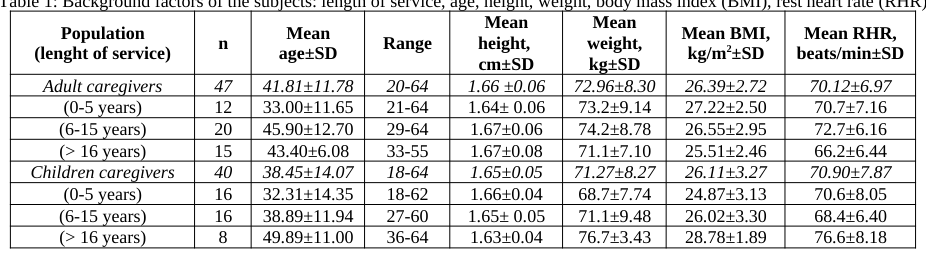
Participants 100 social caregivers (adult caregivers and children caregivers) at the age of 18[Equation or mathematical symbol available in the original paper PDF]64 participated in the survey on existing work conditions and workload (background factors are shown in Table 1).
Table 1: Background factors of the subjects: length of service, age, height, weight, body mass index (BMI), rest heart rate (RHR) Mean BMI,
Measures
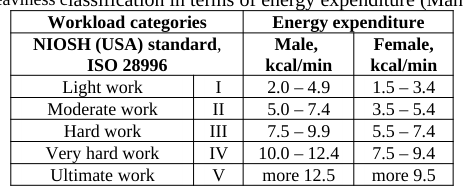
1) The work heaviness degree depending on workers physical activity (intensity) was estimated by heart rate monitoring (HRM). The measurement was based on heart rate (HR) variation, which correlates with oxygen consumption and allows quantifying the objective energy expenditure for each work phases including short rest periods (Jackson et al., 1990) HRM was performed using POLAR S810i™ Heart Rate Monitor device and data processing software Polar Precision Performance. The device sums up the acquired HR data and transforms them Physical Ergonomics II (2018) into metabolic energy consumption (kcal/min). Maximal heart rate was calculated as the most common formula HRmax = 220 [Equation or mathematical symbol available in the original paper PDF][Equation or mathematical symbol available in the original paper PDF]age, although there exist most accurate formulas, for example: HRmax = 205.8 [Equation or mathematical symbol available in the original paper PDF][Equation or mathematical symbol available in the original paper PDF](0.685 × age) (Inbar et al., 1994). Work heaviness in terms of energy expenditure was classified according to classification scale shown in Table 2.
Table 2: Work heaviness classification in terms of energy expenditure (Mantoe et al., 1996) Workload categories Energy expenditure NIOSH (USA) standard,
2) The rating of perceived exertion (RPE) of individuals depending on their age, physical conditions, subjective view of increased heart rate and muscle fatigue was also assessed using Borg rating scale, ranging from 6 to 20 (Borg, 1982). Data were gathered via questionnaires and interviews. 3)The Key Indicator Method (KIM) for assessment of the manual handling of heavy loads developed by the German Federal Institution for Industrial Safety and Occupational Medicine was used to assess social care workers ergonomics risks (Steinberg, 2006). Key indicators (criteria) to be taken into account are: object mass rating points (M); the employee's posture rating points (P); working conditions rating points (C); working time/intensity value points (I). Risk assessment is carried out by physical workload risk score (RS) using the following formula: RS = (M + P + C) × I. According to this method work hardness categories (or risk range) are: I – light work or low load situation (RS < 10); II - moderate work or increased load situation (RS = 10…25); III [Equation or mathematical symbol available in the original paper PDF] hard work or highly increased load situation (RS = 25…50); IV [Equation or mathematical symbol available in the original paper PDF] very hard work or physical overload (RS > 50). 4) National Institute for Occupational Safety and Health (NIOSH) lifting equation is an assessment method for lifting and lowering tasks (Waters et al., 1994). The equation provides a recommended weight limit (RWL) based upon task parameters and the duration the task is performed. The RWL is obtained through the following equation (Dempsey, 2002): RWL = 23[25/H][1 [Equation or mathematical symbol available in the original paper PDF][Equation or mathematical symbol available in the original paper PDF](0.003|V-75|)] × [0.82 + 4.5/D] [1 [Equation or mathematical symbol available in the original paper PDF][Equation or mathematical symbol available in the original paper PDF](0.0032 A)] FM × CM, (1) where H is the horizontal location in cm, V is the vertical location in cm, D is the distance in cm, FM is the frequency multiplier, A is the asymmetry angle in degrees, and CM is the coupling multiplier. The actual load lifted or lowered divided by the RWL provides the lifting index LI. LI values greater than 1.0 are assumed to represent tasks posing risk to the worker population. 5) The work ability evaluation was done through the Work Ability Index (WAI) developed by Finnish researchers and based on workers’ self-perception (Tuomi et al., 1998; Ilmarinen 2009). It is composed of seven items: current work ability compared with the life time best, work ability in relation to job demands, number of current diseases diagnosed by a physician, estimated work impairment due to diseases, sick leave during the past year (12 months), own prognosis of work ability two years from now and mental resources. The final score varies from 7 to 49 points, distributed across the following categories: poor (7[Equation or mathematical symbol available in the original paper PDF]27), moderate (28…36), good (37…43) and excellent work ability (44…49). 6) The results acquired were entered into the computer and processed using EXCEL software and statistical data processing program SPSS.11 according to popular descriptive statistical methods (Pearson's correlation coefficient r, a.o.). Reliability interval (interrater agreement) was also calculated determining Cohen's Kappa coefficient (k) (Landis and Koch, 1977). This coefficient identifies connectivity of the experimental data, the number of participants and the proportion or correlation of the participants' acceptance of the experimental data:
k = (PO - PC)/(1 - PC), (2) where: PO – correspondence proportion of objective experimental data with respondents' responses (yes or no), PC – correspondence proportion of data with number of participants (PC = Σpi
2, where pi is acceptance of each participant expressed in percent or as fractional number).
RESULTS
Respondents (n=87) reported that, generally, during the work time the following parts of the body were loaded: 59.8 % [Equation or mathematical symbol available in the original paper PDF] shoulder girdle, 89.1 % [Equation or mathematical symbol available in the original paper PDF] lower back, 55.4% [Equation or mathematical symbol available in the original paper PDF] arms and hands, but 73.9 % [Equation or mathematical symbol available in the original paper PDF] legs; 56% of caregivers were Physical Ergonomics II (2018) smokers, and 74% did not do any physical activities outside work. Adult caregivers stated that the biggest weight to be lifted was more than 50 kg at one go. However the most common mass to be lifted at one go working in pair is from 30 to 35 kg, but lifting frequency fluctuates from 10 to 30 times per shift. For children caregivers the weight to be lifted does not exceed 25 kg, but lifting frequency quite often is 40 to 200 and more in a shift. The employees note that rest pauses working with adults are sufficient, but at work with children they practically are not taken as children need continuous supervision.
Heart rate of the studied caregivers was observed during intensive work which was comprised by several work cycles: moving of the client from bed to a wheelchair (6 mins), moving them to the bath and placing in it (3 mins), rest pause (2 mins), washing of the client (10 mins), rest pause (3 mins), taking the client out of the bath and moving to bed (6 mins).
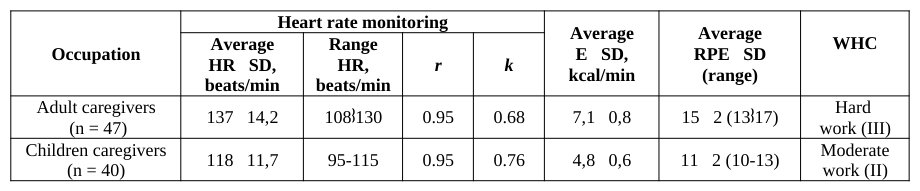
Calculation of the experiment done revealed that the average caregiver’s energy consumption was 7.1[Equation or mathematical symbol available in the original paper PDF] 0.8 kcal/min. Consequently, level of work heaviness of these caregivers according to work heaviness classification data corresponds to the category of heavy work – III, while children caregivers’ average energy consumption was 4.8[Equation or mathematical symbol available in the original paper PDF]0.6 kcal/min., which corresponds to moderate work – II. Table 3 summarizes results of heart rate, indices of energy consumption and self-assessment of work heaviness by Borg’s scale in all participants of the study.
Table 3: Workers[Equation or mathematical symbol available in the original paper PDF] heart rate (HR), Pearson’s correlation (r), Cohen’s Kappa (k), energy expenditure (E), the rate of perceived exertion (RPE, scale 6[Equation or mathematical symbol available in the original paper PDF]20), and work heaviness category (WHC).
18-35 36-50
> 51 18-35
36-50
51
> 51 Risk level II Risk level III
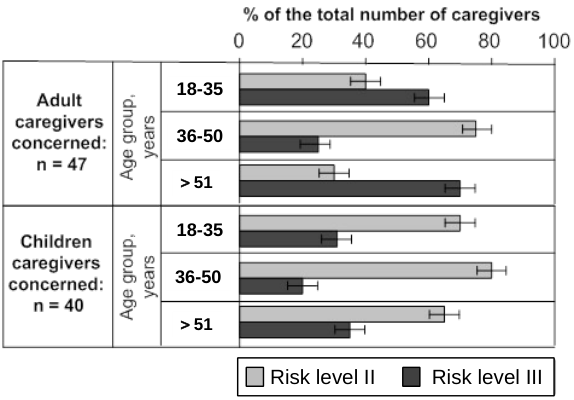
Figure 1. Distribution of physical load risk levels compared together children and adult caregivers, considering standard deviation.
The calculated NIOSH lifting index shows that caregivers work with overload, exceeding the recommended lifting limit more than twice (see Table 4). Physical Ergonomics II (2018)
Table 4: Recommended mass limit (RML), lifting and moving load (M), lifting index (Li), and standard deviation (SD) for social care workers Profession M ± SD, kg RML ± SD, kg Li Adult caregivers (n = 47) 23.9 [Equation or mathematical symbol available in the original paper PDF] 3.1 9.6 [Equation or mathematical symbol available in the original paper PDF] 2.5 2.48 Children caregivers (n = 40) 16.5 [Equation or mathematical symbol available in the original paper PDF] 2.9 6.1 [Equation or mathematical symbol available in the original paper PDF] 1.8 2.70
Analysis of workability revealed the following results: adult caregivers evaluate their workability as moderate (WAI = 39± 2.05), but children caregivers – as good (WAI = 39± 2.65). Total workability evaluation is shown in Table 5.
Table 5: Workability index and criteria (n=87) according to results of ergonomic analysis Employees view/ WAI (≤45/≥45) Scores Rating scores Expert view Adult caregivers (n=47) 7…49 34 ± 2.05 35/33 Children caregivers (n=40) 7…49 39 ± 2.65 40/38
Percentage of workability of adult caregivers depending on the age was the following: 64% of the employees in the age group of 36-50 years, 26% - in the age group of 18 - 35 years, 10% - > 51 year. Among children caregivers, percentage depending on the age was: 78%- of the age group 18-35 years, 14% - of the age group 36 - 50 years, and 8% - over 51 year. It should be noted that in the course of the study there was a comparatively small absenteeism due to illnesses. Within the last 5 years work disability occurred due to increased blood pressure in elderly employees, chronic back pain, as well as pain in the lumbar region, in the arms and shoulder girdle in all age groups. 53% of adult caregivers foresee that they will be able to continue work at least 2 more years, 44% - are not sure they will be able to work, but 3% only – consider that they will work with effort. Children caregivers foresee their workability this way: 68% - will be able to work at least 2 more years and 32% of them are not sure that they will be able to work.
DISCUSSION
In the studied establishment, generally, the caregivers are females who in their daily work are subjected to physically heavy work, mainly heavy manual work, which promote development of muscular and skeletal disease. It is proved also by other authors’ studies in female health in relation to muscular and skeletal diseases, compared to male health. Researchers point out that very often females work in ergonomically unfavourable environment and bad working conditions (Strazdins and Bammer, 2004). In our study, we found out that more than 50% of the employees are smokers and majority spend their leisure time passively, as they do not do any physical activities, which corresponds to results of other studies (Vieira et al., 2008; Pohjonen, 2001).
According to results of the study (HRM data and energy consumption) work heaviness categories vary between the groups: adult caregivers’ work corresponds to III category, but that of child caregivers – to II category. Evaluating heart rate at different loads, it was observed that adult caregivers’ heart rate rapidly increases at high intensity work load (e.g. client washing – 8.2 kcal/min), in some cases reaching 160 and more beats/min., and at the end of the work returns to the normal level after 30 minute rest only. However when the same employees perform lower intensity work (e.g., client transportation to bath [Equation or mathematical symbol available in the original paper PDF] 2.3 kcal/min), at the end of the work heart rate restores much faster – after 8 to 10 minutes.
Regardless of the fact that caregivers of both categories perform physically heavy work, objective measurements suggest that adult caregivers are subjected to more severe physical load than children caregivers. It has been recognized by other authors as well in their studies in workload of caregivers working in shifts (Wakui, 2000). In our study, subjective opinion of the employees, evaluating by Borg’s scale, corresponds with objective results of measurements. Similar results have been acquired evaluating risk level of work heaviness by KIM method, which suggest that essential rate of physical load (III risk level) refers to adult caregivers in the age group of 18[Equation or mathematical symbol available in the original paper PDF]35 years and in the group of 51 and more years, compared to child caregivers. According to evaluation by KIM method, II risk level (RS = 10…25) is possible only in persons who are not prepared for load and in persons with decreased workability (e.g., those younger than 21 and older than 40; new employees who are not prepared for physical load, and frequently being ill), but III risk level means that physical load is significantly increased, and overload is also possible for persons having appropriate physical condition (RS = 25…50) and good workability. Analysing by age groups, it was proved that more than 50% of adult caregivers in the age group of 18 – 35 years are subjected to III Physical Ergonomics II (2018) risk level, but in the group of children caregivers 27% only are subjected to this risk level. It could be explained by the fact that children caregivers are younger than adult caregivers and their work experience is not great. At the same time it has been proved that caregivers exceed limit of mass lifting more than twice. Therefore in such cases, and according to studies of other authors (Smedley et al., 2003; Pohjonen and Ranta, 2001) in order to avoid musculoskeletal diseases ergonomic intervention is needed, which can relieve heavy manual work, providing the employees with proper mechanical aids, necessary for client transportation and especially for client lifting.
Interesting data has been acquired analysing workability of the studied contingent, which is proved by workability index: regardless of heavy work conditions and physical load at work adult caregivers have moderate, but child caregiver’s good workability. Analysis shows low credibility to the diagnosed diseases. It, of course, is in contradiction to our results of physical load analysis and studies of other authors. That could be explained by the difficult economic situation in the country, since in the conditions of existing unemployment, trying not to lose employer’s confidence, employees conceal the true picture and do not reveal the real condition of their health.
CONCLUSIONS
Findings from this study suggest that physical workload insignificantly impact workability of social care workers. Adult caregivers have worse workability’s (34±2.05 scores) than children caregivers (39±2.65 scores). Hence the preventive measures should be oriented on biopsychosocial approach to working persons. Further studies are necessary in order to clarify the lifestyle and habits of social caregivers that can significantly influence their workability and health.
REFERENCES
Borg, G. (1982), “Psychophysical bases of perceived exertion”, Medicine and Science in Sports and Exercise, 14(5), 377-381. Dempsey, P.G. (2002), „Usability of the revised NIOSH equation”, Ergonomics, 45(12), 817-828. Eriksen, W. (2006), “Work factors as predictors of persistent fatigue: a prospective study of nurses’ aides”, Occup Environ Med., 63(6),428-434. Garg, A. (1991), “A biomechanical and ergonomic evaluation of patient transferring task: bed to wheelchair and wheelchair to
bed”, Ergonomics 34, 289-312. Garg, A., Owen, B.D., Carlsor, B. (1992), “An ergonomic evaluation of nursing assistants’ job in a nursing home”, Ergonomics, 35, 979–95). Ilmarinen, J. (2009), “Work ability: a comprehensive concept for occupational health research and preventi on”, Scand J Work
Environ Health, 35(1), 1-5. Inbar, O., Oten, A., Scheinowitz, M., Rotstein, A., Dlin, R., Casaburi, R. (1994), “Normal cardiopulmonary responses during incremental exercise in 20-70-yr-old men”, Med Sci Sport Exerc, 26(5), 538-546. Jackson, A.S., Blair, S.N., Mahar, M.T., Wier, L.T., Ross, R.M. (1990), “Stuteville JE: Prediction of functional aerobic capacity
without exercise testing”, Medicine and Science in Sports and exercise, 22(6), 863-870. Landis, J.R., Koch, G.G. (1977), “The Measurement of Observer Agreement for Categorical Data”, Biometrics, 33, 159-174. Mantoe, H.I., Kemper, W.M., Saris, M., Wasshburn, R.A. (1996), “Measuring Physical Activity and Energy Expenditure”, Human Kinetics Publishers, Champaign, Illinois, USA. Pohjonen, T. (2001), “Perceived work ability of home care workers in relation to individual and work-related factors in different
age groups”, Occup Med, 51(3), 209-217. Pohjonen, T., Ranta, R. (2001), “Effects of worksite physical exercise intervention on physical fitness, perceived health statuss, and work ability among home care workers: five-years follow-up”, Prev Med, 32(6), 465-75. Smedley, J., Trevelyan, F., Inskip, H., Buckle, P., Cooper, C., Coggon, D. (2003), “Impact of ergonomic interventi on on back
pain among nurses”, Scand J Work Environ Health, 29(2), 117-123. Steinberg, U., Caffier, G., Liebers, F. (2006) “Assessment of Manual Material Handling based on Key Indicators – German Guidelines“, in: Handbook of Standards in Ergonomics and Human Factors. Ed. by W. Karwowski. Lawrenz Erlbaum Associates. Mahwah, New Jersey, London, pp. 319-338. Strazdins, L., Bammer, G. (2004), “Women, work and musculoskeletal health”, Soc Sc Med, 58, 997–1005. Suchrcke, M., Rocco, L., McKee, M. (2007). “Health: a vital investment for economic development in eastern Europe and
central Asia”, Copenhagen: WHO. Tuomi, K., Ilmarinen, J., Jahkola, A., Katajarinne, L., Tulkki, A. (1998), “Work Ability Index”, 2nd revised edn. Helsinki: Finnish Institute of Occupational Health. Vieira, E.R, Kumar, S., Narayan, Y. (2008), “Smoking, no-exercise, overweight and low back disorder in welders and nurses”,
Int J Ind Ergon, 38(1), 143-149. Wakui, T. (2000), “Study on work load of matrons under shift work in a special nursing home”, Ind Health, 38 (3), 280-288. Waters, T.R, Putz-Anderson, V., Garg A., Fine, L.J. (1993), “Revised NIOSH equation for the design and evaluation of manual lifting tasks”. Ergonomics. 36(7), 749-76. Physical Ergonomics II (2018)
Woolfson, C., Calite, D., Kallaste, E. (2008), “Employee voice and working environment in post-communist member states: an empirical analysis of Estonia, Latvia and Lithuania”. Industrial Relations Journal, 39, 314-334.
Physical Ergonomics II (2018)
LISTED IN THE AHFE DIGITAL BOOKSTORE CATALOGUE
Explore the complete digital volume
Advances in Physical Ergonomics and Human Factors: Part II
Read this individual research paper free through the original publisher, or explore the full digital proceedings book.
ISBN 978-1-4951-2105-0
Explore this ISBN in the AHFE Bookstore ↗Listed in the July 2026 bookstore catalogue; search by ISBN to confirm current availability · Digital book purchase optional