Xin Yueming, Mao Yue, Fang Liyuan, Yang Yang, Yuanbo Sun (2023). Design of interactive service for stray cat adoption based on shared platform. In: Ergonomics In Design. AHFE Open Access, vol. 77, pp. 337–345. https://doi.org/10.54941/ahfe1003391
1 School of Mechanical Engineering, Northwestern Polytechnical University, No. 127, Youyi West Road, Beilin District, Xi’an City, Shaanxi Province, 710068, China ↗
2 School of Design and Art, Beijing Institute of Technology, No. 5, Zhongguancun South, Street, Haidian District, Beijing10086, China ↗
In order to solve the stray cat adoption problem, increase the sustainability of stray cat rescue activities and improve the current situation of the existing stray cat rescue platform, this study develops the service design practice through four stages: exploration, definition, development and evaluation. Firstly, the design process and the method of service design are analyzed through literature research. Secondly, the causes of stray cat problem and the current status of existing rescue platforms were investigated. In the exploration and definition stage, using user journey map, personas, and service blueprints to gain user’s needs. The study identified pain points and translated them into functions in this service design. In the evaluation stage, SUS test was used to verify the feasibility of the service design. This study constructed a new online cat raising service platform, including online cat raising service framework, APP design and innovative interaction ways. Continuously optimize the service experience of the existing stray cat support platform to attract users to continuously participate in the stray cat rescue activities. To provide theoretical support and reference for future rescue platforms for stray cats.
According to the World Society for the Protection of Animals, there are about 500 million stray cats in the world. They live in a difficult situation. At the same time they spread diseases, destroy the ecology and cause traffic accidents. In order to reduce the number of stray cats, the TNR (Trap-Neuter- Return) solution strategy is currently implemented internationally (Li and Huang, 2012).
At present, TNR is not popular in China, and the existing rescue mode for stray cats is not standardized enough. On the one hand, this is reflected in the lack of supports from relevant laws and regulations. On the other hand, this is reflected in the lack of knowledge of the public in the scientific and reasonable rescue of stray cats. Therefore, most of the existing stray cat
rescues in China rely on individuals or non-governmental organizations, and there are many social conflicts in stray cat raising (Booher, 2003).
Therefore, most of the existing stray cat rescues in China rely on individu- als or non-governmental organizations, and there are many social conflicts in stray cat raising. Through further research, the main ways of stray cat rescue are currently divided into stray cat rescue shelters, stray cat adoption platforms and stray cat helping platforms. Due to the limited resources of the rescue shelters, the adoption of stray cats living space is limited, which affe- cts their health. There are various online platforms such as stray cat adoption websites and applications, which promote the concept of adoption instead of purchasing in order to reduce the number of stray cats. The stray cat helping platforms provide services to users to obtain funds for stray cat rescue. In addition, the feeding behavior of residents is the most common way of stray cat rescue. But such feeding behavior can only help the stray cats in a short period of time. In the long run, it will increase the number of stray cats and lead to a series of social ecological problems.
The shortage of funds limits the ability of shelters to rescue stray cats. Most stray cat helping platforms suffer from the problem of delayed user feedback. As a result, users’ help for stray cats does not last long. Therefore, this study aims to combine the advantages of the rescue system of the shelters and the financial advantages of the stray cat helping platforms to empower the exi- sting rescue shelters. Guiding users to rescue stray cats in a more scientific and reasonable way.
From the perspective of service design, this study observes the core pro- blems and needs of users and service operators, and captures the contacts for constructing the service system. Based on the overall service, the mate- rial resources and non-material resources in the rescue process should be re-integrated to promote the development of rescue activities for stray cats (Zhang and Zhang, 2007).
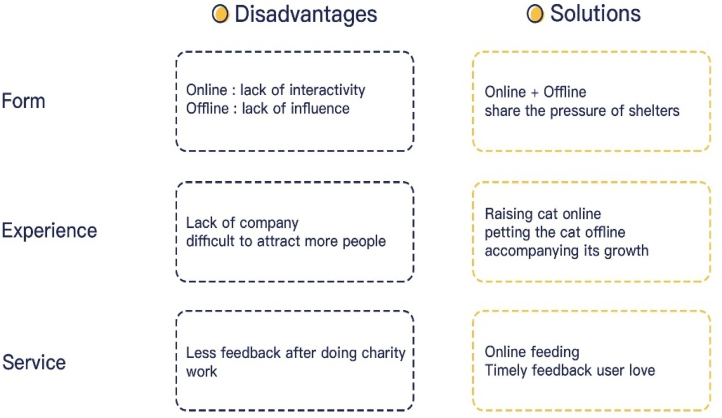
We analyzed the existing competitive products, as shown in Figure 1. Cur- rently, most stray cat support platforms operate on a single online model, which lacks interaction. The offline mode allows for a more effective inte- raction with the cat. But it has a limited impact and radiation population. Therefore, this study adopts the service mode combining online and offline to improve the interaction between users and the platform.
METHOD
This study aims to establish a sharing platform that can better meet users’ needs for online cat raising services, making it easy for users to rescue stray cats scientifically. It optimized the user experience process through the service design method, motivating users to continue their public welfare activities, enhancing the sustainability of the stray cat shelter organization.
Through research and interviews, three types of target users who may use the platform are sorted out and their personas are established. The user jour- ney map is used to sort out the user’s pain points, and then the user needs are summarized. Then build the functions according to the different touch points in the process. Using system map, service blueprint and other methods
Design of Interactive Service for Stray Cat Adoption Based on Shared Platform 339
Figure 1: Competitive product analysis summarize.
to build the overall picture of the service. Finally, using SUS test to summarize and evaluate.
RESULTS
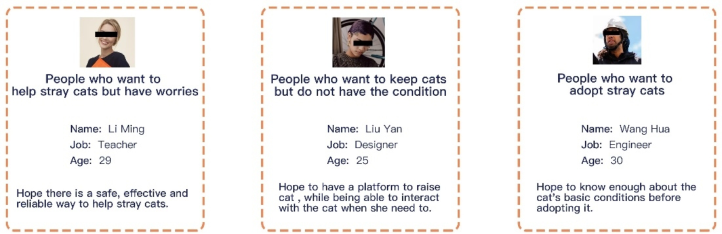
Persona Personas are virtual characters that target specific groups of people with common interests (Huang, 2019). We found that there are many stakeh- olders related to stray cat rescue, such as private feeders who feed stray cats, managers of rescue shelters or pet hospitals, non-governmental rescue organizations and so on. At present, the degree of association among the stakeholders is not high and the collaboration among the parts is not strong, resulting in various rescue resources not forming a synergy. In order to further understand the needs of the user and understand what prevents them from scientifically helping stray cats. This study summarized three typical groups by analyzing questionnaires. One group is those who want to own a cat but can’t. Another group is those who want to help stray cats but have worries. The last group is people who want to adopt stray cats.
For those who want to want to own a cat but can’t. Their core pain points are not having time for cats, not having enough money to keep cats, not having experience in feeding cats, etc. The objective conditions make it impossible for them to feed cats, so they will satisfy the desire to keep cats by watching cat videos on the internet. They hope to gain happiness by interacting with cats in their leisure time.
For people who want to help stray cats but have worries. They are wil- ling to help stray cats, but they are afraid of getting sick. They hope to help stray cats in a safe, reliable and effective way. The user persona is shown in Figure 2.
Figure 2: Persona.
Demand Analysis Stray Cat Rescue Stage On the basis of establishing personas, the overall experience of users is divi- ded into two parts: rescuing stray cat rescue stage and online cat raising stage.
The stray cat rescue stage is divided into the following: discovery stage, rescue stage and feedback stage.
(1) Discovery stage: Users find stray cats in need of rescue in their offline lives or on the online platform. Establish a stray cat rescue platform in this stage to increase the probability of collecting stray cat information by using the power of Internet. (2) Rescue stage: It refers to the stage when users feed cats offline or make donations online. On the one hand, with the advantage of the shel- ter system, the professional staff will sterilize cats to prevent the rapid reproduction of un-neutered stray cats in the society. On the other hand, the online game mode of raising cats attracts more people to share the costs of food and medical treatment for stray cats. (3) Feedback stage: This is the stage where the user receives the feedback. Users can see the appearance of the stray cats they rescue through the camera, and show the results of rescuing stray cats so as to encourage users to continue to help.
Online Cat Raising Stage The online cat raising stage is divided into the following: browsing stage, interaction stage and feedback stage.
(1) Browsing stage: The stage where users looking for cats online, in which different cat-related information is classified and the user’s favorite cat content is intelligently pushed according to the user’s preference. (2) Interaction stage: The stage in which the user watches the video and inte- racts with the cat. Users can interact with the cats they rescue remotely, increasing the intimacy between users and cats. (3) Feedback stage: Transform users’ online services into offline experie- nces. As the user’s intimacy with the cat increases, the user can visit the shelter for further interaction with the cat.
Design of Interactive Service for Stray Cat Adoption Based on Shared Platform 341
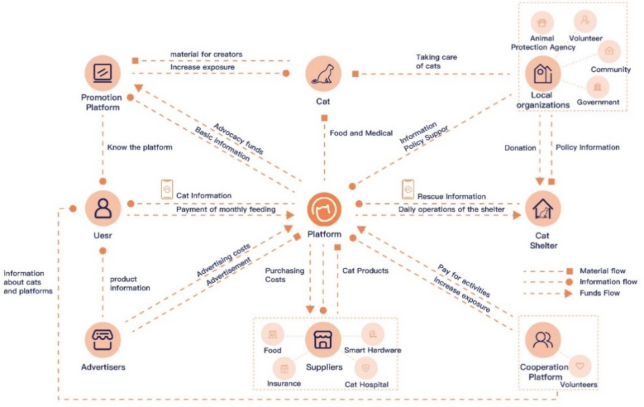
System Map The system map expresses the position of each stakeholder in the service model and the cooperation between each other. It describes how the system operates from the perspective of information, material and money. The system map mainly includes the relationship between platform, user and rescue shelter. The platform provides users with online stray cat feeding servi- ces, and also brings social attention to the rescue shelter, thus bringing funds, manpower and material resources to improve the current situation of the rescue shelter. The monthly online feeding fee paid by users is used for the daily operation of the shelter. The goods purchased by users for the stray cats will be directly delivered to the shelter to alleviate the difficult situation of stray cats. The shelter has cooperated with the platform to provide space and material resources for online cat raising and offline interaction for users. The system map is shown in Figure 3.
Figure 3: System map.
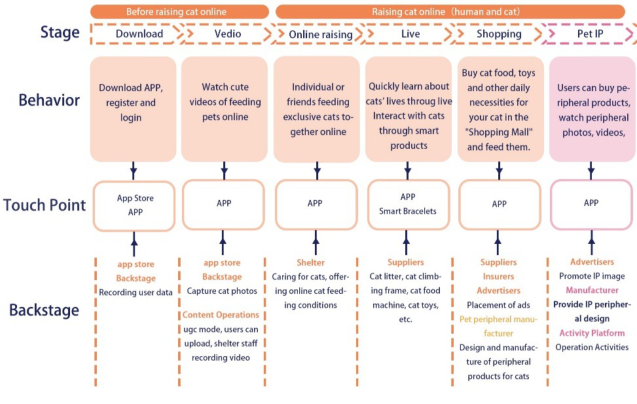
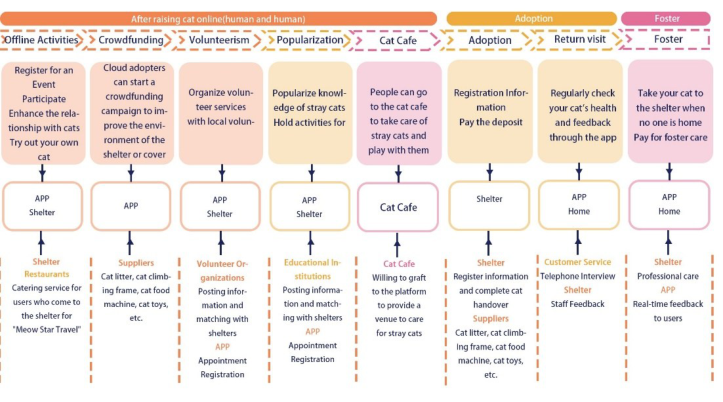
Service Blueprint The service blueprint includes details of how the entire service will evolve over time (Lerouge et al., 2013). Shelter workers upload information about the cats’ appearance, personality, and health to the back-end and analyze it to create an avatar profile of each cat. Based on the avatar of each cat, users choose the cat that matches their preference. In the online feeding service, the cat food machine located in the shelter will drop cat food after the user feeds, and the camera will capture the footage of the cat eating and feed it back to the user. Users can also launch crowdfunding campaigns on the online platform, and cat suppliers working with the platform will deliver a range of cat toys to shelters to improve their environment. The detailed service blueprint is shown in Figure 4 and 5.
Figure 4: Service blueprint 1.Figure 5: Service blueprint 2.
PRACTICE Effectiveness Testing of Interactive Media
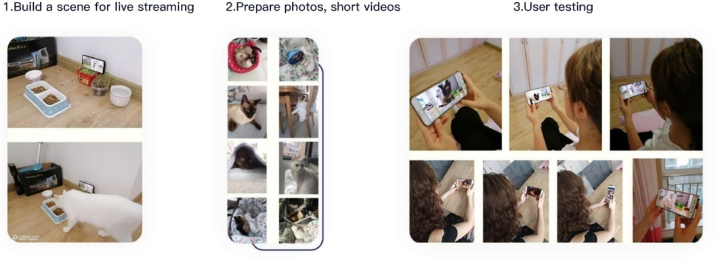
From the point of view of improving the continuous operation ability of the service system and providing users with more comfortable interactive effe- cts. This study tests the impact of interactive media on the operation effect of online cat raising service system. In this study, 10 users were selected to experience different interactive media. The stray cat’s activity track was tran- smitted to different test users through live streaming, short videos and photos. After the test, the study recorded how often they used the three media. Figure
Design of Interactive Service for Stray Cat Adoption Based on Shared Platform 343
out how users are using it and the effects of the interaction medium. Sum- marize the interactive ways and media that can attract users to use online cat raising service platform for a long time. The experimental procedure is shown in Figure 6.
Figure 6: Test procedure.
The experimental results show that users spend more time in short video interaction, and short video is more attractive to users. Short video has the characteristics of short duration and rich content. Also users can have fun of raising stray cats in their leisure time. The investment of short video will also become a key part of the service system. In addition, through the way of live broadcast, users can better understand the current life status of stray cats. The live interaction can enhance the real adoption experience and com- bine the virtual cat with the real cat. Thus, users can have more emotional interaction with stray cats. The tests found that users seldom watch photos. Photos are often used to assist users in recording, regularly reviewing and sharing with friends. Therefore, the service system chooses the interactive way of combining short video with live broadcast. The experimental results are shown in Figure 7.
Figure 7: Experimental result.
Figure available in the original PDF paper.
SUS Test This study is divided into two parts on usability testing. In first section, the study designs six activities and corresponding steps. Participants are requi- red to perform the corresponding activity experience according to the steps. Finally, the experience of the users was questioned, and the process was recor- ded by video. In the second part, 100 users were selected to watch the videos recorded in the previous stage, and SUS questionnaires were issued. The que- stions were divided into three categories. Questions 4, 5 and 10 are validity
and learnability tests. Questions 2, 3, 7 and 8 are the tests of usage efficie- ncy and usability. Questions 1, 6 and 9 constitute the subscale satisfaction. Ultimately, the data are sorted out to exist problems of the service platform. After that,the thinking on the platform design are summarized.
The first part of the test found that the advantage of this platform is strong interaction. Functions such as video, live broadcast, cartoon image intera- ction and feeding can more than meet users’ expectations of remote activi- ties. The second most satisfying feature was the cat’s personality matching function. It quickly helps users find suitable cats to adopt.
The second part, some SUS scale test data is shown in the Table 1. Among the 100 questionnaires sent out in this study, there are 82 valid data. Accor- ding to the data, the online cat raising service system scored 77.71 points in the learnability test and was rated B+. Combined with the results of previous questions, it can be seen that the usage of each function of the service system can reach the standard. But users still need help with the process. For exam- ple, there is confusion about the adoption of stray cats. The usability score is 75.31, with a grade of B. It indicates that the usage status of the service system meets the requirements, but there are some difficulties or obstacles in the use of some functions. The study found that in the interactive video of stray cats, the content captured by the camera is not accurate, the picture is not clear and incomplete. Moreover, the camera’s interaction is not strong, so it cannot be captured flexibly according to the cat’s activities. In addi- tion, the understanding of some ICONS is wrong. For example, the platform expressed ‘diary’ cannot be associated with photo album function. The user satisfaction score is 79.79 points, with a grade of A-, indicating that users have a high degree of overall satisfaction with the service system. The service can meet the user’s expectations well, and the content of the activity is also very good.
Summary and Reflection During the test, this study found that the online cat service platform can attract users to the stray cat rescue activities through interesting activities. The loading of short videos and the interaction of cartoon images can attract
Design of Interactive Service for Stray Cat Adoption Based on Shared Platform 345
users to use the service platform for a long time. There is still have impro- vement in the part of real-time interaction, including the accurate capture of images of stray cats’ interaction and the quality of real-time feedback images. In addition, the stray cat rescue service platform has more operational assi- stance needs such as new operation guidelines and adoption services. The subsequent design will also improve the integration of online and offline services, so as to provide a better experience for users using the service platform.
CONCLUSION
This study starts from the advantages and disadvantages of the existing stray cat rescue mode, explores the needs of cat lovers, combines the advantages of the offline rescue station system and the experience advantages of the online feeding mode, and reduces the difficulties of scientifically rescuing stray cats for the public with the concept of sharing and sharing. Then, interactive expe- riences such as online feeding of stray cats can be used to encourage rescuers to continue to help, so as to promote the sustainable development of stray cat public welfare undertakings and harmonious coexistence between humans and animals. The method of service design is used to better connect the rela- tionship between various stakeholders, so that each link in the system can operate more efficiently and harmoniously. At present, the construction of the adoption service platform for stray cats is constantly improving. In the future, it will also be combined with diversified service modes to bring users more rich rescue experience.
REFERENCES
Booher, Harold, ed. (2003). Handbook of human systems integration. New Jersey: Wiley. Huang Wenqi. (2019). The application of service design methodology in the design
of human-pet shared products. Design (09), 126–127. Kundu, & Saikat. (2015). Service information blueprint: a scheme for defining service information requirements. Journal of Service Science Research, 7(1), 21–53. Lerouge C, Ma J, Sneha S, et al. User profiles and personas in the design and deve-
lopment of consumer health technologies[J]. International Journal of Medical Infor-matics, 2013, 82(11); E251–E268. Li, Jiawen & Huang, Qunshan. (2012). Causes, hazards and countermeasures of urban stray dogs and cats. Guangdong Animal Husbandry and Veterinary Science and Technology (04), 37–39. Zhang, Yunzhu & Zhang, Siya. (2007). Feasibility analysis of controlling the number
of stray cats with the TNR method. Veterinary Herald (10), 52–54.
LISTED IN THE AHFE DIGITAL BOOKSTORE CATALOGUE
Explore the complete digital volume
Ergonomics In Design
Read this individual research paper free through the original publisher, or explore the full digital proceedings book.
ISBN 978-1-958651-53-7
Explore this ISBN in the AHFE Bookstore ↗Listed in the July 2026 bookstore catalogue; search by ISBN to confirm current availability · Digital book purchase optional