Zhang Boyang, Yuanbo Sun, Huayu Zhang (2023). Design of Self-Driving Tour Planning Interface Based on Tourism Motivation. In: Usability and User Experience. AHFE Open Access, vol. 110, pp. 279–287. https://doi.org/10.54941/ahfe1003201
Objective: To study the interactive perception effect of users' travel motivation on self driving travel planning function and demand characteristics.Methods: Taking the user's travel motivation as the starting point, the author analyzed the travel motivation of self driving tour users through factor analysis, analyzed the case of existing travel planning products, summarized the defects and deficiencies of the products, and elaborated the demand characteristics of self driving tour in the travel planning.Conclusion: Based on the user's tourism motivation, design the travel planning function of self driving tour, sort out the characteristics of travel planning before, during and after tourism, provide intelligent information services for tourists, use mobile Internet technology to build a close relationship between tourists and service providers, and form an emotional recognition effect between the user's use of the operating interface and the product.
Self-driving tour has become the preferred way for people to travel in short and medium distance. Relevant data show that the total revenue of China’s tourism industry will reach 6.85 trillion yuan in 2021, an increase of 9.3% over the same period last year. According to preliminary estimates, the con- tribution of tourism industry to GDP reached 10.08 trillion yuan in 2021, accounting for 11.10% of GDP, and is gradually becoming a pillar industry of the national economy. With the prosperity of the domestic tourism industry, the number of tourists is increasing every year, and the number of self-driving tourists is also growing rapidly. By 2020, the average number of self-driving tourists per year has reached 19.9587 million, and the number of self-driving tourists has been expanding. Self-driving tourism has gradually become the focus of attention of scholars at home and abroad. Although there have been many research results in the academic field, it is not difficult to find that most of the research content is carried out around a group of tourists, and there are few discussions on the motivation of self-driving travel, user experience and post-travel behaviour.
Although self-driving travel is relatively convenient, tourists often encoun- ter many unpredictable problems when self-driving travel, such as the sele- ction of characteristic scenic spots, the best route planning, the location query
of gas stations and repair points, and the parking at night accommodation. Therefore, the study of tourism itinerary planning should take “user experie- nce”as an important basis for design decisions, accurately focus on user needs based on tourism motivation, and accurately provide users with personalized and differentiated high-quality services.
THE IMPORTANCE OF USER EXPERIENCE IN TOURISM PRODUCTS Factors Affecting User Experience of Self-Driving Tour
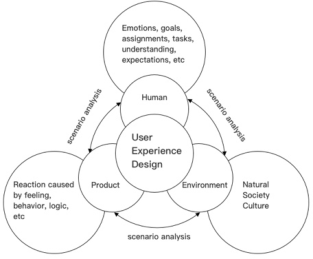
According to the ISO definition, user experience is “the personal cogni- tion and response formed by the use or expected use of a product, system or service”. The essential feature of user experience design (Figure 1) is to coordinate the dynamic relationship of the situation composed of “human - products - environment”, and create multiple structures and harmonious lifestyles for people. Travel itinerary planning refers to the choice of stopping points in the future travel process after tourists have generated their travel dreams by searching and browsing relevant recommendations in the self- driving travel APP. It involves food, housing, transportation, travel, shopping, entertainment and other links of tourism. Therefore, the dynamic relation- ship between people, products and environment has become an influential factor in the travel APP itinerary planning and design.
Human: Experience is generated in the process of interaction between peo- ple and products. Therefore, it is particularly important to take the user as the center and fully consider the needs of users in the process of travel plan- ning. However, in the experience economy environment, the impact of diverse society and heterogeneous culture leads to the diversity and diversity of users’ cognitive needs. Cognitive needs affect the user’s information processing and internalization process. Under the influence of the user’s own perception abi- lity, travel motivation and other factors, users evaluate the information of tourism products through experience, memory and brand impression, and only after determining the information they can consume. Therefore, the user’s travel motivation affects the design of travel planning.
Products: It is true that the impact of diverse society and heterogeneous cul- ture has led to the diversity and diversity of users’ cognitive needs. However,
Figure 1: Human-machine system model of user experience and product design.
Design of Self-Driving Tour Planning Interface Based on Tourism Motivation 281
in the experience economy environment, for specific user groups (tourists), their travel needs are more emotional and personalized. The needs of users have transited from basic sensory needs to emotional needs and self needs. Users hope that the product is more “human”, can form emotional memory, and more hope that the product has personalized characteristics, meets the “customized” self demand, and feel surprise in the experience.
Environment: Experience is closely related to specific situations and sce- narios. In different environments, users’ experience is different. In terms of tourism itinerary planning, the early planning stage is in the desktop envi- ronment, and the tourism stage is in the mobile environment. In the desktop environment, the user’s environment is relatively stable and there are few interference sources, which ensures that the user has a high degree of focus to participate in the interaction process with the product. In the mobile environment, facing the diversity of the environment, the complexity of the interference sources, the multiplicity of the target tasks, the user’s input and focus are obviously not high. The desktop environment and mobile envi- ronment constitute the environmental factors that affect the user’s travel planning.
Analysis of Travel Planning of Existing Tourism APP “Ctrip” is the tourism software with a relatively high share in the domestic tourism market at present. It adds the “Journey” module in the navigation bar of the home page to enter the sub-page. Users can click “Add Journey” to enter their own travel plan. At the bottom of the sub-page, the system recom- mends 9 types of tourism packages and various tourism strategies. Although the records of various tourism strategies are very detailed, they are too long to extract useful information. The system does not accurately extract users’ needs, and it is difficult to make accurate recommendations to users. Users need to spend a lot of time and energy to make a schedule. If the user is not familiar with the destination, the travel plan made may be very unreasonable.
“Ctrip”, “Mafengwo”, “Tuniu Travel” and other APPs have launched free travel modules, covering a complete set of travel plans, but almost all of them are different travel packages in a tourist city, with fixed itinerary and lack of flexible adjustment. This does not reflect the personalized and exclusive characteristics of users. Moreover, the entire travel planning module lacks the collection of user feedback, and the system is difficult to detect the changes in user needs, and make reasonable information adjustments, which will greatly reduce the interaction experience of the system.
After the user’s travel plan is set, “Ctrip” and “Tuniu Travel” will pre- sent the travel plan from top to bottom in the form of cards according to the travel time sequence, so that tourists can view the travel plan from the perspective of the whole journey. When tourists start to travel, enter “My Journey”, click the corresponding scenic spots, hotels and other pages, and navigate through Baidu Map, which facilitates the travel of tourists. Howe- ver, for tourist attractions, only the most basic introduction and navigation services are far from meeting the various needs of tourists in the process of tourism. This requires the travel APP to analyze the complex situation and
scenario of the destination, understand the needs of tourists at different stages of travel, and intelligently provide various travel services for tourists. After the start of the trip, the destination of “Tuniu Travel” has been switched to the destination. The recommended content at the bottom is still the travel strategy of other parts of the country. It does not reflect the special services for users and the update of real-time travel information. When tourists have new needs during the trip, it is impossible to quickly screen the target.
The travel planning design of travel APP should start from the perspe- ctive of user experience, extract the core needs of users, provide experience service points during travel, and let the travel planning products bring users a wonderful experience throughout the journey.
MOTIVATION AND TYPE OF SELF-DRIVING TOUR The American scholars put forward the tourist psychological type model to analyze the differences between different types of tourists in the aspects of tourism motivation, demand and expected behaviour, which has aroused widespread concern in the theoretical circle (Davis D, 1988). Cohen clas- sifies tourists into four types based on the degree and way of communication between tourists and local people (Cohen E, 1979). In 1982, Pearce sum- marized and classified the universal behaviours of tourist groups by using the multidimensional analysis scale Divide tourists into five types (Pearce P, 1982). In 1992, Yanakis summed up 14 special role forms of leisure tou- rists by using principal component analysis (Gibson, 1992). Loker-Murphy carried out a detailed study on the motives of backpackers in Australia in 1996 and found that these tourists showed four kinds of tourism motivations and behaviour clustering (Loker-Murphy Lauris, 1996). Generally speaking, foreign scholars mainly study the characteristics of tourist types from two aspects: the motivation, behaviour and the commonness and difference of tourist experience.
The early research of tourism geography in China basically did not involve the demand of tourism market. By the late 1980s, tourists, the main body of tourism activities, began to receive the attention of the academic community. The research on tourism market demand has made great progress. However, throughout the domestic research on the space-time distribution of tourism market, tourism motivation and behaviour, there are many studies on the types of tourists and the quality of their experience.
Self-Driving Travel Motivation According to the results of literature reading, the author designed a que- stionnaire, which consists of four parts, including 17 questions. The form of the questionnaire is single choice, multiple choice, and matrix scale que- stions. It is divided into four parts: user characteristics of self-drive travel, self-drive travel motivation, self-drive travel experience expectations and sati- sfaction, and population information. The third part and the fourth part use the Likert scale to require tourists to indicate their response to the statement by using a rating method of 1 (very inconsistent)∼5 (very consistent). The
Design of Self-Driving Tour Planning Interface Based on Tourism Motivation 283
survey was conducted from October to November 2022, and the question- naire was randomly distributed on the network. A total of 223 questionnaires were distributed, and 149 valid questionnaires were obtained through reco- very and review, with an effective recovery rate of 66.8%. SPSS software was used for statistical analysis of the questionnaire.
Generally speaking, the average score of Likert scale 1∼5 is between 1∼2.4, which indicates opposition, 2.5∼3.4 indicates neutrality, and 3.5∼5 indicates approval (Cevat Tosun, 2002). Self-driving travel users agreed with 11 of the 19 travel motivations (Table 1), and 8 of them expressed neutral opi- nions, indicating that the travel motivations of the sample users are multiple and comprehensive. Comparatively speaking, the average value of the eight tourism motivations of “appreciating the natural landscape”, “feeling the fresh air environment”, “spending time with family and friends”, “releasing psychological pressure”, “enjoying freedom during travel”, “tasting local food”, “experiencing different cultures or histories”, and “understanding local customs” is above 4, Moreover, the standard deviation shows that the above eight tourism motivations are consistent with the general motivation of most tourists.
User Type of Self-Driving Tour The method of factor analysis was used to sum up 19 tourism motivations. Four common factors were selected and named according to the eigenvalue and cumulative explanatory variance criteria. The cumulative contribution rate of the four common factors was 62.411%.
The factor load of all the original variables in the corresponding com- mon factors (Table 2) is greater than 0.5, indicating that the common factors are significantly related to the original variables. Among the four common
Table 1. Self-driving travel motivation survey.
Table available in the original PDF paper.
Tourism motivation Average value Standard deviation Get recognition and respect 3.109 1.095 Harvest friendship and social opportunities 3.454 1.087 Make new friends 3.193 1.084 Highlight personality 2.866 1.041 Improve driving skills 2.664 1.152 Experience the pleasure of driving 3.059 1.342 Appreciate the natural landscape 4.504 0.687 Feel the fresh air environment 4.311 0.767 Spend time with family and friends 4.176 0.908 Release psychological pressure 4.361 0.767 Get rid of monotonous daily life 3.983 0.911 Realize self-driving travel plan 3.479 1.213 Experience adventure 3.218 1.222 Experience a convenient and flexible journey 3.664 1.091 Enjoy freedom during travel 4.218 0.815 Taste local specialties 4.353 0.743 Experience different cultures or histories 4.193 0.784 Understand local customs 4.034 0.892 Share or record travel experience 3.899 0.896
Table 2. Factor load factor after rotation.
Table available in the original PDF paper.
Tourism motivation Factor1 Factor2 Factor3 Factor4 Get recognition and respect 0.694 Harvest friendship and social opportunities 0.797 Make new friends 0.860 Highlight personality 0.592 Improve driving skills 0.675 Experience the pleasure of driving 0.610 Appreciate the natural landscape 0.721 Feel the fresh air environment 0.752 Spend time with family and friends 0.602 Release psychological pressure 0.684 Get rid of monotonous daily life 0.549 Realize self-driving travel plan 0.629 Experience adventure 0.711 Experience a convenient and flexible journey 0.837 Enjoy freedom during travel 0.625 Taste local specialties 0.626 Experience different cultures or histories 0.828 Understand local customs 0.793 Share or record travel experience 0.588
factors, F1 has a large factor load in the six variables of “gaining recogni- tion and respect”, “gaining friendship and social opportunities”, “meeting new friends”, “highlighting personality”, “improving driving skills”, and “experiencing the pleasure of driving”, which is named “social factor” in this paper. F2 has a large factor load in the five variables of “appreciating the natural landscape”, “feeling the fresh air environment”, “spending time with family and friends”, “releasing psychological pressure”, and “getting rid of the monotonous daily life”, which is named “relaxation factor” in this paper. F3 has a large factor load in the four variables of “realizing self-driving tra- vel plan”, “experiencing adventure”, “experiencing convenient and flexible journey”, and “enjoying freedom during travel”, which is named as “freedom factor”in this paper. F4 has a large factor load in the four variables of “tasting local cuisine”, “experiencing different cultures or histories”, “understanding local customs and customs”, and “sharing or recording travel experience”, which is named “cultural factor” in this paper.
According to the analysis of tourism motivation in Table 2, the types of tourists are divided into four types, namely, tourists who pursue social inte- raction, tourists who pursue relaxation, tourists who pursue freedom, and tourists who pursue culture.
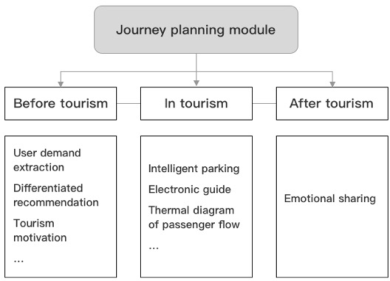
OVERALL FRAMEWORK DESIGN OF APP TRAVEL PLANNING BASED ON TOURISM MOTIVATION The overall functional layout of the travel itinerary planning APP should be concise and clear, with clear layers. According to the time nodes of the user’s travel process, it can be divided into three modules: pre-travel infor- mation service module, in-travel information service module and post-travel information service module (Figure 2).
Design of Self-Driving Tour Planning Interface Based on Tourism Motivation 285
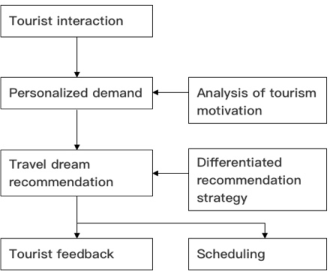
DESIGN OF PRE-TOURISM INFORMATION SERVICE MODULE Differentiated recommendation: at the stage of tourism planning when users generate tourism dreams, the system sets user demand collection page, analy- zes user demand and user travel motivation based on background big data, and gives recommendations for tourism dream points and differentiated recommendation strategies. Users can click favorite travel dream points, add and filter them independently, plan their travel, and choose a full set of tra- vel strategies. And each individual travel dream point can be deleted and moved, and users can flexibly adjust the travel arrangement. If the user is still unsatisfied, he can submit feedback, and the system can adjust the sche- dule according to the feedback (Figure 3). In this way, users do not have to make choices like looking for a needle in a haystack in the endless strategy. Improve the effectiveness of users’ access to information and realize humani- zed design. Situational interaction: At present, most of the recommendations in tourism APP are in the form of pictures. It is inevitable that the pictures will be very different from the real scene. A large number of identical pho- tos will make it more difficult for users to choose. Now that the 5G era has arrived, the popular short video introduction service can be accessed at the
Figure 3: Travel APP travel planning service framework.
introduction interface of scenic spots and hotels. Recommend the characte- ristic videos shot by famous tourism bloggers or popular tourists to tourists, so that tourists can obtain more direct tourism experience and stimulate the generation of users’ tourism desire. The video scene can replace the functional prototype to some extent, allowing the system to give people a comprehensive experience.
Design of Information Service Module in Tourism Intelligent parking: After arriving at the destination, users do not need to download separate parking software. On the intelligent parking page, they can find the parking lot, parking space and vehicle location information of the scenic spot as quickly as possible.
Looking for other tourists: The platform can obtain the current longitude and latitude coordinates of tourists through GPS positioning data, so as to analyze and judge the specific geographical location of tourists. Through the precise geographical location, it can judge the passengers who use the plat- form near the location at the same time, quickly find other online travellers, and provide convenience for realizing social travel and finding companions.
Passenger flow heat map: through the passenger flow heat map, tourists can remotely query the real-time heat of a scenic spot and the passenger flow heat of different time periods, and with the help of its prompt, adjust the tour route in real time to effectively avoid the crowded area.
Search for nearby attractions: The platform can find the data of nearby attractions from the database through GPS data analysis, and recommend it to tourists according to the size of attraction index of attractions. Travellers can choose their favorite scenic spots, and then open the navigation softw- are through the API interface to navigate to the entrance of the scenic spots according to the best route. Other users can also upload GPS geographical data of some special scenic spots by themselves. After being certified by the background staff, they can provide it to other travellers for reference on the interactive platform of self-driving travel service.
Design of Post-Tourism Information Service Module Emotional sharing: The travel is over, but the feelings and memories genera- ted by the travel are not over. On the emotion station page, the system has a large number of travel long map templates and small video templates. Users can select a template, upload travel photos and text content according to the travel time sequence, and the system will automatically generate personali- zed travel map and travel log. It is convenient for users to record and share, triggers users to remember and think, and generates self-satisfaction. A good experience will stimulate the generation of the desire for the next trip, and increase the user’s dependence on and satisfaction with the product.
CONCLUSION
This paper studies the travel planning module in the existing travel APP based on the user’s travel motivation. The design of travel planning should not
Design of Self-Driving Tour Planning Interface Based on Tourism Motivation 287
only ignite the user’s desire to travel, but also provide differentiated and fle- xible travel strategies according to the user’s travel motivation, and reflect the whole-process “intimate companionship” service. This research is at the initial stage, and there are still many problems. Future travel planning rese- arch should be based on various complex situations and scenarios, deeply explore user needs, and create unique experiences and memories for users from natural exploration, cultural exploration and other directions.
ACKNOWLEDGMENT
The authors would like to acknowledge.
REFERENCES
Cevat Tosun. (2002). Host perceptions of impacts: a comparative tourism study[J]. Annals of Tourism Research, 29(1):231∼253. Cohen, E.. (1979). Rethinking the sociology of tourism. Annals of Tourism Research, 6(1), 18–35. Davis, D., Allen, J., & Cosenza, R. M.. (1988). Segmenting local residents by their
attitudes, interests, and opinions toward tourism. Journal of Travel Research, 27(2), 2–8. Gibson, Y. H.. (1992). Roles tourists play. Annals of Tourism Research. Mcgehee, N. G., Loker-Murphy, L., & Uysal, M.. (1996). The australian international pleasure travel market: motivations from a gendered perspective. journal of tourism studies. Pi-Sunyer, O., & Pearce, P. L.. (1982). The social psychology of tourist behaviour.
Contemporary Sociology, 12(6), 728.
LISTED IN THE AHFE DIGITAL BOOKSTORE CATALOGUE
Explore the complete digital volume
Usability and User Experience
Read this individual research paper free through the original publisher, or explore the full digital proceedings book.
ISBN 978-1-958651-86-5
Explore this ISBN in the AHFE Bookstore ↗Listed in the July 2026 bookstore catalogue; search by ISBN to confirm current availability · Digital book purchase optional