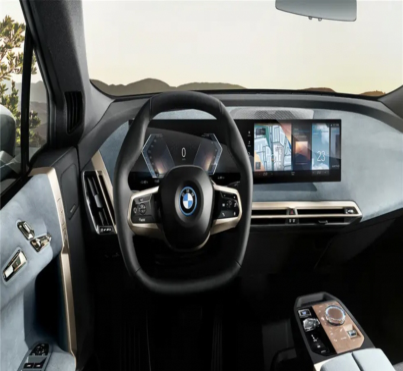
With the development of electronic technology, car interaction carriers have evolved from being dominated by hardware interfaces to software interfaces, with Tesla leading the way and even adopting pure software interfaces as car interaction carriers. In the automotive interaction design process, there is a lack of corresponding design strategies to guide the selection of interaction carriers, different interaction carriers have different characteristics, and the wrong use of interaction carriers will affect the user experience. This paper uses literature research and comparative research methods to study automotive interaction carriers and their characteristics, and to develop an automotive interaction design strategy for human-computer interaction carriers.
Interaction is the process of interaction between two or more entities in which a series of information is exchanged. The interaction vehicle is the part that the user operates and undertakes to give feedback. The exchange of infor- mation between a person and a car is called automotive (human-machine) interaction. In traditional automotive HCI design, simple control and infor- mation display is mainly carried out between the human and the car through the hardware interface as the interaction carrier. With the development of ele- ctronic technology, the interaction carrier of the car has evolved from being dominated by the hardware interface to being dominated by the software interface. In recent years, with the rise of the “software for cars” concept, car brands such as Tesla have adopted a pure software interface as the vehi- cle interaction carrier. Both software-led and hardware-led interactions have certain usability issues.
The existing interaction design process is mostly proposed for software interface interaction. The software interface interaction establishment pro- cess can be summarized as follows: user research - requirement definition - task analysis - system framework - interface design - low-fidelity mode- ling and testing - high-fidelity modeling and testing. For the design process of hardware interface interaction, Sun Yuanbo has the following descripti- ons in Human Factors Engineering Fundamentals and Design: (1) interface
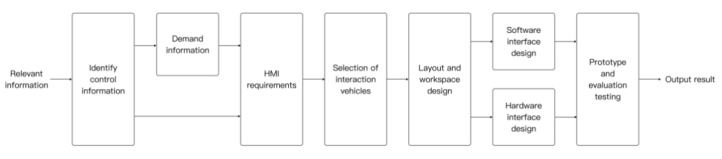
requirements; (2) control or selection of display/control or selection of con- troller; (3) layout and operation space design; and (4) evaluation scheme. In the second phase of hardware interface interaction design the interaction carrier is selected according to the requirements. The car interaction carrier consists of two parts: hardware and software. In the car interaction design process (see Figure 1), the selection of the interaction carrier should be based on the requirements of the human-machine interface, and the spatial layout design is carried out after the interaction carrier is determined, followed by the design of the software and hardware interfaces.
Figure 1: Car interaction design process.
However, in automotive HCI design there is no clear design strategy to guide the selection of interaction carriers. In existing automotive intera- ction design, the choice of interaction carrier is often determined by multiple factors such as brand positioning and model price, without considering the impact of different types of interaction design carriers on usability. Therefore, an HCI-oriented interaction design strategy can guide the selection of intera- ction carriers in automotive interaction design from a design perspective, so as to effectively improve the user experience of automotive interaction.
INTRODUCTION TO VEHICLE INTERACTIVE CARRIER Interaction is the process of interaction between two or more entities in which a series of information is exchanged. The interaction vehicle is the part that the user operates and undertakes to give feedback (Sun Yuanbo, 2010). The exchange of information between a person and the vehicle is called automotive interaction. The interaction carrier of automotive intera- ction has undergone a development process from hardware interface-led to software interface-led.
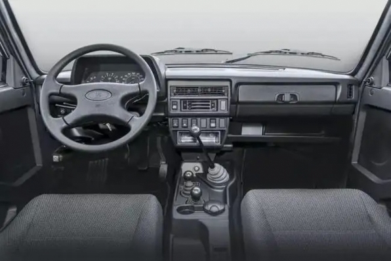
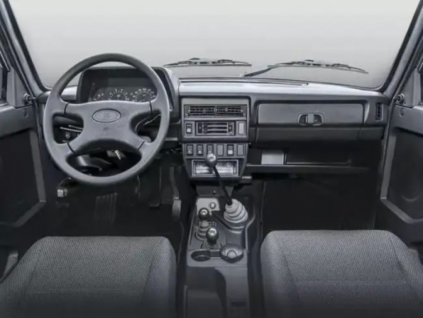
The first four-wheeled car was invented in 1885 by the German Got- tlieb Daimler, whose vehicle interaction vehicle was a simple lever that was cranked to control direction and communicate information. With the mass production of cars, the early car interaction carriers solidified into three main operating components: steering wheel, foot pedal and joystick. With the widespread introduction of radio in the 1950s, the widespread incorpora- tion of radio in the car gave a new form to the vehicle interaction vehicle. The control of volume and radio station adjustments led to a dramatic increase in the number of buttons in the car. From the 1960s onwards, the increased functionality of the centre console led to a gradual enrichment of the hardw- are interface in the form of knobs, toggles, buttons, sliders and other different
Figure 2: Hardware interface domination period.
forms of control to match the different functional tasks (Zeng Qingshu, 2019) (see Figure 2). The 1990s saw a move towards electronic vehicles and the incorporation of new technologies brought changes to the vehicle interaction vehicle. Digital displays began to appear, albeit in smaller areas and with monochrome displays, increasing the intuitiveness of reading information.
In the 21st century, with the development of IoT, Telematics, intelligent ecology and driverless technology, more and more cars are using electronic screens as the main car interaction carrier, or even using multiple electronic screens as the interaction carrier, for example, the Range Rover Starliner uses a three-screen linkage design (Li Shuaishuai, 2020). The electronic screen as a car interaction carrier can achieve more information presentation compared to the interaction carrier of hardware interface, and at the same time provide new possibilities for the way of car interaction. Some car companies, such as Tesla, use pure software interfaces as interaction carriers, completely abando- ning hardware control, a radical design that has usability issues during real driving. In addition, with the development of wearable interactive devices interaction technology may provide new ways of interacting with the vehicle in the future.
In summary, automotive interaction vehicles have gone through a deve- lopment process of pure hardware interface - hardware interface dominant - software interface dominant. The software interface plays a leading role, while the hardware interface still plays an important role. The hardware interface includes hardware devices such as steering wheels, brakes, instru- ment panels, central control systems and their physical control buttons; the software interface includes the interactive information interface of LCD instruments, large central control screens and other devices (He Keyan, 2019).
CAR INTERACTION CARRIER CHARACTERISTICS The human-computer interaction vehicle in automotive interaction design consists of two parts: hardware and software. The hardware carrier inclu- des physical controls such as buttons, knobs, wheels and toggles, while the software carrier mainly includes software interfaces such as touch screens.
Vehicle Interaction Design Strategy 367
Due to the need for increasingly complex information presentation, the veh- icle interaction carrier has changed from a hardware carrier-led interaction to a software carrier-led interaction. The tasks to be performed by the dri- ver in the vehicle space are divided into primary tasks related to driving (e.g. driving and shifting gears) and secondary tasks not related to driving (e.g. other operations such as adjusting air conditioning and music). These secon- dary tasks, which are not directly related to driving behaviour, can distract the driver’s attention to varying degrees, increasing the driver’s cognitive load and causing “information overload” (Gao Zhenhai, 2015). Different human- computer interaction vehicles in automotive interaction design have different characteristics, which can cause an increase in the driver’s cognitive load and affect the user experience.
Software Interaction Carrier Characteristics Software interaction vehicles do not provide haptic feedback. Haptics can influence our everyday perceptions and emotions, allowing us to perceive physical experiences and material sensations. Haptic engagement serves to deepen perceptions and gives people more direct, concrete sensory stimula- tion. Software interaction vehicles do not provide haptic feedback in the same way as hardware interaction vehicles, which provide pressure feedback when pressing a physical button and damping feedback when rotating a knob or scroll wheel. As a result, the user is unable to haptically sense whether the interaction has been completed after the software interaction has been perfor- med, and therefore requires the visual system to be involved in the localisation and confirmation process, which increases the visual load and tends to deflect the driver’s vision, increasing the risk of driving. Research has shown that traditional touchscreens inevitably create a visual load demand due to the lack of haptic feedback, which places a greater demand on visual attention. In mobile devices, haptic feedback has been shown to reduce error rates in input and selection tasks, reduce task completion times and increase worklo- ads. Trials have shown that haptic feedback reduces the time spent navigating the interface. When haptic feedback was enabled, users could also complete more tasks.
However, when haptic feedback was enabled, the probability of making a secondary observation of the interface was reduced (Pitts, Matthew J, 2012). At the same time, during hardware interaction, because of the fixed posi- tion of the physical keys, the user can perceive the position of the hardware through the sense of touch, which over time creates muscle memory and ena- bles blind operation without the involvement of the visual system. Software interaction vehicles are less likely to be operated blindly by the user during software interaction because they do not provide haptic feedback.
Software interaction vehicles have lower visual priority than hardware interaction vehicles. The visual prominence of the software screen appea- rance is weaker than the physical buttons, so it takes longer for the user to recognise the software interaction vehicle during interaction, which undoub- tedly has an impact on driving performance. For some emergency operations, the user’s reaction time is shorter with the hardware interaction vehicle than
with the software interaction vehicle. Studies have shown that in complex medical devices, physical keys will be visually more intuitive to respond to in the operator interface, which will ensure that the healthcare professional completes the operation steps more efficiently (W.W. Wierwille, 1995).
Complex layers of software interaction information can increase the visual load. As the functionality of in-car information systems increases, more inte- ractive operations need to be carried out via the touch screen. Due to the limited size of the software screen, the operating interface is often spread across multiple levels of menus based on information hierarchy, which can increase the visual load on the user while increasing the length of time the driver has to multitask, making them prone to inattention and irritability (Li Qihan, 2018). During driving, the driver often needs to click multiple times to find the corresponding interface, which takes the driver’s attention away from the primary visual attentional zone (PVAL) for driving (Zhou Xiao, 2018), and the increased driver’s eye drift time can lead to an increased risk factor for driving. According to J.D. Power user market research, users have significant complaints about the full touch screen air conditioning controls. Users often need to open multi-level menus to make adjustments, which, if required by the driver, inevitably causes the driver to be out of sight for longer periods of time, which has a negative impact on driving safety.
Hardware Interaction Carrier Characteristics Hardware interaction carriers make it difficult to distinguish between dif- ferent levels of information. As physical buttons assume a single function, an increasing number of functions and complex control logic will lead to an increasing number of buttons. On the 2023 Chevrolet Corvette z06 sports car, a large number of function switches are present in the interior in the form of buttons (see Figure 3), however, users generally respond that too many phy- sical buttons have a negative effect on operation. Experiments have shown that as the number of physical buttons increases, the speed and accuracy of user perception decreases.
Figure 3: 2023 Chevrolet Corvette Z06.
Vehicle Interaction Design Strategy 369
At the same time, hardware interaction differs from software interaction in that the arrangement of the hardware is often influenced by the layout of the space in the vehicle, making it difficult to differentiate the presentation of different levels of information compared to software interaction. Some stu- dies have shown that in the design of medical products, software interaction interfaces are effective in controlling the error rate of healthcare professionals when dealing with complex layers of information due to the email interaction interface and the use of graphical user interfaces when faced with multiple complex layers of tasks (Wang Jieyuan, 2020).
Hardware interaction carriers are more difficult to learn. As a product tends to become feature rich, its operation becomes complex. Physical buttons play an important role in automotive safety, but as automotive tech- nology develops at a rapid pace and control functions become more and more numerous, when the number of controllers is large and their shapes are diffi- cult to distinguish, appropriate symbols, text or graphics can be engraved or printed on the controller to show the difference. However, the relevant illu- strations printed on the keys often have a certain learning cost, and hardware interaction is more expensive for beginners to learn than software intera- ction, which can be illustrated visually for operation. At the same time, the variety of ways in which hardware interaction carriers can be operated also contributes to the high learning costs of hardware interaction. For exam- ple, some in-vehicle interface knobs can be rotated for selection, but can also be pushed, pulled or pressed to control multiple levels of menus on the screen. This multi-use phenomenon is contrary to Norman’s seven principles of user-centred design - ‘ensure high visibility’ - and makes it difficult for the user to choose the right operation, thus increasing learning costs. The combination switch on the steering column of a modern car cab is a typi- cal multi-functional manipulator, usually with light control, wiper and water spray control, horn control, etc. It also needs to be lifted, pressed down and rotated to perform different operations, which has a certain learning cost.
In summary, hardware and software interaction carriers have different characteristics and have their own advantages and disadvantages in diffe- rent usage scenarios and processes. A reasonable combination of software and hardware interaction carriers, complementing each other’s strengths and weaknesses, will improve the efficiency and safety of car interaction.
INTERACTION DESIGN STRATEGIES FOR CARS BASED ON INTERACTION CARRIERS The characteristics of hardware and software interaction carriers are diffe- rent, so in the process of interaction design for cars, different interaction design strategies need to be developed according to the different characteri- stics of the different interaction carriers.
Preference for Hardware Interaction Vehicles When Designing Driver Safety-related Functions Automotive human-machine system interaction is a typical transient non- immersive operation. In the process of car use, driving is always the main task, which occupies most of the attention resources. At the same time, because
unexpected events may happen at any time, users’ attention can only be limited and briefly devoted to car-machine task operations, and the design should avoid conflicts between secondary tasks and primary tasks, shorten the time of secondary cognition, and reduce learning costs (Lansdown, 2000). Hardware interaction vehicles have haptic feedback, and experiments have shown that the probability of making secondary observations of an interface is reduced when haptic feedback is enabled (Pitts, Matthew J, 2012).
Since the visual priority of the hardware interaction vehicle is better than that of the software interaction vehicle. For some emergency operations, the user’s reaction time is shorter with the hardware interaction vehicle than with the software interaction vehicle. During the interaction process, the user takes longer to recognise the software interaction vehicle, and the increased reco- gnition time for functions related to driving safety can pose a significant risk to driving safety.
Software interaction carriers are less stable than hardware interaction carriers and are more susceptible to environmental influences, so driving safety-related functions are preferred to hardware interaction carriers.The 2018 Vehicle Reliability Study (VDS) out of J.D. Power shows that the in- vehicle information system is a high area for vehicle problems, accounting for 20% of all failure problems, and more than half of the problems with the in-vehicle information system are screen Interaction failure problems (Xia Yuru, 2016). The use of hardware interfaces is also more stable in terms of environmental factors and less subject to environmental influences. Softw- are interface interactions are more susceptible to environmental influences. Studies have shown that drivers use touch screens with different efficiency in different lighting environments. Also, touch screens suffer from the problem of not being recognised when gloves are worn or when there is dirt on the hands.
Preference for Hardware Interaction Vehicles When Designing Frequently Used Functions The hardware interaction carrier can provide the user with haptic feedback, and the physical button position is fixed, the user can perceive the position of the hardware through the sense of touch, and after a long time, muscle memory is formed, and can operate blindly without the involvement of the visual system, for the more frequently used functions can effectively improve the efficiency of the operation, when the haptic feedback is enabled, the user can also complete more tasks. However, when haptic feedback is enabled, the user has less time to look at the interface twice. In a related experimental experiment comparing touch screens with buttons, button-based HMI pro- vides tactile and orientation sensation in air conditioning and entertainment tasks, is better in operational performance, and has less impact on the main task of driving (He Jiajie, 2018).
For the more frequently used functions such as left/right switching, up/down switching and accessing higher/lower menus, the use of a hardw- are interaction carrier can ensure safe driving. For the more frequently used operations such as left/right switching and up/down switching, operating on
Vehicle Interaction Design Strategy 371
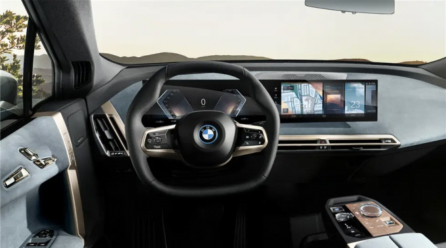
the larger software screen increases the distance the driver’s body has to move. The user needs to slide the function card in the corresponding area horizontally or vertically to find the desired function, and the complexity of the operation will undoubtedly cause the driver’s eyes to drift away for lon- ger periods of time, which has a detrimental effect on driving safety. BMW uses the iDrive knob in the central control interaction (see Figure 4), which allows the user to remain fully seated with the arms in a natural position compared to using a touch screen, and improves driving safety by allowing the body to move a shorter distance compared to interacting with a touch screen.
Preference for Software Interaction Vehicles When Designing Functions with Complex Information Hierarchies Hardware interaction vehicles are more homogeneous in appearance than software interaction vehicles, making it difficult to convey complex levels of information and increasing the number of keystrokes as the level of informa- tion increases. Experiments have shown that as the number of physical keys increases, the user’s cognitive speed and accuracy decreases. At the same time, the learning cost of hardware interaction carriers is high. When the functi- ons are complex, the use of software interaction carriers is more conducive to the user’s understanding through visualisation and improves interaction efficiency. Related experiments show that in static tasks, users are able to use all their attentional resources on the operation of the interface. In tasks such as navigation and communication, which are complex operations with a large amount of information on the page, Tesla’s touch operation and large screen display are experienced better than traditional button-based opera- tion (He Jiajie, 2018). At the same time, the software interaction carrier has a larger display area, displaying a richer content, while it is easier to divide the different functional areas to facilitate the user’s operation, such as Tesla’s screen (see Figure 5) is divided into a menu, information display area, quick operation area.
Figure 4: BMW iDrive knob.Figure 5: Tesla interface layout.
CONCLUSION
The existing automotive interaction design process lacks a design strategy to guide the selection of interaction vehicles. This paper discusses the design strategy for automotive interaction based on interaction design carriers. Fir- stly, the paper introduces and analyses the car interaction carrier, which consists of two parts: hardware and software. Then, the paper analyses the respective characteristics of the hardware and software interaction carriers. Finally, the paper proposes an interaction design strategy based on the chara- cteristics of the interaction carrier and the interaction design task of the car, which provides a reference for the interaction design of the car.
REFERENCES
Gao Z H, Duan L F, Zhao H & Yu H L. (2015). Assessment of driver cognitive load under multitasking based on physiological signals. Automotive Engineering (01), 33–37. doi:10.19562/j.chinasae.qcgc.2015.01.006. He, Jiajie. (2018). A comparative study on user experience evaluation of different
types of automotive HMI interfaces based on multiple indicators (Master’s the- sis, Zhejiang University of Technology). https://kns.cnki.net/KCMS/detail/detail. aspx?dbname=CMFD201901&filename=1018193880.nh He, Ke-Yin, Yu, Shu-Cong & Meng, Jian. (2019). Automotive interaction design in the era of smart network connectivity. Automotive and Accessories (15), 78–79. Lansdown, T. C. (2000). Driver visual allocation and the introduction of intelligent
transport systems. Proceedings of the Institution of Mechanical Engineers, Part D: Journal of Automobile Engineering, 214(6), 645-652. Li Qihan, Wang F. & Wang X. (2018). Analysis of the design of home car centre control panel’s livability. Modern Trade Industry (01), 185–186. doi:10.19311/j.cnki.1672–3198.2018.01.087. Li, Shuai-Shuai. (2020). Research on the development trend of automotive HMI.
Today’s Media (01), 91–93.
Vehicle Interaction Design Strategy 373
Pitts, Matthew J., et al. “Visual–haptic feedback interaction in automotive touchscreens.” Displays 33.1 (2012): 7–16. Sun Yuanbo. (2010). Human Factors Engineering Fundamentals and Design. Beijing:
Beijing University of Technology Press. W. W. Wierwille, Development of an initial model relating deiver in-vehicle visual demands to accident rate, in: Proceedings of the Third Annual Mid-Atlantic Human Factors Conference, 1995, pp. 1–7. Wang Jieyuan & Wang Chunpeng. (2020). The application of physical keys in
human-computer interaction interface. Western Leather (04), 72+77. Xia Yuru. (2016). Research on the development of China’s new energy vehicle industry under government leadership (Master’s thesis, Yunnan University of Fina- nce and Economics). https://kns.cnki.net/KCMS/detail/detail.aspx?dbname=CM FD201701&filename=1017026574.nh Zeng, Qingli. Automotive Human-Machine Interaction Interface Design. China
Light Industry Press. Zhou Xiao. (2018). Research on the influence of AR-HUD assisted driving system on driving behavior (Master’s thesis, Wuhan University of Tech- nology). https://kns.cnki.net/KCMS/detail/detail.aspx?dbname=CMFD201902& filename=1019831189.nh
LISTED IN THE AHFE DIGITAL BOOKSTORE CATALOGUE
Explore the complete digital volume
Ergonomics In Design
Read this individual research paper free through the original publisher, or explore the full digital proceedings book.
ISBN 978-1-958651-53-7
Explore this ISBN in the AHFE Bookstore ↗Listed in the July 2026 bookstore catalogue; search by ISBN to confirm current availability · Digital book purchase optional