The Virtual reality specialization has been the trend in recent years. At the same time, vehicle HMI is faced with multimodal and 3D interaction methods. This is an opportunity to build vehicle HMI VR design tools. Design strategies for building prototype tools are developed based on user requirements. By studying and sorting out the HMI design content, we study the requirements of HMI VR design tools based on the Kano model, and build a suitable design strategy to guide the subsequent development based on the requirement priority and user feedback. Most of the envisioned functional requirements were positively evaluated, and there is positive value for designers in building vehicle HMI VR design tools.
Virtual reality (VR), due to its media characteristics, breaks through the limi- tations of traditional two-dimensional desktop interface work and enables the expansion of display scale and dimensionality (Hussain, 2020) that brings new ways of interaction (Jerald, 2015). This all provides the opportunity to create new tools for design production, opening up new possibilities for design work.
Many fields that require 3D work have explored the value of virtual rea- lity applications. Bazzaro conducted a study on the way architectural interior prototypes are displayed, and the use and aesthetic perception of interior pro- totypes displayed on a desktop interface is inferior to that of full-size virtual interior prototypes (Bazzaro et al. 2018). The desktop interface took more time than virtual reality in terms of part assembly of the model (Toma et al. 2012). The Aldea study proposed a VR evaluation tool called VRHEAD, which was designed to facilitate an iterative design process and support rapid implementation of virtual prototypes to evaluate Human-Machine Intera- ction (HMI) for self-driving cars. Preliminary results suggest that VRHEAD is a promising tool for rapid implementation and evaluation of design concepts as a promising approach (Aldea et al. 2022).
In recent years, with the electrification, intelligence and networking of automobiles, the human-computer interaction content of automobiles has been significantly expanded and the design of automotive interiors has
Design Strategy of Vehicle HMI VR Prototyping Tool Based on Kano Model 355
become more flexible, while virtual reality, as opposed to traditional desktop interface working conditions, seems to allow designers to quickly try a variety of interior interaction schemes and accurately grasp the 3D scale.
However, whether the expectations and needs of users for this particu- lar medium are the same as those of design aids in the traditional medium requires further validation.
MATERIALS AND METHODS
Platform Functional Requirements VR platform functions are mainly based on the content of HMI design, the characteristics of VR and the existing interaction design prototype tools to build. VR has the characteristics of immersion, conceptualization and inte- ractivity compared to other media (Burdea and Coiffet, 2003) and scenario resources will be good design aids, such as setting up traffic environments and interior environments. Existing interaction design tools, usually with basic element parameters editing function and interaction setting function, such as figma.
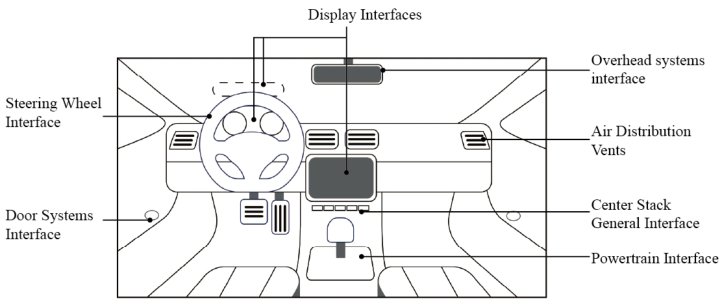
The current main HMI components are as follows (see Figure 1). The HMI design content can be divided into two-dimensional and three-dimensional design content. The two-dimensional design content mainly includes the information displayed in the dashboard, the central control instrument, and the HUD. Three-dimensional design content mainly includes the steering wheel, various controllers, displays and the overall layout.
In summary, according to the main positioning of the platform, the auxi- liary design dimensions and virtual reality features, HMI design content and design process. The overall functions are divided into several functio- nal themes of basic functions, flat assistance, three-dimensional assistance, environmental assistance, evaluation and management (see Table 1). The basic functions are assumed to be the necessary functions, and the plat- form positioning has a direct relationship to the set of interactive functions, which is generally the basic of the prototyping tool. The planar assistance
Type Function Definition Basic Function Set Interaction You can set [Trigger Condition] and [Feedback Status] to establish interaction between different components. 2D-Aided Add text and symbols
Allow users to create custom text and symbols via input method. Pre-made Icon Library
You can select basic gauge types and ICONs in the pre-made component library, including and not limited to the content in the image. Import media Import images and videos, such as UI and elements of existing HMIs 2D-Aided Create models Create simple objects such as planes, circles, geometries, spheres and columns and edit their parameters such as dimensions, coordinates, angles, CMFs, etc. Pre-made component library
You can select car interaction components such as basic, different size displays and steering wheels in the prefabricated component library. Pre-made dashboard layouts
You can select some of the currently available dashboard layouts for quick creation and multiple experimentation. Reference Import a reference model such as a standard human body for the cockpit and set different preset poses/states. Environment Assist
Set the model You can select several different sizes of interior spaces, such as different classes of sedans, coupes, SUVs and MPVs, etc. Setting environment
Setting scenario and road conditions, such as urban or suburban, night or day, weather conditions, etc. Evaluate and manage
Layer Explorer Introduce the Layer Explorer to manage, view and edit the parameters of the components and their interactions. State saving Save multiple states of the scenario for comparison or selective editing. Demo mode Enter demo mode to experience the set interaction.
function contains some 2D-related HMI design content, such as adding text and symbols, pre-made icon library, importing media; the three-dimensional assistance contains some 3D or space-related HMI design content, such as making models, pre-made component library, pre-made dashboard layout, reference. Environment function plays the function of immersion and spatial flexibility of virtual reality, which mainly provides designers with contextual support for HMI design, including setting models and setting environment. Evaluation and management functions, evaluation is to articulate the process after interactive prototyping for scenario testing, and management is to allow users to have better prototyping effectiveness while enhancing the grasp of working conditions.
KANO Questionnaire Design and Related Indicators The KANO model is suitable for exploring the needs of new content products such as XR. Ning (Ning, 2021) explored the needs of MR-assisted experimen- tal teaching platform functions through KANO; Xu (Xu, 2019) explored the
Design Strategy of Vehicle HMI VR Prototyping Tool Based on Kano Model 357
needs of virtual reality interior design software based on the KANO model and obtained optimization opportunities.
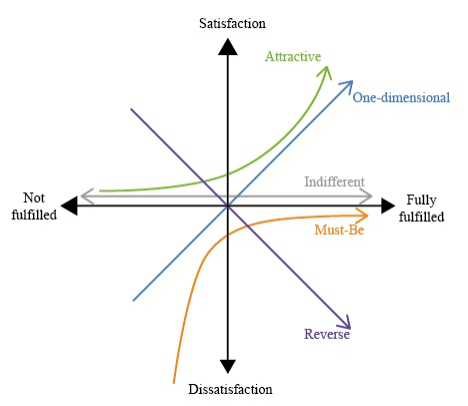
The KANO model is plotted as follows (see Figure 2), the horizontal coordinates represent the availability of quality attributes and the vertical coordinates represent the magnitude of satisfaction. These five attributes are determined based on the relationship between the degree of availability of quality and satisfaction. The five attributes are defined according to the relati- onship between quality availability and satisfaction. The different satisfaction influencing properties are defined as five types, namely, attractive attributes (A), expected attributes (O), must-be attributes (M), indifferent attributes (I), and reverse attributes (R).
For the basic functional requirements summarized in the previous section, the questionnaire was constructed based on the KANO model (see Table 2). At the end of the questionnaire, an open-ended question was provided about improving the existing HMI prototyping tool, and expectations for the VR HMI prototyping tool.
After collecting the positive and negative attitudes of users towards the features, the specific attributes of the features are defined through the com- parison table of classification results (see Table 3), in which the user samples that get suspicious functional attributes (Q) will be eliminated.
The priority between similar or different types of requirements is further judged by SII and DII after obtaining the specific attributes. Berger et al. proposed Satisfaction Increment Index (SII) and Dissatisfaction Decrement Index (DDI) to measure the improvement performance of satisfaction and dissatisfaction, respectively (Berger, 1993), and the absolute values of SII and DDI The absolute values of SII and DDI range from 0 to 1, and the larger the value, the greater the improvement benefit; conversely, the smaller the value, the smaller the improvement benefit. After tallying the questionnaire results,
Question Like It Deserve Indifferent Tolerable Don’t like How would you rate the design platform if it had a “set interaction” feature?
How would you rate the design platform if it did not have the “Set Interaction” feature?
Table 3. Comparison table of classification of function attribute evaluation results.
Table available in the original PDF paper.
Founction Name Negative Questions Like It Deserve Indifferent Tolerable Don’t like
Positive Questions Like It Q R R R R Deserve M I I I R Indifferent M I I I R Tolerable M I I I R Don’t like O A A A Q A: Attractive; O: One-dimensional; M: Must-be; I: Indifferent; R: Reverse; Q: Questionable
a two-dimensional quadrant diagram was created by SII and DDI and used to establish four quadrants to prioritize attributes that could be improved (Chen et al. 2021).
Finally, a questionnaire test was conducted on 33 HMI designers and rela- ted practitioners, and 24 valid data were obtained. 96% of the subjects had experience in using desktop interface HMI prototyping software, such as Figma and Sketch software, and 80% of the participants had experience in using related 3D creative tools, such as Rhinoceros and Blender. 88% of the participants had experienced virtual reality.
RESULTS
The results of the questionnaire on functional requirements were tallied in percentages and functional requirement attributes were summarized (see Table 4). Three functional requirements were defined as must-be Require- ments (M), which were Setup Interaction, Import Media, and Presentation Mode. Six functional requirements were defined as attractive requirements (A), namely, prefabricated component library, prefabricated icon library, pre- fabricated dashboard layout, reference, setup environment, and resource manager. There are four functional requirements defined as in indifferent requirements (I), which are Add Text Symbol, Set Model and State Save.
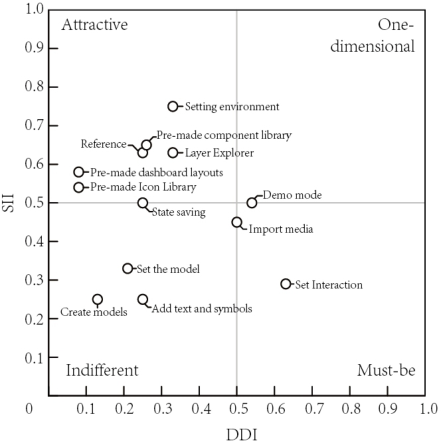
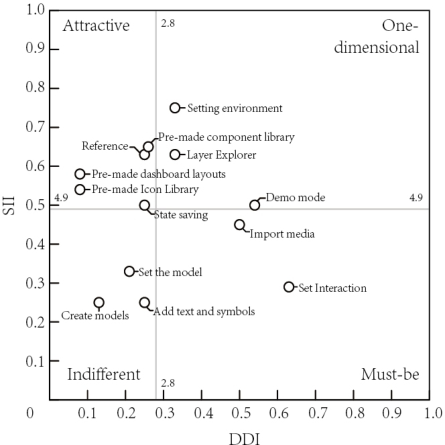
The SII and DII indicators for each functional requirement were calcula- ted (see Table 5), where the DII was processed in absolute value. Meanwhile, the SII-DII matrix was constructed based on the obtained SII and DII data. The matrix was constructed with the median of SII and DII as the coordi- nate origin for comparing the priority of requirements of the same type (see
Design Strategy of Vehicle HMI VR Prototyping Tool Based on Kano Model 359
Table 4. Type of function requirements (%).
Table available in the original PDF paper.
Type Function A O M I R TYPE Set Interaction 20.8 8.3 37.5 33.3 0 M Basic Function
2D-aided Add text and symbols 12.5 12.5 12.5 62.5 0 I Pre-made Icon Library 50.0 4.2 4.2 42.7 0 A Import media 25.0 20.8 29.2 25 0 M 3D-aided Create models 25.0 0 12.5 62.5 0 I Pre-made component library 45.8 16.7 8.3 25.0 4.2 A Pre-made dashboard layouts 54.2 4.2 4.2 37.5 0 A Reference 50.0 12.5 12.5 25.0 0 A
Environment Assist
Set the model 25.0 8.3 12.5 54.2 0 I Setting environment 54.2 20.8 12.5 12.5 0 A Evaluate and manage Layer Explorer 42.7 20.8 12.5 25.0 0 A State saving 33.3 16.7 8.3 42.7 0 I Demo mode 25.0 25.0 29.2 20.8 0 M
Table 5. SII and DII of functional requirement.
Table available in the original PDF paper.
Function SII DII Set Interaction 0.29 0.46 Add text and symbols 0.25 0.25 Pre-made Icon Library 0.54 0.08 Import media 0.45 0.5 Create models 0.25 0.13 Pre-made component library 0.65 0.26 Pre-made dashboard layouts 0.58 0.08 Reference 0.63 0.25 Set the model 0.33 0.21 Setting environment 0.75 0.33 Layer Explorer 0.63 0.33 State saving 0.50 0.25 Demo mode 0.50 0.54
Figure 3); the matrix was constructed with the mean of SII and DII as the coordinate origin for analyzing the relative requirements type (see Figure 4).
ANALYSIS AND PRELIMINARY DESIGN STRATEGY The analysis of the comprehensive chart results (see Figure 3 and Table 3) shows that among the must-be features(M), if the setting interaction function is missing, it is the most likely to cause user dissatisfaction. This matches with the expectation of feature setting at the beginning, indicating that the set- ting interaction function should be the most essential feature of the platform. Missing demo mode is the second most likely cause of user dissatisfaction, probably because it has a clear contextual relationship with the setup intera- ction and is related to the coherence of the design process, since the next step after the setup interaction is usually the design evaluation. Importing media
Figure 3: SII-DII matrix.Figure 4: Relative type SII-DII matrix.
has a slight essential property, and most prototyping software in the desktop interface medium has import media functionality, but the fact that import media functionality is not yet uniformly available in VR prototyping software diminishes the tendency for users to consider this functionality essential.
Among the attractive features (A), setting the environment is the most interesting to users, and users also showed their expectation of the virtual reality display medium in the interview that “the environment can create
Design Strategy of Vehicle HMI VR Prototyping Tool Based on Kano Model 361
a more realistic design background”, and this feature can make full use of the immersive characteristics of virtual reality to support interactive design. Secondly, the library of pre-built components for quick 3D tasks is favored by users, probably due to their expectation of high freedom of interaction with virtual reality and breaking the limits of real space. The reference and layer manager have the same SII results, but layer management is more conside- red by users as a necessary feature, probably due to the fact that most of the existing platforms have this feature; meanwhile, the function of the reference lies in assisting designers to carry out user-centered design more precisely, fil- ling the gap of the current HMI prototyping software and triggering some interest from users. The other two features are also very attractive to users. The prefabricated dashboard is more fascinating to users than the prefabri- cated icon library, and users also put forward the view that “the prototype in the desktop interface is a bit false from the cockpit”, which further reveals the advantage of virtual reality in creating HMI prototypes in terms of space resources. It should be noted that in the relative attribute results of the requi- rements (see Figure 4), the setting environment and layer explorer are in the first quadrant, showing a clear trend of expectation. This is perhaps because the design assistance effect brought by these two features is more direct and familiar compared to other charming features, and should be given priority in the construction of the platform.
Of the indifferent features (I), modeling was the least of users’ concerns, possibly due to the availability of pre-built 3D models (e.g., pre-built com- ponent libraries), and also because some users noted that “building the envisioned 3D effect requires more effort”. Setting the model was also defined as a non-differentiated requirement, possibly due to the overlap between its functionality and the pre-defined dashboard layout, or perhaps the designers felt that the model was less likely to influence the development of the car’s interaction design, as they were more concerned with what was on the screen and “wanted to see how the interface would look on the final screen”. Status saving, although classified as a non-differentiated feature (10), also has con- siderable appealing properties (8), a result perhaps due to the fact that users are not yet familiar with such features. Rather surprisingly, adding text and symbols, a necessary feature in interaction design prototyping software with a desktop interface, was defined as a non-differentiated feature, perhaps due to the fact that users rarely use such features in 3D software or lack the expe- rience of entering text in VR, or possibly because designers care more about the basic information area division and visual effect of the presentation than the specific information.
From the type of functionality, the basic function, that is, setting up intera- ction, is defined as a must-have function, just like the initial assumption. From the classification of flat or three-dimensional aided design, the 3D aided design function has head more fascinating functions than the 2D aided design function, which shows that designers are optimistic about the 3D aided design function of virtual reality, generating enough interest in this area. At the same time, compared with the 3D-aided design function, the 2D-aided design function has the necessary attribute function, and the designers are more strict about the graphic-aided design, because most of them have used
the desktop interface interactive prototyping software with this function in their lives. In terms of setting environment, external environment is more important to designers than internal environment. Setting environment is the charm function, while setting models is the undifferentiated function, which may be due to designers’ preference for contextual support in conducting HMI design, discovering opportunity points and optimization directions. In terms of evaluation and management, designers attach great importance to resource management and evaluation of HMI. Presentation mode is defi- ned as a must-have function, and layer resource management is defined as a charismatic function.
Combined with the above discussion, a preliminary functional design strategy for the virtual reality HMI prototyping tool can be derived.
1) The platform must include at least set interaction, import media and Demo mode features. 2) Improve designer satisfaction through pre-made features. All prefabrica- ted features trigger enough interest from users to be defined as charming features. 3) Give users enough HMI design cues. The reference and setting environ- ment are defined as fascinating features, and they both give designers design opportunities and optimization directions. 4) Try to have the common functions of interactive prototyping under desktop interface, such as layer resource management. 5) Under virtual reality, some functions may need to be omitted or built to fit the six degrees of freedom of operation. People do not show signifi- cant evaluation of creating models and adding textual content, but they are usually necessary for HMI-related design functions under desktop interface. 6) Some experimental features may not satisfy users and may need to be introduced in conjunction with specific application cases, such as the state saving function.
CONCLUSION
By exploring the functional requirements of virtual reality HMI prototyping tools through the KANO model, HMI designers and related practitioners have a positive attitude toward most of the pre-programmed functions, and there exists a fairly positive expected value of virtual reality-assisted HMI design. According to the preliminary design strategy, developers should focus on the implementation of basic functions, improve designers’ design effici- ency and experience through prefabricated functions, and bring designers sufficient HMI design context support through the advantages of virtual rea- lity medium, etc. However, describing function through text and images is still not intuitive enough, and in the future VR prototypes will need to be develo- ped to give users a clearer understanding of the purpose of the function and how it supports the design work.
The trend of specialization in virtual reality will make the computer’s assi- stance to design more comprehensive. In the context of completing hardware
Design Strategy of Vehicle HMI VR Prototyping Tool Based on Kano Model 363
support, new productivity content, and new design platforms will bring surprising value to designers.
REFERENCES
Aldea, A., Tinga, A. M., Van Zeumeren, I. M., Van Nes, N., & Aschenbrenner, D. (2022, June). Virtual Reality Tool for Human-Machine Interface Evalua- tion and Development (VRHEAD). In 2022 IEEE Intelligent Vehicles Symposium (IV) (pp.151–158). IEEE. Bazzaro, F., Charrier, M., Chevriau, S., Rouxel, T., & Sagot, J. C. (2018). Impact of
Architectural Representation on Users’feelings: From 2D Plans to Virtual Models and Physical Prototypes. Journal of Architectural and Planning Research, 244– 257. Berger, C. (1993). Kano’s methods for understanding customer-defined quality. Center for quality management journal, 2(4), 3–36. Burdea, G. C., & Coiffet, P. (2003). Virtual reality technology. John Wiley & Sons. Cai, N., Pan, Z., Zhang, M., Pan, Z., Luo, T., Miao, J., & Lu, J. (2022, February).
A virtual experimental platform based on MR glasses guided by Kano’s Theory. In Thirteenth International Conference on Graphics and Image Processing (ICGIP 2021) (Vol. 12083, pp. 689–697). SPIE. Chen, M. C., Hsu, C. L., & Huang, C. H. (2021). Applying the Kano model to investigate the quality of transportation services at mega events. Journal of Retailing and Consumer Services, 60, 102442. Hussain, S. F. (2020). A Comparison of 3d Shape Recognition in Computer
Aided Design Between Virtual Reality and Conventional Two Dimensional Displays (Doctoral dissertation, Purdue University Graduate School). Jerald, J. (2015). The VR book: Human-centered design for virtual reality. Morgan & Claypool. Macey, S., & Wardle, G. (2014). H-Point 2nd Edition: The Fundamentals of Car
Design & Packaging. Toma, M. I., Gîrbacia, F., & Antonya, C. (2012). A comparative evaluation of human interaction for design and assembly of 3D CAD models in desktop and immer- sive environments. International Journal on Interactive Design and Manufacturing (IJIDeM), 6, 179–193. Xu, K., Chen, Y. V., Zhang, L., & Rui, L. (2019). Improving Design Software
Based On Fuzzy Kano Model: A Case Study of Virtual Reality Interior Design Software. The Design Journal, 22(sup1), 1983–1992.
LISTED IN THE AHFE DIGITAL BOOKSTORE CATALOGUE
Explore the complete digital volume
Ergonomics In Design
Read this individual research paper free through the original publisher, or explore the full digital proceedings book.
ISBN 978-1-958651-53-7
Explore this ISBN in the AHFE Bookstore ↗Listed in the July 2026 bookstore catalogue; search by ISBN to confirm current availability · Digital book purchase optional