The aim of this study is to explore the advantages, feasibility and potential of applying head-mounted display (HMD)-based virtual reality (VR) in design work. The problems associated with working with desktop interfaces (DI) and the feasibility of using virtual reality as a solution was identified by research and review related paper. The advantages and problems of performing general operations under VR or DI condition was explored by a comparative experiment. According to the results of the review and the comparative experiment, we summary and analysis the advantages and problems of each aspect of nowadays DI and VR. Otherwise, we made a further review to discuss the solution of the problems of HMD-based VR. Finally, this paper proposes suggestions for the application of VR in design working, meanwhile, with the development of technology, VR will be applied better.
The scale and dimensionality of the product model image displayed on desktop interface (referred to as DI) devices differs from the real world, it is usually a 2D (two dimensional) projection, isn’t on the same scale as the actual product. However, in product design, it is important to have pre- cise dimensions and proper styling, whether software or hardware design. These limitations of DI may have an impact on design and therefore on the quality of the product. Virtual reality (VR), due to its imaging technology, can improve this problem. Meanwhile, the development of head-mounted display (HMD)-based VR technology makes it possible for designers to design product by it.
The application of VR in design process has been studied to some extent. Han and Leite explored the feasibility of its application to architectural eva- luation by conducting a quantitative comparison experiment between DI and VR (Han and Leite, 2021); Marcello Lorusso conducted a qualitative comparison of VR3D (three dimensional) sketching and paper sketching to explore the VR application to mouse concept design (Lorusso et al., 2020); Ronald Poelman et al. set a series of simple tasks to discuss the usability diffe- rences between work by flat displays, stereoscopic displays, and HMD-based
Application Research of Virtual Reality as a Tool for Design 495
VR condition (Poelman et al., 2010); Aurora et al. summarized 84 studies that applied VR to product design, a large number of existing studies focus on modelling and design review (Berni and Borgianni, 2020). These studies provide a certain research base for this paper, but still exist the following shortcomings. Firstly, most of these VR application studies focus on the design review phase, with relatively few application studies in the product development phase and a lack of statistical methods. Secondly, a significant proportion of the studies used well-developed VR design software, such as Gravity Sketch. It is difficult to rule out the influence of usability issues of the software itself. Thirdly, the current problems with VR are pointed out in these studies, but fewer declare their specific future directions for solution.
Therefore, this paper uses literature review and comparative experiment of common operations, to comprehensively summary the advantages and problems of nowadays VR and DI to identify the feasibility and possibility of applying HMD-based VR to design work and order suggestions. Three couple of same and simple tasks were used, they are refined form the based operation of design software, to test the designer.
EXISTING PROBLEMS OF DI CONDITION IN DESIGN WORK Display Scale Problems
The display scale problem may also appear when performing design tasks for large-sized products by DI. For example, in automotive design process, validate the 1:1 clay automotive model is a fundamental stage. However, the DI conditions doesn’t enable designers to design large size products as actual scale, may cause large discrepancies between the design concept and prototype.
Dimension Problems Product design all involves space design. However, the DI doesn’t provide good depth and spatial information (Gaoliang et al., 2009). Meanwhile, due to the limitation of dimensions, the DI is not intuitive enough to display and modify (Zheng et al., 2001).
Efficiency Problems DI may also affect design efficiency. If the designers had considered scale and dimension problems at the development stage, they needn’t waste a lot of time on iterative revisions after design verification. There is also room for productivity improvements in specific tasks by DI. A study by Toma et al. showed that the DI took more time in the task of assembling the parts of the model (Toma et al., 2012).
HMD-BASED VR FEATURES AND EXISTING PROBLEMS Features of HMD-Based VR
Compared with monitors of DI, HMD expand the user’s field of view (FOV) (Geng et al., 2018), user can view large-sized products more conveniently.
HMD forming parallax to give people a 3D visual experience by displays pictures for both eyes separately (Sutherland, 1968), which expands the display dimension. Therefore, HMD-based VR can break through the limi- tations of DI in display scale and dimension. Meanwhile, its controller has higher degree of freedom (DOF).
Existing Problems of HMD-Based VR Although HMD-based VR solves part of the problems of DI, it also has problems.
Problems of Wearing HMD include eye masks, headphone and headband, which wrap around the eyelids and ears when worn by users, cause thermal discomfort under pro- longed use (Wang Zihao et al., 2020). HMD can cause spine burden to users under the effect of gravity (Yan et al., 2019). HMD also have pressure pro- blems, which cause soreness and pain due to uneven local force when users wear them (Wang et al., 2020).
Problems of Sensory Conflicts HMD-based VR can cause motion sickness problems. Motion sickness is triggered by visual-vestibular conflicts, which occur when the visual speed information received by the human brain doesn’t match the balance informa- tion in the human vestibule (Sherman, 2006), and is manifested by dizziness and nausea.
Vergence-accommodation conflict (VAC) is another HMD-based VR- induced sensory conflict problem. Vergence and accommodation are function of eyes which work in tandem to help people understand the objects they are viewing (Koulieris et al., 2017). However, In HMD, the distance from the screen to the observer’s eyes is always a certain distance, triggering VAC that further leads to visual fatigue (Hoffman et al., 2008) and can cause certain cognitive problems such as distance perception errors (Lin and Woldegiorgis, 2015).
Problems of Interaction Issues The VR 3D interface paradigms are still immature. VR space gives users more DOF (degree of freedom) than the DI. Interaction guidelines that have matu- red in the DI may not be fully applicable in VR (Bowman et al., 2001). In addition, due to the expansion of the operating dimension, traditional DI input devices, such as keyboard and mouse, are inappropriate to use in the virtual 3D space (Jayaram et al., 2001). The input devices currently available for VR are also very diverse, including sensor glove, controller, eye tracker and so on. They all bring certain learning costs to users.
TEST A contrastive test was conducted to further explore the advantages and problems of HMD-based VR versus DI in common software manipulation tasks.
Application Research of Virtual Reality as a Tool for Design 497
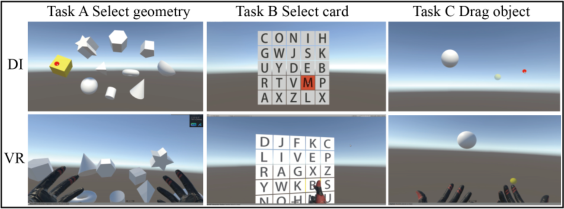
Figure 1: Prototype used for the experiment.
Materials and Methods
Hardware equipment includes a set of VR equipment, two laptops and a camera, VR HMD device model for HTC VIVE pro, using the original con- troller. For software, Unity engine was used as the test software development platform. Unity2018.4.14f and SteamVR2.7.3 were used to build the VR test prototype, and Unity2019.1.9f1 and SteamVR2.7.3 were used to build the DI test prototype. The tool of screen recording is oCam460.0.
A total of 20 participants completed the experiment (10 males and 10 females), aged 22-25, all graduate students in design-related disciplines. 8 participants (40%) had no experience in VR. For avoid operational pro- blems caused by the usability of the design software itself, this experiment will compare the most general interactive operations. By abstract the fundamen- tal action categories of interaction operations in design software, two basic actions, selection and dragging, are obtained. The selection action includes both part selection in 3D space and command selection in plane. Therefore, the tasks in the formal test phase respectively are: task A, selecting three diffe- rent geometric objects in space; task B, selecting three cards with alphabet and task C, dragging a white sphere to a specified location, completely wrapped around the yellow ball (see Figure 1).
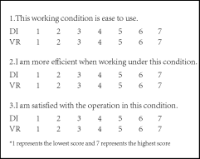
For reduce the impact of the user’s VR unfamiliarity, participants were trained on VR and DI operation environment before the formal test, and model hand interaction technique was used. In task A and task B, for avoid memory interference for participants testing in the previous task condition (VR/DI),The position of geometries and alphabets on card was changed when accomplish task. For balance the primacy effect, the first 10 participants were asked to use the DI first and then VR, and the others use VR first. Collect quantitative data, including task time (in milliseconds), number of mistakes and questionnaire (see Figure 2) results. Qualitative information collected by interview, including self-reports of experience, efficiency, and accuracy.
Results
With display dimension as independent variable (VR and DI), task time, subjective ease of use, efficiency and satisfaction as dependent variables, independent-sample T test was used in SPSS software for statistical analysis (see Table 1).
Figure 2: Questionnaire.Figure 3: Experimental scenario.Table 1. DI and VR test results.
The experimental results show that the selection of geometry in VR inter- face is obviously slower than in DI. Dragging a sphere in VR is significantly faster than in DI. In the task of card selection, the participants think DI inter- face is more easily to use and satisfying than VR interface. In the task of dragging objects, the subjective evaluation of VR interface is significantly better than DI overall. In the task of dragging object, the subjective evalua- tion of VR interface is significantly better than DI overall. In the geometry selection task, there is no significant difference between DI interface and VR interface.
Pierce correlation was used to analyze correlation of subjective and obje- ctive efficiency in SPSS. The significant correlation only appeared in the task of dragging object under DI condition, that means participants had a significant feeling of efficiency in this task. In addition, according to the expe- rimental recording, only the task that selected the card on the DI interface had the case of wrong selection.
Application Research of Virtual Reality as a Tool for Design 499
Analysis In the selection-type (Task A and Task B) operations, the overall subjective evaluation and actual efficiency of DI are better than VR, especially in the selection of geometry. In other words, regardless of whether the selected object is 3D or 2D, people prefer to perform selection-type operations in DI, and the stereoscopic vision and larger FOV of VR do not show advantages about these tasks. Despite DI exist the display scale problem, participants prefer DI for selection, which may be related to the participants’ experience with DI software. Meanwhile, VR showed a disadvantage compared to DI in that it required more substantial body movement for 3D operations, as a participant said “objects in VR are not easily reached by hand at a distance”, This is an issue of display-control ratio and interaction way.
In the operation of dragging objects, VR presents an extremely obvious advantage over DI in terms of subjective evaluation and task time. Thus, it is clear that the increased DOF and immersion created by VR operations do bring a certain efficiency gain to the task of moving objects in 3D space. In contrast to VR, the inefficiency of performing this operation in DI was also clearly perceived by participants, and its dimensional limitations were also mentioned, with 5 participants said that “the depth in the DI is not easy to judge” and “it is difficult to judge the orientation and distance”. In addi- tion, 2 participants reported problems with the wearing of the HMD, such as problems with facial pressure. No participants reported motion sickness and visual discomfort in all test, it may be related to the length of wear and the content displayed.
Limitations First, the sample size of this experiment is limited (20 people). Need to more adequate participants ensure the reliability of data. In the operation of moving object (C-DI), the majority of participants (18 people) indicated that they dislike the operation in simulator of SteamVR. Test should take more mature interaction techniques such as manipulating axe inside. In addition, general operations may not adequately account for the application in the design. Follow-up research could develop a design tool based on controlled variables that would allow participants to do a full design task.
COMPARATIVE ANALYSIS, APPLICATION SUGGESTION AND TECHNOLOGY PROSPECT Comparative Analysis and Application Suggestions
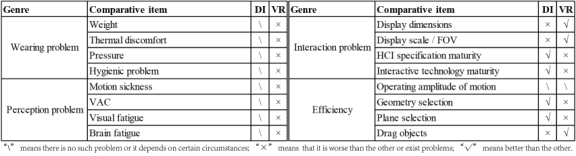
According to the results of literature review and comparative experiments, the current advantages and problems of DI and VR are summarized (see Figure 4).
Because of VR’s advantages in displaying dimensions and scale, as well as its excellent performance in dragging object, it is suitable to use VR to view the actual effect of the product and carry out moving operations in 3D space. However, it is important to pay attention to avoid the problems caused by HMD-based VR. The suitable HMD equipment and a reasonable
Figure 4: Advantages and problems of DI and VR.
use duration is necessary. However, for some tasks that needn’t to view 3D effects, such as three-views, it is still appropriate to perform the tasks under DI condition. DI still has advantages in selective tasks, it is better to use DI when face to the work that require fast and accurate selection.
Solution Direction and Prospect of HMDVR Problem Solution Direction of Wearing Problem
As for the weight of HMD, study shows that 300g and below is considered to be comfortable (Yan et al., 2019). It can be lightweight from the compo- nents of HMD: lens, case, earmuff and so on. As for the thermal discomfort, Wang et al. suggested that improved from the dissipation of eyepiece and display (Wang, Z. et al., 2020). The problem can also be mitigated by con- trolling the working temperature. For the problem of HMD paste pressure, human head models can be constructed for target population, and it can be improved from the materials (Wang, H. et al., 2020). HMD should be cleaned regularly to keep it hygienic.
Perception of the Direction of Conflict Resolution For reduce the incidence of motion sickness, a certain sensory external envi- ronment information so that reducing the difference between the virtual and reality is effective (Moss and Muth, 2011). Providing support in sports positions can also reduce the symptoms of dizziness (Onuki et al., 2017). Alternatively, the most effective method of motion sickness relief is real natural decay (Jasper et al., 2020).
For the problem of VAC, it is mainly in the display technology to achi- eve the correct focus cues of human eye. Representative technologies include multi/varifocal displays, light field displays, and holographic displays (Chang et al., 2020).
Interaction Problem Solving Direction VR needs a clearer interaction specification and perhaps a similar learning from DI. Weiß et al. found that choosing right way to right situation, such as when a precisely selected task is required, it is recommended to use 2D interfaces in VR(Weiß et al., 2018). In response to the wide variety of current interaction techniques, Weise et al. listed each existing interaction technique including virtual hands and control sticks and their individual characteristics (Weise et al., 2019), it helps developers to select and use the appropriate interaction method in accordance with the development needs.
Application Research of Virtual Reality as a Tool for Design 501
CONCLUSION
The scale and dimensionality of the DI display imposes limitations on product design, and VR can partially solve the problems encountered with DI due to its technology.
After experimental comparison and literature review, comparative analysis of the respective advantages and problems of DI and VR found that users can already perform certain design work by HMD-based VR. But it is necessary to avoid causing its problems. For fully utilize the advantages of DI and VR and avoid the problems of both, designer should choose the right tool in the right situation.
With the development of more mature VR interaction technology, the pro- blems caused by HMD will be solved, HMD-based VR will be more widely and deeply applied in the design industry.
REFERENCES
Bazzaro, F., Charrier, M., Chevriau, S., Rouxel, T. and Sagot, J.C., 2018. Impact of Architectural Representation on Users’Feelings: From 2D Plans to Virtual Models and Physical Prototypes. Journal of Architectural and Planning Research, pp. 244–257. Berni, A. and Borgianni, Y., 2020. Applications of virtual reality in engineering and
product design: Why, what, how, when and where. Electronics, 9(7), p. 1064. Bowman, D.A., Kruijff, E., LaViola, J.J. and Poupyrev, I., 2001. An introduction to 3-D user interface design. Presence, 10(1), pp. 96–108. Chang, C., Bang, K., Wetzstein, G., Lee, B. and Gao, L., 2020. Toward the
next-generation VR/AR optics: a review of holographic near-eye displays from a human-centric perspective. Optica, 7(11), pp. 1563–1578. Gaoliang, P., Jun, G. and Xu, H., 2009. Towards the development of a desktop virtual reality⣳based system for modular fixture configuration design. Assembly automation. Han, B. and Leite, F., 2021. Measuring the Impact of Immersive Virtual Rea-
lity on Construction Design Review Applications: Head-Mounted Display versus Desktop Monitor. Journal of Construction Engineering and Management, 147(6), p.04021042. Hoffman, D.M., Girshick, A.R., Akeley, K. and Banks, M.S., 2008. Vergence– accommodation conflicts hinder visual performance and cause visual fatigue. Jour- nal of vision, 8(3), pp. 33–33. Jasper, A., Cone, N., Meusel, C., Curtis, M., Dorneich, M.C. and Gilbert, S.B.,
2020. Visually Induced Motion Sickness Susceptibility and Recovery Based on Four Mitigation Techniques. Frontiers in Virtual Reality, 1, p.22. Jayaram, S., Vance, J., Gadh, R., Jayaram, U. and Srinivasan, H., 2001. Assessment of VR technology and its applications to engineering problems. J. Comput. Inf. Sci. Eng., 1(1), pp. 72–83. Koulieris, G.A., Bui, B., Banks, M.S. and Drettakis, G., 2017. Accommodation and
comfort in head-mounted displays. ACM Transactions on Graphics (TOG), 36(4), pp. 1–11. Lin, C.J. and Woldegiorgis, B.H., 2015. Interaction and visual performance in stereoscopic displays: A review. Journal of the Society for Information Display, 23(7), pp. 319–332.
Lorusso, M., Rossoni, M. and Colombo, G., 2020. Conceptual modeling in product design within virtual reality environments. Moss, J.D. and Muth, E.R., 2011. Characteristics of head-mounted displays and their
effects on simulator sickness. Human factors, 53(3), pp. 308–319. Onuki, Y., Ono, S. and Kumazawa, I., 2017, March. Air cushion: A pilot study of the passive technique to mitigate simulator sickness by responding to vection. In 2017 IEEE Virtual Reality (VR) (pp. 323-324). IEEE. Poelman, R., Rusak, Z., Verbraeck, A. and Alcubilla, L.S., 2010. The Effect of
Visual Feedback on Learnability and Usability of Design Methods. Strojniski Vestnik/Journal of Mechanical Engineering, 56(11). Sherman, C.R., 2002. Motion sickness: review of causes and preventive strategies. Journal of travel medicine, 9(5), pp. 251–256. Sutherland, I.E., 1968, December. A head-mounted three dimensional display. In Pro-
ceedings of the December 9-11, 1968, fall joint computer conference, part I (pp. 757–764). Toma, M.I., Gîrbacia, F. and Antonya, C., 2012. A comparative evaluation of human interaction for design and assembly of 3D CAD models in desktop and immer- sive environments. International Journal on Interactive Design and Manufacturing (IJIDeM), 6(3), pp. 179–193. Wang, H., Chi, Z., and He, R., 2020. Fit improvement of facial interface for VR
headset based on principal component analysis panel. JOURNAL OF MACHINE DESIGN 37(5), pp. 117–124. Wang, Z., He, R., Liu, L., Lu, Y. and Liu, C., 2020. Thermal Comfort of Headmounted Display. PACKAGING ENGINEERING, 41(2), pp. 249–254. Weiß, Y., Hepperle, D., Sieß, A. and Wölfel, M., 2018, October. What user interface
to use for virtual reality? 2d, 3d or speech–a user study. In 2018 International Conference on Cyberworlds (CW) (pp. 50-57). IEEE. Weise, M., Zender, R. and Lucke, U., 2020. How Can I Grab That?. i-com, 19(2), pp. 67–85. Weise, M., Zender, R. and Lucke, U., 2019. A comprehensive classification of 3D
selection and manipulation techniques. In Proceedings of Mensch und Computer 2019 (pp. 321–332). Yan, Y., Chen, K., Xie, Y., Song, Y. and Liu, Y., 2018, July. The effects of weight on comfort of virtual reality devices. In International Conference on Applied Human Factors and Ergonomics (pp. 239–248). Springer, Cham. Zheng, J.M., Chan, K.W. and Gibson, I., 2001. Desktop virtual reality interface
for computer aided conceptual design using geometric techniques. Journal of Engineering Design, 12(4), pp. 309–329.
LISTED IN THE AHFE DIGITAL BOOKSTORE CATALOGUE
Explore the complete digital volume
Ergonomics In Design
Read this individual research paper free through the original publisher, or explore the full digital proceedings book.
ISBN 978-1-958651-23-0
Explore this ISBN in the AHFE Bookstore ↗Listed in the July 2026 bookstore catalogue; search by ISBN to confirm current availability · Digital book purchase optional