Ge Li, Yuanbo Sun (2022). "How can I learn to use this car faster?": User education for intelligent connected car. In: Ergonomics In Design. AHFE Open Access, vol. 47, pp. 46–52. https://doi.org/10.54941/ahfe1001918
Intelligent connected vehicles and automated driving system have developed rapidly in recent years. Level 3 (L3) automated driving system will have major changes in human-vehicle interaction. Intelligent networked vehicles are facing problems such as lack of standards, operational differences, and complicated car HMI system, which have greatly affected users’ acceptance of autonomous driving. Existing user education is mainly conducted through user manuals and video tutorials, which have disadvantages such as low learning efficiency, long time-consuming, and poor user experience. Based on the intelligent connected vehicle, this research presents a car HMI guidance in the driving takeover scenario. Using a between-group design, N=40 participants were divided into 4 groups to complete the learning of the automated driving system. The result shows that using the car HMI to learn automated driving system can effectively improve user experience and improve learning efficiency. In particular, an interactive system based on multi-mode interaction can further enhance the result of learning and improve user experience.
As the real-time analytics to commodity sensors and embedded systems incre- asingly im-proved, more car manufacturers and software providers started the research and application of higher levels of automated vehicles. The China Association of Automobile Manufacturers, the National Highway Traffic Safety Administration (NHTSA, 2017), and the Society of Automotive Engineers (SAE International, 2018) have all classified autonomous driving ac-cording to the proportion of human and system control rights. At Level 3 of driving automation, the driving automation system performs the entire dynamic driving task while engaged (Czarnecki, 2018), which changed the way humans interact with cars. On the one hand, it brings more non-driving scenes and behaviors, and further enriches the functions of the car and the value or emotion; on the other hand, fully autonomous driving cannot be achieved in the short term, it will take a long time for autonomous driving to achieve L4/L5 technology (Campbell et al. 2018). Drivers should be rece- ptive to a request to intervention and response, and to determine when the engagement of an automated driving system is ap-propriate (Seppelt et al. 2007). As a result, there is an operation gap between the existing automotive
“How Can I Learn to Use This Car Faster?”: User Education for Intelligent Connected Car 47
HMI system and the system at level 3 of driving automation. Users who have passed the regular driving test are unable to use the autopilot function with- out studying. Further-more, the differentiation of car interaction has been initially presented, and users have already encountered certain obstacles in learning. With the further enrichment of non-driving scenes and the transfer of the right to take over, how to learn quickly and drive safely is one of the significant challenges.
L3 cars are essentially different from existing traditional cars, and their application and promotion will bring about a revolution in the automo- tive industry. In the future, the development of automobile driving systems may be unified or personalized. Uncertainty has led to people’s unacceptance and even fear of autonomous driving. Therefore, the learnability-oriented intelligent networked vehicle interaction design is of great significance for enhancing people’s acceptance of autonomous driving, thereby promoting the further development of autonomous driving.
When training drivers on the L3 automated driving system, an idealized training system was proposed. The complex learning content can be broken down into multiple subtasks, and variable priority can be provided (Boot et al. 2010). Both system functionality and system limits should be conclu- ded in the learning program (Cassidy, 2009) (Redding et al. 1992). However, there are currently two mainstream learning methods related to driving take- over operations, user manual and video tutorial (Mehlenbacher et al, 2002). The user manual can carry enough information. But for ordinary users, the learning cost is high, the learning time is long, and the process is boring. Users often cannot complete the learning of all content. The process of learning through video tutorials is relatively easy. However, the learning efficiency is low, and the learning content carried by the video is limited, which can- not cover all scenarios. The intelligent net-worked vehicle interaction system based on the Internet of Vehicles has brought new opportunities. Scene-based intelligent push can guide users to complete the learning of driving takeover tasks in specific situations.
Method
To compare the learning efficiency and user experience when users learn to use Advanced Driving Assistance System (ADAS), we designed an in-car HMI system and combined its intelligent push with assisted driving scenarios. N = 40 participants were recruited to the study. Participants were divided into 4 groups, with 10 people in each group for a comparative test. Partici- pants had normal or corrected to normal vision and hearing, and all of them were in good physical condition on the day of the test.
Participants need to complete the learning of the automatic cruise function during the test, including four functions such as turning on the automa- tic cruise, adjusting the cruise speed, adjusting the following distance, and automatically changing lanes. Group 1 used graphic descriptions to finish the learning, which mainly refers to the active cruise control in Autopilot in the Tesla MODEL 3 manual. Group 2 learned through video tutorials. The
48 Li and Sun
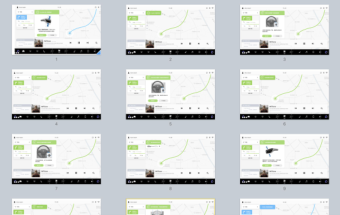
Figure 1: The in-car HMI interface is designed based on driving scenarios (left) and the participants of Group 3 and Group 4 completed learning in the car environment (right).
video instruction comes from the instruction video on Tesla’s official web- site, which is edited to be consistent with the graphic description. Based on the learning content, the high-fidelity prototype of the human-vehicle intera- ction system is used by Group3 and Group 4 to learn relative operations (see fig. 1). The HMI Group 4 used added notification tone and text-to-speech (TTS) to compare the impact of multi-mode interaction on the learnability of human-vehicle interaction. Group 1 and Group 2’s experiments were condu- cted in a laboratory environment; Group 3 and Group 4’s experiments were carried out in the car environment. A 13-inch iPad was used to carry intera- ctive tasks. When the user had behavior in the car, the experimenter would remotely control the system to give corresponding feedback. During the test, a third-view video was per-formed throughout the entire process, and the subjects wore an eye tracker to collect their eye movement data and record the first-view video. After the test is completed, the participants were asked to fill in the self-report based on the semantic difference 5-point scale and complete the test of the learning content.
RESULTS AND DISCUSSION
The experiment data were collected by questionnaire, which consists of two parts, the subjective self-evaluation and the objective test questions. Eye tra- ckers and video recordings are also used to help record the participants’ expression, focus, and time on tasks.
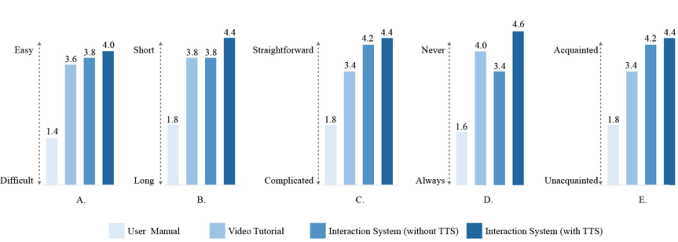
The questionnaire was completed within 10 minutes after each experiment. The data was sorted and the average value was calculated in groups. Since the answer to the objective questions may affect the subjective evaluation, the subjective evaluation is set before the objective questions. The points of subje- ctive evaluations which are based on the semantic differential scale (Garland, 1990) and numbered from 1 to 5 are shown in Figure 2. It can be seen from the histogram that the learning experience of manual is significantly worse than other methods, and the time that the participants felt they spent in learning is longer than other methods. Participants are more likely to think that the learning content is complicated. They are more easily distracted, and the evaluation of the learning effect is the worst. Learning through HMI without TTS is slightly better or the same as learning through
“How Can I Learn to Use This Car Faster?”: User Education for Intelligent Connected Car 49
Figure 2: This shows a figure consisting of the participants’ self-evaluation. Questi- ons include A. Whether the experience of the learning process is easy or difficult; B. Whether the learning time is short or long; C. Whether the learning content is straight- forward or complicated; D. How often you get distracted during the test; E. How you evaluate your learning results.Figure 3: The time-on-task of participants using different learning methods.
the video tutorial, while the participants who use the video tutorial learning are more likely to be distracted or show impatient emotions. Among the 4 groups, learning through HMI with warning tune and TTS is better than the other methods in all scores. In the feedback of the fourth group of subjects, this method is closer to real companion-ship. It feels like someone reminding you of all the unfamiliar operations in the passenger seat, learning is easier and more secure.
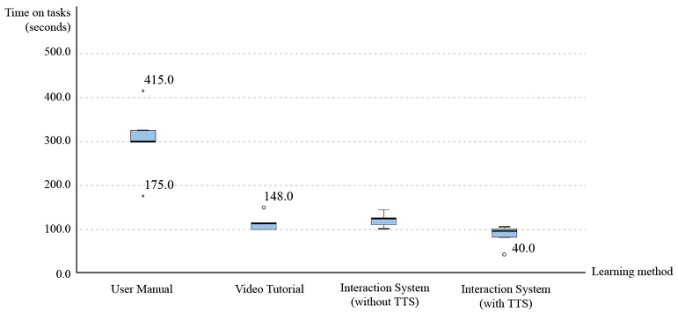
In terms of content bearing, user manuals carry the riches and the most professional content; while video tutorials carry the least information, with only general presentations and no specific operation guidelines. In the obje- ctive evaluation, statistics and analysis of the time of completion of learning are first carried out. As shown in Figure 3, the time spent on the graphic lear- ning method is much longer than the other three methods. The longest time is 415s, which is 9 times the shortest learning time of 40s learning by the HMI with voice broadcast. Group 2,3 and 4 spent similar time on learning, while participants who studied through video tutorials felt that they spent much longer time.
50 Li and Sun
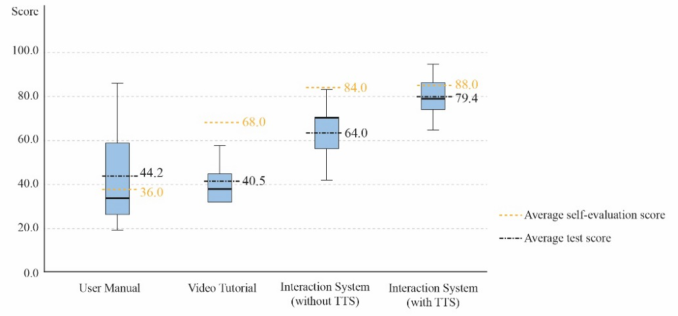
Figure 4: This figure demonstrated the scores that participants get in the test using different learning methods. The average self-evaluation scores are particularly added in comparison with the objective test score.
Furthermore, all subjects were asked to fill in questions to test their lear- ning results. The scores are shown in Figure 4. The learning results of subjects who used the user manual and learning videos are far worse than those who use the interactive system. The score distribution among the participants who learned through pictures and texts is scattered, and the participates generally hold a negative attitude towards their learning achievements; in contrast, participants who use video tutorials generally have poor results, but they have a positive attitude towards their learning achievements and give them- selves high scores in self-evaluation, which are quite different from the actual results. In the self-assessment, whether there is a voice broadcast has little effect on the participants’ feelings. The self-feeling with voice broadcast is slightly better than that without voice broadcast; however, in actual perfor- mance, the performance of participants who use the HMI system with voice broadcast is significantly better than none, and their actual score is consistent with their self-rating.
CONCLUSION
From the perspective of learning content, user manuals can carry richer and more professional content, but they are not suitable for novice users to read and learn; the production cost of videos is relatively high, and they cannot carry too many details. Video tutorials are suitable for advertising special features and main functions to users, but it is not suitable for carrying spe- cific teaching guidance. In-car HMI system can carry abundant content and display personalized information according to the user’s experience. The lear- ning of in-car functions in the driving environment can make it easier for users to understand and remember.
From the perspective of user experience, the user manual is more boring for the users, and during the test, some users were impatient and unable to understand. The user experience of video learning has improved, but because the video speed is too fast, participants need to watch the video repeatedly
“How Can I Learn to Use This Car Faster?”: User Education for Intelligent Connected Car 51
to complete the learning, and some choose to end the experiment before they complete learning. In the actual process, users are more likely to be bored and distracted and may have a more negative performance than in the experimental environment.
When using the in-car HMI system to learn, voice broadcast has a great impact on the user experience. In the absence of voice broadcast, the user’s perception is more biased towards learning through graphics and text; but with the addition of voice broadcast, participants will have a more relaxed and pleasant learning experience, and their perception is more biased tow- ards actual driving. In actual situations, the interaction during driving will be combined with the environment to further enhance the user experience. It is expected that there will be more positive performance than in the static experimental environment.
From the perspective of learning efficiency, the learning efficiency of the manual is the lowest. With an average time of 302.8s, the average score is only 44.2 points; the learning efficiency of the interactive interface is the highest. In the case of no voice broadcast, it took an average of 118.8s to get 64 points. After adding voice broadcast, there was a significant improvement. With an average time of 82.6s, the average score was 79.4 points.
Through experiments, the existing main learning methods of assisted driving were com-pared and evaluated. The experiment proved that from the user experience and objective evaluation, scene-based interactive push can effectively improve the learnability of the system and improve the user experience.
REFERENCES
Boot, W. R., Basak, C., Erickson, K. I., Neider, M., Simons, D. J., Fabiani, M., ... & Kramer, A. F. (2010). Transfer of skill engendered by complex task training under conditions of variable priority. Acta psychologica, 135(3), 349–357. Campbell, J. L., Brown, J. L., Graving, J. S., Richard, C. M., Lichty, M. G., Bacon, L.
P., ... & Sanquist, T. (2018). Human factors design guidance for level 2 and level 3 automated driving concepts Cassidy, A. M. (2009). Mental models, trust, and reliance: Exploring the effect of human perceptions on automation use. NAVAL POSTGRADUATE SCHOOL MONTEREY CA. Czarnecki, K. (2018). On-road safety of automated driving system (ads)—Taxonomy
and safety analysis methods. Garland, R. (1990). A comparison of three forms of the semantic differential.
Marketing Bulletin, 1(1), 19–24. Mehlenbacher, B., Wogalter, M. S., & Laughery, K. R. (2002, September). On the reading of product owner’s manuals: Perceptions and product complexity. In Pro- ceedings of the Human Factors and Ergonomics Society Annual Meeting (Vol. 46, No. 6, pp. 730–734). Sage CA: Los Angeles, CA: SAGE Publications. National Highway Traffic Safety Administration (NHTSA), U.S. Department of
Transportation Releases Policy on Automated Vehicle Development. (2017). Automated Driving Systems: A Vision for Safety. Redding, R. E., Cannon, J. R., & Seamster, T. L. (1992, October). Expertise in air traffic control (ATC): What is it, and how can we train for it?. In Proceedings of
52 Li and Sun
the Human Factors Society Annual Meeting (Vol. 36, No. 17, pp. 1326–1330). Sage CA: Los Angeles, CA: SAGE Publications. SAE International. (June 15, 2018) Taxonomy and Definitions for Terms Related to Driving Automation Systems for On-Road Motor Seppelt, B. D., & Lee, J. D. (2007). Making adaptive cruise control (ACC) limits
visible. International journal of human-computer studies, 65(3), 192–205.
LISTED IN THE AHFE DIGITAL BOOKSTORE CATALOGUE
Explore the complete digital volume
Ergonomics In Design
Read this individual research paper free through the original publisher, or explore the full digital proceedings book.
ISBN 978-1-958651-23-0
Explore this ISBN in the AHFE Bookstore ↗Listed in the July 2026 bookstore catalogue; search by ISBN to confirm current availability · Digital book purchase optional